Showing posts with label LITERATURE. Show all posts

Saturday, 9 January 2021

Zoom book club recommends...


寧為太平犬,不做亂世人">寧為太平犬,不做亂世人

A slightly late Happy New Year to everybody out there in Blogland. How are we all enjoying living in those interesting times the Chinese (allegedly) warned us about?

Like most people, I've spent most of the past year doing whatever it takes to get me through the day. Like reading books, then meeting up with friends to talk about them ... only with an extra helping of everybody being on the other end of a Zoom call and a side order of silently screaming "You're on mute!" Happy days.

Apart from the social interaction, however degraded by Zoom fatigue, reading groups have two great features. They introduce you to books you wouldn't otherwise have read, and reading a more diverse selection of books means that some of those books will fulfill what those old Heineken adverts used to promise, and refresh the parts other books cannot reach.

Our last two books were good examples. Both fiction, but each one refreshing completely different parts:

Exhibit A: Fifty-Fifty by Steve Cavanagh.

Exhibit B: Redhead by the Side of the Road by Anne Tyler.

No significant spoilers ahead.

On different levels, I enjoyed both books, although they're chalk and cheese. Of course, opinions differed, but I'm not here to debate whether any specific book was "good" or "bad." I am here to say that your reading diet, like your actual diet, is healthier if it's varied. 

Fifty-Fifty is a plot-driven courtroom drama and thriller, which kicks off with the discovery that a colourful Italian-American former mayor of New York has been brutally murdered in his own home.

Yikes! Be careful, Rudy!
The central mystery is that, when the ex-mayor was murdered, the only other two people in the house were his grown-up offspring, Alexandra and Sofia Giuliani Avellino. In this whodunnit, each sister accuses the other one of the murder and there seems to be no conclusive evidence to show which one of them actually did it (or, for that matter, whether the two sisters conspired together to do their old man in).

Enter hard-boiled criminal lawyer Eddie Flynn, defending the sister who, his gut instinct tells him, is the innocent party. Is Eddie's instinct right? Expect the classic whodunnit menu of red herrings, the killer(s) covering her/their tracks with acts of ruthless brutality and twisted ingenuity, unexpected plot twists and startling revelations.

Fifty-Fifty is your classic airport thriller done well (in my opinion). The part of me it reached was the part that wants straightforward entertainment, puzzles and distraction. It's not going to change me on a fundamental level. Now that I've read it and know how the mystery gets solved, I've no particular desire to re-read it, but it passed the time pleasantly enough.

But it does what it does pretty well. It's easy to dismiss this sort of genre writing, especially when, like Fifty-Fifty, the book gets singled out as a Richard and Judy Bookclub pick of the week, the literary equivalent of getting kissed by your mum at the school gates and for ever blowing your chances of hanging out with the cool kids.

But, literary snobbery aside, think about these facts. It's easy to write. Almost all of us leaned that stuff at school. But it's hard to write well enough that people want to read what you've written, and carry on reading it for several hundred pages. Even if you have this talent, it requires a pretty special blend of talent, determination and luck to actually get published. Most books which make it into print don't sell that well. Fifty-Fifty did pretty well and, although it reads well enough as a stand-alone novel, it's only one of a series of books that Steve Cavanagh's written about the reformed con artist turned criminal lawyer Eddie Flynn, showing that the guy's not just a flukeish one-hit wonder.

But it's also a work of genre, which stands at a remove from the real world. It contains several tropes of the crime genre. Eddie Flynn, for example, is an instantly recognisable type - the dogged, incorruptible, rebellious, maverick outsider hero with a troubled personal life. The same goes for what he's up against - out there, there's a devilish plot, an elaborate game being played against law enforcement and natural justice, planned by a brilliant, but warped, mind (or minds - you'll have to read to the end to find out which). We've been here before, from the evil schemes of Professor Moriarty and Hannibal Lecter, to the elaborate mind games of a TV series like The Bridge

Now I'm no expert on crimes and solving crimes,* but I'm pretty sure that, in real life, this isn't generally how it works. From what I gather, solving crimes is a team effort and most stuff gets solved by following established, tested procedures, at least in functioning systems of law enforcement. Where there's systemic corruption, incompetence, or even just institutional groupthink, some team members need to stand up and go against the flow but, in real life, I don't think most crimes end up being solved by some Eddie Flynn or Philip Marlowe type going rogue and kicking doors open.

As for violent crimes, yes, in a lot of real-life cases the victim and perpetrator are known to one another, so that's like the crime scene in Fifty-Fifty. But that's where the similarity ends; in real life, these sorts of crimes are mostly unplanned or poorly-planned and easy to solve. Even in those very rare cases of ruthless, high-functioning game-playing killers who plan and carry out their crimes methodically, the offenders rarely turn out to be warped geniuses of the crime fiction trope, but exceptions who fall through the cracks due at least partly to luck, or to an outbreak of the groupthink. incompetence or corruption I've already alluded to on the part of the authorities.

Although the rules of the genre are not the same as the rules of real life, Fifty-Fifty does a pretty decent job within the conventions and limits of the genre. Most of what happens is internally consistent and believable within the world of the book. The police and court procedure stuff sounded convincing and well-researched to me and, though it was a work of genre fiction it also touched on real-world social issues from unequal access to justice for rich and poor, to sexism, which gave it more of a feeling of heft and believability than many less accomplished crime novels.

Redhead by the Side of the Road is a different kind of novel altogether. From the opening, I had a sinking feeling that this book wasn't going to be a barrel of laughs:

"You have to wonder what goes through the mind of a man like Micah Mortimer. He lives alone; he keeps himself to himself; his routine is etched in stone."

Sure enough, it turns out that Micah is a self-employed tech guy, living the proverbial life of quiet desperation, just about getting by with very few limited and unsatisfactory relationships with his fellow humans, scraping just enough of a living to afford a rented apartment which he keeps spotless with an unvarying cleaning routine. In his rented box, Micah writes notes to the other residents of his block, complaining about their persistent failure to flatten their cardboard packaging when the recycling goes out on bin days. 

At this point, I cheered myself up by checking the page count. Only 178 pages? Phew! At least it looked like I wouldn't be spending too much of my down time with Micah and his rather bleak little life.

So I stuck with it, and was very surprised at how much I ended up enjoying this book. Unlike the event-packed Fifty-Fifty, nothing much happens for most of the book. Only once does something fairly major, dramatic and unexpected happen to Micah, But what does happen turns out to be surprisingly compelling.

Unlike Fifty-Fifty, the entertainment here isn't straightforward. There's lots of everyday miscommunication and conflicts, especially between orderly, routine ways of living and messy, spontaneous lives, observed in a way that can be simultaneously sad and hilarious (there are points where both you're seriously willing Micah not to innocently say that wildly inappropriate thing he's about to say to his semi-detached girlfriend and can't help finding it funny at the same time).

There are puzzles here, too but, again, they're not the slightly detached clear-cut "It was Colonel Mustard with the candlestick in the billiard room" puzzles of the whodunnit but as messy, ambiguous and often unresolved as the ones from everyday life.

As for distraction, there doesn't seem to be a lot of it. Except that, by a chapter or so in, there is. It's just a change of mental gears from Fifty-Fifty, slowing down and seeing the universe of small detail you miss when you're speeding, pedal to the metal, through the big, noisy world of the plot-driven thriller. 

That's a wonderful thing about books. They're fractal - you can zoom in or out to any scale and still be drawn into a dense, engaging landscape where you can uttely lose yourself. 

I don't think I've done justice to how well-written and unexpectedly absorbing Redhead By The Side of the Road is, but just take my word for it and give it a go. After all, what have you got to lose? It's only 178 pages and, if you're stuck in lockdown while the world around you burns, you might as well try something new.

Anyway, as the omnishambles that was 2020 lurches into the existential horror show of 2021, have a good one and stay safe, everybody. I don't know about you, but after a weird and terrible year, I'm starting to feel a bit more chipper about life. There are obvious reasons to be more cheerful (we have vaccines, alleluia!), but I'm sensing another sort of shift. 

Maybe it's just me, but I'm getting a feeling that we're pretty damn close to rock bottom and the only way is up.  The abject failure of the Trump putsch only heightened a sense that a toxic boil is bursting and change is coming. It feels like a time for reflection, a time to take stock. So, after sharing a couple of literary discoveries from the last year, I'd like to close by sharing my piece of music of the year which, I think, perfectly captures the zeitgeist.

It's not celebratory, in fact it's downright mournful. But it's also spine-tinglingly powerful, beautiful and utterly appropriate. Ladies and gentlemen, sit back and enjoy the legend that is Annie Lennox and the socially distanced London Voices Choir, totally smashing it with this awesome rendition of Dido's Lament from Purcell's Dido and Aeneas:


"We have always been surrounded by terror and by the beauty that is an inseparable part of it."

The Engineer of Human Souls by Josef Škvorecký.


*If you are, examples, corrections and clarifications are welcome in the comments (comments moderated by me, but I'm happy to publish any reasonable feedback).


Thursday, 31 May 2018

One of these things is not Orwellian

"Orwellian" has become one of the most over-used expressions in the English language (or Oldspeak, as we still don't call it more than three decades after 1984). To give just one ridiculous example, Tommy Robinson, former leader of the English Defence League has just been jailed for contempt of court, after he continued to make broadcasts on social media which could have prejudiced an ongoing court case, despite being told to stop it.

Cue a flurry of Tweets calling his trial and conviction "Orwellian." Which is, of course, very silly. Rules to make trials as fair and impartial as possible would have had no place in Orwell's satire of an unfair, arbitrary society where  rule by the most powerful has replaced the rule of law.

Also, Orwell went to Spain to shoot people like Tommy Robinson in the head, as somebody less silly just pointed out on Twitter.

In contrast, here's what "Orwellian" really looks like:
“Since the school has introduced these cameras, it is like there are a pair of mystery eyes constantly watching me, and I don’t dare let my mind wander.”
... said an unnamed student in a Chinese high school, which recently introduced facial recognition technology to monitor students’ attentiveness in class.
Winston turned around abruptly. He had set his features into the expression of quiet optimism which it was advisable to wear when facing the telescreen.
1984

Thursday, 23 February 2017

Yours sincerely, scribble

God, I look a mess. Or rather, my signature does. I've been half-consciously dissatisfied with my analogue avatar for years, but this fuzzy background feeling of discontent came into sharp focus when my 10 year old started to develop his own signature.

He's a good kid and I'm proud of him in many ways, but even as a doting parent, I wouldn't claim that an innate gift for neat handwriting is one of his particular talents. Having said that, he's worked hard on his writing over the last year at school and he can now produce a neat, legible, hand when he puts his mind to it.

Except when he's signing greeting cards or letters. I've seen a gradual upward slope of improvement since he first started adding his mark to family greeting cards, some time back in pre-school, culminating a pinnacle some time in this last year, when I got a little glow of vicarious pride in a completely clear and legible signature that boasted "this is the handwriting of a literate, well-educated child - aren't we good parents?" But, recently, we got past peak signature and things have gone downhill ever since. Now I'm imagining any adult who sees a birthday card, or thank you note, signed by our lad silently judging us for producing a kid who can't write properly, or is too lazy to try.

But, of course, he can write properly. He's still making an effort with his school work and his general handwriting is still improving. What he's doing is exactly the same daft thing I did as a kid.

I learned to read and write to a certain level and was taught to sign my name at the bottom of cards, letters and suchlike.  So far, so good. But, eventually, I noticed that grown-ups and some older kids didn't just write their name to sign off. They wrote it in a special way, with extra loops and flourishes, exaggerated, elaborated, or simplified out of all recognition, until the name that finished off their correspondence was an indecipherable scrawl. Nobody taught me to to copy this style, but, to me, the people doing it were grown up, worldly and sophisticated, so having an almost unreadable grown-up signature became aspirational.

In went the swoops and swirls and simplifications and flourishes and I ended up with more or less the same signature I have today. The signature hasn't changed much in all those years, but as a kid, I thought it looked pretty cool. Today, I think it looks rubbish. Come to think of it, it probably looked rubbish even back then (except to my uncritical eye), because I was using the wrong tools.The style I was attempting could have potentially looked OK(ish), but in those days, a lad transitioned from writing in pencil to using a Biro at about the same time he graduated from shorts to big boy trousers [ex-lasses can insert the female equivalent of big boy trousers here] and attempted copperplate flourishes in ballpoint pen are not a good look.

Interestingly, one of the few bits of Orwell's 1984 that works as a specific prediction (as opposed to a broad satire on 1940s propaganda and authoritarianism which each subsequent generation has appropriated to label the real, or perceived, political bullying and obfuscation of its own day), was a throwaway line about how bad everybody's writing would get when people started routinely using ballpoints (I'm guessing that the "ink pencil" in this passage was inspired by Mr Bíró's invention, which would have been a novelty and shorthand for modernity when Orwell was writing):
Winston fitted a nib into the pen holder and sucked it to get the grease off. The pen was an archaic instrument, seldom used even for signatures, and he had procured one, furtively and with some difficulty, simply because of a feeling that the beautiful creamy paper deserved to be written on with a real nib instead of being scratched with an ink pencil. Actually he was not used to writing by hand. Apart from very short notes, it was usual to dictate everything into the speakwrite, which was of course impossible for his present purpose. He dipped the pen into the ink and then faltered for just a second.
This would work as a time-specific prediction for somebody of my generation, whose writing habits were formed in the 1960s and 70s (I turned 21 in 1984). But not for my son's generation (teachers have clearly learned a thing or two about handwriting since the 1970s), as newsletters we get from school these days contain the following guidance on the right stuff for your child's pencil case - "a black ink pen (not biro) - in Years 3/4 we request that these are self-inked and do not require cartridges".Orwell's line about not being used to writing by hand came true, too, although the erosion of handwriting by the routine use of technology (keyboard as opposed to speakwrite) happened a bit later than 1984.

Mind you, if you think your scribbly signature looks bad in Biro, just look at what you just did the last time a delivery person bearing a package got your signature on one of those digital thingies you sign with a stylus. A monkey could have signed that for you and nobody would be the wiser.

These days, I'd be far happier if my signature wasn't the one that looked dead cool to the prepubescent me. Just my name in my own normal handwriting would be fine. OK, the scribble is a fraction of a second quicker than writing it out properly, but who signs things so often that the time saved matters? Prescribing doctors, perhaps (and we all know what a mess their spider signatures can be), and autograph-pestered celebs (although these days, knowing how to quickly insert yourself into a fan's selfie, then gracefully slip away is probably a more useful celebrity time-management skill). But most of us don't sign things so regularly that the odd half-second matters.

Maybe I'm just turning into grumpy old bugger, but my scribbly signature now looks to me like a number plate in some daft italic font that some boy racer stuck on his pimped ride, fondly imagining that it makes him look like the king of the road, when it really just looks a bit prattish. The only thing that stops me changing is (perceived?) path dependency. I kind of think that so many authorities and organisations have my signature that if I started changing it now, it'd raise all sorts of questions and lead to confusion and delay.

For example, my passport just ran out. I'll need to send off another application soon. The signature I'd like to use in my application is probably sufficiently different from the scrawl they have on file to raise questions. I'm sure I'd be able to convince them that I'm not an impostor trying to obtain a fake passport, but is it worth the hassle? I even thought about phoning the passport office and asking whether it would cause a problem if my signature looked different from the one they've already got, but I couldn't imagine the question not sounding suspicious, nor could I think of a good answer to the question "Why would you want to change your signature?" - "Because I just decided I don't like the one I've been  using for the last forty or so years" sounded a bit feeble.

So I'll probably stick with the ugly scribble I came up with when I was too young to know better. But then I look at my son's signature and say ""Just don't do it - you'll regret this one day, when you realise that your normal handwriting looks way better." But I only say it in my head, because there's nothing like parental disapproval to turn a thing that a child already thinks is awesome into something that's definitely super-awesome, with a side-order of amazing.

Monday, 7 November 2016

Sublime, improbable Martian engineering

 *Spoiler alert- if you've not already read H G Wells's The War of the Worlds, do so immediately, or read on at your own peril...*

I've just been re-reading the first alien invasion novel, H G Wells's The War of the Worlds, and I can see again why it created a genre all of its own and why it immediately grabbed me as a child. Mainly because it's such a cracking yarn - the alien visitation starts off as an intriguing curiosity, but escalates to being, ominous, threatening, awe-inspiring and terrifying at an unstoppable pace that mirrors the relentless advance of Well's iconic Martian tripods, seen here in  one of the novel's big reveals:
And this Thing I saw! How can I describe it? A monstrous tripod, higher than many houses, striding over the young pine trees, and smashing them aside in its career; a walking engine of glittering metal, striding now across the heather; articulate ropes of steel dangling from it, and the clattering tumult of its passage mingling with the riot of the thunder. A flash, and it came out vividly, heeling over one way with two feet in the air, to vanish and reappear almost instantly as it seemed, with the next flash, a hundred yards nearer. Can you imagine a milking stool tilted and bowled violently along the ground? That was the impression those instant flashes gave. But instead of a milking stool imagine it a great body of machinery on a tripod stand... Seen nearer, the Thing was incredibly strange, for it was no mere insensate machine driving on its way. Machine it was, with a ringing metallic pace, and long, flexible, glittering tentacles (one of which gripped a young pine tree) swinging and rattling about its strange body. It picked its road as it went striding along, and the brazen hood that surmounted it moved to and fro with the inevitable suggestion of a head looking about.
That's a fantastic piece of writing and there are lots more like it. The book also has its expository digressions, where the action stops and Wells explains things rather than just showing you awesome stuff, but these aren't too long (at least by the standards of the time when Wells was writing) and by this stage he's already created enough momentum to keep you gripped and reading on. Compare and contrast with that other piece of proto-sci-fi, 20,000 Leagues Under the Sea, which also starts with strange, ominous events, building up to an exciting reveal and some great set pieces, but is so weighted down with the ballast of endless pages of over-long explanation that Verne almost sinks the cracking yarn he created.*

If the The War of the Worlds looks forward to every alien invasion yarn that followed, it also looks back to an aesthetic trope that's probably been around for ever, but was largely formalised in the Eighteenth Century and peaked with early Nineteenth Century Romanticism - the sublime. That's the idea that humans don't just appreciate things which are beautiful in an ordered, harmonious way, but also dig stuff that's wild, inhuman in scale and frankly terrifying - as the Tate Britain put it, in the blurb to an exhibition dedicated to "Art and the Sublime":
The best-known theory published in Britain is Edmund Burke’s A Philosophical Enquiry into the Origin of Our Ideas of the Sublime and Beautiful (1757). Burke’s definition of the sublime focuses on such terms as darkness, obscurity, privation, vastness, magnificence, loudness and suddenness, and that our reaction is defined by a kind of pleasurable terror.

During the eighteenth and nineteenth centuries, the sublime was associated in particular with the immensity or turbulence of Nature and human responses to it. Consequently, in Western art, ‘sublime’ landscapes and seascapes, especially those from the Romantic period, often represent towering mountain ranges, deep chasms, violent storms and seas, volcanic eruptions or avalanches which, if actually experienced, would be life threatening.
Compare Wells's description of the towering Martian tripod with William Wordsworth describing his youthful memory of stealing a boat and rowing out onto Ullswater at night, in The Prelude. As young Wordsworth looks back guiltily at a peak overlooking the lake, the huge, shadowy, inhuman form seems, by an unsettling trick of perspective, to be pursuing his boat:
And, as I rose upon the stroke, my boat
Went heaving through the water like a swan;
When, from behind that craggy steep till then
The horizon's bound, a huge peak, black and huge,
As if with voluntary power instinct,
Upreared its head. I struck and struck again,
And growing still in stature the grim shape
Towered up between me and the stars, and still,
For so it seemed, with purpose of its own
And measured motion like a living thing,
Strode after me...
Wordsworth's looming peak only looked threatening, but extreme fans of the sublime had access to far more hardcore material than that. Wells's Martians may have wreaked terrible destruction on the South East of England, but even they would have had a hard time competing with acts of God. The Almighty's awesome destructive capacity was given the sublime treatment by popular Nineteenth Century painter John Martin, in a series of massive, full-frontal disaster porn canvasses like The Great Day of His Wrath:
It's the end of the World as we know it (and I feel fine).
Sublimely terrifying and imaginative though Well's Martian tripods are, it's probably best not to think too hard about how they work. According to Wells's description, the unearthly three-legged machines move like "a milking stool tilted and bowled violently along the ground" and elsewhere he writes of their swiftness and "rolling" motion, which is vivid enough.

But if the whole machine is whirling around to pivot from one leg to the next, surely the Martian pilot within is also being whirled around, unable to stay facing the machine's direction of travel (or any other fixed direction) and getting horribly dizzy, (assuming that the Martian vestibular system can suffer from dizziness).

Maybe the tripod legs whirl around, but the cowl housing the Martian pilot doesn't. But that would imply that controlling part of the machine is mounted on some sort of axle or pivot, which, according to Wells, isn't the way the Martians, with their biomimetic technology, do things:
And of their appliances, perhaps nothing is more wonderful to a man than the curious fact that what is the dominant feature of almost all human devices in mechanism is absent--the wheel is absent; among all the things they brought to earth there is no trace or suggestion of their use of wheels. One would have at least expected it in locomotion...

 ...And not only did the Martians either not know of (which is incredible), or abstain from, the wheel, but in their apparatus singularly little use is made of the fixed pivot or relatively fixed pivot, with circular motions thereabout confined to one plane. Almost all the joints of the machinery present a complicated system of sliding parts moving over small but beautifully curved friction bearings. And while upon this matter of detail, it is remarkable that the long leverages of their machines are in most cases actuated by a sort of sham musculature of the disks in an elastic sheath; these disks become polarised and drawn closely and powerfully together when traversed by a current of electricity. In this way the curious parallelism to animal motions, which was so striking and disturbing to the human beholder, was attained.
Of course, this might just be one of the singularly rare occasions when the Martians did make use of the fixed pivot, but it definitely goes against the Martians' overriding design ethos. Or maybe the cowl isn't on a pivot, just hyper-mobile, like an owl's head:
But this would present difficulties of its own - if the tripod rolled around in only one direction, the head would eventually have to snap back round, even if it could stay pointing in one direction for a while. If the tripod alternated its direction of roll, a hyper-mobile head would work, but the change from whirling in one direction to another would would be inefficient, robbing the machine of momentum, just as it was getting onto a roll.

Movie versions of the novel have struggled (or not tried) to reproduce the motion of the Martian tripods, as described by Wells. In the 1953 film adaptation, the special effects people decided that they just wouldn't be able to create a convincing walking tripod and opted to redesign the Martian fighting machines as floating manta ray-shaped craft, topped with a heat ray on a flexible mounting that looked like a striking cobra. In a nod to the original novel, the film's hero scientist explains that the seemingly unsupported Martian craft are actually held up in mid air and moved by means of three invisible "electromagnetic legs."

With the advent of CGI, a later generation of special effects wizards were finally able to produce a plausible-looking version of the Wellsian tripods for Steven Spielberg's 2005 film adaptation - sort of. In some ways the CGI works well and the tripod machines have some of the Wellsian details right. For example, the limbs are flexible, just as Wells described, looking more like a supple living thing than a stiff, jointed mechanism

.
But the motion is distinctly un-Wellsian - Spielberg's tripods don't whirl forwards with an unstoppable rolling gait, but pick their three-legged way through the ruins like a dog with an injured paw, or a human walking with one good leg, a plaster cast and a crutch. I don't think this really catches the essence of Wells's vision, where the tripods signified two things. First, alienness - no creature on our planet has evolved to walk on three legs. Second, implacable swiftness - it's clear from the original novel that the Martian machines move fast and efficiently on their three legs, bearing down like express trains on the puny humans in their path, pursuing and outflanking them with ease.

To date, nobody (AFAIK) has been able to represent, or reproduce the sort of tripod locomotion Wells described so vividly. Whether this is a failure of imagination, technical skill, or just a reflection of the fact that it's impossible to translate Wells's vision into actual engineering, I don't know (although the fact that terrestrial biology has taken millions of years not to come up with a working three-legged creature might point to three legs just being an inefficient number for a walker).


An impossible form of locomotion, or just one nobody's figured out yet? You decide.


*To be fair, I've only read it in translation and it probably sounds better in French, but the endless pauses in the action when Verne just stops everything to list species of fish, or whatever, must be just as boring in any language.

Tuesday, 12 July 2016

David Cameron (abridged)

I just decided to write a biography of David Cameron, because I think I’d be rather good at it. Here goes:
Asked why he wanted to become prime minister, David Cameron is supposed to have said “Because I think I’d be rather good at it.”*

He went on to accidentally plunge Britain into its biggest existential crisis since World War Two, then walked away, humming a little tune:

"Do doooo, do doo.... Right..."

The End (© Andrew King).
I think that just about covers all the important details. Publishers can contact me via this blog.


*I don't know the original source of this story, but the earliest reference I could find in the minute I spent extensively researching my biography was this, by Leo McKinstry, in the Express.

Thursday, 8 October 2015

In the Peeple's Republic

Let me see if I've got this. A short while back, some people claimed to have invented this thing called Peeple, which would let you rate the people in your life. Some other people pointed out that this was a really horrible idea. But then turned out that that the thing was just a made-up thing, so those other people felt a bit silly for getting so upset about it. 

But then we found out that some people in China have invented a variant of the thing which is apparently a real thing and lets the Very Important People who live there rate all the less-important people in the country (they're making a list and checking it twice, they're gonna find out who's naughty or nice). The Chinese thing is called a Universal Credit Score and it's like the credit rating you'd get from Experian, except that you're not just rated on your financial credit-worthiness:
Things that will make your score deteriorate include posting political opinions without prior permission, talking about or describing a different history than the official one, or even publishing accurate up-to-date news from the Shanghai stock market collapse (which was and is embarrassing to the Chinese regime).
The Universal Credit Score starts to look all social media-ish and Peeply when you download the app. The app in question is called Sesame Credit (presumably no relation to Credit Sesame) and it lets you see your citizen status' score and post it on Weibo to impress your friends (although you need to check that your friends aren't the sorts of people who'd express unorthodox political views, because associating with subversives can have a negative effect on your citizen status rating).

Your citizen status score is expressed in points. And what do points mean? Prizes! Here are some of the featured prizes:
  • At a score of 650, you may rent a car without leaving a deposit.
  • At 700, you get access to a bureaucratic fast track to a Singapore travel permit.
  • And at 750, you get a similar fast track to a coveted pan-European Schengen visa.
At the moment it's all about exclusive privileges for permium citizens, but once the thing is fully rolled out, any backsliders, deviants and malcontents will receive their due punishment:
It has also announced that while there are benefits today for obedient people, it intends to add various sanctions for people who don’t behave, like limited Internet connectivity. Such people will also be barred from serving in certain high-status and influential positions, like government official, reporter, CEO, statistician, and similar.
No wonder some of our own political elite are already in love with the Chinese way of doing things.

A word of caution, though - just as Peeple turned out to be not quite everything it was supposed to be, there are apparently still fewer than a million people listed on Credit China (which currently holds conventional credit rating scores, but will supposedly include citizen status rating information in future) and the number of people who've chosen to brag about their citizen status rating on Weibo is currently an underwhelming figure somewhere below 100,000, so I'm not sure whether, in a country with 1,393,000,000+ people, this yet counts as an actual thing.

If this does turn out to be an actual thing, it would confirm my idea of what sort of nightmare we're most likely to end up in - despite the ubiquitous surveillance, it'll look less like 1984's boot stamping on a human face than Brave New World's society of docile, contented, conformist consumers, kept in check by shiny distractions, peer pressure and a large doses of conditioning propaganda from a managerialist overclass.

It's the consumerist, elective element of this scenario that makes it seem more Huxleyite than Orwellian - first they offer you the rent-a-car and holiday deals and the opportunity to be the envy of all your friends. They'll only start revoking your personhood if you're not absolutely delighted with their amazing offers. 

It's kind of credible, because it's only a more formalised version of what we have at home - give up a little freedom in return for owning stuff you can't afford, a little privacy in return for finding out that somebody you barely know has posted an amusingly-captioned picture of a cat on social media and a little more of your freedom and privacy so that the security services can protect you from the vanishingly-small risk of falling victim to a terrorist outrage. You're getting something back in return for surrendering a little bit of your autonomy, not being beaten into submission by a black-uniformed goon. And everything will be OK, so long as you don't start asking difficult questions about whether what you're being offered is worth as much as what you're expected to give up.

It's a funny old world where the Communist Party of China seems to be trying to control the masses with the equivalent of a retail loyalty card, whilst the most vocal remaining proponents of the old Maoist maxim that 'Political power grows out of the barrel of a gun' are those God-fearing, tea-partying, National Rifle Association card-carrying folk on the American right. Somebody ought to tell those guys that when the gubbermint finally come to get 'em, the varmints won't be comin' in black helicopters to prise their guns from their cold, dead hands. They'll more likely be making them a suspiciously good offer on no-deposit car rental.

Thursday, 9 July 2015

The lost poets of utility

In pre-literate Greece, the hidden purpose of poetry was to teach by entertaining; if it failed to entertain, it could not teach.

Evidence for this, Havelock argues, comes from later opinions. Aristophanes in Frogs called the master poets of old 'the poets of utility'.
From John Man's uneven but thought-provoking history of the alphabet, Alpha Beta .

The ways in which people can spread information have multiplied since the days of the Homeric bards. Instead of a single medium, the human voice, people can now use paper, printing, recording, telephony, broadcasting and the the Internet to spread information from one mind to many. Thanks to standing on the shoulders of giants, we live in a golden age of communication.

Or we should do. There's a problem. Not with the vast proliferation of media, but with the message. If the aim of communication is to spread useful knowledge, you'll succeed best if your communication is clear, vivid and memorable. Or, to use John Man's word, entertaining. In other words, almost entirely unlike this:
Among the most spirit-sapping indignities of office life is the relentless battering of workers' ears by the strangled vocabulary of management-speak. It might even seem to some innocent souls as though all you need to do to acquire a high-level job is to learn its stultifying jargon. Bureaucratese is a maddeningly viral kind of Unspeak engineered to deflect blame, complicate simple ideas, obscure problems, and perpetuate power relations.
The key phrase here is 'power relations' - being impenetrably dull is only a bug if you're genuinely trying to communicate with other people as equals. If you're trying to keep useful knowledge and power from the designated hoi polloi, it's a feature (see The Transatlantic Trade and Investment Partnership, the pronouncements of the various Eurocrats and IMF wonks presiding over the Eurozone disaster, the house styles of most big, hierarchical organisations and so on ... and on and on and on).

The irony is that most people see a concern for style, clarity and searching for the memorable, even poetic phrase as an arty-farty, airy-fairy elite concern, whilst accepting dull, prosaic management-ese as the default mode of communication for the serious, practical, utilitarian business of real life.

As far as I can see, management-ese is the ultimate form of elitist (non) communication, a set of inscrutable hieroglyphs used by the high priests of the Cult of Management and their acolytes to exclude, bamboozle and intimidate the uninitiated.

For most other people, this style of communication is hopelessly inefficient and irrelevant - it doesn't entertain, so it's a terrible way to teach anything worth knowing. It's not just ugly, it's also the precise opposite of being utilitarian.

Or, as somebody who hasn't been retrofitted with the default management droid's tin ear for language might say, it's neither use nor ornament.

Sunday, 21 June 2015

Decline and Fall teaser trailer

Gibbon's Decline and Fall of the Roman Empire is one of those books I feel as if I ought to have read, although the feeling's never been strong enough to actually do anything about it. Well, it wasn't until I read Gibbon's description of the trial of (Anti)Pope John XXIII at the Council of Constance;* 'the most scandalous charges were suppressed; the vicar of Christ was only accused of piracy, rape, sodomy and incest.'

In other words, Decline and Fall promises to deliver all the gossip and scandal any reasonable person could possibly need, thus rendering every 100 Shocking Celebrity Secrets You Just Won't Believe! article on the Internet obsolete. Well, that's my summer holiday reading sorted.


*Quoted in Colin McEvedy's The New Penguin Atlas of Medieval History.


Sunday, 12 April 2015

Sign of the times

Here's a handy content guide, recently spotted on the back cover of an actual book for grown-ups. Published by Harper Collins. Author's name redacted out of pity.

I wouldn't recommend this guide as a helpful aid to choosing your general reading matter, although some of the party election leaflets starting to come through the nation's letterboxes might benefit from a few clarifying icons. I can certainly think of a few past party election leaflets which would have been improved by a bit more content information:
  • Policy description for illustration purposes only. Actual policies may vary.
  • Warning: Choking hazard
  • May contain nuts.
Party names redacted out of pity.

Update - it did belatedly occur to me that there was a slight problem with my plan, namely the lack of widely-recognised icons for the sort of content I had in mind. But it's probably not insurmountable - after all, somebody's already come up with a neat little graphic for "Policy description for illustration purposes only. Actual policies may vary."
© Nick Clegg.
And those with nut allergies should recognise this one and be warned:
:

Friday, 13 March 2015

Emily Dickinson, minus carriage

Because I could not stop for Death
He kindly stopped for me;
The Carriage held but just Ourselves
And Immortality.
wrote Emily Dickinson.

Nearly a hundred years after Emily took her last carriage ride, another writer much possessed by Death began his own bid for immortality, at least of a literary kind.

Terry Pratchett had a horribly premature end, but I can't help feeling that, thanks to the immensely rich imaginative world he created in his head and the way it spoke to million of his fellow mortals, he lived as full and satisfying a life as any of us can hope to. I haven't read all of his books and probably wouldn't want to read every one, but his fabulously engaging Discworld universe was a fantastic place to hang out and lose yourself in for while, even for those of us who didn't follow the whole series.

For people who haven't read any of the Dicsworld novels, it's probably a good idea to start with the very first one, The Colour of Magic, not because it's one of the best (some of his later ones are much better IMHO), but because it does a great job of introducing how his comic fantasy of a flat earth, where magic is real, works. Once you've read that, well, everyone has different favourites, and there may be some really good ones I haven't read, but I can recommend Equal Rites, Mort, Pyramids, Wyrd Sisters, Reaper Man or Small Gods if you want to spend some time in an entertaining and thoroughly absorbing alternate universe (or look back at a weird, yet recognisable, reflection of the one we actually live in, caught in a comical funhouse mirror).

I hope the implacable, premature Death who stopped for Terry also had a little of the irreverence, mercy and wisdom of the grim reaper who collects souls on the Discworld and that no carriages were involved this time, just a black-robed figure, riding a pale horse called Binky.

Rest in peace, or as Death should say 'REST IN PEACE.'

Friday, 28 November 2014

Arrested development

So I'm in this reading group and our book of the month has been Past Imperfect by Julian Fellowes, the Downton Abbey guy. It's mostly about very posh people and class, so it did put some rather interesting context round the presumably trending topics of Plebgate and David Mellor's taxi rant.

In very brief outline,  Past Imperfect is set around now. The life of the late middle-aged narrator (a  moderately successful novelist from an upper-class background) is changed when an old acquaintance, Damian Baxter, who is dying, gets in touch about something that had happened when they were both young together.

Back around the turn of the 1960s/70s, the youthful narrator had introduced Baxter, whose parents were ordinary folk, to his smart set of posh/aristocratic friends who were stuck in a sort of time warp, doing their own DIY version of the debutante season, even though the official version of "The Season" with the monarch receiving debs at Court had finished by the end of the '50s.

Although low-born, Baxter was handsome, clever and charming, so was, at first, a great success at the marriage market-cum-networking event that was The Season. Hearts were broken, social snubs were variously avoided and delivered, but by the end of the season, the poshos had closed ranks against Baxter, who eventually reacted to their snubs with an action too dreadful to be mentioned in polite circles (spoiler - it's not really that bad), broke with the toffs, but being a very clever chap went on to make shedloads of money and ended up richer than most of the people who were looking down their noses at him.

Many years later, Baxter received an anonymous letter that made him think he made one of the deb gels preggers during that frantic season. As he's now dying, he wants the narrator to find out who bore his unacknowledged child, so that he can bestow his fortune on his own flesh and blood (following an adult case of mumps, Baxter became infertile around the time he split with his posh friends, hence the lack of other heirs to his immense wealth).

The rest of the book is the story of the narrator's attempt to identify the mother and child, which inevitably involves him revisiting the friendships and emotions of his lost youth and meditating on things like youth and maturity, the passage of time, loss, disappointment, the nature of love and friendship and so on.

It's not a bad read, good enough at least to keep you turning the pages and not worrying too much about some of the pieces of plotting that seem a bit contrived. And, more to the point here, I presume that it's a reasonably accurate picture of that gilded upper-class world, given Fellowes' own background (son of a diplomat, childhood home in South Kensington, thence to prep school, Ampleforth College, before reading Eng Lit at Magdalene, where his career in the arts was launched at the Footlights, then marriage to the impeccably upper-crust Emma Joy Kitchener LVO, former Lady-in-Waiting to HRH Princess Michael of Kent and great-grandniece of Herbert Kitchener, 1st Earl Kitchener).

One thing that struck me forcibly, what with all the stuff in the media about toffs behaving badly, is that in Fellowes' world some of the toffs are terrible, boorish snobs, but even the gracious ones are horribly condescending. It's like the difference between the cringe-making embarrassment of a Mitchell/Mellor "do you know who I am?" rant and the habitual condescension of a David Cameron, who has the savoir faire to condescend to the oiks, whilst staying just the right side of identifiable rudeness (apart from the odd lapse like 'calm down dear'). In this world, good manners isn't about being considerate and kind, so much as being able to remind one's inferiors who's boss without anything so frightfully ill-bred as raising one's voice or losing control.

The other thing that struck me was how timeless the truly privileged are, and not in a good way. The book has a lot to say about growing older, growing up, mellowing, dealing with life's sorrows, setbacks and disappointments and maybe finding a little wisdom and humility along the way. But the whole structure of the exclusive, cliquey world of privilege militates against that sort of maturity.

A lot of otherwise ordinary people reach peak tribalism and get completely up themselves around adolescence. I would say we've all been there, but I'm only speaking from personal experience and maybe there are some people who don't pass through this difficult phase and inflict it on others, but it's still quite common. You're young, you know it all, and certain other types of people just aren't where it's at. Maybe it's people who wear the wrong sort of clothes, or listen to the wrong sort of music, or older people ('hope I die before I get old'), or people whose taste in this that or the other is naff, or you find any one of a million other trivial reasons for celebrating your own tribal or individual identity and looking down on people who don't get it and insist on being hopelessly and unforgivably unlike yourself and daring to like stuff you don't like.

Then you grow up a bit. Life takes you down a peg or two and you realise that you're not that special and that a lot of  people and things you'd previously dismissed for no very good reason are actually quite good and worthwhile. Then you cringe for a bit, at how you were a bit of a prat, maybe forgive yourself to the extent that it's all part of the process of carving out your own identity and, after having had the grace to be embarrassed about having occasionally been an insufferable brat, you move on and get on with the rest of your life.

Unless you belong to an elite that teaches you from an early age that you are special and that other people are, and aways will be, your inferiors in any number of tiny but irredeemable ways (having appalling taste, as defined by elite standards, saying the wrong thing - for example I discovered from this book that saying 'pleased to meet you' is apparently a terrible social faux pas in really posh circles - I don't know or care why). Being incredibly posh, it seems, is like being perpetually nineteen and just knowing that you're cooler and objectively better than the other kids because they're on the wrong side of some arbitrary fence (jock/nerd, mod/rocker, punk/new romantic Star Wars/Star Trek, or any other youthful division of People Like Me versus The Others - I'm sure that younger readers, if there be any, can think of more up-to-date examples).

As a posh person, you are brought up to believe in the very core of your being that you are objectively better than the plebs and, if the conditioning works, you stay that way for the rest of your life. Sometimes the exasperation caused by some mere policeman or taxi driver not realising their own essential uncoolness must be too much for an overgrown spoiled adolescent to bear. It's moments like this that separate the true lady or gent, who has completely internalised that impenetrable sense of superiority from the insecure bounder who lets the side down by letting fly with the stuff that one is just supposed to think.

Which is why Pleb/taxigate is so "toxic" for our more privileged rulers. Remember that old Conservative party slogan - "Are you thinking what we're thinking?"  Updated, it could read, "Is Cameron thinking what Mitchell's saying?" IMHO, probably, although his smooth poker face is unlikely to give him away quite so catastrophically.

Tuesday, 10 June 2014

The city and the stars

By most people's standards, John William Burgon (1813 –1888) had an interesting and successful professional life. He was an assistant in the antiquities department of the British Museum, then Gresham Professor of Divinity before ending up as dean of Chichester Cathedral. But time, devourer of all things, would already have more or less obliterated his memory if it wasn't for one poem. Or, more precisely, one couplet from his poem, Petra:
match me such marvel save in Eastern clime,
a rose-red city half as old as time.
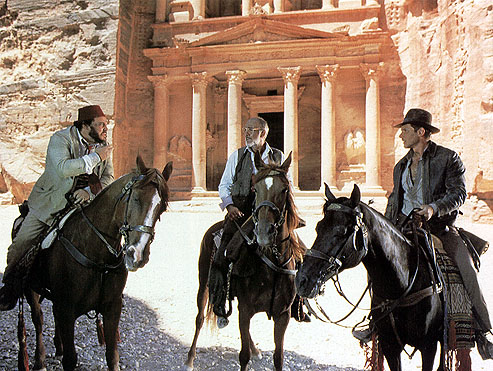
Lines that it's now almost obligatory to quote in any book or documentary about the remains of the eponymous Nabataean city, famous as a UNESCO World Heritage Site, but probably famouser as a film location in Raiders of the Lost Ark.

There are a couple of interesting things about 'a rose red city half as old as time.' First, Burgon's best phrase, and the one thing for which he's now remembered, seems to be mostly a quotation from another poet, Samuel Rogers, who used the 'half as old as time' trope in his poem A Farewell, when he wrote about 'many a temple half as old as Time.' As a meditation on the transience of things, Rogers' poem anticipates Edward FitzGerald's famous translation of The Rubáiyát of Omar Khayyám, with passages like this:
...Many an eye
Bright as the brightest now, is closed in night,
And many a voice how eloquent, is mute,
although some of Rogers' other lines simply make it clear why we've forgotten him and remembered FitzGerald:
And now a parting word is due from him
Who, in the classic fields of Italy,
(If haply thou hast borne with him so long,)
Through many a grove by many a fount has led thee...
Haply, I can't bear with this sort of stuff for very long.

The other interesting thing is that Burgon probably meant the ringing phrase 'half as old as time', which sounds like poetic license, quite literally. As the literary scholar, Hugh Kenner, pointed out:
Though romantic, Burgon was being workmanlike. To his generation the age of Time was quite definite; for since Adam was created in the year 4004 B.C. on October 23, Time in the year Burgon wrote, 1845, was exactly 5849 years old, going back through half of which we locate the founding of Petra at 1080 B.C.
Even in that generation, geologists were having a tough time trying to reconcile the evidence in the rocks with the Biblical account of the creation, but as a devout believer in Biblical inerrancy, Burgon's faith in his Bible-based chronology was probably immune to such challenges.

Today, people who study these things estimate that our Universe (and, presumably, time itself), came into existence some time between 12 and 14 billion years ago.
The Universe is old. According to the most recent measurements, it is 13.7 billion years old. The rise of mankind, on the other hand, is fairly recent, with Homo Erectus, the first "modern human," appearing around a million years ago and Homo Sapiens, today's humans, arriving only in the past 200,000 years. Imagine compressing the time the Universe has existed into the span of a single day with the Big Bang occurring at the stroke of midnight. Humans crash the party late - at 11:59:56pm, just four seconds before the end of the day.
From a cosmic perspective, Petra has existed for the blink of an eye, rather than being 'half as old as time.' The earth itself, which has been around for an an estimated four and a half billion years, is less than half as old as time. But the recent discovery of something really ancient reminded me of Burgon's conception of a truly epic timescale:
An international team of scientists, led by astronomers at Queen Mary University of London (QMUL), report of two new planets orbiting Kapteyn’s star, one of the oldest stars found near the Sun ...

What makes this discovery different however, is the peculiar story of the star. Kapteyn's star was born in a dwarf galaxy absorbed and disrupted by the early Milky Way. This galactic disruption event put the star in its fast halo orbit. The likely remnant core of the original dwarf galaxy is Omega Centauri, an enigmatic globular cluster 16,000 light-years from Earth that contains hundreds of thousands of similarly old suns. This sets the most likely age of the planets at 11.5 billion years, which is 2.5 times older than Earth and "only" 2 billion years younger than the universe itself (around 13.7 billion years).
Astronomy magazine

To humans, the four and a half billion year age of our own planet is an unimaginable abyss of time, but these exoplanets were already older than that when our world was still nothing but stardust. I know that astronomers have already seen objects even older than the exoplanets orbiting Kapteyn's Star, but there's something about the idea of a planet that ancient, a real place, in our cosmic back yard,* with a surface you could walk on and touch (if only you could figure out how to travel 13 light years) that sends shivers down my spine. I think 'Petra' would be an awesome** name for the planet currently known as Kapetyn b, if only 'more than 80% as old as time' didn't sound paradoxically less impressive than 'half as old as time.'


*i.e. further away than you can possibly imagine, but that's just peanuts compared to space...

**In the 'makes the hairs stand up on the back of your neck' sense of the word, as opposed to the conversational 'if you could just pass me your plate, that would be awesome' usage.

Saturday, 6 July 2013

Kevin hearts Kevin

Readers of a certain age will remember The Undertones' acerbic take on the greatest love of all:
Girls try to attract his attention
But what a shame, it's in vain total rejection
He will never be left on the shelf
'Cause Kevin he's in love with himself
Now the Kevins* of the world can now solemnise their deep sense of self-commitment by joining themselves in matrimony. Apparently, people marrying themselves is a real thing.

Such a ceremony obviously has zero legal validity, although I don't suppose this will stop the opponents of marriage equality citing this phenomenon as proof that allowing gay people to get married would be the first step on the slippery slope towards a decadent dystopia full of depraved perverts marrying a sibling, both grandparents, all the Dagenham Girl Pipers, an iPad Mini, an egg whisk, a gerbil, or the Grand Duchy of Luxembourg as the fancy happens to take them.

I don't think we really want to dwell on the physical aspects of self-marriage, but anybody who thought that Kevin sounded like a bit of a tosser might enjoy one of the ruder bits in Joyce's Ulysses where the medical student Buck Mulligan amuses his drinking cronies with that classic of undergraduate humour, Everyman His Own Wife or A Honeymoon in the Hand.


via


*And Traceys, not to forget the Tarquins and Jocastas (you need to fast-forward from the Seventies and move up the social scale to enjoy the most hilariously inflated estimates of self-worth) 

Saturday, 29 October 2011

Imperial purple

The imperial stool is capacious enough for a sultan of the most morbid corpulence.

From Millennium by Felipe Fernández-Armesto, which I'm re-reading at the moment.* It's over-written and the clarity of some of the points is drowned in a sea of purple prose but, on the other hand, they don't generally write 'em like that any more and, every now and then, the over-wrought language is a thing of joy in itself. The moody extravagance of the sentence above puts me in mind of Yeats' Byzantium:

Fresh images beget,
That dolphin-torn, that gong-tormented sea. 

*OK, dipping into would be more accurate.

Friday, 27 May 2011

Happy Cat Feedz Lotz of Peepul

Behold, the feeding of the five thousand, according to the LOLCat New Testament:

Teh Aposslz caem bak, an dey telld Happy Cat all teh stuff dey did an teechd. An den, bcuz dere wuz too many peepul an dey wuzn't getting lunch, he wuz liek "Hay, letz go rest nao, k?"

An so dey went away in a boat an went were nowun wuz. But lotz of peepul seez dem, an chaesd dem an got dere furst. An Happy Cat seez dem, an touhght dey wuz liek sheep wifout a shephurd. An he teeched dem stuff.

It wuz getting laet, so teh disiples wuz liek "Hay, itz rly laet, an we iz, liek, in teh middul of nowerez. U sendz dem hoem so dey can bai dinnur, k?"

But Happy Cat wuz liek "No wai! U giv dem fudz!" An dey wuz liek "But dats lotz of munniez! U wantz us to uze dat much munniez on teh fudz?"
An Happy Cat wuz liek "Hao much fudz duz we haz? U go check, k?" An dey checkd, an wuz liek "Dere iz fiev bredz an two tunaz."

An den Happy Cat wuz liek "Everwun sitz down nao, k?" An so everwun satz down on teh grass. An he grabbd teh fudz, an he lukd to teh Ceiling, an wuz liek "Hay, thx Ceiling Cat" an broek teh bredz. Den he wuz liek "Heer, u pass dis out, k?" An everwun ate an everwun wuz fullz, an teh disiplz pickd up teh leftovurz, an dere wuz twelv bukkitz ful. An dey put it in teh fridge to saev for latur. Fiev thousand peepulz atez. Srsly.

Here endeth today's lesson. See teh rest ov teh gud buk here.

Thursday, 7 April 2011

The gospels as infomercials

Years ago, the publisher Canongate produced a series of “Pocket Canons”; individual books from the Bible (authorised King James version) published in bite-sized separate editions. It’s a good idea; although the language of the Authorised Version is a joy to read or hear, bound into one book, it’s easy to be put off by the sheer bulk of the whole Bible (along with some of the more impenetrable proverbs, exhaustive rules and, regulations and the tedious lists of “so-and begat so-and-so; and so-and so begat so-and so, yea, even unto the nth generation…”).

I decided to take some Pocket Canons down from the bookshelf recently, in order to read the four canonical gospels in the (probable) order they were written. I wasn’t motivated by anything more than a vague curiosity about Christianity’s source material and how the story had developed and changed through four iterations.

Slipping the tiny volume into a pocket to read on a train, or taking it off the bedside table, where it takes up little more space than a drinks mat, is a curiously liberating experience. It puts you in a much more equal relationship with the text, in a way you never are when listening to a few de-contextualised passages being quoted by somebody trying to make a point, or when the rest of your hefty Bible silently sneers at you because you’ve only read about 25 pages out of 1,200-odd, you lightweight.

Each of the Pocket Canons has a short introduction from a well-known figure (some religious, some not). Some of these commentaries might be interesting, but I didn’t purposely read them, as the whole purpose of the exercise was to read the original stories without the overlay of commentary. Of course, it’s hard to deliberately not read things and my eye slipped over Nick Cave’s introduction to Mark. I don’t think it detracted very much from my reading – the gist of it was that Nick was an Anglican who’d been turned off by the namby-pamby  “gentle Jesus meek and mild” presented to him in Sunday school, but had been re-engaged when an Anglican vicar suggested he read the spare, lean, direct account of Jesus’ life in Mark. He has faith, I don’t, but his comments were quite interesting. Fair enough, I thought, and read Mark.

After Mark, Matthew. This had an intro by A N Wilson. Again, I wasn’t intending to read the intro, but I skimmed over it. This time I didn’t think ‘fair enough’ but thought the commentary was frustrating and annoying. Although I hadn’t intended to get side-tracked, Wilson’s comments are worth thinking about, because they highlight an enormous gulf of understanding between a lot of mainstream believers and non-believers. It’s possible that he was making a subtle point that I’m too dense to understand, but to me his thinking sounded confused and evasive. Whoever’s right or wrong, it’s worth examining what the problem is.

Wilson rhetorically supposes that the reader, born into a ‘post-Christian age, into a world of newspapers and investigative reporting and science’ will look at Matthew’s account of the virgin birth, the journey of the Magi, the various miracles and the resurrection and ask ‘is it true?’

He then tells the reader not to ask this question. Wilson says that although it seems reasonable to ask whether specific events in Matthew’s account are literally true, asking the question ‘can lead only to the most pointless, arid negativism.’

‘Your educated, scientific, modern mind’ says Wilson, ‘will decide that no one ever walked on water; no Virgin ever conceived; that corpses do not come to life.’ True enough. I’m no expert in hydrodynamics, obstetrics or (thankfully), death, but my experience of the world and what I’ve been taught and read suggest that such things don’t happen. But according to Wilson, if we make the mistake of ‘rejecting the Gospel’ because we think these are intelligent reasons to doubt it, we are in fact just ‘too hemmed in by our imaginative limitations to see the sort of things this book is doing’, and risk ‘rejecting one of the most extraordinary books ever written.’

Instead of applying ‘supposedly rational’ tests to the text, he suggests that we should think about Matthew in the context of Bach’s sublime setting in the St Matthew Passion or ‘old women in Stalin’s Russia … who stubbornly continued to chant the opening verses of the Sermon on the Mount in defiance of the KGB.’ He goes on to extol the power and passion of the Gospel, in all its terrible wonder, its truthfulness and its self-contradiction. He speaks of irreconcilables, ‘rather than being fudged’ being ‘held together in self-contradiction’ whatever that means. He tells us that the author did not attempt to write a realistic, post-enlightenment history, but crucially fails to say directly what the author did write.

The point I think he’s trying to make is that there is some sort of deeper truth than historical truth and forms of understanding that transcend mere facts and if we don’t appreciate this, we’re missing something important.

I agree that you don’t have to take everything in the world literally, or on face value, but I can’t for the life of me, see how the key events related in the gospels can be anything other than either true or false. There are, of course, parts of the Gospels that are neither. When Jesus told parables about vineyards, or of seed falling on good earth or stony ground, or the widow’s mite, nobody this side of the extreme end of the autistic spectrum would think of asking about the real vineyard, field or widow. They’re made up stories, intended to illustrate a point. Everybody knows that. We all get it; that’s why nobody objects that foxes and pigs don’t really talk when reading Aesop or Animal Farm. It’s fiction with a point, it doesn’t pretend to be anything else and there are few people so imaginatively limited that they don’t understand this.

In more general terms, you can learn lots of things from literature and art, even when the story being told is the figment of somebody’s imagination. Empathy, seeing the world through different eyes, dealing with difficult situations, the nature of heroism and cowardice, prejudice, honesty and deceit, that thing we call love, loss, the nature of society, they’re all in there. You can be moved, changed or enlightened by a fictional story in a book, or a film, TV, radio, the theatre without the story being literally true or the characters ever having actually existed. But here’s the important point – those works of fiction are clearly labelled and you look for them on the fiction shelves. You watch a film and words like these pop up on the screen:

All characters appearing in this work are fictitious. Any resemblance to real persons, living or dead, is purely coincidental.

The Gospels contain no such disclaimer. If we exclude parables and proverbs that are clearly not meant to be taken literally, we’re still left with a narrative. The events in it are either true or they are not. Maybe I’m imaginatively limited, but I can’t see how they can be neither, or both. Either Jesus was born of a virgin, or he wasn’t. He either walked on water or he didn’t. He died and rose again, or just died. Either there is a God or there isn’t. If there is, either Jesus was his son or he wasn’t.

There are religious people who aren’t worried by this. Fundamentalists, who believe that every word in the Bible is literally true. This position contradicts a consistent meticulously-constructed account of how the world works that’s been painstakingly pieced together over two thousand years of patient observation and discovery, but at least it’s consistent – the Bible is true and anything that says different, ain’t. Of course, even if you believe in the literal truth of the Bible, you still have to deal with the Ned Flanders problem of internal inconsistency:

Why me, Lord? Where have I gone wrong? I've always been nice to people. I don't drink or dance or swear. I've even kept Kosher just to be on the safe side. I've done everything the Bible says, even the stuff that contradicts the other stuff.
Or, as A N Wilson put it:

The irreconcilables rather than being fudged are held together in self-contradiction.

Nope, I still don’t understand. Is A N Wilson saying something really clever here, something I’m too dim to grasp, or is he just Ned Flanders gone to college?

But most religious folk aren’t Ned Flanders. They accept that not all of the Bible, or all of the Gospels can be literally true. Fair enough – every historian, every person who hears or reads a news report has to deal with distortions, errors and omissions. It doesn’t invalidate a belief in the reality of historical events or current affairs. Neither does it absolve us from having some sort of view, however provisional about what’s true and what isn’t. However powerfully written an account of some event is, however influential, it is either fact or fiction.

I just don’t get the distinction that Wilson makes between ‘a realistic narrative of the kind that we might expect of a post-enlightenment historian’ and the vaguely-defined alternative kind of narrative that he implies the gospels must be. Sure, a lot has changed in two thousand years, but it seems unlikely that the nature of events has changed, such that things could simultaneously happen and not happen at the time of Christ.

Rather than thinking about allegedly real events in the context of literature, which seems like a category error to me, perhaps it would be better to think about events in the Bible as if we were a jury, trying to decide what had probably happened. Legal systems may have changed, but then, as now, people were judging their fellows for alleged crimes and had some idea that the accused either had or hadn’t committed a certain act. There have been documented legal systems since Hammurabi drew up his code in about 1,700BC. Leviticus is famously full of laws. The Jesus of the gospels is all too aware of law.

Think not that I am come to destroy the law, or the prophets: I am not come to destroy, but to fulfil.
Matthew 5:17

Then, as now, people didn’t have perfect knowledge, but if somebody was accused of a crime they’d go through some sort of process to establish what had actually happened. Even if there is, or was, insufficient evidence to know whodunnit, people then, as now, knew that something either happened or didn't happen.

Let’s say that the body of X is found in a ditch, showing obvious signs of violent assault. Y is brought to trial for the crime. Maybe there’s enough evidence to convict Y, maybe not. But in those circumstances, people would know they had to decide whether or not Y’s guilt could be reasonably established. They would know that he must be either guilty or innocent. There might be mitigating factors, self-defence, being of unsound mind, whatever, but there’s no getting round the fact that X has been killed and Y either did do it or didn’t do it.

There might be a world of cultural difference between a judge trying to decide such a case in First Century Jerusalem and the members of a modern jury, but all would have an idea of literal truth and objective reality – Y either battered X to death or Y didn’t. Regardless of mitigating circumstances or insufficient evidence, the objective truth is out there. Maybe there’s enough evidence to pronounce judgement or maybe there isn’t, but Y either did it or didn’t do it. There’s no ever-so-subtle pre-enlightenment world where a Judge might think ‘you know what, actually, it’s wrong to even ask whether it’s true that Y killed X; it may seem like a reasonable question, but asking it would lead me into the most pointless, arid negativism.’

Yes, the gospels have inspired great literature and art, along with debates about morality, authority and the individual conscience, they’ve caused people to impose and challenge systems of government, given comfort to the afflicted and afflicted the comfortable (and sometimes vice versa), they are the basis of the most widespread religion on earth, and they contain great poetry. None of which is relevant to questioning the assertions that Jesus was the son of God, that he was born of a virgin, that he healed the sick, raised the dead, walked on water, fed 5,000 people with five loaves and two fish, was crucified and rose from the dead. These events either happened, or they didn’t and A N Wilson hasn’t made an understandable case that convinces me it’s somehow wrong to even ask whether or not these things are true.

Wilson seems all too typical of mainstream religious people. They think themselves too sophisticated and intelligent to accept the evidence-denying certainties of fundamentalists, so reject a too-literal interpretation of scripture. But when you ask them what they actually do believe, what they literally believe to be true, it’s like trying to nail jelly to a wall. Ask the direct question 'do you think X is literally true?’ and instead of a direct answer, you get a lecture on how simple-minded and limited your question is, without any coherent explanation of how an actual event can pull off the impressive trick of having both not happened, yet (in a very real sense), happened.

All of which is a bit annoying. People who ask simple, straightforward questions stand accused of being shallow and literal-minded, yet as far as I can see, the people making these accusations are fudging the issue, refusing to say what they believe and leaving the events recounted in the gospels in some sort of convenient limbo in between fact and fiction.

Once upon a time there was news, there were features and there were advertisements. News was a more or less accurate accounts of stuff that had happened. Features were more or less factual and informative articles about something or other. People trying to sell stuff wrote adverts. Simple. These days we have amphibious things called “infomercials”, things that look at first sight like informative features, but turn out to be thinly-disguised attempts to sell stuff. I don’t have a problem with adverts that come out and advertise that they are adverts. I ignore most of them, or, on the rare occasions that I see something advertising a good or service I’m interested in, I might take a look. Infomercials, though, are uniquely irritating – anodyne filler features, written in an attempt to flog something by sneakily flying in below your critical radar. I find their bland slipperiness particularly off-putting.

For all their talk of the wonder, power and majesty of the gospels, people who refuse to even engage with the question of whether specific events are likely to have been true are demoting the gospels to the status of infomercials in their fence-sitting attempt to have the best of both worlds. Is it a feature or an advertisement? Neither; it’s an informercial. The virgin birth – fact or fiction? Neither; it’s something that transcends your crude categories. To me this all smells of fudge and intellectual dishonesty.* My working theory is that the people who tell us that we’re asking the wrong question because our minds aren’t subtle enough just want to kick the question into the long grass because it’s too uncomfortable for them, or challenges their authority or preconceptions. If somebody can demonstrate in clear, understandable language that there's more to this subtle, truth-transcending, pre-enlightenment way of knowing than fudge and wooly language, I really would be interested to hear the point made clearly. Until then, I don't understand their point and I don't think it's my fault that I don't understand.

*which, coincidentally, are among the whacky ingredients that go into Heston Blumenthal’s radical re-invention of the  fairy cake, his first recipe to actually  include an abstract concept alongside the more traditional freeze-dried yew berries, bergamot oil with a hint of eau-de-cologne and tiny squares of gold leaf

Friday, 14 January 2011

Not quite written by committee

The King James translation has been described as 'the greatest monument of English prose' as well as 'the only great work of art ever created by a committee'. Both statements are true. Fifty-four scholars worked seven years to produce the work from its extant texts in Aramaic, Hebrew, Greek, Latin, English. Such an undertaking can be expected to produce great scholarship, but hardly writing as spare and sublime as the King James…

Charlton Heston

For once, I think that the received opinion is bang on the nail. The language of King James Bible is powerful and enthralling. As the recent anniversary reminded us, it still permeates the our language after four centuries and echoes back in the words people use today. It's like the Cosmic Background Radiation of the English language. When journalists use that truism about 'a famine of Biblical proportions',  this is what they mean:
The tongue of the sucking child cleaveth to the roof of his mouth for thirst: the young children ask bread, and no man breaketh it unto them ...
...they are not known in the streets: their skin cleaveth to their bones; it is withered, it is become like a stick.
They that be slain with the sword are better than they that be slain with hunger: for these pine away, stricken through for want of the fruits of the field.
 From Lamentations, 4

I would,though, take issue with Heston's assertion that it was 'the only great work of art ever created by a committee.' It's a snappy quote, and I'd like to know who he borrowed it from, but it may be almost - but not entirely - wrong.  The reason why is worth remembering:

The Authorized King James translation of the Bible wasn't, of course, the first English translation of the Bible.  John Wycliffe completed the first English translation in the 1380s. To the contemporary church hierarchy this was an outrageously subversive act - the language of the Latin Bible was accessible only to an educated priestly elite, which meant that the clergy had privileged access to the authority vested in sacred texts. Conversely, with no direct access to the source material, the laity were powerless to challenge doctrine and the authority of the Church. A host of vernacular translations would also have given the Church a severe administrative headache. It made very good sense for a multi-national corporation like the Catholic Church to keep all its internal communications and official documents in one language.

Having annoyed those in authority, Wycliffe clearly needed to be taught a lesson. At various times the Pope issued decrees against him, he was brought to trial before the Archbishop of Canterbury, charged with - although not convicted of - heresy and expelled from Oxford University for his efforts.

After Wycliffe's death, his Bible translation went viral among the proto-Protestant Lollard movement (or as viral as a document can go with quill-pen copying technology). Lollards read their Bibles, then went around telling people that doctrines like transubstantiation, the Eucharist, Indulgences, and a hierarchical church organization didn't appear anywhere in the Good Book. Then there was trouble.

In 1401, in a high-profile initiative designed to address the radicalisation of the Lollard Community, Parliament passed the statute De haeretico comburendo, (On the Burning of the Heretic). It sounds harsh, but I'm sure the authorities considered the measures tough, but proportionate. In 1415 the Council of Constance declared Wycliffe himself a heretic and he was duly burnt although, as he'd already been dead for thirty years, this constituted getting off rather lightly.

Fast forward a century or so. In the 1520s and '30s, William Tyndale translated large parts of the Bible  - the entire New Testament, the Pentateuch and the book of Jonah - into English. At first, it looked as if his translation would go the way of Wycliffe's, rejected by churchmen and the conventionally pious Henry VIII alike. The new printing technology ensured that more copies of his work could be disseminated, but Tyndale's translations were banned from England and any copies burnt. Tyndale moved to the continent, where he continued to work and be published. It looked as if the Tyndale version was destined to be just another samizdat Bible, passed furtively around among dissenters.

Then, Henry VIII began to have those marital difficulties for which he's famous. Tyndale made the career-limiting mistake of writing a pamphlet opposing Henry's attempts to have his marriage to Catherine of Aragon annulled. Henry asked the Holy Roman Emperor to have Tyndale seized. After a time spent on the run he was eventually betrayed, tried for heresy, strangled at the stake, then burned.

Tyndale's translation, though, fared rather better. As Henry's conflicts with the Pope over his marriages escalated, the centre of power in England shifted. The interests of the Pope in Rome and his trans-national organisation became irrelevant and, in England,  it was the King and his obedient English clergy calling the shots. For the first time, it was in the interest of the English Church and state to have an authorised, national Bible to assert national authority and undermine that of the Catholic Church.  Thomas Cranmer assembled a committee of ten bishops to produce the definitive English Bible, but the project went so slowly that by 1537 he was complaining that their Bible wouldn't be ready until the day after Doomsday.

Tyndale's partial translation, however, was already widely published and available. The Bishops' attempt to translate a new English Bible from scratch was abandoned and work started on a national Bible based on Tyndale's work. Miles Coverdale amended some of Tyndale's translations to make them less objectionable to the clergy, but left his work largely intact. He added his own translations of the remaining books of the Bible, to create the Great Bible, the first authorized Bible in English.

Fast forward another seventy years, to King James I, trying to reconcile High Church Anglicans with the Puritan wing of the English Church. He ordered a new, definitive national edition of the Bible to be produced. Forty seven* scholars, working in six committees were tasked with translating the Bible 'out of the original tongues, and with the former translations diligently compared and revised, by His Majesty's special command.'

So, 'created by committee', then? Well, not quite. The committees of translators were allowed to consult an approved selection of existing translations, including Tyndale's partial translation itself, along with the Great Bible, and the Sixteenth Century Matthew's Bible and the Geneva Bible - all translations that were substantially based on Tyndale's work. Scholars disagree on exactly how many of the words in the King James Bible are Tyndale's, but some studies suggest figures like 84% for the New Testament and 76% for the Old Testament.

Considering the raw deal he got, I think it's only fair that Tyndale should get a bit more of the credit. Mind you, 'the only thirty-odd per cent of  a great work of art ever created by committee' doesn't have quite the same ring to it.

Via.

If you have been, thanks for reading and here's a small YouTube treat for all you Charlton Heston fans out there...

*Fifty four scholars were originally approved, but only forty seven contributed to the translation.