Showing posts with label SCIENCE. Show all posts

Tuesday, 23 November 2021

Our woman on Havana

Havana Syndorome has been back in the news recently.

When this story of mysterious symptoms afflicting US Embassy staff in Havana first emerged, I was sceptical of the various theories attributing the outbreak to things like microwaves or sonic pulses. So it was interesting to hear what one of my favourite science communicators, the physicst Sabine Hossenfelder, had to say on the subject.

One of the things I like about Sabine is that she's got a dryly sceptical take on things, and she's pretty good at cutting throught the hype surrounding various science-related topics, from the overblown claims being made about progress towards nuclear fusion power to terraforming Mars. So it was interesting to see that from three alternative explanations, (mass hysteria, microwave pulses and ultrasound), she sets out the reasons why she thinks mass hysteria is the least likely explanation:

It's not a slam dunk, but it's made me question whether my initial reaction - that this is clearly and obviously made up - was right. A timely reminder that sometimes we need to be sceptical even about our own scepticism.

Sunday, 18 April 2021

Paleoart: the next generation

The past is a foreign country; they do things differently there. The deep past is so weird and wonderful it's practically another planet. I've enjoyed the sheer otherness of artists' attempts to recreate scenes from deep time since I was a kid. Here's an illustration of "early forms of life" from the pages of the Odhams Encyclopaedia for Children I was given for my 6th birthday. The artist was one John Rignall:

It's the sort of busy scene, packed with weird and wonderful detail which might appeal to a child, and it did. Looked at from a half century later it shows how far and fast reconstructions of the Mesozoic world have changed. From the kangaroo-posed therapod to the offended-looking tail-dragging sauropod to the absence of feathery dinos that aren't Archaeopteryx, the ancient creatures all have a retro look.

OK, it's an impressionistic overview for kids, including an assemblage of plants and animals most of which lived many millions of years apart from one another. But even the more "realistic" dino books I had as a kid featured reconstructions like this one by Zdenek Burian, of semi-aquatic Brachiosauruses adopting a watery lifestyle to take the enormous weight off their feet:

Some people are, apparently, a bit fed up that the dinosaurs they thought they knew as kids have been superseded by new best guesses at what these creatures looked like in life. Personally, I find a lot of the new paleoart keeps the sense of wonder I had as a child new and fresh.

For a taste of what I mean, I can warmly recommend a visit to Dr Mark Witton's wonderful paleoart-themed blog. It's full to the brim with strange, beautiful and astonishing visions of past life by Mark and many others. From my personal favourite for their sheer weirdness, the giant azhdarchid pterosaurs, to bizarre big-headed predators from the Triassic, or Diplodocus, there are wonders on every page. And also discussions of why (scientists think) these critters look the way they're illustrated. 

 There is, for example, an interesting post on lips versus exposed teeth in illustrations of extinct carnivores. That post seemed, at least to this non-expert, to make a pretty solid case for assuming lips in all but a very few cases. Interestingly, John Rignall's therapod dinosaur from my childhood encyclopaedia, although its teeth are showing slightly, looks as if it has lips. At the very least, Rignall has made it ambiguous and not as boldly and ostentatiously toothy as many lipless carnivorous dinosaur illustrations of the time:

Also interesting that, from all the big, fierce , famous, carnivorous dinosaurs he could have chosen, (T Rex, Allosaurus, Megalodon), Rignall chose the obscure Antrodemus, a contested name for what most paleontologists would call bits of an Allosaurus. Although Rignall might be up there with modern paleoart with what seems to be lips on his Antrodemus/Allosaurus, the kangeroo posture and palms-down hands is definitely retro dino - compare and contrast with this modern reconstruction of the posture of Allosaurus jimmadseni:

Image credit: Scott Hartman (Creative Commons Attribution)

The other great thing about Mark is that, although there's lots of solid science in there, he doesn't take himself too seriously and he's generous with the playful pop culture references; see What Daleks, xenomorphs and slasher movies tell us about palaeoart and here, on his Twitter feed, Mark imagines what a gorilla the size of King Kong might actually look like, (given the biomechanics of very large animals, not much like a gorilla):

"It was skeletal and circulatory weakness killed the beast. We've come up with a patch for these issues with the release of Kong 2.0."

This is fantastic (in both senses of the word), but it's worth remembering that scientist's current understading of the constraints on the size and shape of animals is built on some old and well-established principles. As Stephen Jay Gould once noted:

Galileo first recognized this principle in his "Discorsi" of 1638, the masterpiece he wrote while under house arrest by the Inquisition. He argued that the bone of a large animal must thicken disproportionately to provide the same relative strength as the slender bone of a small creature.
For more speculation on the biology of oversized apes (in this case of the human variety), this video on the biology of giants by YouTuber Trey the Explainer also has some fun with the topic of biological scale:


I'm liking this stuff very much. Almost as much as this awesome poster for the, sadly unmade, Hammer movie Zeppelins v Pterodactyls. Yes, I know I've shared this image before but honestly, just look at this thing. As Dr Johnson almost said, when a man is tired of pterodactyl-on-Zeppelin action, he is tired of life.


Wednesday, 4 July 2018

The eternal mystery of Piers Morgan

That noted public intellectual, Piers Morgan, recently posed an interesting question to Twitter.
Atheists can never say what was there before the Big Bang. They just say 'nothing' but they can't explain what 'nothing' actually is. No human brain can, which is why I believe in something that has superior powers to the human brain. 
OK, I was being sarcastic. His question itself isn't that interesting. Dara Ó Briain more or less answered it in a stand up session where he had a go at the sort of people who justify their supernatural beliefs by saying "But science doesn't know everything!" His response was something along the lines of "But science knows it doesn't know everything. That's why we still do science."

What is interesting is how Piers's statement challenges theology. Think about the logic here: "The human brain can't explain everything about the universe, so why should I accept your incomplete atheistic world view?" Yet Piers is happy to believe in a God who is supposedly beyond human understanding. So why should I believe theists who can't fully explain what "God" actually is?

At best it's a draw between two incomplete world views. I don't understand everything about the universe. You don't understand everything about God.

But the universe is the thing that we both agree exists.

The mystery of faith...

Friday, 5 January 2018

Important (?)

Trying to correct disinformation is futile, because corrections don't change minds, they simply increase the salience of the original lies. This "boomerang effect", according to current received wisdom, is why people who know what they're talking about are unable to stop lies and the lying liars who tell them.

Interestingly depressing, if true. But how robust is the evidence for the boomerang effect? Not very, according to Daniel Engber. If so, the boomerang effect theory may be, at best, demoralising people with good information into silence. At worst, it may be making them comfortably complicit with the bullshitters and liars:

"Today’s proclamations about the end of facts could reflect some wishful thinking, too. They let us off the hook for failing to arrive at common ground and say it’s not our fault when people think there really is a war on Christmas or a plague of voter fraud. In this twisted pipe-dream vision of democracy, we needn’t bother with the hard and heavy work of changing people’s minds, since disagreement is a product of our very nature or an unpleasant but irresolvable feature of our age."

I don't know whether Engber's right, but it does seem plausible that facts might be more robust and powerful than proponents of the boomerang effect suggest. After all, if people were as fact-proof as the theory suggests, why did Big Tobacco and Big Sugar spend so much of their time and money trying to suppress facts, or undermine them with fear, uncertainty and doubt?


Wednesday, 22 November 2017

"To insanity and beyond!"

'I don’t believe in science.' Man who thinks Earth is flat plans to launch self on a rocket

...“I don’t believe in science,” said Hughes, whose main sponsor for the rocket is Research Flat Earth. “I know about aerodynamics and fluid dynamics and how things move through the air, about the certain size of rocket nozzles, and thrust. But that’s not science, that’s just a formula. There’s no difference between science and science fiction.”
USA Today

A proud day for the USA, but a bittersweet one for the UK's own delusional space programme, which was cancelled when interstellar colony ship enthusiast Aidan Powlesland failed to get himself elected as Ukip leader, robbing us of the chance to be the first nation to fire members of its unrealty-based community beyond the reach of Earth's gravity and experts, while probably winning us a bonus Darwin Award, too.

From the annals of questionable research

"Countries where people tend to value autonomy and harmony the most tend to drink more alcohol, our latest study shows. And countries where people are more likely to value hierarchy, security and obedience, tend to drink less alcohol."
Really? I guess it's time to pour myself a large vodka and drink a toast to Mother Russia, avatar of that famously harmonious society where everybody's too busy enjoying their world-beating levels of personal autonomy to get uptight about heavy stuff like hierarchy, security and obedience:
"Alcohol consumption in Russia stays among the highest in the world. According to the WHO in a 2011 report, annual per capita consumption was about 15.76 litres, fourth highest volume in Europe."
It's not too hard to guess where this study went wrong, just from skimming the article about it. This, for example, looks like a clue:
"We found that countries with populations that valued autonomy and harmony, such as France and Germany, tended to have higher average levels of alcohol consumption. However, countries such as Iran and Senegal, where people hold more traditional values dear, such as hierarchy and being part of a collective, drank less alcohol."
So people in rich countries like France and Germany are drinking more than people in theocracies where alcohol is banned, and/or poor countries where many people couldn't afford to drink as much, even if they wanted to? This doesn't exactly convince me that where a nation sits on the liberal/authoritarian spectrum is likely to be the most useful predictor of how much booze the people there are drinking.

Thursday, 2 November 2017

I'm not saying it's aliens...


"ALIENS COULD BE JUST LIKE US—DARWIN'S THEORY OF EVOLUTION MEANS E.T. WOULD BE HUMAN-LIKE", according to the Newsweek headline. "What would aliens look like? More similar to us than people realise, scientists suggest", is the Independent's headline offering.  "Now, scientists are suggesting that ... if other intelligent species are indeed lurking in the depths of space, they might look a whole lot like us", claims another journalist.

Klingons and Romulans and Vulcans, oh my! Except, when you see what the scientists' speculations/educated guesses actually were, you begin to wonder whether the folks at Newsweek, the Indy and BGR even bothered to read what the boffins wrote:
Aliens may not have two legs, or any legs at all, but their structure, from an evolutionary standpoint, will be much more familiar than we might have thought. By familiar, I don’t mean superficially familiar. They may look, on the surface, wildly different from anything on Earth. But they will be similar on a more fundamental level: their bodies will be constructed in the same way (formerly free-living parts within formerly free-living parts), and they will have undergone a similar evolutionary history (independent organisms cooperating to form new, higher level organisms).
The piece is helpfully illustrated with pictures of imagined aliens which look, respectively, like some kind of tentacled polyp surmounted by a tiny umbrella and a giant mutant tardigrade.

Some journalists* could do better (even the hacks at the Sun got as far as looking at the pictures before writing their article, so it's not as if I'm setting the bar unreasonably high here, folks).


*Even the UFO-believers-style aliens at the top of the article in The Conversation look several times more human than anything the article is actually suggesting.

 ________

 Update - while it's easy to sum up what these scientists weren't claiming (that aliens will look anything like  humans or, for that matter, like anything else on earth), it's harder to make out what specific claim they were making. You only need to read the title of P. Z. Myers' post on the subject ("We can predict that aliens exist, if aliens exist") to tell that at least one biologist is completely unimpressed by the alleged specificity of these "predictions" about alien biology.

Friday, 13 October 2017

Despotic diagnosis disorder

I learnt a new word today - "drapetomania."*

Drapetomania was a psychological disorder invented by the American physician Samuel A Cartwright, to account for the fact that some slaves tried to escape from their owners. Cartwright speculated that these unaccountable symptoms must have been triggered by slave owners who "made themselves too familiar with [slaves], treating them as equals" and prescribed the remedy of "whipping the devil out of them" (the slaves, not the over-familiar slave owners).

It's an extreme example of medicalising behaviour which challenges existing power relations. Other examples which spring to mind are the abuse of psychiatry to silence dissent in the Soviet Union (a practice which now seems to be enjoying a revival under Putin and his fellow authoritarian leaders in different parts of the former USSR) and the made-up diagnosis of "hysteria" as a catch-all term to pathologise women who were uppity, unhappy, or otherwise failing to comply with male expectations.

There are less dramatic, but still sinister, pathologies being invented in the our own age. In 2012, Bruce Levine warned about children being given a new diagnosis - "opposition defiant disorder", complete with the auto-stigmatising acronym "ODD."
Of course, a stroppy kid who fails to comply with the requests of even a reasonable authority figure might just be a little brat, but that's not really a medical diagnosis. There are cases when adult authority figures are anything but reasonable and throwing a major strop would be a completely reasonable response from a sane child.

This is how authoritarian whims are camouflaged as objective judgements. Which brings me, in a roundabout way, to Donald J Trump. Most of the outrageous antics coming from the Trump White House seem designed to distract from more important things (for example policies which are either failing to happen, or which would be unpopular if people stopped thinking about the latest 3am Tweet for long enough to think about what the guy's actually doing). However, some of his outbursts do also shine a light on the sort of power relations behind labels like drapetomania, hysteria and ODD

The authoritarian mindset is all about enforcing certain norms of behaviour and swiftly punishing transgressors - in Trump's mind it's perfectly OK to try and get NFL players who take a knee to protest against police brutality, fired. But Trump himself is all about flouting norms, being more outrageous, offensive and abusive than all you other losers, because he can. His behaviour here is a useful reminder of the hypocrisy at the heart of most** authoritarianism - the less powerful are punished for putting a toe out of line, while unreasonable authority figures get to stomp all over the rules at will.

In the Trump clown show, the hypocrisy is out there. If you want to disguise and embed such blatant double standards in a whole society, it helps to have a science-y sounding diagnosis to explain why the powerless must be mad if they expect to get away with half the stuff their "betters" do as a matter of course. I'd diagnose this ailment as form of social perversion, and I'm calling it Despotic Diagnosis Disorder until somebody comes up with a better name.


**Not all - I guess there have been, and are, ascetic authoritarians who practice self-discipline whilst also disciplining others - Savonarola, warrior monks, abusive Christian Brothers and nuns in Catholic institutions, presumably living frugal lives of self-denial, while battering the living bejesus out of the unfortunate children in their care...


Monday, 23 January 2017

Gutenberg's Project 1.0

Johannes Gutenberg is best known for having an amazingly clever idea that changed Europe and the world for ever but, as his Wikipedia entry notes, his experimental printing press wasn't his first attempt at a tech startup:
Around 1439, Gutenberg was involved in a financial misadventure making polished metal mirrors (which were believed to capture holy light from religious relics) for sale to pilgrims to Aachen 
I don't know what to make of the fact that the guy responsible* for one of the modern world's most fundamental, ubiquitous, era-defining pieces of technology was also taking a punt on an idea as bonkers as the recent, infamous £160 Internet-connected hairbrush. On the whole, I find it kind of comforting to think that people who can have brilliant ideas can also come up with something which, with the benefit of hindsight, looks totally insane.

Hindsight, of course, is the key - everybody now knows that printing with movable type worked out really well (even if it never made Gutenberg rich), whereas most people with enough sense to avoid homoeopaths, televangelists and crystal healers would now run a mile from somebody trying to flog them a holiness-infused mirror, allegedly activated by having once been in the vicinity of an splinter that reputedly came from the True Cross, or a finger bone purported to have belonged to St Thomas. But, at the time, printing was new and untried and, for people with a devout upbringing (which would have included almost everybody), the efficacy of relics was probably seen as being as commonsense and uncontroversial as the idea that aspirin works is to us.

People in the past weren't stupid - they just worked with a different level of knowledge and a different set of assumptions. Sure, they had ideas that now look daft, but, as the smart hairbrush reminds us, technically competent people can still do sophisticated versions of daft to this day.

The astronomer and mathematician, Johannes Kepler, who was born just over a century after Gutenberg died, took the new and controversial Copernican notion of a solar system with the sun at the centre and worked out how the planets moved (in elliptical orbits) in order to produce the motions that astronomers actually observed.

Like Gutenberg, though, he didn't just have a brilliant idea or insight from nowhere. Before coming up with his laws of planetary motion, based on the mathematics of elliptical orbits, Kepler was looking for a simple underlying principle which might explain why the planets orbited where they did. If our world was just another planet, as Copernicus had suggested, there were (as far as anybody knew then), six planets in all. There were other things in nature that were strictly limited in number, thought Kepler - for example the five Platonic (regular) solids:
The Platonic solids, on a tourist T-shirt I bought in Skiathos (an island with no particular connection to Plato, AFAIK, but it looks good and, hey, it's Greek).

Six planets with five intervals between the spheres of adjoining planets. Kepler's first attempt at explaining the orbits of the planets involved assuming that the spheres to which the planets were presumably fixed were separated by volumes corresponding to those taken up by each of the Platonic solids.To modern eyes, his model looks contrived and artificial:
But, up to a point, it seemed to work, sort of:
Interval between planetary orbits Platonic solid Ratio in Kepler's model Actual ratio
Saturn to Jupiter cube 1.73 1.73
Jupiter to Mars tetrahedron 3.00 3.42
Mars to Earth dodecahedron 1.26 1.52
Earth to Venus icosahedron 1.26 1.38
Venus to Mercury octahedron 1.73 1.87
Although Kepler realised that his figures were close, but no cigar, he never abandoned the idea that the regular solids played some role in ordering the orbits of the planets. It's only with the benefit of hindsight that we can see that one simple, underlying, principle (6 planets ordered by intervals corresponding to the 5 Platonic solids) was an illusion, whilst another (planets move in ellipses with the sun at one focus) matches reality. Not only do the elliptical orbits agree exactly with observation (well, almost exactly - there were still anomalies which weren't explained until Einstein came along), but the approximate correspondence between planetary distances and a system of nested Platonic solids definitively fell apart after 1781, when William Herschel discovered Uranus and proved that the number of planets which could exist, unlike the number of regular solids, wasn't limited by some fundamental law.

Because we've all been taught at school about ideas and innovations that changed the world, versus those outmoded ideas that nobody believes in any more, we tend to imagine that we're smart enough to recognise the good stuff and discard stupid ideas, but I'm not so sure.

Without hindsight, we could just as easily end up looking like Jeremy Paxman in that famous 1999 interview with Bowie, where the self-appointed voice of common sense pours cold water on the pop star's airy-fairy notion that this over-hyped Internet nonsense is somehow going to be important, rather than being just another of those silly fads that doesn't impress an experienced member of the commentariat who's seen it all before:


Although, having said all that, I'm still going to stick with my original assessment of the smart hairbrush as a self-evidently stupid idea. History will be the judge of that.


*OK, the Chinese invented printing some 13 centuries before Gutenberg and beat him to movable type by 400 years and some Dutch people will tell you that Laurens Janszoon Coster beat him to it in Europe, but it was still a big deal, for all the qualifications and squabbles over precedence.

Monday, 7 November 2016

Sublime, improbable Martian engineering

 *Spoiler alert- if you've not already read H G Wells's The War of the Worlds, do so immediately, or read on at your own peril...*

I've just been re-reading the first alien invasion novel, H G Wells's The War of the Worlds, and I can see again why it created a genre all of its own and why it immediately grabbed me as a child. Mainly because it's such a cracking yarn - the alien visitation starts off as an intriguing curiosity, but escalates to being, ominous, threatening, awe-inspiring and terrifying at an unstoppable pace that mirrors the relentless advance of Well's iconic Martian tripods, seen here in  one of the novel's big reveals:
And this Thing I saw! How can I describe it? A monstrous tripod, higher than many houses, striding over the young pine trees, and smashing them aside in its career; a walking engine of glittering metal, striding now across the heather; articulate ropes of steel dangling from it, and the clattering tumult of its passage mingling with the riot of the thunder. A flash, and it came out vividly, heeling over one way with two feet in the air, to vanish and reappear almost instantly as it seemed, with the next flash, a hundred yards nearer. Can you imagine a milking stool tilted and bowled violently along the ground? That was the impression those instant flashes gave. But instead of a milking stool imagine it a great body of machinery on a tripod stand... Seen nearer, the Thing was incredibly strange, for it was no mere insensate machine driving on its way. Machine it was, with a ringing metallic pace, and long, flexible, glittering tentacles (one of which gripped a young pine tree) swinging and rattling about its strange body. It picked its road as it went striding along, and the brazen hood that surmounted it moved to and fro with the inevitable suggestion of a head looking about.
That's a fantastic piece of writing and there are lots more like it. The book also has its expository digressions, where the action stops and Wells explains things rather than just showing you awesome stuff, but these aren't too long (at least by the standards of the time when Wells was writing) and by this stage he's already created enough momentum to keep you gripped and reading on. Compare and contrast with that other piece of proto-sci-fi, 20,000 Leagues Under the Sea, which also starts with strange, ominous events, building up to an exciting reveal and some great set pieces, but is so weighted down with the ballast of endless pages of over-long explanation that Verne almost sinks the cracking yarn he created.*

If the The War of the Worlds looks forward to every alien invasion yarn that followed, it also looks back to an aesthetic trope that's probably been around for ever, but was largely formalised in the Eighteenth Century and peaked with early Nineteenth Century Romanticism - the sublime. That's the idea that humans don't just appreciate things which are beautiful in an ordered, harmonious way, but also dig stuff that's wild, inhuman in scale and frankly terrifying - as the Tate Britain put it, in the blurb to an exhibition dedicated to "Art and the Sublime":
The best-known theory published in Britain is Edmund Burke’s A Philosophical Enquiry into the Origin of Our Ideas of the Sublime and Beautiful (1757). Burke’s definition of the sublime focuses on such terms as darkness, obscurity, privation, vastness, magnificence, loudness and suddenness, and that our reaction is defined by a kind of pleasurable terror.

During the eighteenth and nineteenth centuries, the sublime was associated in particular with the immensity or turbulence of Nature and human responses to it. Consequently, in Western art, ‘sublime’ landscapes and seascapes, especially those from the Romantic period, often represent towering mountain ranges, deep chasms, violent storms and seas, volcanic eruptions or avalanches which, if actually experienced, would be life threatening.
Compare Wells's description of the towering Martian tripod with William Wordsworth describing his youthful memory of stealing a boat and rowing out onto Ullswater at night, in The Prelude. As young Wordsworth looks back guiltily at a peak overlooking the lake, the huge, shadowy, inhuman form seems, by an unsettling trick of perspective, to be pursuing his boat:
And, as I rose upon the stroke, my boat
Went heaving through the water like a swan;
When, from behind that craggy steep till then
The horizon's bound, a huge peak, black and huge,
As if with voluntary power instinct,
Upreared its head. I struck and struck again,
And growing still in stature the grim shape
Towered up between me and the stars, and still,
For so it seemed, with purpose of its own
And measured motion like a living thing,
Strode after me...
Wordsworth's looming peak only looked threatening, but extreme fans of the sublime had access to far more hardcore material than that. Wells's Martians may have wreaked terrible destruction on the South East of England, but even they would have had a hard time competing with acts of God. The Almighty's awesome destructive capacity was given the sublime treatment by popular Nineteenth Century painter John Martin, in a series of massive, full-frontal disaster porn canvasses like The Great Day of His Wrath:
It's the end of the World as we know it (and I feel fine).
Sublimely terrifying and imaginative though Well's Martian tripods are, it's probably best not to think too hard about how they work. According to Wells's description, the unearthly three-legged machines move like "a milking stool tilted and bowled violently along the ground" and elsewhere he writes of their swiftness and "rolling" motion, which is vivid enough.

But if the whole machine is whirling around to pivot from one leg to the next, surely the Martian pilot within is also being whirled around, unable to stay facing the machine's direction of travel (or any other fixed direction) and getting horribly dizzy, (assuming that the Martian vestibular system can suffer from dizziness).

Maybe the tripod legs whirl around, but the cowl housing the Martian pilot doesn't. But that would imply that controlling part of the machine is mounted on some sort of axle or pivot, which, according to Wells, isn't the way the Martians, with their biomimetic technology, do things:
And of their appliances, perhaps nothing is more wonderful to a man than the curious fact that what is the dominant feature of almost all human devices in mechanism is absent--the wheel is absent; among all the things they brought to earth there is no trace or suggestion of their use of wheels. One would have at least expected it in locomotion...

 ...And not only did the Martians either not know of (which is incredible), or abstain from, the wheel, but in their apparatus singularly little use is made of the fixed pivot or relatively fixed pivot, with circular motions thereabout confined to one plane. Almost all the joints of the machinery present a complicated system of sliding parts moving over small but beautifully curved friction bearings. And while upon this matter of detail, it is remarkable that the long leverages of their machines are in most cases actuated by a sort of sham musculature of the disks in an elastic sheath; these disks become polarised and drawn closely and powerfully together when traversed by a current of electricity. In this way the curious parallelism to animal motions, which was so striking and disturbing to the human beholder, was attained.
Of course, this might just be one of the singularly rare occasions when the Martians did make use of the fixed pivot, but it definitely goes against the Martians' overriding design ethos. Or maybe the cowl isn't on a pivot, just hyper-mobile, like an owl's head:
But this would present difficulties of its own - if the tripod rolled around in only one direction, the head would eventually have to snap back round, even if it could stay pointing in one direction for a while. If the tripod alternated its direction of roll, a hyper-mobile head would work, but the change from whirling in one direction to another would would be inefficient, robbing the machine of momentum, just as it was getting onto a roll.

Movie versions of the novel have struggled (or not tried) to reproduce the motion of the Martian tripods, as described by Wells. In the 1953 film adaptation, the special effects people decided that they just wouldn't be able to create a convincing walking tripod and opted to redesign the Martian fighting machines as floating manta ray-shaped craft, topped with a heat ray on a flexible mounting that looked like a striking cobra. In a nod to the original novel, the film's hero scientist explains that the seemingly unsupported Martian craft are actually held up in mid air and moved by means of three invisible "electromagnetic legs."

With the advent of CGI, a later generation of special effects wizards were finally able to produce a plausible-looking version of the Wellsian tripods for Steven Spielberg's 2005 film adaptation - sort of. In some ways the CGI works well and the tripod machines have some of the Wellsian details right. For example, the limbs are flexible, just as Wells described, looking more like a supple living thing than a stiff, jointed mechanism

.
But the motion is distinctly un-Wellsian - Spielberg's tripods don't whirl forwards with an unstoppable rolling gait, but pick their three-legged way through the ruins like a dog with an injured paw, or a human walking with one good leg, a plaster cast and a crutch. I don't think this really catches the essence of Wells's vision, where the tripods signified two things. First, alienness - no creature on our planet has evolved to walk on three legs. Second, implacable swiftness - it's clear from the original novel that the Martian machines move fast and efficiently on their three legs, bearing down like express trains on the puny humans in their path, pursuing and outflanking them with ease.

To date, nobody (AFAIK) has been able to represent, or reproduce the sort of tripod locomotion Wells described so vividly. Whether this is a failure of imagination, technical skill, or just a reflection of the fact that it's impossible to translate Wells's vision into actual engineering, I don't know (although the fact that terrestrial biology has taken millions of years not to come up with a working three-legged creature might point to three legs just being an inefficient number for a walker).


An impossible form of locomotion, or just one nobody's figured out yet? You decide.


*To be fair, I've only read it in translation and it probably sounds better in French, but the endless pauses in the action when Verne just stops everything to list species of fish, or whatever, must be just as boring in any language.

Wednesday, 21 September 2016

Lunasceptic

Not content with merely ignoring living experts, one of Britain's top Brexiteers has now thrown the suspiciously foreign-sounding Principia Mathematica, by that well-known charlatan Isaac Newton, onto the know-nothing movement's towering bonfire of the realities:
Ukip MP Douglas Carswell has become embroiled in a bizarre argument with scientists over whether the moon or sun causes ocean tides.

Scientific knowledge generally holds that tides are caused by the gravitational pull of the moon orbiting the earth. The Sun’s much further distance means it has a much more limted effect because of the effect of the inverse square law on gravitational pull.

However, committed eurosceptic Mr Carswell on Monday challenged a top scientist at Sussex University’s Science Policy Research Unit (SPRU) over the claim, arguing that the sun in fact primarily causes tides.
The Curmudgeon has a satirical take on this, although I wonder why he bothers when these lunatics have automated self-parody fitted as standard.

Tuesday, 3 May 2016

Death, where is thy sting?

It's later than you think. In the regrettably sexist, but still magnificent, words of the Book of Common Prayer:
MAN, that is born of a woman, hath but a short time to live, and is full of misery. He cometh up, and is cut down, like a flower; he fleeth as it were a shadow, and never continueth in one stay.
But is time really short? What if, as Bob Berman and Robert Lanza argue, all those fleeting moments are, in fact, eternal?
Of course, as you’re reading this, you’re experiencing a ‘now’. But consider: from your great-grandmother’s perspective, your nows exist in her future and her great-grandmother’s nows exist in her past. The words ‘past’ and ‘future’ are just ideas relative to each individual observer.

So what happened to your great-grandmother after she died? To start with – since time doesn’t exist – there is no ‘after death’, except the death of her physical body in your now. Since everything is just nows, there is no absolute space/time matrix for her energy to dissipate – it’s simply impossible for her to have ‘gone’ anywhere.

Think of it like one of those old phonographs. The information on the record is turned into a three-dimensional reality that we can experience a moment at a time. All the other information on the record exists as potential. Any causal history leading up to the ‘now’ being experienced can be thought of as the ‘past’ (ie, the songs that played before wherever the needle is), and any events that follow occur in the ‘future’; these parallel nows are said to be in superposition. Likewise, the before-death state, including your current life with its memories, goes back into superposition, into the part of the record that represents just information.

In short, death does not actually exist. 
It's a startling theory - or rather it would be to anybody who's never read Vonnegut's Slaughterhouse Five:
The most important thing I learned on Tralfamadore was that when a person dies he only appears to die. He is still very much alive in the past, so it is very silly for people to cry at his funeral. All moments, past, present and future, always have existed, always will exist. The Tralfamadorians can look at all the different moments just that way we can look at a stretch of the Rocky Mountains, for instance. They can see how permanent all the moments are, and they can look at any moment that interests them. It is just an illusion we have here on Earth that one moment follows another one, like beads on a string, and that once a moment is gone it is gone forever.When a Tralfamadorian sees a corpse, all he thinks is that the dead person is in bad condition in that particular moment, but that the same person is just fine in plenty of other moments. Now, when I myself hear that somebody is dead, I simply shrug and say what the Tralfamadorians say about dead people, which is "So it goes." 
That was science fiction, not science, and there are plenty of physicists who'd argue with Berman and Lanza's view of the nature of time and reality, but it's an interesting idea. Even if it is true, I wouldn't necessarily go along with Berman and Lanza's cheery assertion that their view of time and mortality is less troubling than the idea of past time just disappearing and oblivion being real:
...let’s recap the scientific view of death: essentially, you drop dead and that’s the end of everything. This is the view favoured by intellectuals who pride themselves on being stoic and realistic enough to avoid cowardly refuge in Karl Marx’s spiritual ‘opium’ – the belief in an afterlife. This modern view is not a cheerful one. 
But the fact that moments are eternal might be irrelevant if it's only the ordering of events by the passage of time that makes us conscious that anything's happening at all. The moments might be eternal, but our consciousness might only exist in time, leaving us as unaware of the "eternal" moments of our lives as if we'd been snuffed out. And even if events are permanent in some way that makes a difference to us, it might still take a lot of stoicism to face the fact that every moment of our lives is eternal - the worst moment of your life as much as the best, and every point in between. Eternal joy and eternal suffering.

When it comes down to the most fundamental level of reality, nobody (yet) knows what's true. And, since there's no particular reason to expect the Universe to be constructed in accordance with our fondest wishes, that might be just as well. But, whatever the truth, reality is whatever it is, so you might as well roll with it. Or, to quote another Sci Fi classic "Time is an illusion. Lunchtime doubly so" and, more importantly, "DON'T PANIC!"

Friday, 18 September 2015

Forbidden ex-planet

The latest batch of Pluto images downloaded from the New Horizons probe look alien and stunning, sure enough. But to me, they also look both unreal and strangely familiar. They remind me of the artwork from some vintage science fiction film, an alien world as imagined by a visual effects artist from the 1950s.

To see what I mean, compare Pluto with the planet Altair IV, as visualised for the 1956 classic Forbidden Planet - the desolate plains, punctuated by towering mountain ranges, the hazy, layered atmosphere. The only thing missing from the New Horizons download is Louis and Bebe Barron's unearthly electronic film score.
Science fact is finally starting to look like science fiction.

The Forbidden Planet image was nicked from NZ Pete's Matte Shot blog, a highly-recommended wunderkammer of cinematic visual effects artistry, in what I hope is an act of fair use.

Friday, 27 March 2015

The indifferent mind of God

It was interesting to see how the recent Stephen Hawking biopic The Theory of Everything tackled the most famous quote from A Brief History of Time ('If we do discover a theory of everything...it would be the ultimate triumph of human reason—for then we would truly know the mind of God'). In the film, the reference to God came across as a concession by Hawking to the Anglican faith of his then wife, Jane.

But here's what Hawking himself actually said about that 'mind of God' phrase; 'What I meant by "we would know the mind of God" is, we would know everything that God would know, if there were a God. Which there isn't. I'm an atheist.'

Well, as somebody once said, that just about wraps it up for God. What is interesting, though, is the way that Hawking's disciplines of the physical sciences and mathematics do get us closer to something god-like than anything else I can think of. And you don't have to be a Stephen Hawking-level cleverstick to see something akin to 'the mind of God' implicit in the most basic mathematical concepts.

Take Orwell: 'Freedom is the freedom to say that two plus two make four. If that is granted, all else follows.' Although by the end of 1984 Winston Smith is so broken down by the system that when his interrogator holds up four fingers he can make himself see five, even the Party's terrifying power to create its own reality is still subjective.

Even if the whole population of Oceania was to be intimidated or indoctrinated into subjectively believing that two plus two equalled five, there would still be higher truths, omnipotent objective realities, including two plus two actually adding up to four and there'd be nothing that even the most powerful worldly authority you could imagine could do to alter these sort of realities.

In the real world, the residents of Indiana discovered this in 1897:
In 1894, Indiana physician and amateur mathematician Edward J. Goodwin (ca. 1825–1902) believed that he had discovered a correct way of squaring the circle. He proposed a bill to Indiana Representative Taylor I. Record, which Record introduced in the House under the long title "A Bill for an act introducing a new mathematical truth and offered as a contribution to education to be used only by the State of Indiana free of cost by paying any royalties whatever on the same, provided it is accepted and adopted by the official action of the Legislature of 1897"
In the event, the bill (which would have implied that, in Indiana at least, pi would henceforth have the nice, round value of 3.2, instead of being one of those pesky irrational numbers with an infinite number of digits after the decimal point), 'was nearly passed, but opinion changed when one senator observed that the General Assembly lacked the power to define mathematical truth.'

Mmm ... the source of ultimate truth, a higher authority, which controls the universe, immaterial, yet all-powerful, infinite and ultimately unknowable (as in the case of pi), the source of infallible truths to which mere mortal humans can only submit and which they'd be foolish to reject. Does that remind you of anybody? In that sense, even a mathematical ignoramus like me can see how underlying mathematical truths and constants have a lot in common with what religious folk say about God, or whatever spiritual reality they happen to believe in.

Still, however god-like these characteristics are, they don't quite add up to God, at least in any sense that I understand the word (although, heaven knows, there are more than enough of senses of the word).For a start, God is traditionally supposed to be a sentient being, not just a set of underlying constants, however all-powerful. Although, come to think of it, at least one famous scientist, science populariser and science fiction author has played with the idea of a mathematical constant being the 'signature' of a god-like higher intelligence, but that was a work of fiction and any resemblance to real deities, living or dead was purely coincidental.

And for seconds, most believers seem to believe in a moral being who wants you to do certain things and not to do others (although you have the free will to ignore His wishes at your peril):
For this, Thou shalt not commit adultery, Thou shalt not kill, Thou shalt not steal, Thou shalt not bear false witness, Thou shalt not covet; and if there be any other commandment, it is briefly comprehended in this saying, namely, Thou shalt love thy neighbour as thyself.
Romans 13:9.

Unlike the mathematical rules of the universe, these moral ones aren't inescapable - you can't change the value of pi, but you can flout any of the Thou Shalts and Thou Shalt Nots He came up with and some humans have been energetically flouting His rules for thousands of years. Even moral precepts as basic as 'Thou shat not kill', which goes back to Moses and Exodus. And not only have people been breaking these rules in a way they can't break the inescapable dictates of mathematical reality, but the rules themselves have none of the elegant consistency of underlying reality.

The injunction not to kill, for example, gets waived, the majority of people think, rightly, in hard cases (a motorist smashing into a single motorcyclist head-on, when an avoiding swerve would mow down twenty people in a bus queue, killing an armed maniac who is preparing to murder innocents, or soldiers defending against an invading army) and even the Bible implies that the not killing thing is more of a context-dependent suggestion than a rule as such (it doesn't seem to have applied to the Chosen People's, sometimes genocidal, wars of conquest, nor were the faithful expected to refrain from killing those who'd made sacrifices to any god but the true God, or the worshippers of Baal, or false prophets, or necromancers, or blasphemers, or adulteresses, etc, etc).

And, unlike mathematical reality, such moral laws are changeable over time (whatever the Old Testament says about punishment, most real churches these days have harmless things like flower-arranging rotas, not stoning-of-adulteresses rotas like the ones Terry Pratchett's fundamentalist Church of Om organises in his novel Small Gods).

In short, the moral rules have none of the inescapable nature of the mathematical ones. Rather than being inhumanly universal, they bear all the hallmarks of the messy, fallible, exception-laden, frequently-broken, sometimes inconsistent, changeable rules that humans make when trying to govern themselves.

Yes, there is a higher power to which humans must submit - it's called reality and it won't change to accommodate our whims. But that level of omnipotent, objective reality seems to be non-moral and, as far as anyone knows, it's not sentient. When it comes to the messy, complicated business of human morality, fairness and justice, these things have none of the universal, unchangeable qualities of underlying reality, but seems to be changeable, contingent, negotiable, subject to power relations, and fashion. Just what you'd expect, in fact from something created by humans.

If you want to call the universal, inescapable rules to which we must all submit "God", then it seems to me that God cares a lot about things like the sum of two plus two, or inviolably irrational numbers, or the impossibility of four-sided triangles, but is pretty much indifferent to whether we keep the sabbath holy, eat fish on Friday, dress modestly, shun or enjoy sexual relations with people of the same gender, make graven images, believe in Him (Her? It?), commit adultery, go around killing one another, or whatever.

That sort of stuff, He/She/It apparently leaves for mere mortals to work out for themselves as best they can.

Thursday, 4 December 2014

Did civilization splutter to a halt in the '70s?

Now, wealth is concentrated in the hands of a tiny elite. A report by Credit Suisse this October found that the richest 1 per cent of humans own half the world’s assets ... When wealth accumulates so spectacularly by doing nothing, there is less impetus to invest in genuine innovation.
Michael Hanlon thinks that innovation 'spluttered to a halt more than 40 years ago' and pins at least some of the blame on the direction the political economy has taken since the end of the post-war boom. We've sort of been here before with David Graeber's Of Flying Cars and the Declining Rate of Profit. Like Gaeber, Hanlon also blames the de-funding of public research:
During the Golden Quarter, we saw a boom in public spending on research and innovation. The taxpayers of Europe, the US and elsewhere replaced the great 19th‑century venture capitalists. And so we find that nearly all the advances of this period came either from tax-funded universities or from popular movements. The first electronic computers came not from the labs of IBM but from the universities of Manchester and Pennsylvania. 
Graeber qualified this by noting that:
 ...the United States never did abandon gigantic, government-controlled schemes of technological development. Mainly, they just shifted to military research.
If  Hanlon's right and Graeber's qualification also stands, maybe the question is how come no people longer seem to be getting obvious trickle-down benefits from the military-industrial complex (jets, radar, ARPANET), that we got in the boom years?

Graeber and Hanlon also agree that dreaming big is off the agenda, due to the lack of space for blue-skies thinking, intellectual timidity and risk aversion:
Those thinkers most likely to make a conceptual breakthrough are the least likely to receive funding, and, if breakthroughs occur, they are not likely to find anyone willing to follow up on their most daring implications. [Graeber]
Could it be that the missing part of the jigsaw is our attitude towards risk? Nothing ventured, nothing gained, as the saying goes.[Hanlon]
And they both conclude that things could have been / could be so much better:
For earlier generations, many science fiction fantasies had been brought into being. Those who grew up at the turn of the century reading Jules Verne or H.G. Wells imagined the world of, say, 1960 with flying machines, rocket ships, submarines, radio, and television—and that was pretty much what they got. If it wasn’t unrealistic in 1900 to dream of men traveling to the moon, then why was it unrealistic in the sixties to dream of jet-packs and robot laundry-maids?[Graeber]

If the pace of change had continued, we could be living in a world where Alzheimer’s was treatable, where clean nuclear power had ended the threat of climate change, where the brilliance of genetics was used to bring the benefits of cheap and healthy food to the bottom billion, and where cancer really was on the back foot.[Hanlon] 
There's obviously a huge counter-factual going on here and there's only so far you can go in speculating about discoveries and innovations that don't actually exist in our timeline. Maybe some of the progress Hanlon and Graeber think we  missed out on is down to purely technical limitations and nothing to do with priorities and political economy.

But I'm still left wondering how much better the world might be, if the trillions captured by vested interests for socially useless speculation and rent-seeking were available for real-world innovation and whether, if the innovation motor really has stalled, anybody has any jump leads.

Wednesday, 12 November 2014

The long drop

...From morn
To noon he fell, from noon to dewy eve,
A summer's day; and with the setting sun
Dropped from the zenith, like a falling star 
Now that's poetry in IMAX. Kind of appropriate for today's long drop:
Rosetta will release Philae at 08:35 GMT/09:35 CET at a distance of 22.5 km from the centre of the comet, landing about seven hours later. The one-way signal travel time between Rosetta and Earth on November is 28 minutes 20 seconds, meaning that confirmation of the landing will arrive at Earth ground stations at around 16:00 GMT/17:00 CET. 
Okay, seven hours doesn't add up to a summer's day and comet 67P/Churyumov–Gerasimenko isn't exactly Lemnos, but a seven hour drop's still an epic plummet by anybody's standards.

Mulciber/Hephaestus/Vulcan survived his fall. Whether Philae makes it is still in the lap of the (other) gods at the time of writing, although, unlike Vulcan, she (he? it?) has the benefit of a live webcast...

Tuesday, 10 June 2014

The city and the stars

By most people's standards, John William Burgon (1813 –1888) had an interesting and successful professional life. He was an assistant in the antiquities department of the British Museum, then Gresham Professor of Divinity before ending up as dean of Chichester Cathedral. But time, devourer of all things, would already have more or less obliterated his memory if it wasn't for one poem. Or, more precisely, one couplet from his poem, Petra:
match me such marvel save in Eastern clime,
a rose-red city half as old as time.
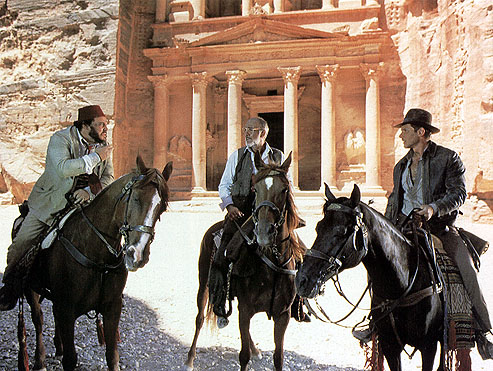
Lines that it's now almost obligatory to quote in any book or documentary about the remains of the eponymous Nabataean city, famous as a UNESCO World Heritage Site, but probably famouser as a film location in Raiders of the Lost Ark.

There are a couple of interesting things about 'a rose red city half as old as time.' First, Burgon's best phrase, and the one thing for which he's now remembered, seems to be mostly a quotation from another poet, Samuel Rogers, who used the 'half as old as time' trope in his poem A Farewell, when he wrote about 'many a temple half as old as Time.' As a meditation on the transience of things, Rogers' poem anticipates Edward FitzGerald's famous translation of The Rubáiyát of Omar Khayyám, with passages like this:
...Many an eye
Bright as the brightest now, is closed in night,
And many a voice how eloquent, is mute,
although some of Rogers' other lines simply make it clear why we've forgotten him and remembered FitzGerald:
And now a parting word is due from him
Who, in the classic fields of Italy,
(If haply thou hast borne with him so long,)
Through many a grove by many a fount has led thee...
Haply, I can't bear with this sort of stuff for very long.

The other interesting thing is that Burgon probably meant the ringing phrase 'half as old as time', which sounds like poetic license, quite literally. As the literary scholar, Hugh Kenner, pointed out:
Though romantic, Burgon was being workmanlike. To his generation the age of Time was quite definite; for since Adam was created in the year 4004 B.C. on October 23, Time in the year Burgon wrote, 1845, was exactly 5849 years old, going back through half of which we locate the founding of Petra at 1080 B.C.
Even in that generation, geologists were having a tough time trying to reconcile the evidence in the rocks with the Biblical account of the creation, but as a devout believer in Biblical inerrancy, Burgon's faith in his Bible-based chronology was probably immune to such challenges.

Today, people who study these things estimate that our Universe (and, presumably, time itself), came into existence some time between 12 and 14 billion years ago.
The Universe is old. According to the most recent measurements, it is 13.7 billion years old. The rise of mankind, on the other hand, is fairly recent, with Homo Erectus, the first "modern human," appearing around a million years ago and Homo Sapiens, today's humans, arriving only in the past 200,000 years. Imagine compressing the time the Universe has existed into the span of a single day with the Big Bang occurring at the stroke of midnight. Humans crash the party late - at 11:59:56pm, just four seconds before the end of the day.
From a cosmic perspective, Petra has existed for the blink of an eye, rather than being 'half as old as time.' The earth itself, which has been around for an an estimated four and a half billion years, is less than half as old as time. But the recent discovery of something really ancient reminded me of Burgon's conception of a truly epic timescale:
An international team of scientists, led by astronomers at Queen Mary University of London (QMUL), report of two new planets orbiting Kapteyn’s star, one of the oldest stars found near the Sun ...

What makes this discovery different however, is the peculiar story of the star. Kapteyn's star was born in a dwarf galaxy absorbed and disrupted by the early Milky Way. This galactic disruption event put the star in its fast halo orbit. The likely remnant core of the original dwarf galaxy is Omega Centauri, an enigmatic globular cluster 16,000 light-years from Earth that contains hundreds of thousands of similarly old suns. This sets the most likely age of the planets at 11.5 billion years, which is 2.5 times older than Earth and "only" 2 billion years younger than the universe itself (around 13.7 billion years).
Astronomy magazine

To humans, the four and a half billion year age of our own planet is an unimaginable abyss of time, but these exoplanets were already older than that when our world was still nothing but stardust. I know that astronomers have already seen objects even older than the exoplanets orbiting Kapteyn's Star, but there's something about the idea of a planet that ancient, a real place, in our cosmic back yard,* with a surface you could walk on and touch (if only you could figure out how to travel 13 light years) that sends shivers down my spine. I think 'Petra' would be an awesome** name for the planet currently known as Kapetyn b, if only 'more than 80% as old as time' didn't sound paradoxically less impressive than 'half as old as time.'


*i.e. further away than you can possibly imagine, but that's just peanuts compared to space...

**In the 'makes the hairs stand up on the back of your neck' sense of the word, as opposed to the conversational 'if you could just pass me your plate, that would be awesome' usage.

Tuesday, 13 May 2014

Toxic horsemeat and Trekkies

I've nothing in particular against Liberal Democrat councillors. They didn't sign the coalition agreement and they may well be lovely people, doing good things in local communities. According to our latest local Lib Dem flyer, our lot have successfully 'fought the Conservative run Council's proposals to scrap grit bins', had a pedestrian crossing built at a sensible place in our road (check - I can see it from where I'm writing) and, following complaints from residents in one of the roads coming off ours, they've had a new "no through road" sign put up. Maybe councillors with different affiliations would have done similar things, but I'm happy to give them the credit for actually having got them done.

And then they go and spoil it all by saying something stupid like 'I love you':
It's a 2 horse race on 22nd May. The local election on 22nd May is between the local Lib Dem Focus Team candidates and the Conservatives. Labour has come third in this area for many years. A vote for any candidate other than the Lib Dems could let the Conservatives in.

This may be true in terms of the local electoral arithmetic and tactical voting, but if you actually wanted to toxify your own brand in one short message, then that message would be 'why not vote Lib Dem to keep the Tories out?' [long pause to let the bitter laughter subside]:
Apologies for including another party political broadcast, especially a negative attack ad, but this one does hit the nail on the head (even if it doesn't seem to be doing Labour much good - maybe they should have saved it up for the general election).

It must be terribly depressing to be a progressive Lib Dem at the moment, whether you're looking down at the grit bins, or up at the stars:
In order to be certain, we then ran an analysis of the 100 TV programmes that are most particularly favoured by supporters of each of the three main parties. Sure enough, while only 2 of Conservative voters’ and 6 of Labour voters’ top 100 TV shows are related to science, science fiction or the supernatural, it is 17 of the Lib Dem top 100. The full results will be published next week, but in case you’re wondering the list includes Doctor Who, Red Dwarf, Futurama, Being Human, Buffy the Vampire Slayer and Tomorrow’s World.

Is this evidence of the Liberal Democrat ability to think big, and imagine a better world in the future? Is it true that “Science Fiction is a crutch for people who can’t handle reality”? Or is it the other way round...
Freddie Sayers of YouGov

My take on this is that a preference for science, SF and fantasy is evidence of an enquiring mind and a welcome ability to imagine alternatives to the tyranny of the zeitgeist (even if a lot of science fiction and fantasy is really about current issues, rather than distant planets and dragons, it's still an analysis or critique of the present, rather than mere dumb acceptance of the status quo). Of course, not all Sci Fi and fantasy has a progressive agenda, but Freddie Sayers has evidence that Lib Dems like the stuff that does:
It all started in May last year, when we ran a survey on Star Wars and Star Trek. Asked which series they prefer, the country as a whole narrowly prefers Star Wars (29% to 27%). But Liberal Democrat supporters buck the trend, with 36% preferring Star Trek and 20% preferring Star Wars.
As commentator Martin points out:
That Star Wars and Star Trek poll is interesting. Star Trek is basically a manifesto of progressivism. It is an idealistic world of diversity, open borders and no religion where money and capitalism are bad while government and science is good. I would have thought the conservatives would absolutely adore Star Wars, which is basically a gang of old school heroes (Han Solo the cowboy, Leia the Princess, and our hero, the quite Jesus-like Luke) going up against big government with nothing but spiritual faith and a great sense of missing the good old days of the Old Republic. It seems to me like Star Trek is explores the same world John Lennon dreamed about in 'Imagine', while there is really no wonder Reagan embraced Star Wars imagery and mythology in combatting the evil Soviet Empire.
But yeah, this basically is no surprise when you consider that much of sci-fi fits in with the Lib Dem attitude and psyche.
It must be an enormous bummer to be a progressive in a party with leaders who have abandoned the dream of boldly going where no one has gone before by joining the Dark Side and propping up a party for people who'd rather live a long time ago in a galaxy far, far away.

 ________________________

Update - if you didn't like the two party political broadcasts I've embedded, I suggest you feast your eyes and ears on the Worst Party Political Broadcast Ever. It's by the English Democrats, (a sort of cut-price, Celt-free version of UKIP) and looks like something slapped together by the English Tourist Board on an off day, intercut with shots of a bloke in a field holding up cards with various xenophobic slogans and statues of  the great and good from the Michael Gove list of approved English heroes, all set to an acoustic dirge, apparently performed by Billy Bragg's evil right-wing twin that goes:
Build a pride,
Hear the call,
From Land's End to Hadrian's Wall,
This is England,
The land of Saint George 
Hat tip to Tom Pride, who embeds the whole atrocity here.

Update 2 -Interestingly, the local Conservatives have just delivered their leaflet, in which they also claim credit for the local grit bin/pedestrian crossing triumph. I might be tempted to try and find out which of the twio parties is lying to me,* if there was a snowball in hell's chance of me voting for either of the above. Which there isn't.

*Of course, there's a third possibility, namely that both parties had a hand in delivering these things, in which case, they're both telling half-truths (or half-lies, if you're a glass half empty person), by claiming all the credit. If this is the true scenario, then the Lib Dems come out as slightly bigger liars than the Conservatives, by virtue of not only claiming all the credit for the grit bins, but claiming that the nasty Conservatives would have taken them away. But I'm way too swiched off by both parties to care which one is telling the biggest fibs in this case.

Tuesday, 18 March 2014

The uneven march of progress


Bob Seidensticker is annoyed with theists who give unhelpfully convoluted philosophical answers to empirical questions and concludes that nonscientific philosophy doesn't get anybody very far:
Alvin Plantinga argued that philosophy is relevant at the frontier of science when he said that philosophy is just thinking hard about something. By that definition, Werner Heisenberg (a physicist) was doing philosophy when he came up with his uncertainty principle, Kurt Gödel (a mathematician) was doing philosophy when he discovered his incompleteness theorems, and Alan Turing (a computer scientist) was doing philosophy when he developed the Turing Test. Maybe string theory or ideas on the multiverse are philosophy.

A broad definition of philosophy doesn’t bother me, but note that all these “philosophers” were first scientists or mathematicians. That’s why they were able to make their contributions. While a scientist can put on a philosopher’s hat and do great work, the reverse is not true...

...Lots of sites have Top Ten lists of scientific discoveries for 2013 ... We found new clues that Mars was once habitable, the Voyager 1 spacecraft left the solar system, DNA was sequenced from [a] 700,000 year old animal and 100,000 year old human remains, a meteor exploded over Russia, new gene therapies were found, life was found in a pristine Antarctic lake, and Jupiter’s Ganymede was mapped.

I couldn’t find a list of the Top Ten philosophical breakthroughs for 2013.
Cross Examined

This is a narrow point about scientifically unqualified 'philosophers putting on an imaginary lab coat and playing scientist like a child plays house.' Specifically, he objects to religious apologists muddying scientific enquiries about, say, the origin of the universe, with 'Complicated philosophical arguments' that 'simply try to paper over the glaring fact that evidence for God is negligible and that we have no justification for belief', (he calls these 'caltrop arguments').

But his criticism also opens up a far wider question. Is science the only field in which humans are making anything that we could sensibly call progress? In a very narrow sense, the answer could be 'no' - if you were to define technology as a separate discipline from science, you could also point to clear evidence of technological progress. But if by "science", you mean all the empirical disciplines of science, mathematics and technology, then there seems to be a case to be answered.

The positive side of  Seidensticker's case seems unarguable. Look at two examples of how far science and technology have come in one generation. In 1990, no astronomer in human history had ever observed a planet orbiting another star. In 1992 the first extrasolar planet (orbiting  a pulsar) was discovered. In 1995 the first planet orbiting an ordinary star (other than the sun) was discovered. Today, astronomers know of more than a thousand confirmed exoplanets, with many candidate observations awaiting confirmation and new observations taking place all the time.

Back to early '90s technology on planet earth - 'By Christmas 1990, Berners-Lee had built all the tools necessary for a working Web: the HyperText Transfer Protocol (HTTP) 0.9, the HyperText Markup Language (HTML), the first Web browser (named WorldWideWeb, which was also a Web editor), the first HTTP server software (later known as CERN httpd), the first web server (http://info.cern.ch), and the first Web pages that described the project itself.' It's obvious, even to a total non-expert, that there has been rather a lot of progress on the WWW front since then.

The apparent lack of noticeable progress in fields outside science and technology also seems to support the negative side of Seidensticker's thesis.

Starting with philosophy, never mind 'the the Top Ten philosophical breakthroughs for 2013', how many lay people could name a single philosophical breakthrough that's happened since the creation of the very first Web server, circa 1990? For that matter, how many philosophical breakthroughs of the last century could your averagely well informed non-expert name?

Science and technology can boast many well-known successes: Watson and Crick announcing the structure of DNA, the start of TV broadcasting, the discovery of penicillin and the introduction of antibiotics, the jet engine, insulin, nylon, the discovery of how our universe came into being, the Hubble space telescope, the Large Hadron Collider, the moon landings, the birth of the electronic computer and many more. People understand terms like "splitting the atom" and "rocket science" as metaphors for tasks that require intelligence, hard thinking and expertise. I'm not claiming that acceptance into the general lexicon necessarily validates a breakthrough (we still use 'mesmerise' and a lot of jargon from Freudian analysis in general speech, although Anton Mesmer was more of a charismatic stage magician than a scientist and Freud's theories were unscientific and, generally, plain wrong). But it's still an impressive list.

What have you got, philosophy? Not a lot. Two explanations come to mind:
  1. Philosphers' minds are so highly trained that the average person in the street is too stupid to understand the brain-bogglingly clever breakthroughs they've made.
  2. They just haven't made many/any.
I tend towards explanation 2. on the grounds that the general public are aware of some of the most intellectually difficult problems that the human mind has ever wrestled with. People like David Attenborough and Brian Cox pop up regularly on prime-time telly, explaining really hard stuff like evolution and the origin of the whole damn universe. If philosophy had such an exciting story of discovery to tell, where's the philosophical equivalent of Brian Cox, getting all enthusiastic, awe-struck and wistful about the amazing things philosophers have discovered in the the last few years in that new blockbuster series, Wonders of Philosophy? Alain de Botton, lovely man though he is, doesn't quite cut it in the astonishing discoveries stakes.

And how about progress in the arts? The arts certainly have a higher public profile than philosophy - who hasn't heard of Picasso, Andy Worhol, George Gershwin, Georgia O'Keeffe, The Beatles, Lady Gaga, Orson Welles, J K Rowling, John Steinbeck, Harper Lee or Brian Eno? But how far has art itself "progressed"? Here's the blurb for an exhibition of Ice Age art:
Discover masterpieces from the last Ice Age drawn from across Europe in this groundbreaking show. Created by artists with modern minds like our own, this is a unique opportunity to see the world's oldest known sculptures, drawings and portraits.

These exceptional pieces will be presented alongside modern works by Henry Moore, Mondrian and Matisse, illustrating the fundamental human desire to communicate and make art as a way of understanding ourselves and our place in the world.

Ice Age art was created between 40,000 and 10,000 years ago and many of the pieces are made of mammoth ivory and reindeer antler. They show skilful, practised artists experimenting with perspectives, scale, volumes, light and movement, as well as seeking knowledge through imagination, abstraction and illusion.

One of the most beautiful pieces in the exhibition is a 23,000-year-old sculpture of an abstract figure from Lespugue, France. Picasso was fascinated with this figure and it influenced his 1930s sculptural works.

Although an astonishing amount of time divides us from these Ice Age artists, such evocative pieces show that creativity and expression have remained remarkably similar across thousands of years.
Ice Age art: arrival of the modern mind, The British Museum, 2013.

There are great artists now and there were great artists in prehistory. It's by no means clear that the work of modern visual artists is 'better' in any meaningful way than that of their paleolithic ancestors. You might argue that humans have developed many different techniques and forms of art in the intervening millennia, both in the visual arts and in other domains of artistic expression. But stop to think about what has changed. While 'creativity and expression have remained remarkably similar across thousands of years', science and technology haven't, and advances in these empirical disciplines often seem to have been the drivers of artistic progress. For example:
  • abstract geometrical decoration in Islamic art - although originally inspired by a perceived religious prohibition of idolatry, these new forms were enabled by mathematical knowledge
  • the move towards abstraction and conceptualism in Twentieth Century Western art, driven at least in part by the widespread availability of the camera, which usurped the unique ability of the representative artist to create a convincing facsimile of nature
  • and while we're on the subject of photography, it's an art form that wouldn't exist without the technology coming first
  • ditto cinematography and video games (if you think the latter comes under the ambit of "art" - if not, why not?)
  • humans have had music and musicians since the stone age - what they lacked back then wasn't artistry, but the people who later invented fiddles, guitars, harpsichords, pianos, pipe organs, trombones, sitars, saxophones, synthesisers and musical notation
  • and talking of notation, information technology started with accounting symbols pressed into wet clay, which eventually developed into written language, the medium that transformed the oral storytelling tradition into the various forms of the thing we now call literature
And so on. In short, perhaps the "progress" part of "artistic progress" is down to science and technology, rather than to humans' native artistic drives and talents, which may have existed, virtually unchanged, since the stone age.

So, maybe "science", in its broadest sense is demonstrably progressing, while philosophy and the arts aren't. Is the human race making measurable progress in any field other than the empirical disciplines? I can think of one field where there seems to have been a measurable degree of progress - politics and society:
People sometimes do not realize how total has been the normative triumph of some of the ideas typically associated with democracy, even if one thinks that democracy itself has not succeeded quite as spectacularly. Take, for instance, the norm that rulers of states should be selected through some process that involves voting by all adults in society (I’m being deliberately vague here) rather than, say, inheriting their position by succeeding their fathers. In 1788 there were only a couple of countries in the world that could even claim to publicly recognize something remotely like this norm. Most people could not vote, and voting was not generally recognized as something that needed to happen before rulers could rule; rulers could and did claim to have authority to rule on other grounds. Norms of hereditary selection structured the symbolic universe in which political competition took place, and defined its ultimate boundaries for most people (at least those who lived in state spaces). Yet by 2008 there were only four or five countries in the world that did not publicly acknowledge universal voting rights. 
Even acknowledging the existence of other, less encouraging, developments, that's pretty impressive. We can actually pick out a few identifiable markers of progress (assuming that what "progressives" think of as progress is progress): the ending of apartheid in south Africa and of racial segregation in the southern sates of the USA, the reversal of a lot of anti-gay legal discrimination across most of the developed world a continuation in the general decline in levels of violence identified by Steven Pinker (OK, this one is contested, but as one critic put it, Pinker's vocal critics, like John Gray have provided 'reasons to doubt Pinker’s explanation of the decline of violence is correct, however he has not provided reasons to doubt that violence is declining'),

And this progress seems to have some public recognition - people who couldn't name a contemporary philosopher would recognise the names of Nelson Mandela, Emmeline Pankhurst, Martin Luther King, Rosa Parks, or Peter Tatchell.

Is this another separate domain of human progress, or is it also driven, in a more subtle way, by the relentless march of science and technology?

I'm not sure that there's always a direct link between scientific progress and social progress, but people have proposed all such links. For example, the idea that slave societies don't develop technology because they've already got slaves to do the work. I've heard it argued that the ancient Greeks, who invented the steam engine and astronomical computer could have had their own industrial revolution if only they hadn't been so addicted to enslaving people. A steampunk late classical world would make a good backdrop to an alt-history SF novel (I'm certain it already has, although I've not read one), but this thesis rather glosses over the coercive aspects of the actual Industrial Revolution, (the use of enclosure and eviction to destroy the self-sufficiency of the lower orders to create a class of biddable proletarian wage-slaves, dependent on selling their labour).

You could, more plausibly point to the defeat of the inefficient slave states of the American South by the industrialised North in the Civil War.

But then again, Nazi Germany wasn't known for its tolerance or liberalism, yet it had an atomic weapons programme, pioneered radar, jet engines and rocket propulsion - indeed the man responsible for designing slave-labour-built vengeance weapons for Hitler went on to head the team that put humans on the moon, while his Soviet rival in the space race, Sergei Korolev, was no product of a tolerant, enlightened society, but a former inmate of Stalin's gulags, only reprieved because his talents were needed for the war effort.

There's even the Orson Welles' "cuckoo clock" argument that, far from going hand in hand with technical progress, political progress - peace, justice, equity and so on - actually retards it:
You know what the fellow said – in Italy, for thirty years under the Borgias, they had warfare, terror, murder and bloodshed, but they produced Michelangelo, Leonardo da Vinci and the Renaissance. In Switzerland, they had brotherly love, they had five hundred years of democracy and peace – and what did that produce? The cuckoo clock.
The Third Man

Does social and political progress exist as a thing apart from scientific and technical progress? Ultimately it's hard to measure things like justice and an equitable distribution of power, so I wouldn't say this is a sure thing. But I like to think so.