Showing posts with label ARCHITECTURE. Show all posts
Tuesday, 7 August 2018
Friday, 27 April 2018
A simple (part of) the solution
The UK population is growing by more than 500,000 people every year but only about half the homes required are built. I believe there is one key reason behind the UK housing problem: a lack of apartment living. But it’s possible to change this. I’m originally from Greece and one thing that has struck me about the UK is that British people dream of living in houses.At first sight, this seems like a good idea. My only quibble is with the title of the piece, "The simple solution to UK’s housing problem – apartments." Simple? Really? I very much doubt whether there's just one simple solution to such a complex problem. To be fair, the article does talk about wider issues, like the need for rent controls and stronger tenants' rights as a prerequisite for turning flats in the private rented sector into proper homes.
As the chart below shows, just 14% of British people live in apartments. This is one of the lowest percentages in Europe. In Germany the figure is 57%, in Spain it is 66%, and the Euro area average is 48%.
But building more apartments does seem like a sensible part of the solution. As the article acknowledges, a shift in mindset is needed, so that flats aren't just seen as the sort of cramped, shoddy places where you'd only live if you had no alternative, so we're talking about building properly designed quality homes. Having lived in a flat in the past, these would be my top three suggestions for turning flats from those unloved boxes from which most Brits aspire to escape, into proper homes:
- Abolish leasehold for residential properties. Even this government seems to be inching towards doing something about landowners jacking up and creaming off ground rents, but the whole leasehold system is a worse than socially useless subsidy for the rentier class, and it needs to go.
- Decent soundproofing is a necessity, not a luxury, for people living in high-density accommodation.
- Put balconies on flats (or patios, if ground floor). I'm no gardener, but one unanticipated thing I grew to love about moving from a flat to a house was the patio. Just having a little bit of outside space of your own really does a lot to make your home feel less claustrophobic. Of course, in a block of flats, this is the one area where decent soundproofing won't help if your neighbours are making an unholy din on their balconies but inconsiderate people is a whole other problem to which there's definitely no "one simple solution."
Labels:
ARCHITECTURE,
GOOD IDEAS,
OPINIONATED,
SOCIETY
Monday, 14 October 2013
A ghastly sight
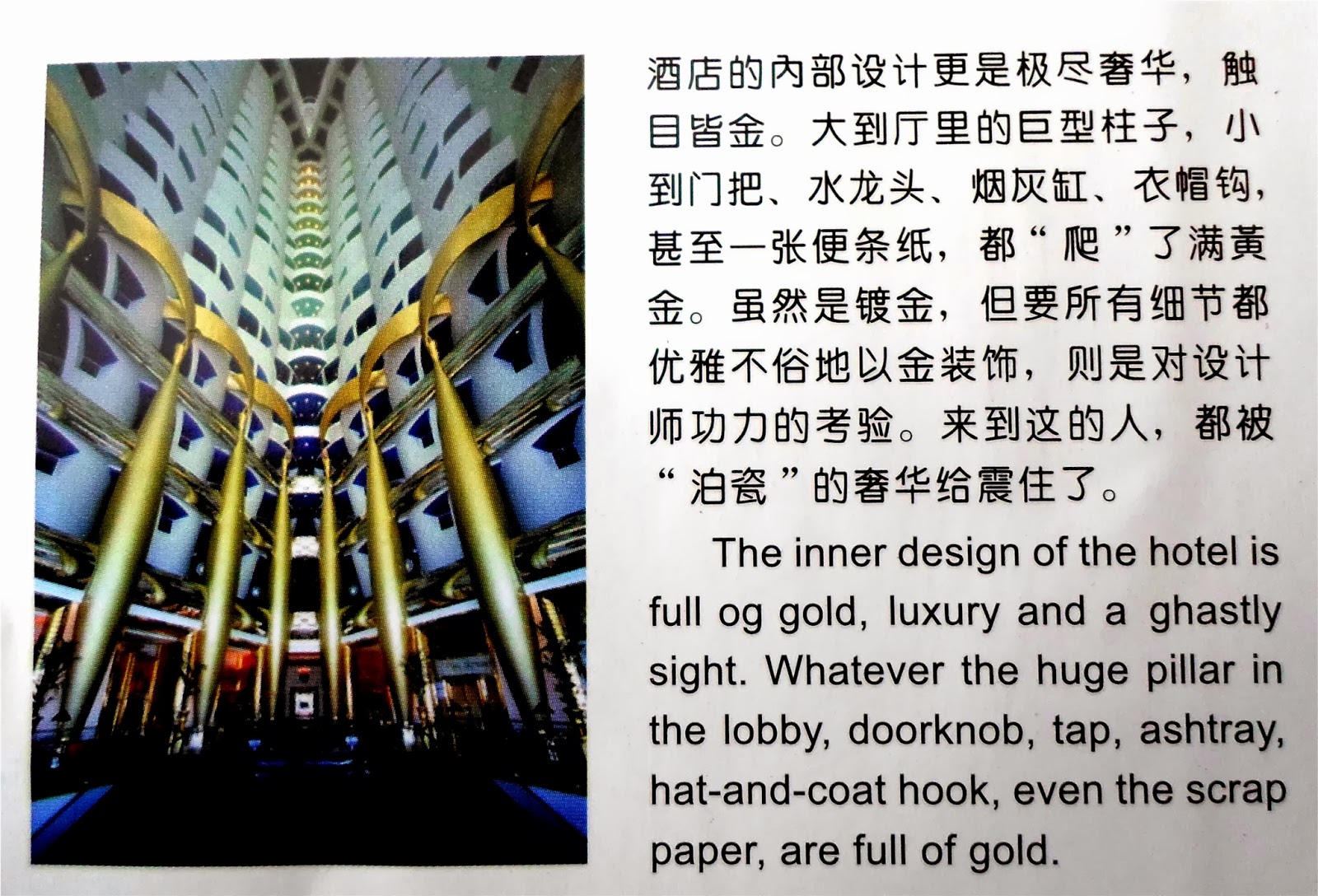
Some notes on the interior decor of Dubai's (in)famous Burj al-Arab monster hotel, according to the blurb that came with a 3-D card model of the world's fourth tallest hotel.
Looks like they got Sam Wollaston to proofread their translation:
Update 'world's tallest hotel' corrected to 'world's fourth tallest hotel.' It still seems to hold the record for the world's tackiest hotel, though.
Looks like they got Sam Wollaston to proofread their translation:
The Burj al-Arab is extraordinary, with its exterior steel skeleton and its helipad like a waterlily in the sky. Inside it's all gold leaf, crimson velvet, mosaics, marble, crystal chandeliers and giant fish tanks. A suite costs up to £14,500 a night.
It's fabulous, hideous, and the very pinnacle of tackiness - like Vegas after a serious, no-expense-spared, sheik-over.
_____________________
Update 'world's tallest hotel' corrected to 'world's fourth tallest hotel.' It still seems to hold the record for the world's tackiest hotel, though.
Labels:
ARCHITECTURE,
strange things
Wednesday, 4 September 2013
Megalomania watch
A few days ago I had a bit of a go at the City of London's brutalist monuments to elite power, looming over the puny lives of the ant-like common people. I hadn't anticipated that, within days, we'd have a far more potent symbol of the relationship between the City and the rest of us, now that the top-heavy monolith at 20 Fenchurch Street has gone rogue, like some Bond villain's doomsday device, its curved, mirrored glass focussing the sun's blazing rays on the surrounding streets, destroying everything in its path.
Can we just agree now that these things are pure evil,* or do we have to wait until the executive suite is fitted out with a piranha-filled moat where some Persian cat-stroking CEO can dispose of insuffiently-ruthless henchmen?
*Since the incineration of the local neighbourhood was (presumably) unplanned, you could argue that it's something closer to banal, blundering indifference than evil. Still, once you've been sat on by a 250 pound gorilla, the gorilla's exact intentions are rather less important than the fact that somebody let the damn thing out of its cage.
Labels:
ARCHITECTURE,
ECONOMY,
SOCIETY,
strange things
Tuesday, 5 March 2013
Fantastic monster
The blessed Saint Bernard of Clairvaux would probably have disapproved of the scary cyclops head that I spotted on holiday a couple of weeks ago:
Saintly Bernard might have been mollified to learn that this particular monstrous apparition neither adorns a pagan shrine, nor defiles a house of God, but serves as a hand-hold on a children's climbing wall in a playground just off the B5115, between Llandudno and Colwyn Bay. Here, thanks to the magic of my crappy phone camera, is the whole thing in context and in living colour:
St. Bernard would also have been unlikely to approve of the Darth Vader head currently adorning Washington's National Cathedral.
We do, however, know about the sort of things St. Bernard did approve of. Denouncing dissidents to the authorities, for example. Bernard had 'one of the first philosophical minds of the whole Middle Ages', Peter Abelard, brought before the pope and cardinals of the Curia on a trumped-up charge of heresy. We also know that Bernard was a hate-preacher, promoting violent jihad against the infidel and endorsing a fanatical band of armed militants. If Bernard was looking for fantastic monsters, he could have simply looked in the mirror.
In recognition of his immense piety, St Bernard of Clairvaux is the patron saint of Cistercians, Burgundy, beekeepers, candle makers, Gibraltar, Queens' College, Cambridge, Speyer Cathedral and the Knights Templar.
Wubba wubba wubba wubba woo woo woo.
We do, however, know about the sort of things St. Bernard did approve of. Denouncing dissidents to the authorities, for example. Bernard had 'one of the first philosophical minds of the whole Middle Ages', Peter Abelard, brought before the pope and cardinals of the Curia on a trumped-up charge of heresy. We also know that Bernard was a hate-preacher, promoting violent jihad against the infidel and endorsing a fanatical band of armed militants. If Bernard was looking for fantastic monsters, he could have simply looked in the mirror.
In recognition of his immense piety, St Bernard of Clairvaux is the patron saint of Cistercians, Burgundy, beekeepers, candle makers, Gibraltar, Queens' College, Cambridge, Speyer Cathedral and the Knights Templar.
Wubba wubba wubba wubba woo woo woo.
Labels:
ARCHITECTURE,
ART,
HISTORY,
RELIGION,
strange things
Thursday, 17 November 2011
Mock the weak
A lot of people make fun of Milton Keynes, which is fine by me. I think it's a better place to live than most outsiders imagine, although the reality falls short of the Milton Keynes Development Corporation's original vision of a beautifully planned, orderly, harmonious place to live with no building higher than the highest tree. If people want to make fun of concrete cows and the grid roads and all the roundabouts (which really do keep traffic congestion to a minimum), I don't have a problem with that.
In fact, I rather welcome the fact that people treat the place as a bit of a joke, because it means there's less of the thin-skinned, self-important local pride that makes other places look even sillier. I lived in Leighton Buzzard for a short while, at the time when Jeremy Clarkson made a throwaway remark about in a car review about Leighton Buzzard being 'the fifth-best town in Bedfordshire'. The Pages of the Leighton Buzzard Observer carried a furious rebuttal from the affronted council leader (or some such local dignitary), raging and spluttering as if somebody might have actually noticed this remark, or could have cared less.
I'm no Clarkson fan, but this was practically the least offensive thing he's ever said. A comment from Clarkson shouldn't have even been local-newsworthy unless he'd at least called the local council lazy, feckless and flatulent and preferably accused them of murdering prostitutes in between meetings of the planning committee.
What does rile me is comfortably-off people sneering at everybody who lives on the city's poorer estates. Take this nasty little "satirical" e-mail from earlier this year, as reproduced in the Anna Raccoon blog
An Earthquake measuring 5.2 on the Richter scale hit the new city of Milton Keynes on Wednesday morning.
Casualties were seen wandering aimlessly saying “bang out of order”, “mental” and “sorted”. Some are still confused that something interesting actually happened in Newport Pagnell! Some residents of Fishermead were woken before their ‘giros’ arrived and it caused quite a panic!
The earthquake decimated half of the Fullers Slade area causing in excess of £17.55 worth of damage. Several priceless collections of mementos from Ibiza, Corfu, Rhyl and Blackpool were damaged beyond repair including a cute little donkey that ‘broke wind’ when you clapped your hands.
At a time when unemployment is soaring, the numbers of the working poor are at a record high and desperate people are killing themselves after being thrown on the employment scrapheap, isn't it good to know that there are people out there unafraid of mocking the poorest and weakest members of society? I guess, as it becomes less acceptable to taunt people for their race or sexuality, the sort of inadequates who always need somebody to look down have to find a new target to kick, (preferably somebody too weak to kick back). "Chav" is in danger of becoming the new "queer".
What I love is the irony of the thrusting, aspirational suburban golf club set sniggering at the poor for their lack of taste. It's a bit rich, coming from the class that's spent years disfiguring the countryside with a rash of unsightly mock Tudor "executive" homes. These Petit Trianon playhouses for the petit bourgeois are just the architectural equivalent of a flatulent ornamental donkey for people with more money than sense.
The poor, of course, don't get much of a say about what their accommodation looks like. In Milton Keynes this led to some very strange results on the older estates, where 1970's architects were given free rein to design radical, modernist machines for living to house the "overspill" from Greater London. Some of the designs were pretty stark and brutal. The linear, angular, gleaming, metal-clad lines of the '70s buildings in Netherfield, for example, certainly have what Kevin McCloud would call 'integrity', but it's the hard, uncompromising integrity of a housing project designed by daleks.
I hardly need to add that, being low-cost pre-fabricated social housing, they haven't worn tremendously well. The years and individual redecoration can't disguise the uncompromising geometry, but they have destroyed the pristine, chilly unity of the facades, which look patchier and shabbier by the year A lot of MK's original buildings were only supposed to be temporary, built to house the people who came to build the city, then to be torn down to make way for something better. Forty years later, we're still waiting.
I was in Netherfield the other day, when I spotted something rather extraordinary. I'm a bit conflicted about sharing it as, after all I've said about mocking the poor, it might seem like more middle-class piss-taking, but this is such an astonishing collision between the aesthetic of the suburban executive home and the stark functionalism of '70's prefabricated social housing, that you really have to see it to believe it. Sorry about the quality of the following picture, taken with a low-quality mobile phone camera with a scratchy lens - at least it saved me the job of pixellating out the car number plates:
No matter whether the person responsible was rich or poor, (for all I know it might have been the landlord) this is just so wrong it's off the scale. Somebody actually took something from the Decade That Taste Forgot, hybridised it with its opposite and came up with something this unspeakably what-the-hell-were-you thinking?. It's so wrong it's almost right. 'As beautiful as the chance encounter of a sewing machine and an umbrella on a dissecting table' as somebody once remarked. If you want to marvel in higher quality, somebody's posted a far better picture of the building in question here, or you could just put Farthing Grove, Milton Keynes into Google Maps and find it for yourself on Street View.
Milton Keynes - you've just gotta love the weirdness.
Update (Occupy Milton Keynes)
Having posted this, I think I belatedly get it. Seen from the point of view of a resident, maybe this isn't so mental after all. You've got the powers that be pouring people, like so much fungible human overspill, into their anonymous, generic boxes, then one day one of the residents decides to stop being the passive recipient of somebody else's aesthetic and stick two big fingers up at the people who designed these anonymous hutches. What you see before you is an act of defiance and individuality, a sane protest against an absurd world.
It still looks bloody ugly, though.
Update 2 "Civic" amended to "local", as I ended up talking about Leighton Buzzard, which isn't a city by any stretch of the imagination.
Labels:
ARCHITECTURE,
BAD IDEAS,
LOCAL,
MILTON KEYNES,
photograhs,
places,
SOCIETY
Tuesday, 26 July 2011
Rachel Whiteread for social insects
Here's an interesting vid, in which some boffins explore negative space by pouring ten tons of concrete into a huge ants' nest, with impressive results:
Labels:
ARCHITECTURE,
NATURE,
strange things
Monday, 10 May 2010
Sunday, 28 March 2010
Unreal gates and hen's feet

"The Great Gate of Kiev" is the best-known piece from Mussorgsky's famous piano suite "Pictures from an Exhibition". I'd always assumed that the piece's title referred to to a painting of a real landmark in Kiev, but I recently discovered, after listening to a radio programme on the subject, that the gate existed only as an architectural design by the architect and painter Viktor Hartmann (see above).
Other things I didn't know were that the full title of the suite is " Pictures from an Exhibition – A Remembrance of Viktor Hartmann" and that the full title of the movement about the gate at Kiev is "The Bogatyr Gates (in the Capital in Kiev)". The titles of the individual pieces allude to works by Hartmann, a friend of Mussorgsky, who died at the early age of 39. "Pictures from an Exhibition" was written soon after Hartmann's death as Mussorgsky's tribute to his late friend. Some of Hartmann's drawings and watercolours have been lost, but his design for the Bogatyr Gates is one of the surviving pictures.
The Bogatyr Gates were themselves intended to be a memorial. In 1866, the revolutionary Dmitry Karakozov tried to assasinate Tsar Alexander II. After the attempt failed, Viktor Hartmann sketched a design for a monumental gate to commemorate Alexander having survived the attempted assassination. I can't say I'm a huge fan of Hartmann's design - it's a strange compound of self-conscious gingerbread cottage ornateness and Imperial grandeur. It's the sort of royal kitsch that puts me in mind of the Prince Regent's plaything, the Royal Pavillion at Brighton.
Unlike the Royal Pavilion, The Bogatyr Gates, never got beyond a sketch on paper. It's always a possibility that some post-soviet oligarch might decide to spend a few million on making Hartmann's design a reality, but I rather hope not. In any case, the gates were a rather premature monument as, after three more failed assassination attempts, Tsar Alexander II was finally dispatched by a group of bomb-throwing revolutionaries in 1881.Perhaps the next most famous of Mussorgsky's musical "pictures" is "Baba-Yagá (The Hut on Hen's Legs)". Baba-Yagá is a witch-like character from Russian folklore, who flies around on a broomstick or mortar, kidnapping children and living in a hut on hen's legs. The Hartmann painting that inspired this piece is of a clock made in the style of Baba-Yagá's hut - imagine a cuckoo clock resting on chicken's feet and you get the picture. The surprising thing about The Hut on Hen's Legs is that unlike The Bogatyr Gates, which never existed as more than a sketch, the fowl-footed hut is probably based on a real structure. According to Wikipedia, the fairytale description of Baba-Yagá's hut:
may be an interpretation [citation needed] of an ordinary construction popular among hunter-nomadic peoples of Siberia of Uralic (Finno-Ugric) and Tungusic families, invented to preserve supplies against animals during long periods of absence. A doorless and windowless log cabin is built upon supports made from the stumps of two or three closely grown trees cut at the height of eight to ten feet. The stumps, with their spreading roots, would give an impression of "chicken legs".
To give you an idea of how a hut built on tree trunks could look like a hut on hen's legs, check out this extraordinary picture of a Sami storehouse in Sweden. It really does look like something straight out a fairytale or any fantasy novel from "The Hobbit" onwards:

Photo by M Prinke on Flikr.
Labels:
ARCHITECTURE,
ART,
HISTORY,
MUSIC,
STORIES,
strange things
Thursday, 25 March 2010
Frozen music
Architecture is music in space, as it were a frozen music.
(Friedrich Wilhelm Joseph von Schelling)
Labels:
ARCHITECTURE,
DESIGN,
MATHEMATICS,
MUSIC
Wednesday, 10 March 2010
Bricks
In my last post I asked "What have the Normans ever done for us?" I didn't say much about architecture, because I was most interested on the impact on ordinary people when one set of rulers was replaced by another. The Norman have certainly left us more impressive buildings than the Anglo-Saxons, but the buildings that impress us are of two types - castles and places of worship. There was a revolution in the size and ambition of buildings intended to enforce and cement the authority of a more centralized state and the semi-autonomous church that stood alongside the state, providing literate administrators.
The places where ordinary folk lived didn't, I think, change much with the conquest. What I've read suggests that peasants, farmers and most other people lived in timber-framed houses with wattle and daub walls and an earth floor, pre and post-1066. Further up the social scale, there may have been some improvements - an Anglo-Saxon lord's great hall was a scaled-up version of the wattle-and-daub house, whereas some of the manors where the Norman nobs and their retinue lived were made of stone or flint.
There's one architectural advance the Normans seem to have brought along which eventually changed more lives, although it took a few centuries to make a real impact. Several years ago, I went on a guided walk around St. Albans. There were a few interesting little snippets of local history, but one piece of information stuck in my head because it seemed so surprising at the time. About a decade after the Norman Conquest, work started on The Cathedral and Abbey Church of St Alban. The tour guide told us that much of the building material for the Abbey Church (now Cathedral) at St Albans was recycled from the ruins of the old Roman town of Verulamium, just down the hill. Those building materials included bricks, which, the tour guide said, the English no longer knew how to make. The Romans had made and used bricks, but throughout the Dark Ages, apparently, brick making was a lost art in England (and, presumably, the rest of the British Isles).
Never mind losing heated baths, straight, paved roads, sewage disposal, public libraries, firemen, police and the rest - during the Dark Ages, we even lost the ability to make the humble brick. For over six and a half centuries. It's an almost shocking indication of how far the level of civilization in these islands fell after the Romans went. The Romans may have been militaristic, authoritarian oppressors, but they also brought practical technological and cultural advances from all overs their vast, cosmopolitan empire. The Romans may not have originated many important inventions themselves, but who cares where a good idea comes from, so long as a lot of people benefit from it?
Elsewhere in Europe, the brick maker's art survived. Bricks were still being manufactured in Italy and the information I've been able to uncover suggests that the Normans, and their allies in the religious orders, were instrumental in introducing brick making back into England. Although the Normans preferred to use materials like white Caen limestone for their grand fortifications and ecclesiastical buildings, they would also use whatever came to hand, whether old Roman bricks in St Albans Abbey or flint cobbles in Canterbury Cathedral.
Traditionally, the story of the English brick renaissance seems to start at Coggeshall in Essex. In 1140, Savigniac monks founded Coggeshall Abbey. By 1147, the Saviginiac Order, in the grip of terminal financial and administrative difficulties, was merged with the Cistercians. Now the Cistercians were a clever and enterprising bunch, responsible for the development and diffusion of a wide range of technical skills and they were particuarly good at architecture, project management and the various building trades. In particular, they have been credited with introducing bricks to England. Brickwork at Coggeshall Abbey, dated at between 1190-1220 was generally considered the earliest post-Roman brickwork in England.
It's a story which seems to hang together neatly, although in 1996 British Archaeology reported that even earlier brickwork had been identified at the nearby church of Bradwell-juxta-Coggeshall, the bricks having apparently been made by local builders, rather than the Cistercians. It's an interesting discovery, although I still suspect that the re-introduction of bricks had something to do with the diffusion of technology from the continent, via the Normans and the religious orders they patronised. It seems unlikely than a group of Essex locals suddenly getting the idea to make bricks out of nowhere after the art had been forgotten for nearly seven centuries. Even if it was the Essex builders, not the Cistercian monks who brought back the brick, they started out by making floor and roof tiles, a continental import, so the original impetus for re-discovery probably still came from the Normans, who created the conditions that allowed specialised trades to reappear and and the continental religious orders, busily propagating the diffusion of skills and technologies.
Brick architecture took a long time to develop and spread in this country, but we've probably got the Normans and their allies to thank for the rediscovery. Eventually, bricks would have made a comeback anyway, either through trade, migration or invasion by somebody else, but it was the Normans and the monks who probably put an end to the dark, brickless centuries.
The places where ordinary folk lived didn't, I think, change much with the conquest. What I've read suggests that peasants, farmers and most other people lived in timber-framed houses with wattle and daub walls and an earth floor, pre and post-1066. Further up the social scale, there may have been some improvements - an Anglo-Saxon lord's great hall was a scaled-up version of the wattle-and-daub house, whereas some of the manors where the Norman nobs and their retinue lived were made of stone or flint.
There's one architectural advance the Normans seem to have brought along which eventually changed more lives, although it took a few centuries to make a real impact. Several years ago, I went on a guided walk around St. Albans. There were a few interesting little snippets of local history, but one piece of information stuck in my head because it seemed so surprising at the time. About a decade after the Norman Conquest, work started on The Cathedral and Abbey Church of St Alban. The tour guide told us that much of the building material for the Abbey Church (now Cathedral) at St Albans was recycled from the ruins of the old Roman town of Verulamium, just down the hill. Those building materials included bricks, which, the tour guide said, the English no longer knew how to make. The Romans had made and used bricks, but throughout the Dark Ages, apparently, brick making was a lost art in England (and, presumably, the rest of the British Isles).
Never mind losing heated baths, straight, paved roads, sewage disposal, public libraries, firemen, police and the rest - during the Dark Ages, we even lost the ability to make the humble brick. For over six and a half centuries. It's an almost shocking indication of how far the level of civilization in these islands fell after the Romans went. The Romans may have been militaristic, authoritarian oppressors, but they also brought practical technological and cultural advances from all overs their vast, cosmopolitan empire. The Romans may not have originated many important inventions themselves, but who cares where a good idea comes from, so long as a lot of people benefit from it?
Elsewhere in Europe, the brick maker's art survived. Bricks were still being manufactured in Italy and the information I've been able to uncover suggests that the Normans, and their allies in the religious orders, were instrumental in introducing brick making back into England. Although the Normans preferred to use materials like white Caen limestone for their grand fortifications and ecclesiastical buildings, they would also use whatever came to hand, whether old Roman bricks in St Albans Abbey or flint cobbles in Canterbury Cathedral.
Traditionally, the story of the English brick renaissance seems to start at Coggeshall in Essex. In 1140, Savigniac monks founded Coggeshall Abbey. By 1147, the Saviginiac Order, in the grip of terminal financial and administrative difficulties, was merged with the Cistercians. Now the Cistercians were a clever and enterprising bunch, responsible for the development and diffusion of a wide range of technical skills and they were particuarly good at architecture, project management and the various building trades. In particular, they have been credited with introducing bricks to England. Brickwork at Coggeshall Abbey, dated at between 1190-1220 was generally considered the earliest post-Roman brickwork in England.
It's a story which seems to hang together neatly, although in 1996 British Archaeology reported that even earlier brickwork had been identified at the nearby church of Bradwell-juxta-Coggeshall, the bricks having apparently been made by local builders, rather than the Cistercians. It's an interesting discovery, although I still suspect that the re-introduction of bricks had something to do with the diffusion of technology from the continent, via the Normans and the religious orders they patronised. It seems unlikely than a group of Essex locals suddenly getting the idea to make bricks out of nowhere after the art had been forgotten for nearly seven centuries. Even if it was the Essex builders, not the Cistercian monks who brought back the brick, they started out by making floor and roof tiles, a continental import, so the original impetus for re-discovery probably still came from the Normans, who created the conditions that allowed specialised trades to reappear and and the continental religious orders, busily propagating the diffusion of skills and technologies.
Brick architecture took a long time to develop and spread in this country, but we've probably got the Normans and their allies to thank for the rediscovery. Eventually, bricks would have made a comeback anyway, either through trade, migration or invasion by somebody else, but it was the Normans and the monks who probably put an end to the dark, brickless centuries.
Labels:
ARCHITECTURE,
DISASTERS,
HEROES,
HISTORY,
places,
SOCIETY,
strange things
Monday, 11 January 2010
Relocation rage
I'm a peace-loving, mild-man nerd sort of person, but having just caught a glimpse of the TV property programme Relocation, Relocation, I'm filled with an overwhelming urge to beat the presenters to a bloody pulp with the first heavy implement I can lay my hands on. The programme's frighteningly reminiscent of the recent Daily Mash parody:
I'm trying to think of something that might make TV property shows less infuriating. My suggestion would be to have Grand Designs hosted not by Kevin McCloud, but Sigourney Weaver. Rather than wibbling on about the "integrity" of the latest mansion being shown off, she could take a long look at the monstrous ego-pod being constructed by some loathsome pair of self-obsessed executive leeches and re-use the famous line from Aliens:
"I say we take off and nuke the entire site from orbit. It's the only way to be sure."
I'd actually change channels to watch that.
TV property shows rose by 1.8% last year as the easing of the credit crunch helped bring forward a second series of Dreadful Middle Class Bastards.
Levels of property TV had fallen through 2008 amid the first wave of bankruptcies among awful people convinced they could make a fortune by installing an ensuite shower room in a former crack den.
But now the market for gimlet-eyed couples talking to a spiv about the 'wow factor' of a house they can't afford appears to be rallying...
"We'll be standing back and watching these soulless automatons argue about kitchen units and then sharing in their utterly repellent self-satisfaction when they win the battle with their architect over the stained glass window in the downstairs toilet."

I'm trying to think of something that might make TV property shows less infuriating. My suggestion would be to have Grand Designs hosted not by Kevin McCloud, but Sigourney Weaver. Rather than wibbling on about the "integrity" of the latest mansion being shown off, she could take a long look at the monstrous ego-pod being constructed by some loathsome pair of self-obsessed executive leeches and re-use the famous line from Aliens:
"I say we take off and nuke the entire site from orbit. It's the only way to be sure."
I'd actually change channels to watch that.
Labels:
ARCHITECTURE,
BAD IDEAS,
ENVIRONMENT,
OPINIONATED,
SOCIETY
Friday, 8 January 2010
Thursday, 12 November 2009
Grand Designs and A Place In The Sun
Following on from yesterday's post, a little more information about Holland's spherical houses can be found by clicking on this link. It confirms that the top half of the sphere was the living room, bathroom and kitchen, with the bedrooms in the bottom half, which I'd guessed from the position of the portholes. It also states that the houses were constructed in the 1980's not the '70's, as my original sources asserted.
I've not yet come across anything written by people who've actually lived in the Bolwoningen, which is a shame, as I'm curious to know how good / bad /impractical such radical dwellings really are. On paper, the shape seems like a good use of space, with the minimum surface area / footprint for a given amount of interior space, but there's the problem of fitting furniture and appliances with lots of straight edges into a space full of curving walls and ceilings.
On an unrelated topic, I'm also curious to know the truth about The Sun's conduct in the "lettergate" affair. If this is genuine and this post at Harry's Place is correct, The Sun's own web site managed to mis-spell the bereaved mother's name. Since the paper's already told us what an unforgivable blunder it is to make such a mistake, I'd be interested to know whether The Sun intend a) to apologise for being caught red handed or b) send in some high-powered lawyers to challenge the libellous allegation that they made such an insensitive mistake. So far News International have been uncharacteristically silent.
I've not yet come across anything written by people who've actually lived in the Bolwoningen, which is a shame, as I'm curious to know how good / bad /impractical such radical dwellings really are. On paper, the shape seems like a good use of space, with the minimum surface area / footprint for a given amount of interior space, but there's the problem of fitting furniture and appliances with lots of straight edges into a space full of curving walls and ceilings.
On an unrelated topic, I'm also curious to know the truth about The Sun's conduct in the "lettergate" affair. If this is genuine and this post at Harry's Place is correct, The Sun's own web site managed to mis-spell the bereaved mother's name. Since the paper's already told us what an unforgivable blunder it is to make such a mistake, I'd be interested to know whether The Sun intend a) to apologise for being caught red handed or b) send in some high-powered lawyers to challenge the libellous allegation that they made such an insensitive mistake. So far News International have been uncharacteristically silent.
Labels:
ARCHITECTURE,
BAD IDEAS,
JOURNALISM,
STORIES,
strange things,
VILLAINS
Wednesday, 11 November 2009
Property bubbles
When I were a lad, the 21st Century was a far distant time when we'd all be living in space-age pods. In 1970s Holland, an architect called Dries Kreijkamp was already building the future, in the shape of spherical houses with portholes. Sadly for those of us who believed that the future would be exciting and resemble science fiction, his globular Bolwoningen houses never caught on. Now they've made belated headlines after appearing in Travel and Leisure's list of the world's 15 ugliest buildings.
To hell with Travel and Leisure - I kind of like them in a retro-nostalgic kind of way. More interesting than a boring box by Barratt Homes, anyway. Links to more pictures of Kreijkamp's pods for living here and here.
Labels:
ARCHITECTURE,
NOSTALGIA,
SCIENCE FICTION,
strange things
Wednesday, 13 August 2008
Religion - Devil's advocate
Religion, especially the organised variety, doesn't make a whole lot of sense to me. But does it have anything going for it? On the face of it, yes. It's been the inspiration behind some of humanity's great works of architecture and art. From the surreal mud mosques of Mali to William Byrd's Ave Verum Corpus, works dedicated to the glory of religion can astonish and move even a crusty old humanist like me. The cathedrals of medieval Europe, the gilded pagodas of the Far East, the gospel music of the American Deep South, the geometrical marvels of Islamic architecture, Milton's Paradise Lost, Nkosi Sikeleli Africa, the Parthenon; it's a list which could go on and on.
As important, maybe more so, is the sense of community and fellowship which people can experience at their church, temple, mosque, whatever. In our self-centred, atomised western world, this valuable feeling of community isn't something to be lightly dismissed. In a country where you probably live miles from your family and hardly know your neighbours, a sense of belonging would be a valuable addition to many people's lives and religious congregations often provide that. Furthermore, there are plenty of religious people are just genuinely nice people - perhaps being socialised by a strong community can make them so.
So, what's not to like?
Well, my problem is with truth. As most religions believe themselves to be in possession of a very special truth - The Truth - this should be, along with humility, one of religion's Unique Selling Points. The trouble is that if you can't accept that central truth, then by definition you don't have faith and aren't religious - and that's where I am. There have always been a few who questioned the claims of religion, but in the last couple of centuries, the evidence that the creation myths of the world's religions aren't truthful accounts of what actually happened has become overwhelming.
Speaking as someone from a culture where Christianity has been the dominant faith, obviously Darwin V Genesis has been the big match. It isn't the triumph of Darwin alone which conflicts with the narratives of Christianity. Think about the size and age of the universe, according to the best estimates patiently put together by generations of scientists. The Universe of the Bible was a large place, but of comprehensible size and old, but of an age which could be grasped in terms of the generations of men and women. Within that framework, it would be possible to believe in an earth that was at the centre of the universe and in a God whose chief concern was his earthly creation. Now that we know that the size of all human civilization is an almost dimensionless point in great gulfs of time and space, it would seem a tad presumptuous to postulate a God who created everything and yet keeps us under his special care. In the words of Arthur C Clarke, "if there are any gods whose chief concern is man, they cannot be very important gods."
As if that wasn't enough, there have been generations of pesky Biblical scholars, picking apart our sacred texts, pointing out inconsistencies and contradictions, suggesting that Gospel Truth ain't necessarily ... well ... true. In fact the documents have all the hallmarks of texts written amended and developed by fallible humans rather than direct dictation from on high.
Some religionists - often the more "liberal" and sophisticated ones, don't have a problem reconciling all of this with faith. The bits which have been thrown into doubt or dis proven are, they say, beautiful metaphors. The bits which are currently un-provable or un-dis-provable are, they say the real Truth. I almost prefer the wilful blindness of Biblical literalists, determined to ignore any contrary evidence to the literal truth of Genesis to this level of intellectual dishonesty.
So, although there are many things which religious people have, which I actually admire, the central tenet of their religion is the sticking point, along with all the accompanying baggage of faith trumping observation, empirical inquiry, questioning or anything else which isn't literally a prejudice (pre-judging an issue in the absence of evidence). It's a bit like the placebo effect - good things can happen though believing alone, but that doesn't actually make what you believe in true. In fact, I did a bit of a sneaky thing in including the Parthenon in my list of religiously-inspired architecture - although religious people find it hard to accept dismissal of their own spiritual beliefs, they find it quite easy to dismiss those of past believers, whose beliefs, presumably just as deeply held, are no longer in fashion. To quote Arthur C Clarke again, "No one ever demonstrated, so far as I am aware, the non-existence of Zeus or Thor — but they have few followers now".
Along with many religious people I believe that there is more to life than our society's current obsessions with making money, shopping and celebrity. But whatever that "more" is, I don't think it's the sugar pill of religion.
As important, maybe more so, is the sense of community and fellowship which people can experience at their church, temple, mosque, whatever. In our self-centred, atomised western world, this valuable feeling of community isn't something to be lightly dismissed. In a country where you probably live miles from your family and hardly know your neighbours, a sense of belonging would be a valuable addition to many people's lives and religious congregations often provide that. Furthermore, there are plenty of religious people are just genuinely nice people - perhaps being socialised by a strong community can make them so.
So, what's not to like?
Well, my problem is with truth. As most religions believe themselves to be in possession of a very special truth - The Truth - this should be, along with humility, one of religion's Unique Selling Points. The trouble is that if you can't accept that central truth, then by definition you don't have faith and aren't religious - and that's where I am. There have always been a few who questioned the claims of religion, but in the last couple of centuries, the evidence that the creation myths of the world's religions aren't truthful accounts of what actually happened has become overwhelming.
Speaking as someone from a culture where Christianity has been the dominant faith, obviously Darwin V Genesis has been the big match. It isn't the triumph of Darwin alone which conflicts with the narratives of Christianity. Think about the size and age of the universe, according to the best estimates patiently put together by generations of scientists. The Universe of the Bible was a large place, but of comprehensible size and old, but of an age which could be grasped in terms of the generations of men and women. Within that framework, it would be possible to believe in an earth that was at the centre of the universe and in a God whose chief concern was his earthly creation. Now that we know that the size of all human civilization is an almost dimensionless point in great gulfs of time and space, it would seem a tad presumptuous to postulate a God who created everything and yet keeps us under his special care. In the words of Arthur C Clarke, "if there are any gods whose chief concern is man, they cannot be very important gods."
As if that wasn't enough, there have been generations of pesky Biblical scholars, picking apart our sacred texts, pointing out inconsistencies and contradictions, suggesting that Gospel Truth ain't necessarily ... well ... true. In fact the documents have all the hallmarks of texts written amended and developed by fallible humans rather than direct dictation from on high.
Some religionists - often the more "liberal" and sophisticated ones, don't have a problem reconciling all of this with faith. The bits which have been thrown into doubt or dis proven are, they say, beautiful metaphors. The bits which are currently un-provable or un-dis-provable are, they say the real Truth. I almost prefer the wilful blindness of Biblical literalists, determined to ignore any contrary evidence to the literal truth of Genesis to this level of intellectual dishonesty.
So, although there are many things which religious people have, which I actually admire, the central tenet of their religion is the sticking point, along with all the accompanying baggage of faith trumping observation, empirical inquiry, questioning or anything else which isn't literally a prejudice (pre-judging an issue in the absence of evidence). It's a bit like the placebo effect - good things can happen though believing alone, but that doesn't actually make what you believe in true. In fact, I did a bit of a sneaky thing in including the Parthenon in my list of religiously-inspired architecture - although religious people find it hard to accept dismissal of their own spiritual beliefs, they find it quite easy to dismiss those of past believers, whose beliefs, presumably just as deeply held, are no longer in fashion. To quote Arthur C Clarke again, "No one ever demonstrated, so far as I am aware, the non-existence of Zeus or Thor — but they have few followers now".
Along with many religious people I believe that there is more to life than our society's current obsessions with making money, shopping and celebrity. But whatever that "more" is, I don't think it's the sugar pill of religion.
Labels:
ARCHITECTURE,
ART,
OPINIONATED,
RELIGION
Thursday, 31 July 2008
The Great Sheds of Bedfordshire
Almost every time I pass Bedford on the A421, I make a mental note that I must visit the mighty airship sheds at Cardington as I whizz past them on the way to somewhere else. I haven't got round to it yet, but as you can see here, they're pretty impressive structures. The two most famous residents of the Cardington Sheds were the Vickers R100, designed by Barnes Wallis and N S Norway (better known by his pen-name, Neville Shute) and the Royal Airship Works' ill-fated R101. The crash of the R101 on an attempted trial flight to India in 1930 did for the British airship industry what the later loss of the Hindenberg did for Germany's Zeppelins.
Here's a short film about the R101.
Labels:
AIRSHIPS,
ARCHITECTURE,
AVIATION,
HISTORY
Subscribe to:
Posts (Atom)


