Showing posts with label TV. Show all posts

Wednesday, 24 July 2019

Alien archaeology (with spoilers)

I've been watching the old BBC series, Quatermass and the Pit on BBC iPlayer recently, and enjoying it a lot. If you haven't seen it yet, I'd recommend it (or the film version), especially if you're planning to read the rest of this post (spoilers ahoy!).

I was struck was how unexpectedly similar some of the underlying ideas, themes and major plot elements were to a very different Sci Fi classic, 2001: A Space Odyssey. Namely:
  • Both involve the discovery and excavation of an ancient alien artifact: the Martian spacecraft buried under London in Quatermass, the lunar monolith in 2001.
  • In both stories, the authorities try to keep the discovery a secret with cover stories. In Quatermass, the alien spacecraft is explained away as an unidentified German V weapon that had fallen on London in World War 2. In 2001, the moon base is quarantined on the pretext of an outbreak of some unidentified disease.
  • In both cases, the aliens who left the artifact behind altered the minds of our ancient hominid ancestors, pushing them towards greater intelligence and putting them on to the path to being human.
  • In both cases the seemingly inert alien artifact is activated by being exposed to a power source, leading to the climax of the story.
  • The human propensity for violence and its origin hangs over both stories. The Quatermass Martians bequeath intelligence to the hominids, but also their own propensity for violence, which we are told, stems form the insect-like Martians' instinct carry out periodic eugenic purges of their hives, in order to exterminate the unfit. In 2001, the aliens are presented as inscrutable, rather than evil, but it's also clear that, along with the gift of intelligence, their intervention also gifted our ancestors with the weapons, and perhaps the desire, to kill one another.
  • Quatemass and the Pit ends with a warning that the human race may destroy itself if it fails to curb the drive towards violence and weapon-making abilities that came, along with our intelligence from the aliens. This theme isn't made so explicit in the film version of 2001, (in the famous jump cut from bone club to orbiting satellite, it's never made clear that the first few spacecraft are orbiting weapons of mass destruction) but the novel is a lot less coy about the continuity of human violence.
At first sight, it seems as if Clarke might have been, perhaps unconsciously, influenced by this 1950s TV series. But, despite the striking similarities, it's probably not that simple. Quatermass and the Pit was first broadcast on the BBC in the winter of 1958-9, after Arthur C Clarke had moved permanently to Sri Lanka, and the film version didn't come out until 1967, (filming of 2001 had already started in 1965).

Also, the two elements (the discovery of an ancient alien artifact and aliens encountering ancient humans) had been explored in two of Arthur C Clarke's earlier short stories, The Sentinel (1951) and Encounter in the Dawn (1953), so it could even be that Nigel Kneale was influenced by Clarke's short stories when writing this Quatermass tale, rather than the other way round. Or maybe the parallels are just coincidence, but they've intriguing enough to be worth a bit more digging when I've got the time/inclination. Who knows what I might uncover...


Saturday, 17 November 2018

The shape of evil

My 1931 beginners' guide to astronomy, The Stars In Their Courses by Sir James Jeans, really is the gift that keeps on giving. Currently loving this passage on the Coal Sack Nebula from the very end of the book:
This region contains one of the most brilliant parts of the Milky Way, and also one of its most remarkable features, a pear-shaped black patch on the sky 8° long by 5° wide, which the early navigators and astronomers called the Coal Sack. Early Australian folk-lore interprets this as a yawning pit of darkness and also as the embodiment of evil in the shape of an emu, which lies in wait at the foot of a tree represented by the Stars of the Cross for an opossum driven by its persecutors to take refuge among its branches.
If you grew up watching British TV in the 1970s, the idea of the embodiment of evil in the shape of an emu will ring a few bells...
"Hello, Possums!"

Tuesday, 19 September 2017

Breaking: pound shop Oswald Mosley to undergo trial by TV (licence)

"Nigel Farage has threatened to stop paying his licence fee unless the BBC apologises for reporting that he had "blood on his hands" over the death of a Polish man in the wake of the EU referendum."

If you think that a broadcaster has seriously defamed you, I think the correct response is "see you in court", not "I'm probably thinking about not paying for my TV licence."

Come on, Nige, I'm sure you and your rich mates can have a whip round and get you lawyered up. Defend your reputation properly, man. Or are you scared you might lose?


Thursday, 22 October 2015

Who's the sugar daddy?

This article in the Telegraph by one Alex Deane, from a pressure group that calls itself People Against Sugar Tax, is ... erm ... interesting:

Jamie Oliver is a patronising bully and he can stick his sugar tax

A sugar tax on drinks and sweets would only hurt poor people. Politicians should ignore celebrities who want a nanny-state

...Oliver grandly told the Health Select Committee that he had had “robust” discussions with the Prime Minister about his proposed introduction of a 20 per cent tax on sugar-sweetened drinks. Which, we can confidently say, would be the beginning of sugar taxes, not the end of it – because the state, he thinks, should “frankly, act like a parent” when it comes to such matters.
This tells us all we need to know. Paternalism is a rather literal word for it. They know what’s best – not just for them, but for us. Not only do they know it; they want to force us all to share their choices, regardless of our own views.

It’s an unpleasant campaign, because it is hugely patronising. We all know that sugar isn’t good for us. From time to time, we choose to have it anyway. We eat sugary things because they taste good.
It’s an unpleasant campaign, because – whilse [sic] they really don’t like this point – those preaching over sugar are too rich to have to care about the price of food. The effect of sugar taxes would be to raise the price of food for those least able to afford it.

"If this bullying nonsense made it to the statute books, what have a stealth tax on those least able to afford it"
There's crumb of plausibility in Deane's extravagant Bake Off show-stopper-style confection of outrage. The look and feel of some prosperous celebrity chef lecturing the poor on how to make their pittance stretch further is patronising and paternalist, just like the man said. Even when the chef in question is less irritating than Jamie Oliver. 

Hugh Fearnley-Whittingstall, for example, comes across as a thoroughly nice chap, but I still find it hard to stomach the spectacle of this well-heeled old Etonian advising the poor on how to eke out their slender food budget a little further. It's all too Victorian, too Lady Bountiful dishing out improving platitudes and nourishing broth to the lower orders.

Having said that, Jamie might get on my nerves with his mockney mucker patter, but AFAIK, he's no "bully." Bullies punch down, but Jamie offers training to young people from disadvantaged backgrounds who want careers in the restaurant business at his Westland Place restaurant and he took on the catering giants whose profits rested on feeding cut-price Turkey Twizzlers and similar muck to school kids. He might not be my cup of tea, but credit where it's due.

But what about his accuser, Alex Deane? Who's he?
The Independent has established that Alex Deane, a former chief-of-staff to David Cameron, played a key role in attempts to use the freedom of information law against one public organisation involved in promoting awareness against the health dangers of roll-up tobacco. Mr Deane is a director of Bell Pottinger which earlier this year requested documents from a health-awareness organisation funded by the NHS, the Bristol-based Smoke Free South West, following a campaign it ran against roll-up tobacco, which is popular in that part of the country.
I'm not sure that a Big Tobacco shill who's been using lawfare to silence critics is in any position to call Jamie Oliver is a bully, or to act all outraged over an "unpleasant campaign". Or that People Against Sugar Tax is definitely the grass roots campaign set up by ordinary people that it pretends to be.

Sunday, 16 November 2014

The Reverend Doctor

...it is rather more the concern of the poor to stand up for the laws than of the rich; for it is the law which defends the weak against the strong, the humble against the powerful, the little against the great; and weak and strong, humble and powerful, little and great there would be, even were there no laws whatever. Beside; what after all is the mischief? The owner of a great estate does not eat or drink more than the owner of a small one. His fields do not produce worse crops, nor does the produce maintain fewer mouths. If estates were more equally divided, would greater numbers be fed, or clothed, or employed? Either therefore large fortunes are not a public evil, or, if they be in any degree an evil, it is to be borne with for the sake of those fixed and general rules concerning property, in the preservation and steadiness of which all are interested.
From Reasons for contentment: addressed to the labouring part of the British public, by William Paley Archdeacon of Carlisle, 1792.

If there are still black-coated clergy preaching the virtues of political disengagement and knowing your place to the lower orders, their message isn't getting through to a generation that mostly spends its Sundays in debt-fuelled retail therapy, rather than mandatory contemplation of the divine. These days, elites need different mouthpieces to propagate norms of proper deference and passive conformity. How many people could even name the present Archdeacon of Carlisle? My guess is not many. Who has taken his place in our culture?

Who indeed? Anna Chen identifies one candidate - 'Doctor Who was always a bastion of establishment values when it was created just as the Sixties began to swing, but there was something innocent about it, and you could filter out the stories from the residual politics.' But not any more, she reckons in a blog post which challenges the oft-repeated assertion that that bastion of the establishment, the BBC, is somehow riddled with subversive left-wing bias:
The BBC has calibrated its culture to the norms of business and the military, with more armed forces personnel featuring as protagonists in its drama and documentaries over the past few years than I can remember, while the space to challenge the mainstream political narrative has shrunk to almost nothing. Imposing a reading of the world at odds with people's experience, BBC output not only leaves capitalism and the status quo unquestioned, it's actually reinforced. All those celebrity chefs, big swinging business dicks and talent judges constantly putting you in your place in the New Order, clipping your wings, accustoming you to taking orders...
...Respect hierarchy, genuflect before authority, fall in with militarism under the delusion that you have value as an individual. Forget the proud heritage of the post-war era where the mass of the population enjoyed an unprecedented confidence born of an increasingly (if far from perfect) egalitarian society. 

Tuesday, 13 May 2014

Toxic horsemeat and Trekkies

I've nothing in particular against Liberal Democrat councillors. They didn't sign the coalition agreement and they may well be lovely people, doing good things in local communities. According to our latest local Lib Dem flyer, our lot have successfully 'fought the Conservative run Council's proposals to scrap grit bins', had a pedestrian crossing built at a sensible place in our road (check - I can see it from where I'm writing) and, following complaints from residents in one of the roads coming off ours, they've had a new "no through road" sign put up. Maybe councillors with different affiliations would have done similar things, but I'm happy to give them the credit for actually having got them done.

And then they go and spoil it all by saying something stupid like 'I love you':
It's a 2 horse race on 22nd May. The local election on 22nd May is between the local Lib Dem Focus Team candidates and the Conservatives. Labour has come third in this area for many years. A vote for any candidate other than the Lib Dems could let the Conservatives in.

This may be true in terms of the local electoral arithmetic and tactical voting, but if you actually wanted to toxify your own brand in one short message, then that message would be 'why not vote Lib Dem to keep the Tories out?' [long pause to let the bitter laughter subside]:
Apologies for including another party political broadcast, especially a negative attack ad, but this one does hit the nail on the head (even if it doesn't seem to be doing Labour much good - maybe they should have saved it up for the general election).

It must be terribly depressing to be a progressive Lib Dem at the moment, whether you're looking down at the grit bins, or up at the stars:
In order to be certain, we then ran an analysis of the 100 TV programmes that are most particularly favoured by supporters of each of the three main parties. Sure enough, while only 2 of Conservative voters’ and 6 of Labour voters’ top 100 TV shows are related to science, science fiction or the supernatural, it is 17 of the Lib Dem top 100. The full results will be published next week, but in case you’re wondering the list includes Doctor Who, Red Dwarf, Futurama, Being Human, Buffy the Vampire Slayer and Tomorrow’s World.

Is this evidence of the Liberal Democrat ability to think big, and imagine a better world in the future? Is it true that “Science Fiction is a crutch for people who can’t handle reality”? Or is it the other way round...
Freddie Sayers of YouGov

My take on this is that a preference for science, SF and fantasy is evidence of an enquiring mind and a welcome ability to imagine alternatives to the tyranny of the zeitgeist (even if a lot of science fiction and fantasy is really about current issues, rather than distant planets and dragons, it's still an analysis or critique of the present, rather than mere dumb acceptance of the status quo). Of course, not all Sci Fi and fantasy has a progressive agenda, but Freddie Sayers has evidence that Lib Dems like the stuff that does:
It all started in May last year, when we ran a survey on Star Wars and Star Trek. Asked which series they prefer, the country as a whole narrowly prefers Star Wars (29% to 27%). But Liberal Democrat supporters buck the trend, with 36% preferring Star Trek and 20% preferring Star Wars.
As commentator Martin points out:
That Star Wars and Star Trek poll is interesting. Star Trek is basically a manifesto of progressivism. It is an idealistic world of diversity, open borders and no religion where money and capitalism are bad while government and science is good. I would have thought the conservatives would absolutely adore Star Wars, which is basically a gang of old school heroes (Han Solo the cowboy, Leia the Princess, and our hero, the quite Jesus-like Luke) going up against big government with nothing but spiritual faith and a great sense of missing the good old days of the Old Republic. It seems to me like Star Trek is explores the same world John Lennon dreamed about in 'Imagine', while there is really no wonder Reagan embraced Star Wars imagery and mythology in combatting the evil Soviet Empire.
But yeah, this basically is no surprise when you consider that much of sci-fi fits in with the Lib Dem attitude and psyche.
It must be an enormous bummer to be a progressive in a party with leaders who have abandoned the dream of boldly going where no one has gone before by joining the Dark Side and propping up a party for people who'd rather live a long time ago in a galaxy far, far away.

 ________________________

Update - if you didn't like the two party political broadcasts I've embedded, I suggest you feast your eyes and ears on the Worst Party Political Broadcast Ever. It's by the English Democrats, (a sort of cut-price, Celt-free version of UKIP) and looks like something slapped together by the English Tourist Board on an off day, intercut with shots of a bloke in a field holding up cards with various xenophobic slogans and statues of  the great and good from the Michael Gove list of approved English heroes, all set to an acoustic dirge, apparently performed by Billy Bragg's evil right-wing twin that goes:
Build a pride,
Hear the call,
From Land's End to Hadrian's Wall,
This is England,
The land of Saint George 
Hat tip to Tom Pride, who embeds the whole atrocity here.

Update 2 -Interestingly, the local Conservatives have just delivered their leaflet, in which they also claim credit for the local grit bin/pedestrian crossing triumph. I might be tempted to try and find out which of the twio parties is lying to me,* if there was a snowball in hell's chance of me voting for either of the above. Which there isn't.

*Of course, there's a third possibility, namely that both parties had a hand in delivering these things, in which case, they're both telling half-truths (or half-lies, if you're a glass half empty person), by claiming all the credit. If this is the true scenario, then the Lib Dems come out as slightly bigger liars than the Conservatives, by virtue of not only claiming all the credit for the grit bins, but claiming that the nasty Conservatives would have taken them away. But I'm way too swiched off by both parties to care which one is telling the biggest fibs in this case.

Wednesday, 5 June 2013

The palpability of the real

 Until this week, I more or less agreed with this:
To my eye, no matter how lifelike it may become, CG still has an eerie, weightless, plastic quality...

The ships, like the Millennium Falcon, had heft, and the light and shadow cast upon them looked right, because they were real. As longtime Industrial Light and Magic technician Paul Huston has said, all those "mechanical systems, plumbing, landing gear, laser blasters, vents, injectors, ducts, fuel tanks" were made of plastic. Some were "scratch-built and some were scavenged from plastic model kits."

The palpability of the real. I lament and mourn the scale model.
This week, I found myself channel-hopping and caught a bit of the BBC mini-series Ice Age Giants, featuring a selection ice age megafauna recreated in CGI. OK, it was on telly, not the big screen, and I wasn't watching in HD, but there were moments where the computer graphics almost captured 'The palpability of the real.'

Up to now, I'd found that even the most sophisticated, seamless and well-executed digital effects had a certain almost indefinably unreal quality. There was something missing, a lack of the real presence that those old-time models had, for all their jerkiness and matte lines.

That was last week. But there were a few sequences in Ice Age Giants that looked as real as any nature programme filmed using real animals. There were some other sequences which, though impressive, retained that elusive mass-less airbrushed quality of earlier CGI, but it looked to me as if the effects wizards are on the cusp of being able to reliably take pixels and conjure up that elusive illusion of solidity.

Ray Harryhausen and his most talented peers are rightly remembered for their pre-digital craft and artisty, but we do tend to remember the best and forget the rest. The creatures in Ice Age Giants were created by the team who do the digital effects for Dr Who - and you've only got to cast your mind back to some of the model effects from the pre-digital Dr Who to realise that a lot of the work people get nostalgic about was distinctly sub-Harryhausen.

Friday, 3 May 2013

Perv Sans Frontières

Another day, another TV personality from my childhood exposed as a creepy groper, would-be rapist and kiddie fiddler. I've no particular fond nostalgia about Stuart Hall, although I may possibly have enjoyed It's A Knock Out when I was too young to know better (my son's currently quite fond of Total Wipeout, the less successful Richard Hammond-hosted modern equivalent, in which a series of contestants try not to fall or get knocked off things in a giant, usually water-filled, soft play area with *hilarious* results, although I'm sure he'll grow out of it).

It's just the fact that Hall and Savile were inescapable parts of TV in the '70s, the wallpaper to our lives. It's a tad unsettling to learn that something like the wallpaper, which you hardly notice from one week to the next, is seriously dodgy. I can't help thinking of the TV pervs of the '70's as a sub-lethal version of Napoleon's wallpaper, lurking, unremarked on the fringes of your living room, being stealthily unwholesome and noxious.

Although millions of people were indirectly exposed to Start Hall, exposure is now only thought to have been harmful in cases of direct contact.

Tuesday, 4 December 2012

Lie detectors, as seen on Jeremy Kyle and in real life

I'm no fan of the Jeremy Kyle show, but I was doing some work at a guy's house the other day while this everyday story of dysfunctional folk was playing loudly on the TV in the next room.

The overheard episode included, among other tales of cruel and unusual relationships, a couple being quizzed over alleged extra-marital exploits. A supposedly errant partner had agreed to submit to a lie detector test, with the results to be confirmed on TV, in front of a rapt studio audience and spouse. My first thought (after, 'where the hell do they get these people?' and 'this sounds as phony as those old wrestling matches between people with names like Big Daddy* and Giant Haystacks') was, 'does anybody, even on reality TV, still believe in lie detectors - I thought they'd been exposed as bunkum years ago?'

Then I went back to what I was doing and forgot all about it. Until I came across an interesting blog post on the subject of lie detectors. Apparently the older "Voice Stress Analysis" system for detecting stress that might be associated with lying was thoroughly debunked some time ago. A system involving "Layered Voice Analysis" has been punted more recently, but doesn't sound much more impressive:
To sum up, then, the scientific evidence say that system doesn’t work and that it is, in fact, incapable of generating any kind of meaningful information about the unconscious emotional or cognitive content of speech without reporting to retrofitting the statistical noise it generates to known or desired outcomes.
I've no idea what "lie detector" system they were using on the Jeremy Kyle Show, but it probably doesn't matter, as there's probably no such thing as a working "lie detector" and I wouldn't be surprised if the confrontations on the show are as fake as staged wrestling matches anyway.

Well, you wouldn't expect much from the Jeremy Kyle show, which is just a piece of light entertainment (in the same, delightful tradition as bear baiting and ducking witches). You might expect a little more from local authorities, trialling ways to combat benefit fraud, but you'd be wrong. Despite the lack of any compelling evidence that it works, Southwark Council are using a "Layered Voice Analysis" system in an attempt to identify benefit fraudsters. Read the full story of how council leaders and other people who should know better (namely insurance company bosses) fell for the lie detector scam here.

There are a couple of interesting twists to the story. First, although "Layered Voice Analysis" itself sounds practically useless, it is used in conjunction with well-structured interview scripts which have been used, with some success, in the criminal justice system for years. Why not just junk the lie-detector mumbo-jumbo and stick to the proven method of using well-prepared interview scripts? If you follow the money, everything becomes clear:
Of the two core components of the Voice Risk Analysis system used in the DWP trials, the only one that has any scientific validity is the scripted interviews – there is a solid body of published research on the psychology of, in particular, witness interviews in criminal justice settings, on which the scripted questions used in Voice Risk Analysis are based but, in purely commercial terms, this scripting has very little value attached to it. All the relevant research is already readily accessible in papers published in scientific journal, so much so that any competitor looking for a way into this particular market could easily develop their own scripting from first principles at not much more than the cost of hiring a halfway decent psychologist to do the work.

Only when the scripting is tied into Nemesysco’s patented software system is there any commercial value, or advantage, in this system because the chain of licensing deals, from Nemesysco to Digilog UK and on to Capita means that only Capita has access to both the software and scripting and so, as long as Capita can sell local authorities the idea that the system might actually work, it has an advantage over its competitors when bidding for contracts and an opportunity to try and recoup some of the £6.5 million is laid out in 2004 when acquiring the rights to what is, in reality, a complete and utter steaming pile of worthless pseudoscientific bullcrap.
Second, the phrase "lie detector" has apparently become so discredited that even the people trying to flog lie detection systems don't like to use it:
A spokesman for Capita said they preferred not to describe it as a lie detector test, insisting it uses the voice checking together with "behavioural analysis by trained operators." 
I guess the preferred phrase, 'voice checking together with behavioural analysis by trained operators,' had too many big words to use on the Jeremy Kyle show.

The conjunction of daytime telly's regular freak show and Southwark Council's uncritical willingness to adopt an unproven but science-y-sounding method for weeding out benefit cheats makes me wonder whether the unknown genius on the council who pushed for this system to be adopted was inspired by sensational tales of low-life scallies being exposed by Jeremy's all-seeing lie detector. Maybe  that person responsible was gullible enough to believe that they were watching reality (as opposed to reality television, which is something completely different). Or maybe he or she was sufficiently Machiavellian to decide that it didn't matter whether any of it was true, so long as the audience kept applauding. Which is a dangerous insight for anyone in a position of power to have.


*According to a source cited in the relevant Wikipedia entry, Margaret Thatcher was 'said to be a fan' of Big 'I am serious and don't call me Shirley (Crabtree)' Daddy. Make of that what you will.

Friday, 13 April 2012

Botched rocket launch triggers crisis

No, not that one.

It's the Clangers again, in a classic episode, bursting with hand-knitted stop-motion goodness. From the controversial malfunctioning door sequence, when Major Clanger famously exclaims (via the magic of nuclear magnetic resonance, transcribed for swanee whistle) "Oh, sod it; the bloody thing’s stuck again", through the disastrous rocket launch, to the rogue iron chicken crashing through walls like an avian terminator and being ineffectively whacked with wooden spoon by an exasperated soup dragon, it's a thrill-packed roller coaster ride from beginning to end.

James Cameron, George Lucas - for a master class in action-adventure sci-fi, watch and learn:
I don't qualify for an early pension or early retirement but, thankfully, nobody's stopping me from taking my second childhood early, so I'm damn well going to enjoy it now.

_____________

Update
 
In an official statement earlier today, Major Clanger reiterated the Clangers' claim that their unsuccessful rocket firing had been a peaceful attempt to launch a skyrocket full of stars and denied that the Clangers' space programme was a cover for testing long-range missile technology.

Thursday, 6 October 2011

Pushing the Channel 4 envelope

With the entertainment industry reeling from the sad, but unsurprising, news that the inexplicable celebrity idiot, Sarah Palin, won’t be running for US president, and Shellow Bowells still on my mind, I’ve come up with a cracking idea for a TV show.

It is a truth universally acknowledged that a celebrity in possession of a failing career must be in want of ritual humiliation on reality TV. Also, nobody ever went broke underestimating the taste of the viewing public. The time is, therefore, right for Celebrity Embarrassing Bodies ©.

Channel 4 executives wishing to acknowledge the genius of the concept, and arrange a power breakfast to develop it, may contact me via the comments section of this blog. Please note that all Blackberries should be turned off for the duration of the meeting and adequate supplies of good, hot coffee, smoked salmon and cream cheese bagels and champagne should be provided to keep the creative juices flowing.

Friday, 26 August 2011

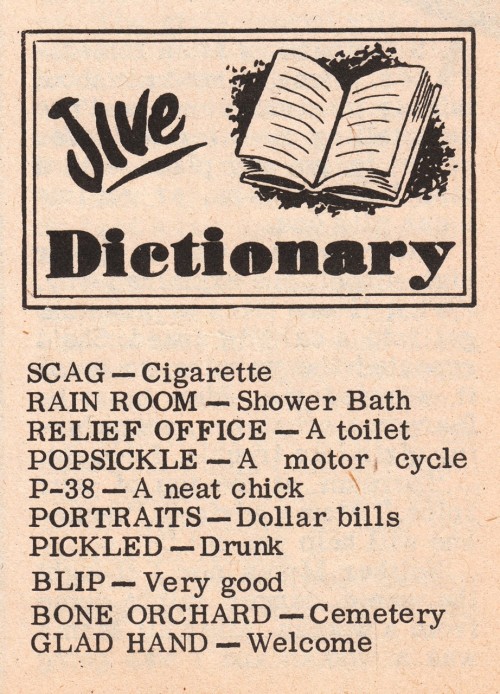
Jive talkin'

I'm assuming that the term "P-38" meaning "a neat chick" refers to the spectacular-looking Lockheed P-38 Lightning, the mount of America's most successful fighter ace, the last 'plane ever flown by author and aviator Antoine de Saint-Exupéry and the inspiration behind the tailfins adorning Cadillac's chrome-laden gas-guzzlers.
Unfortunately, (or not, depending on your point of view), when you google the terms "P-38" and "neat chick", most of the search results that come back are for videos of unclad young ladies being pleasured in a variety of creative ways, so I may have to outsource my etymological research to the good folk at the QI Talk Forum. In the meanwhile, I can't end any discussion of airplane-related jive talk wthout posting this classic:
Alternative link here.

Watch and learn, Dr Starkey, watch and learn.

Via

Friday, 19 August 2011

Sensible children! I have no power over them.

Here's a bit of nightmarish childhood nostalgia from the 1970's. A sinister, black-robed figure lies in wait to trap unwary children (link provided here for anybody looking at the preview on Facebook).. Whether you're old enough to remember public information films like this, or young enough to find them quaint or bizarre, it's well worth visiting the National Archives' extensive on-line collection of British public information films from 1945 to 2006.

If you're my age, you'll remember a lot of these - the clueless holiday makers, Joe and Petunia who used to promote the coastguard service, Rolf Harris on the benefits of teaching your kids to swim, Jimmy Savile clunk clicking, Tufty the road-safety squirrel, Charley the cat, reminding kids to beware of strange men bearing puppies, Patrick Allen, the voice of authority, urging people to save power during the 1973 fuel crisis and the stern warning about putting a rug on your polished floor - you might as well set a man trap... It all looks a bit quaint, patrician and nanny state-ish now, but at least then you could maintain the illusion that there was a benevolent, if stuffy, authority that actually cared whether ordinary people lived or died, an illusion that's looking increasingly questionable.

Mind you, that illusion would have collapsed a hell of a lot sooner if the Protect and Survive films had ever gone out for real. It would have taken more than Patrick Allen's authoritative delivery to persuade the survivors of nuclear Armageddon to keep calm and carry on with neatly wrapping and labelling the dead people in their houses, rather than just screaming 'You Maniacs! You blew it up!'

Thursday, 21 July 2011

Indoctrinated into a very specific Weltanschauung

Coping effectively with life's problems and failures requires realistic expectations. Psychologists call these expectations and judgements 'appraisals'. Life events (such as traffic bottlenecks or the boss's gruff voice) aren't a problem unless we appraise them as such. Life is never perfect and, to some degree, hassles and problems are a part of normal everyday life. If our appraisals are realistic, we're better able to react to day-to-day life events with a sense of proportion.

BBC Health article entitled Coping Skills

From cradle to grave – starting with the Kim-Jong-Il-Jr-style brainwashing offered by CBBC, moving on to oh-so-hip-Daddy-O pop broadcaster Radio 1, through classical Radio 3 to fuddy-duddily left-liberal Radio 4, not forgetting the achingly worthy and progressive TV channels BBC1, BBC2, BBC3 and BBC4 – the audience for Britain’s dominant national broadcaster is indoctrinated into a very specific Weltanschauung.

That Weltanschauung, you won’t be surprised to hear, does not find much room for concepts like limited government, low taxation, liberty, political sovereignty and accountability. It is extremely unlikely that a Tea Party movement could ever take off in Britain: the main reason being that, unlike in the US, the British simply lack the political vocabulary and intellectual building blocks to demand one.

From a James Delingpole piece entitled The BBC Is at Least a Thousand Times More Evil and Dangerous than Rupert Murdoch

That's right, at least a thousand times more evil. Just like that Kim-Jong-Il-Jr. With all that information about an overarching conspiracy that's a thousand times worse than anything the Murdochs and their underlings ever got up to, James Delingpole should really be following the example of James Murdoch and presenting his evidence to a select committee. That should be a hoot:

Adrian Sanders: Finally, are you familiar with the term "a sense of proportion?"
[Pause]
James Delingpole: Mr. Sanders, would you care to elaborate?

Or, as the Flying Rodent put it:

Children's BBC!  Truly, when you're reduced to arguing with Rastamouse, you've long since lost.

Marvellous stuff. Although, in the interests of strict accuracy, I ought to point out that Rastamouse goes out on CBeebies, (the channel for kids aged 6 and under), not CBBC [insert boilerplate apology for not getting out much here].

Funny how Children's BBC is such a magnet for angry wingnuts. Personally I think CBeebies is quite good; we're happy for our kid to spend most of his telly time watching it, as the programmes are generally quite educational and well-made (if occasionally a bit irritating and/or goody-goody) and the channel scores big time from a parental point of view by not being peppered with adverts aimed at unlocking the potential of pester power. But for some people Children's BBC is apparently the nexus of a sinister cult to corrupt the innocent.

There's a programme on CBeebies called Waybuloo (it's apparently been cut from the schedules until later this year, to the anguish of some young fans and their parents). It's aimed at the younger element of the under 6 demographic and involves four brightly coloured characters who live in a benign never-never land and talk a kind of baby language (any resemblance to Teletubbies is purely coincidental). The characters are nice to one another, play with small children, do a sort of yoga, are rendered in impressively seamless CGI and float around in the air when they're really happy. The programme is inoffensive, maybe a little wet in a Christopher Robin-ish kind of way, a bit dull and repetitive if you're 40-something, but pretty wholesome and entirely appropriate viewing for toddlers, I'd have thought.

Apparently, though, Waybuloo caused something of a panic among evangelical Christian parents, concerned that the series was undermining 'wholesome Christian values' by incorporating that suspiciously oriental yoga-like thing and implying that happiness might be attained without explicit reference to the only source of true joy that can be achieved in this life, Our Lord Jesus Christ.

I would refer these people (and James Delingpole) to the BBC article on coping skills, in particular the bit about how keeping a sense of proportion is good for your mental health, but they'd only accuse me of being a conduit for more outrageous BBC propaganda.

Bonus neologism of the day: guanophenia.


Thursday, 2 June 2011

Telly to get your teeth into

I’ve really enjoyed the first two episodes of Adam Curtis’s documentary All Watched Over by Machines of Loving Grace. Whether Curtis’ conclusions are correct or not, there’s so much interesting stuff to chew over that you actually have to start thinking. That's a novelty in itself; the level of most political debate on TV is so anodyne and simplistic that engaging with it is a consciousness-lowering experience.

On balance, I agree with one of Curtis’s main arguments; that we live in an age of ideology and hierarchical power, but the dominant ideology has borrowed ideas from science and technology to give subjective political choices and the self-interested exercise of power the spurious legitimacy of objective necessity.

In episode one, Curtis fingered Ayn Rand as a one of the first proponents of this intellectual sleight-of-hand. Up to a point, you know where you are with Rand’s philosophy that individuals should act exclusively in their own self-interest, be self-reliant and never act collectively or for the common good. Her stroke of genius was to label her political programme “Objectivism.” The implication was that Rand’s philosophy, was objective and rational (of course it’s objective – it’s called “Objectivism”, dummy!), unlike rival philosophies, which were weak, muddle-headed and subjective, (as defined by Rand).

Having made it an article of faith that her own preferences were driven by pure rational objectivity, Rand and her followers were on their way to creating what Michael Shermer called ‘the unlikeliest cult in history.’ By pronouncing itself objective and rational, the Randian cult attracted a lot of bright people who should have known better (such as Silicon Valley tech entrepreneurs) as well as, more recently, a bunch of simple-minded, selfish Tea Party chimps. That much I knew. What I didn't realise, until watching the documentary, was that long-time US Federal Reserve chief, Alan Greenspan, was a major acolyte.

In episode two, we were shown another historical precedent - General Smuts's quaint idea of "Holism" an "objective" philosophy based on the perceived ecological balance of nature (an idea which, conveniently for Smuts, supported the status quo of the white-run British Empire):

It had very much in common with his philosophy of life as subsequently developed and embodied in his Holism and Evolution. Small units must needs develop into bigger wholes, and they in their turn again must grow into larger and ever-larger structures without cessation. Advancement lay along that path. Thus the unification of the four provinces in the Union of South Africa, the idea of the British Commonwealth of Nations, and, finally, the great whole resulting from the combination of the peoples of the earth in a great league of nations were but a logical progression consistent with his philosophical tenets.

It's a new variation on an old theme. It's presumably more or less how organised religions started. One chief is a mere human being whose orders can be questioned (at the risk of a beating), so priesthoods emerged to tell the plebs that power isn't being exercised in the interests of the guy who'd have you killed if you didn't do what he wanted, but is ordained by a higher power. Challenging unfairness and rocking the boat wasn't just risky, it was evil. And, by the way, if you trespass against the norms of the tribe and go upsetting the priests and the strong man who looks after them on earth, you'll burn for all eternity, peasant.

In a  scientific, (largely) post-religious age, hellfire is an insufficient threat. Now we're kept in line with the lie that the existing order is the natural order, the only possible order, objective, rational and beyond criticism. In the past, the self-interest of the tribal elite was dressed up as God's will. In a managerialist age, it's dressed up as the inescapable conclusion of objective, rational thought, sanctified by spreadsheet. Dissent is routinely dismissed as 'politically motivated' (what the hell else would it be?), or 'inappropriate' (another weasel word intended to convey faux objectivity by people who don't take responsibility for their own beliefs). There is, they say, no alternative. Life is unfair - now just grow up and used to it. Which is a great message for those interested in comforting the comfortable and making sure the afflicted don't bother them with their problems. It's also a lie - ecosystems change and evolve, the political certainties of one generation are consigned to the dustbin of history by the next. People have changed the political facts of life, challenged the divine right of kings, slavery, apartheid and shoving little kids up chimneys and they can do it again.

This is only one strand in the web of ideas in Curtis's documentary. Some of them may be proved duds - on computers, networks and market instability, for example, this guy, coming from a libertarian viewpoint, thinks that Curtis got it wrong. From an opposing camp, there are mutterings that he focused too much on the role of computer networks in market instability, ignoring more obvious triggers such as the repeal of the Glass–Steagall Act. I've heard rumours that, presumably in episode three, Curtis will have a go at Dawkins and the idea of the selfish gene, citing these as ideas that encourage a mechanistic views of humans as mindless component parts of a system (if so he's obviously not read Dawkins carefully enough, because Dawkins has been explicitly saying for well over thirty years that the selfish gene is a metaphor which illuminates the mechanism of evolution and doesn't dictate the principles of morality or how society should be organised).

But, right or wrong, there's plenty to get your teeth into and I'd urge everybody to listen up – it’s a great antidote to the torpor and hopelessness induced by the endlessly repeated mantra that ‘there is no alternative.’ There's an interesting article about the documentaries on The Register here, a link to the programme website and BBC iPlayer here, and I'm guessing if you miss it on iPlayer (or don't get the content in your region), somebody will be posting these somewhere on the Internet sometime soon.

As a bonus, the programme's title referenced a wonderfully mad poem by Richard Brautigan about mammals and computers living together in mutually programming harmony. Did anybody else notice the (presumably coincidental) echo in George W Bush's alleged statement that 'I know the human being and fish can coexist peacefully'? Wonderful stuff.

Sunday, 12 December 2010

Libertarians v. pampered wasters

This morning, BBC Radio 4's Broadcasting House programme featured a couple of talking heads discussing the recent student tuition fee protests. In the blue corner was a "Liberatarian Conservative" commentator by the name of James Delingpole, who gave us all this small piece of his mind:

I think they probably need to grow up a bit, I mean, you know the problem with kids that age is that their frontal lobes haven't formed properly and they're not really capable of behaving rationally like grown-ups.

He continued, in the same plain-speaking, no-nonsense vein :

This has nothing to do with bankers. This has to do with the very simple fact that the country is £4.8 trillion in debt ... we cannot afford to subsidise wasters to spend three years doing windsurfing, dubstep and X-Factor studies...

Interesting, forthright opinions. I was sure I'd come across this straight-talking scourge of useless wasters somewhere before. It took me a little while to remember exactly where I'd previously encountered Mr Delingpole and his performing opinions, then I remembered that he'd been on the telly a long while back. There was a programme about the upper classes on Channel 4, featuring Deligpole attempting, with various levels of success, to ingratiate himself with a succession of condescending toffs. My memories of the programme are hazy, but the dominant impressions that stayed with me were that:

a) the toffs came across as a bunch of arrogant, self-indulgent wastrels who clearly thought Delingpole their social inferior

and

b) half of the programme seemed to consist of Delingpole gushing to camera about his moonstruck infatuation with this bunch of condescending, pampered nonentities, the other half was a record of his undignified attempts to gain their acceptance, despite the fact that they would no more consider treating him as an equal than they would an over-affectionate spaniel puppy

My own memories of this rather cringe-worthy piece of TV have grown dim, so I'm grateful to Skipper for this lively review, written at the time:


Which left the upper classes and Mr James Dellingpole [sic], allegedly a journalist. He had been to Oxford and admired the upper classes enormously but had failed to break into their closed circle, something which had clearly upset him. Like Evelyn Waugh he seemed to have a huge crush on toffs, the more blue blooded the better. He desperately admired their 'backbone, spunk and honour'. So he forayed forth into a Mayfair party, Channel 4 cameras at his back, and tried to elicit comment from the various aristos who stalked the event like elusive rare fauna. He did manage to corner the odd startled specimen. Earl Spencer and Prince Michael both snubbed him awfully but did it so politely he seemed not too dismayed. His problem was that: he was poorly dressed -more M and S than Saville Row; his voice also signalled clearly he was not of their tribe; and, just maybe,(though this is no more than conjecture as I have no idea of Mr Dellingpole's ethnic provenance) his appearance might have sparked off negative reactions in a notoriously anti-semitic social grouping. In other words, they saw him as an awful oik who was trying to crash their exclusivity. His approach was too crude and transparent. They were bound to see him off the premises. But was he dismayed? Any sensible person would have been and given up at that point. But he wasn't and, luckily for him, things improved a bit after this disastrous start.

He decided to try the Cresta Run in St Moritz where, I was amazed to discover, a closed group of aristos have risked life and limb since the last century. This was where the film became not no much sociology as social anthropology. The toffs wore plus four tweeds to ride their bob sleighs. One explained: 'This form of dress worked OK when we started and so, on that basis, we haven't changed it.' Seems like that statement sums up the attitude of the British aristocracy and provides their epitaph at the same time. James declared he would try the Run, whatever the dire dangers to various parts of his body. Visibly scared, he survived and, generally, was treated with a modicum of respect by the toffs. Next came living in the fast lane. For this he shacked up with Channel 4 favourite, Charlie Brockett of jungle fame. Charlie, a convicted felon of course, proved too nice a guy to be anything other than charming and James was allowed to drive a Ferrari as well as exchange good natured banter with the fraudster peer. But I suspected throughout that James secretly wanted to be stepped on, to be humiliated rather than merely humoured.

But the real object of James's dreams, it seemed, was to ride to hounds. This he arranged to do with the Cotswold Hunt and, with great commitment and assiduity learned how to ride. He eventually issued forth with the 'unspeakable' though never quite made contact with the 'uneatable'. But he survived again and, though condescended to by all he met, was not treated too badly. He concluded his gallop around Burke's peerage with a wistful soliloquy on the wonders of this vanishing breed, regretting the loss of this selfless group of noble spirits, warning that we'd miss them once they had gone.

I have seldom seen such a witless programme on such a key topic. Instead of analysis and insight we got a pathetic prostration of a yearning apparently self- loathing inadequate before a collection of parasitic, selfish, useless people with whom the French revolutionaries better knew how to deal.

Now, Mr Delingpole, what were you saying about pampered wasters? Tearing into students on the radio this morning, he wore the mask of a modern hard-nosed no-nonsense meritocrat, but behind the mask cowers an old-fashioned, socially insecure, class-obsessed snob, straight out of the pages of William Makepeace Thackeray. I think we'll see a lot more like him coming out of the woodwork to applaud the impeccably wealthy and well-bred Mr Cameron's Great Leap Backwards to a golden age before the welfare state, when the lower orders knew their place and the wealthy preached to the "undeserving poor" on the virtues of thrift and industry.

I understand that James Delingpole also gets paid for writing down his opinions in the Telegraph, He has some partiualrly strong opinions on the complicated subject of man-made global warming (he doesn't believe in it). His degree, by the way, was in English Literature, which means he's perfectly entitled to his opinion, but no better qualified to pronounce on the subject than a graduate in wind surfing studies.

Sunday, 31 October 2010

The Womble of Westminster

I am proud to be ginger and rodents do valuable work cleaning up the mess others leave behind.

Members of the commentariat, like this one in The Speccy have been impressed by Danny Alexander's allegedly witty response to Harriet Harman's 'ginger rodent' insult. Some people are easily impressed.

Harman's original comment wasn't the smartest thing she's ever said - making fun of ginger people in Scotland was about as astute as naming an accident-prone submarine "Astute", but Danny boy's sound bite was hardly Dorothy Parker either. Rodents 'do valuable work cleaning up the mess others leave behind'? I think Danny's getting rodents mixed up with the Wombles. Maybe he believes that mice and rats just flit around the house like furry 1970's environmentalists, doing a little light dusting, taking out the bins and sorting out the the recycling.

Friday, 10 September 2010

One Step Behind

 Here's a tricky puzzle to outfox Wallander:

Swedish National Police may be in a bit of hot water ... after building a national "shoe database" for use in tracking what kinds of shoes make what kinds of tracks. But how did they build the database? They just went online and downloaded pictures from various websites.

And it turns out that might not be legal.

The police claim that the law lets them ignore copyright in solving crimes, but an intellectual property professor quoted in the article notes that such an exemption only applies in the direct police investigation of a specific crime -- not for the sake of building up a general database. 

Techdirt, via

Thursday, 26 August 2010

When brands go to war

For me, the term "brand fan" isn't a compliment. Like "fashion victim", it's practically an insult. Who would want to be labelled as a mere passive consumer of shiny trinkets, mindlessly following the herd and reflexively salivating whenever an advertising executive rings the appropriate bell?

There's lots of stuff out there. Some of it works a bit better or looks a bit better than other stuff. That's all I need to know about it. End of. Time to think about something more interesting.

It is (IMHO) pitiful to take more than a passing interest in brands and desperately sad to be thought of as having a "relationship" with a brand. On the other hand, some of the techniques used by brand managers to manipulate consumers are quite entertaining to watch.

Here's a good one - identify an unpopular celebrity, then send that that celebrity free samples of your competitors' branded apparel, in the hope that they are seen wearing it and damage the brand. Evil genius! More details here (via). I am, by the way, extremely proud to say that I don't know or care who the alleged celebrity known as "Snooki" is.

Sadly for evil brand managers* of the Cruella DeVil school, I can see a potential flaw in this approach. It seems to me that in a society that sets the bar for celebrity so low and which seems to regard any publicity as good publicity, there are people out there who will want to buy anything associated with somebody who they've seen on telly. Never mind the fact that the person may only be famous for being an annoying twit on some reality TV show - they're famous and somebody out there will want to buy stuff just because it's associated with a celebrity.

Is there any group of celebrities so despised that they'd automatically poison any brand they touched? Disgraced British politicians got a pretty rough ride following the recent expenses scandal.** Unfortunately, even the dumbest MP might now think twice before flashing freebie designer goods in the public's face.

Disgraced ex-politicians and their hangers-on might seem a better choice, but the famous ones are brazen enough to turn their notoriety into celebrity. It's well over a decade since disgraced "cash for questions" MP Neil Hamilton became synonymous with political sleaze. Unabashed, Hamilton and his wife Christine lost almost no time in trading on their ill-earned celebrity, popping up on a classic edition of "Have I got News for You" with their grisly "greedy chump and his bossy wife" double act, grinning inanely as Angus Deayton pretended to give them their "fee" in plain brown envelopes. 

For Christine Hamilton, being the publicity-hogging wife of a seedy sleazebag was enough to launch a career of media celebrity that continues to this day, from the "The Christine Hamilton Show", via "I'm A Celebrity, Get Me Out of Here" and "The Book of British Battleaxes", to her latest incarnation as a ghastly mashup of Aunt Agatha and gastro-porn star in this year's "Celebrity Masterchef". If you sent the wretched woman a designer handbag, no doubt hordes of morons would want to buy one just the same. 


The dirty world of negative branding sounds like great fun but, regrettably, I won't be making a career of it. I just don't think I could stoop low enough find a celeb tacky enough to be a guaranteed brand-killer.


*Come to think of it, is there any other sort of brand manager?

** Fiddling their expenses was wrong, but the scale of their wrongdoing and its effect on the rest of society was minuscule compared with the careless, greedy, profligate, economy-wrecking crimes of the financial services industry, which were quickly forgotten once MPs started hogging the headlines with their taxpayer-funded plasma TVs, second home allowances and moat-cleaning bills..

Monday, 26 July 2010

Like a big robot fascist

This morning, I heard a couple of Radio 2 DJs discussing whether the latest episode of "Top Gear" was The Best. Episode. Ever. Whatever that might mean. Of course, "The Daily Mash" is several orders of magnitude more awesome than any eposode of "Top Gear" could ever aspire to be:

GOVERNMENT plans to scrap speed cameras were last night welcomed by middle-aged men who believe themselves to be excellent drivers...

The move has also been hailed as a rare victory for common sense, in a country where anti-establishment voices like Clarkson's are often restricted to prime-time television, national newspaper columns and six-figure book deals.


Top sarcasm!