Showing posts with label places. Show all posts

Tuesday, 10 April 2018

"There's a frood who really knows where his towel is..."

"...from."
"Frenchtex  100% Egyptian cotton loops ... Made in Colombia"
As a citizen of nowhere,* I approve this towel.


*At least until the bastards rob me and my family of our EU citizenship rights.

Monday, 2 April 2018

Angry waters

Bank holiday Monday, England. Incessant rain falls from a colourless sky and anger rules the tiny greyish waves on the ornamental lake.

Sunday, 25 February 2018

"I shall give you Jerusalem"

"If you send your warriors as promised and conquer Egypt, worshipping the sky, then I shall give you Jerusalem. If any of our warriors arrive later than arranged, all will be futile and no one will benefit. If you care to please give me your impressions, and I would also be very willing to accept any samples of French opulence that you care to burden your messengers with."
From a letter sent in 1289, by Arghun Khan, ruler of the Mongol Ilkhanate, (the remnant of Genghis Khan's empire based around Persia), to Philip IV of France, making him an offer which, it turned out, he could refuse.

Unfortunately for Arghun, his letter arrived when rulers in Western Europe had curbed their enthusiasm for Crusading, in favour of securing and expanding their lands closer to home. So Philip is remembered for fighting the English, suppressing the Knights Templar and expelling Jews from France, not for recovering the Holy Land thorough a Franco-Mongol alliance (in any case, given the catastrophic failures of the Fifth and Eighth Crusades in North Africa, the ability of the Europeans to deliver on their side of the bargain was pretty questionable).

Argun also approached Edward I of England, who had been on Crusade in his youth (assisted, at one point, by Mongol warriors) but, like Philip, Edward's priorities lay closer to home: securing and expanding his territories by fighting the French, the Welsh and the Scots ... and expelling Jews from England. I don't know why we see all this anti-Semitism at this specific point in history, but it's tempting to see the end of Crusading as ending the offshoring of religious bigotry - why go abroad to oppress non-Christians, when you can do it from the comfort of home?

The most interesting figure in the story of Argun's failed attempt to form an anti-Mameluke coalition was his ambassador, Rabban Bar Sauma. Born around 1220 at, or near to, the site of modern-day Beijing, Rabban Bar Sauma became a monk of the Nestorian Church of the East in China at the age of 20.  As a middle aged monk and religious scholar, he set off to make a pilgrimage from China to Jerusalem, accompanied by one of his students, Rabban Markos.

The roads to Jerusalem through southern Syria being too dangerous, the two travellers visited the Patriarch of the Church of the East, whose Baghdad base was in Ilkahnate territory, ending up at the court of the Ilkhan after delivering messages on behalf of the Patriarch.

Rabban Markos must have been an able student, because he was promoted to the rank of Nestorian bishop on his travels and, when the Partiarch died during their stay, he was elected the next Patriarch of the Church of the East, under the name of Yaballaha III.

As Wikipedia notes, it was the elevation of Rabban Bar Sauma's former student to high office that propelled his teacher to medieval Europe:
It was Arghun's desire to form a strategic Franco-Mongol alliance with the Christian Europeans against their common enemy, the Muslim Mamluk Sultanate at Cairo. A few years later, the new patriarch Yaballaha III suggested his former teacher Rabban Bar Ṣawma for the embassy, to meet with the Pope and the European monarchs.
It was a pretty eye-opening journey for the one-time boy from Beijing:
He traveled overland through Armenia to the Empire of Trebizond or through the Sultanate of Rum to the Simisso on the Black Sea, then by boat to Constantinople, where he had an audience with Andronicus II Palaeologus. Bar Sauma's writings give a particularly enthusiastic description of the beautiful Hagia Sophia. He next travelled to Italy, again journeying by ship. As their course took them past the island of Sicily, he witnessed and recorded the great eruption of Mount Etna on June 18, 1287. A few days after his arrival, he also witnessed a naval battle in the Bay of Sorrento on St. John's Day, June 24, 1287, during the conflict of the Sicilian Vespers. The battle was between the fleet of Charles II, who had welcomed him in his realm, and James II of Aragon, king of Sicily. According to Bar Sauma, James II was victorious, and his forces killed 12,000 men.

He next travelled to Rome, but too late to meet Pope Honorius IV, who had recently died. So Bar Sauma instead engaged in negotiations with the cardinals, and visited St. Peter's Basilica.
He then travelled to France, where he met both Philip IV and Edward I, before returning to Baghdad in 1288, laden with gifts and replies from the new Pope and European monarchs to the letters Bar Sauma had delivered from Arghun. It was in response to these letters that Arghun wrote to Philip, with his scheme for a joint attack on the Mamelukes.

The well-travelled Rabban Bar Sauma died in 1294, in Baghdad. I don't know if he's as well known in China as Marco Polo is in the West, but he deserves to be - he gives us a unique glimpse into how the different parts of the medieval world were occasionally more interconnected than we think.


Wednesday, 25 October 2017

Northern office gets up itself

Back in the day, the North of England took pride in its no-nonsense, down-to-earth culture. So what's up with these new offices in Manchester boasting about being "peerlessly refined"? The daft buggers.

Monday, 28 August 2017

Atypical British bank holiday weather

The River Great Ouse at Newport Pagnell. The weather's been scorching, we had a dip in the cool, inviting water and saw a grass snake swim across the river, coming out of those reeds and slithering into the undergrowth on the opposite bank.

A timely reminder that there's more to life than whingeing about the state of the world.

Sunday, 4 June 2017

Photoblogging Ely, 2017

With so much grim and ominous news about, I'm going to blog about something completely different. Following on from last year's visit to Ely:

This year, a slightly better picture of the famous octagonal Lantern...

...built to replace the former central tower, which collapsed in 1322 "possibly as a result of digging foundations for the Lady Chapel." Which ties in with what Tracy, the tour guide, told us about the foundations of this enormous building being only six feet deep (about 1.8m), due to the constraints of the local geography. The Lantern was designed to avoid another collapse by being lighter (made of oak beams with lead cladding, rather than stone and designed in such a way as to transfer the weight onto the main body of the building).
You must be ten years or older to take the 170-step tour up to the lantern, so this year we get to go up.
Up close and personal with the interior of the Lantern...

And looking back at the west tower from the parapet that surrounds the Lantern.


West Tower


Ah, the memories...
"Sitting in a sunken garden,
Pinking in a sinking sun,
Thinking of a summer long ago
When one was twenty-one;
Naming all the flowers so friendly.
Shouting at the shrubs so thick.
Lo, behold lobelia –
One bite and the bishop was sick.
How nice to be in England
Now that England's here:
I stand upright in my wheelbarrow
And pretend I'm Boadicea...
"


The view from the Palace Green, opposite the west tower - as per last year, note the Open University graduate, gowned up for one of the OU degree ceremonies being held on the 3rd of June. The marquees and stalls on the green aren't part of the OU event, by the way, but the annual Etheldreda Craft and Food Fair, which has taken place on this spot since time immemorial (only kidding, it started in the 1990s).

Saint Etheldreda (AKA Æthelthryth, Æþelðryþe, or Audrey), was the Northumbrian queen credited with founding the first abbey church on Ely in 672AD. It was Etheldreda, via her pseudonym, Audrey, who gave us the word "tawdry":
 .tawdry (adj.)
    "no longer fresh or elegant but worn as if it were so; in cheap and ostentatious imitation of what is rich or costly," 1670s, adjective use of noun tawdry "silk necktie for women" (1610s), shortened from tawdry lace (1540s), an alteration (with adhesion of the -t- from Saint) of St. Audrey's lace, a necktie or ribbon sold at the annual fair at Ely on Oct. 17 commemorating St. Audrey (queen of Northumbria, died 679). Her association with lace necklaces is that she supposedly died of a throat tumor, which, according to Bede, she considered God's punishment for her youthful stylishness:
Online Etymology Dictionary

I'm guessing that etymologists weren't the target demographic when they launched the Etheldreda Craft and Food Fair.

But never mind Etheldreda/Audrey, the lucky Open University graduates and their friends and family were treated to a graduation speech (or commencement address, as they call them in the U S of A) from none other than Professor Mary Beard:
In a thoughtful touch, Mary Beard ditched the usual formulaic rhetoric about believing that the new graduates would now go out, change the world and follow their dreams. Not that there's anything wrong with that stuff, but she had noticed that these were Open University graduates, most of whom had already gone out into the world of work, perhaps raised a family, been carers and done all sorts of worthwhile things before gaining their degrees. I was impressed with the sensitivity of framing the day as an integrated part of a process of life-long leaning, rather than a stand-alone Year Zero, after which things are transformed utterly.

From the wonderful Mary Beard to Bloody Mary and, not far from the cathedral, a terrible beauty is born (actually, just something terrible):


Ecumenical outreach fail. "Near this place on 16th October 1555 William Wolsey, constable of Welney, Upwell and Outwell, Robert Pygot, painter from Wisbeach, were burnt at the stake for their Christian faith."

Yes, definitely just somthing terrible - if there was anything like terrible beauty coming out of those times, it came from Oxford, rather than Cambridgeshire, with Hugh Latimer's famous last words:
"Be of good comfort, Master Ridley, and play the man! We shall this day light such a candle, by God's grace, in England, as I trust shall never be put out."
It seems pretty certain that the Reformation and the horrible religious conflict that followed  was driven by the advent of printing, from vernacular Bibles to the spread of propaganda works like Foxe's Book of Martyrs, but I wonder whether the apparent steep rise in inequality from the mid-1500s also played a part in stoking the social grievances that sustained the religious conflict through to the English Civil War and Thirty Years' War.


The Cathedral was also hosting the Ely Cathedral Science Festival.

"Touch the meteorites! They are the oldest things you will ever touch." Now that's what I call hands on.

It was nice weather for ducks. But only for ducks that could find a bit of shade.
"...pinking in the sinking sun..."

Tuesday, 18 April 2017

Different bridge

I don't yet have anything instant and/or sensible to say about the snap general election that the PM is trying to call and which I entirely failed to see coming, so here's a nice picture I took a few weeks back:

This was taken on the Millennium, rather than Westminster, Bridge, but I rather like the Wordsworthian vibe of being at the still heart of the city in the early morning, with nobody about, apart from the odd delivery person and early-rising jogger. Some of the ships, towers, domes, theatres and temples have changed since Wordsworth's day (look at the size of the Shard, looming over the tiny silhouettes of Tower Bridge and the Tower of London), but the stillness and clarity of a new morning remain:
Composed upon Westminster Bridge, September 3, 1802

Earth has not anything to show more fair:
Dull would he be of soul who could pass by
A sight so touching in its majesty:
This City now doth, like a garment, wear
The beauty of the morning: silent, bare,
Ships, towers, domes, theatres, and temples lie
Open unto the fields, and to the sky;
All bright and glittering in the smokeless air.
Never did sun more beautifully steep
In his first splendour, valley, rock, or hill;
Ne'er saw I, never felt, a calm so deep!
The river glideth at his own sweet will:
Dear God! the very houses seem asleep;
And all that mighty heart is lying still!

Sunday, 5 June 2016

Potoblogging Ely

Ely Cathedral, West Tower (the gowned people are Open University students, whose degree ceremony was being held in the cathedral yesterday)...

...and with the West Tower out of the way, you can see the famous Octagon Lantern.
Under the Lantern. Sadly, not the sharpest picture, but you can still see that that it looks spectacular.
What a ceiling...

Oliver Cromwell's House (Cromwell lived here with his family between 1636 and 1647, when he wasn't busy in Parliament, or fighting the Civil War).

The Offspring on a cannon which has nothing to do with the English Civil War...

... as you can tell from the Cyrillic writing...
... and the double-headed eagle - gotta be a Crimean War trophy.

And finally, a panorama, featuring Ely Cathedral, St Mary's Church and Cromwell's house in one shot - click to embiggen.

Sunday, 21 February 2016

The off season

Llandudno Pier, February 2016.
"The very pointlessness of a sea walk is its attractiveness to me." John Cooper Clarke
"A seaside resort in the rain is forlorn. Sodden alfresco eateries; puddles on the sun loungers; a great bowl of grey ocean, uninviting." Sara Moss
"I went for fish & chips at a faded seaside resort today.

There's something rather melancholic about out-of-season resorts which kind of appeals to me. I saw the lonely character in the shelter sharing his fish & chips with the birds and I thought it might make an interesting photograph, despite the gloomy weather.

It made me think of a song from my youth, when it was illegal to trade on a Sunday and how boring and tedious Sundays seemed. Well, that's all changed now, but I'm not sure how we are better off."
Amro Gebreel
"Excuses are monuments of nothingness,
They build bridges to nowhere,
Those who use these tools of incompetence,
seldom become anything but nothing at all."
Anon (frequently quoted by motivational speakers and other self-appointed gurus).


"The Little Orme (Welsh: Rhiwledyn, also known as Trwyn y Fuwch, Trwyn y Gogarth and Y Gogarth Fach) is 141 metres (463 ft) in height, and is a HuMP. It is one of two headlands situated at either end of Llandudno Bay, in Conwy County Borough, Wales. The other, larger, headland is the Great Orme."
Wikipedia
"Another good bird quickly followed when we picked up an adult Kittiwake out in the bay between the pier and the Little Orme, not on our predicted list! As we scanned, still trying to find a Razorbill, we saw at least six Kittiwakes, weird."
The Biggest Twitch, Alan Davies and Ruth Miller

Sunday, 18 October 2015

More seaside Gothic

The remains of Skegness Pier (a photo I took some time in the late 1980s).
The 1817 foot pier had cost £20,840 when it opened on 4th June 1881. It included a 700-seat saloon/concert hall at the 'T' shaped head. Steamboat trips began in 1882. The pier-head saloon was extended in 1898, and new refreshment rooms were built at the pier-head...

... On 11th January 1978, a severe storm washed away two large sections of the pier and left the theatre isolated at the seaward end. Plans to link the two sections by monorail, and to build a new 1200 seat theatre and a 250 foot tower all fell through later that year when an application for financial assistance was rejected.

Work began on dismantling the theatre in October 1985 but, while this work was taking place, a fire gutted the building.

Today the pier is only 129 yards (118m) long and no evidence remains of the old pierhead and shelters but what remains of the landward pier deck walkway has since undergone major refurbishment and is now once again a tourist attraction.

Even after refurbishment, what's left of the landward part of the pier looks forlorn. Somebody once defined a pier as a 'disappointed bridge' and that's exactly what it looks like today:


-- Tell me now, Stephen said, poking the boy's shoulder with the book, what is a pier.
-- A pier, sir, Armstrong said. A thing out in the waves. A kind of bridge. Kingstown pier, sir.
Some laughed again: mirthless but with meaning. Two in the back bench whispered. Yes. They knew: had never learned nor ever been innocent. All. With envy he watched their faces. Edith, Ethel, Gerty, Lily. Their likes: their breaths, too, sweetened with tea and jam, their bracelets tittering in the struggle.
-- Kingstown pier, Stephen said. Yes, a disappointed bridge.
James Joyce Ulysses

Thursday, 12 June 2014

To the workers' paradise, by EasyJet!

Exterior
A huge, wide angular building in plain beige with concrete and metal railing balconies ...
Interior
Ordinary, unelaborate interior with a large lounge bar with entertainments stage ... stocky chairs and tables...
What kind of holiday would you have in a place like this? A retro workers' break-style vaction, like the ones organised by Eastern Bloc trade unions in the days before the Berlin Wall came down?
At 7am, the hotel wakes with a start. Loudspeakers crackle into life, blaring out a mixture of revolutionary songs and socialist-era pop. Those guests still asleep are roused by a hotel worker with a whistle.
Bleary-eyed and yawning, the holidaymakers are dragged out onto the hotel lawn for some vigorous open-air exercise.
In fact, the first passage has nothing to do with the second. Although it sounds like something from a Soviet-era holiday camp, the first passage describes a perfectly average* three star hotel, in a popular Mediterranean holiday resort, as reviewed by Gazetteers dot com, which describes itself as 'the travel agents' Trip adviser.' To me, the professionals' honest, unflinching description of the holiday brutalist school of architecture is actually more appealing than the sugar-coated version offered up to the public in holiday brochures and on web sites. I've always like the idea of what you see being what you get.

It almost makes me get the niche appeal of a spartan, ostalgie-themed holiday, although I'm probably too much of a grumpy old git to really appreciate all that early morning 1950's Butlins-style 'Wakey, wakey!' malarkey. But, apparently, not everybody is quite so curmudgeonly about the idea of organised fun as I am.


*The review also notes, in its no-nonsense way, that this is a 'Large, spacious establishment with nothing particularly notable about its style ... has a good range of facilities especially suited to families ... Generously sized adults and children's pools ...Lots of room inside and plenty of sunbathing space', so it's not that the place is actually bad, just ugly.

Tuesday, 26 November 2013

Velvet Divorce, 2014? I think not...


Only an idiot would go to Wikipedia for the straight dope on a contentious current issue. So here's your Idiot's Guide to the likely outcome of the 2014 Scottish independence referendum. Even after taking the usual pinch of salt with my porridge,* if I had to bet on the result, my money would be on a "no" vote.

That's just my back-of-the-envelope, analysis-free prediction, not a comment on the respective merits of the yes/no arguments, which are too muddy with unknowns, complicated webs of relationships, potential unintended consequences (of the status quo, as well as of change), path dependency and partisan noise for a non-expert Sassenach to step into - I'm not that much of an idiot.

Not quite the ultimate in lazy blogging (I did google a couple of actual polling sites, too) but still pretty much the penultimate in lazy blogging.

Still, if we pretend for a moment that our Idiot's Guide is also a Lonely Planet Guide, another quick dip into Wikipedia's polling summaries suggests to me that the Catalans might dragging the Kingdom of Spain into the divorce courts well before the partners in the UK's occasionally rocky marriage get serious about dividing up the wedding presents. And given that Madrid, unlike Westminster, doesn't even seem to be playing lip-service to the Catalans' right to self-determination, it looks as if Iberian affairs will be getting pretty acrimonious next year.

Embittered supporters of the status quo in Westminster might cut up rough over who gets to keep stuff and might try to make things as difficult as possible for an potential independent Scotland ('if you're going to be like that, you can look after the Royal Bank of Scotland - I never liked the bloody thing in the first place'), but at least no Westminster politician (at least in my hearing), has recently declared that the Scots shouldn't be getting a vote on their independence unless the rest of the UK gets to vote on it, too. Sounds like fighting talk to me...

With my hostage to fortune now bound, gagged and securely chained to the radiator, my work here is done.

Saturday, 7 April 2012

Rubbernecking fail

As we're visiting North Wales, we decided to take a look at the unlucky cargo ship MV Carrier St John's, blown onto rocks near Colwyn Bay earlier in the week. Although the ship's mast is visible from the A55, the authorities have sadly blocked off any footpaths in the vicinity of the grounded vessel, so I wasn't able to get a decent picture of the ship lying on the rocks (after trudging down some cliffs, I did get to a vantage point where I could make out a portion of wheelhouse in the distance, but that was it).

As we're staying in Llandudno, where nothing ever happens that's louder than a scone being buttered,* it was disappointing not to get a view of the only exciting thing to have happened round these parts in years. I see somebody's managed to get a distant view on Geograph, so that'll have to do as for an illustration of my "I was close-ish to a moderately interesting news story" story.

Photograph © Richard Hoare, published under this Creative Commons Licence.

* Wit © the late Linda Smith (her description of some genteel seaside resort or other; possibly Hove).

Monday, 20 February 2012

Place name of the week

We took the offspring to a birthday party for one of his friends at the weekend. The venue was Berzerk (Northampton's Premier Children's Activity Centre, it says here).  Berzerk is a large example of your standard children's soft play area, a padded assault course where the wee ones can climb, slide, swing and dive, shrieking and chortling into ball pools, all housed in a big profiled steel shed on an industrial estate. It did more or less what it said on the tin, and satisfied its target demographic, with a party meal of chicken nuggets being served up to replenish the party goers after their gleeful berserker rampages.

The kids also got to meet the Face of Berzerk, Barney the Bear. Unfortunately, visibility from the bear suit was quite limited, so Barney had to be led around by assistants, like a frail invalid, in order to avoid the health and safety nightmare of mowing  down the swarms of unseen small people darting across his path. With no opportunity to safely caper about like a football mascot, or do anything remotely active or entertaining, Barney just waved limply and was duly ignored by all the children he was intended to thrill.

As an adult, the best thing about Berzerk (apart from the entertaining spectacle of Barney The Bear failing to whoop up an audience) is its location. It's in a district of Northampton that goes by the rather wonderful name of Lumbertubs. Lumbertubs - sheer bloody poetry, right up there with Six Mile Bottom. British place names, I love you all! I recently found out that there's a place called Kemeys Inferior near Newport, Gwent, a location that cries out for a leisure complex of its own. Or some kind of complex, anyhow...

Thursday, 17 November 2011

Mock the weak


A lot of people make fun of Milton Keynes, which is fine by me. I think it's a better place to live than most outsiders imagine, although the reality falls short of the Milton Keynes Development Corporation's original vision of a beautifully planned, orderly, harmonious place to live with no building higher than the highest tree. If people want to make fun of concrete cows and the grid roads and all the roundabouts (which really do keep traffic congestion to a minimum), I don't have a problem with that.

In fact, I rather welcome the fact that people treat the place as a bit of a joke, because it means there's less of the thin-skinned, self-important local pride that makes other places look even sillier. I lived in Leighton Buzzard for a short while, at the time when Jeremy Clarkson made a throwaway remark about in a car review about Leighton Buzzard being 'the fifth-best town in Bedfordshire'. The Pages of the Leighton Buzzard Observer carried a furious rebuttal from the affronted council leader (or some such local dignitary), raging and spluttering as if somebody might have actually noticed this remark, or could have cared less.

I'm no Clarkson fan, but this was practically the least offensive thing he's ever said. A comment from Clarkson shouldn't have even been local-newsworthy unless he'd at least called the local council lazy, feckless and flatulent and preferably accused them of murdering prostitutes in between meetings of the planning committee.

What does rile me is comfortably-off people sneering at everybody who lives on the city's poorer estates. Take this nasty little "satirical" e-mail from earlier this year, as reproduced in the Anna Raccoon blog

An Earthquake measuring 5.2 on the Richter scale hit the new city of Milton Keynes on Wednesday morning.

Casualties were seen wandering aimlessly saying “bang out of order”, “mental” and “sorted”. Some are still confused that something interesting actually happened in Newport Pagnell! Some residents of Fishermead were woken before their ‘giros’ arrived and it caused quite a panic!

The earthquake decimated half of the Fullers Slade area causing in excess of £17.55 worth of damage. Several priceless collections of mementos from Ibiza, Corfu, Rhyl and Blackpool were damaged beyond repair including a cute little donkey that ‘broke wind’ when you clapped your hands. 

At a time when unemployment is soaring, the numbers of the working poor are at a record high and desperate people are killing themselves after being thrown on the employment scrapheap, isn't it good to know that there are people out there unafraid of mocking the poorest and weakest members of society? I guess, as it becomes less acceptable to taunt people for their race or sexuality, the sort of inadequates who always need somebody to look down have to find a new target to kick, (preferably somebody too weak to kick back). "Chav" is in danger of becoming the new "queer".

What I love is the irony of the thrusting, aspirational suburban golf club set sniggering at the poor for their lack of taste. It's a bit rich, coming from the class that's spent years disfiguring the countryside with a rash of unsightly mock Tudor "executive" homes. These Petit Trianon playhouses for the petit bourgeois are just the architectural equivalent of a flatulent ornamental donkey for people with more money than sense.

The poor, of course, don't get much of a say about what their accommodation looks like. In Milton Keynes this led to some very strange results on the older estates, where 1970's architects were given free rein to design radical, modernist machines for living to house the "overspill" from Greater London. Some of the designs were pretty stark and brutal. The linear, angular, gleaming, metal-clad lines of the '70s buildings in Netherfield, for example, certainly have what Kevin McCloud would call 'integrity', but it's the hard, uncompromising integrity of a housing project designed by daleks.

I hardly need to add that, being low-cost pre-fabricated social housing, they haven't worn tremendously well. The years and individual redecoration can't disguise the uncompromising geometry, but they have destroyed the pristine, chilly unity of the facades, which look patchier and shabbier by the year A lot of MK's original buildings were only supposed to be temporary, built to house the people who came to build the city, then to be torn down to make way for something better. Forty years later, we're still waiting.

I was in Netherfield the other day, when I spotted something rather extraordinary. I'm a bit conflicted about sharing it as, after all I've said about mocking the poor, it might seem like more middle-class piss-taking, but this is such an astonishing collision between the aesthetic of the suburban executive home and the stark functionalism of '70's prefabricated social housing, that you really have to see it to believe it. Sorry about the quality of the following picture, taken with a low-quality mobile phone camera with a scratchy lens - at least it saved me the job of pixellating out the car number plates:


Yes, somebody has actually looked at one of these Mies van der Rohe-inspired brutalist dwellings and decided that what it really needed was a mock-Tudor facade.

No matter whether the person responsible was rich or poor, (for all I know it might have been the landlord) this is just so wrong it's off the scale. Somebody actually took something from the Decade That Taste Forgot, hybridised it with its opposite and came up with something this unspeakably what-the-hell-were-you thinking?. It's so wrong it's almost right. 'As beautiful as the chance encounter of a sewing machine and an umbrella on a dissecting table' as somebody once remarked. If you want to marvel in higher quality, somebody's posted a far better picture of the building in question here, or you could just put Farthing Grove, Milton Keynes into Google Maps and find it for yourself on Street View.

Milton Keynes - you've just gotta love the weirdness.


Update (Occupy Milton Keynes)

Having posted this, I think I belatedly get it. Seen from the point of view of a resident, maybe this isn't so mental after all. You've got the powers that be pouring people, like so much fungible human overspill, into their anonymous, generic boxes, then one day one of the residents decides to stop being the passive recipient of somebody else's aesthetic and stick two big fingers up at the people who designed these anonymous hutches. What you see before you is an act of defiance and individuality, a sane protest against an absurd world.

It still looks bloody ugly, though.

Update 2 "Civic" amended to "local", as I ended up talking about Leighton Buzzard, which isn't a city by any stretch of the imagination.

Thursday, 28 July 2011

Friday, 22 July 2011

On the rocks

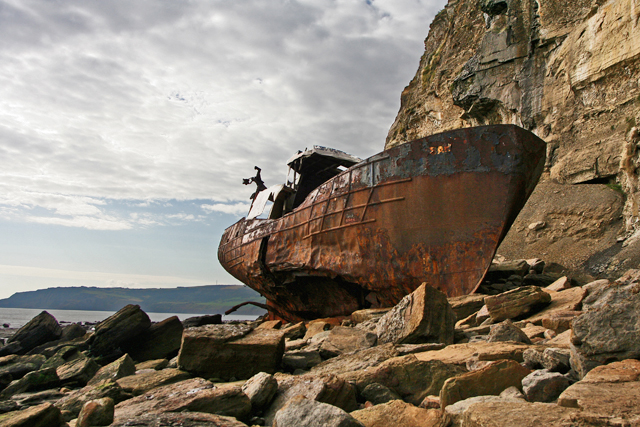
The rusting remains of the SARB-J, a trawler that ran aground near Robin Hood's Bay on the Yorkshire coast in January 1994, geotagged on Geograph.

Photograph © Helen Wilkinson and licensed for reuse under this Creative Commons Licence.


Friday, 11 March 2011

Two resolute bloggers

It’s not easy to summon up the self-discipline to knock out a bite-sized blog post on a regular basis (as opposed to just not bothering, or writing nothing for ages then blurting out a windy, baggy, ramble about the latest bee to have taken up residence in your bonnet). So I’d like to say thanks to a couple of bloggers who have recently taken up this challenge and run with it (albeit for differing lengths of time).

Stephen Nottingham’s Food Blog came back to life in January 2011. Stephen aimed to post each day for a year and has proceeded to nourish the blogosphere with regular recipes and posts on topics as diverse as  food in the movies, food in literature, food in songs, British pie week, the food scene in Cardiff, seafoods in prehistoric Wales, blood donation biscuits and why Jerusalem artichokes cause flatulence. Stephen recently guest posted in the Guardian.

The self-described ‘ex-eurodrone, unfit mother, and slattern’ responsible for Belgian Waffle has also made a resolution to write a daily post although hers only started about a week ago. I’ve rather enjoyed her quirky take on life from a Belgic perspective and I hope she keeps it up. Tip of the week so far; ‘if you save the old oil from your deep fat fryer, you can give a teaspoon a week to your cactuses.’ I don’t need a cactus, a deep fat fryer, or any understanding of why somebody would want to feed old cooking oil to a cactus, to feel better for knowing that. It just makes my life richer knowing that I could do it if I wanted to.

These two blogs have one advantage that mine lacks – a single unifying theme, respectively food and things Belgian.  Paradoxically, limiting your subject matter can help, rather then hinder the process of creativity:

Remember this: the freedom to choose anything does not inspire creativity.  It inspires panic.
Boundaries inspire creativity.  Limitations inspire creativity.  Guidelines inspire creativity.

(Daniel Schwabauer)

Just because you’ve got a theme, doesn’t mean that you can’t encompass other things. For example, the circles of food and Belgocentrism overlap in the Belgian Waffle post entitled "the most Belgian shopping ever":
The man behind me in the supermarket this week was buying the following:
24 cans of Jupiler and a small container of americain (delicious mince for consumption raw, non Belgianists). The only thing that could possibly make this more Belgian would be an economy bag of 40 heads of chicory, and I almost think that would have spoilt the perfect symmetry of it.

To my recollection, Stephen Nottingham’s Food Blog hasn’t yet ventured into Belgian cuisine, although it does offer the word ‘equivorous’ to describe an eater of horse flesh. Ever since I had a particularly succulent horse steak* in Brussels many years ago, I’ve never missed an opportunity to bore friends and acquaintances with the observations that horses taste a lot nicer than you’d expect and that we Brits** are barmy for being so squeamish about horse flesh when we gobble up sheep and cows without a second thought.

*served with frites, mayo and salad, natch.

** vegetarians excepted – if you don’t eat any meat, that’s a consistent position that I can understand and respect

Thursday, 18 November 2010

Circa 980: The Conquest of Paradise

Archaeological fragments combined with passages from the Norse sagas have long suggested that the Vikings reached the Americas centuries before Christopher Columbus. Now there's genetic evidence for this early contact:

Researchers said today that a woman from the Americas probably arrived in Iceland 1,000 years ago, leaving behind genes that are reflected in about 80 Icelanders today....

"As the island was practically isolated from the 10th century onwards, the most probable hypothesis is that these genes correspond to an Amerindian woman who was taken from America by the Vikings some time around the year 1000," Carles Lalueza-Fox, of the Pompeu Fabra university in Spain, said.

As reported in The Guardian (via). At least, that's the simplified version. As Discover points out, it's actually a bit more complicated than that:

The core of the article [A new subclade of mtDNA haplogroup C1 found in icelanders: Evidence of pre-columbian contact?] treads the confusing gray zone between rock-hard precise science and the more vague and intuitive truths of history. One the rock-hard part, there is a huge literature on maternal genetic lineages, the mtDNA....But synthesizing this clarity with human history is more difficult, because we are dependent on the bias of text, and even more tendentious clues from oral history and archaeology.

For example, it's certain that there were Viking settlements in Greenland, which eventually perished, probably because of the arrival of harsher conditions in the shape of a "mini ice age" which the Viking settlers, unlike the native Inuit, lacked the survival skills to cope with. Maybe there were some Amerindian genes in the Greenlandic population when the Vikings arrived - after all, via the Canadian Arctic Archipelago, Greenland isn't far from the North American mainland.

Anyway, eventually the Discovery article gets fed up with such speculation and asks the big question on everyone's lips:

Finally, does this explain Bjork?

If it does, they could go on to have a shot at the following queries (humanity's Top 10 "unanswerable" questions, according to Ask Jeeves):

1. What is the meaning of life?

2. Is there a God?

3. Do blondes have more fun?

4. What is the best diet?

5. Is there anybody out there?

6. Who is the most famous person in the world?

7. What is love?

8. What is the secret to happiness?

9. Did Tony Soprano die?

10. How long will I live?


Monday, 11 October 2010

Stacey Island

No man is an island, entire of itself;
every man is a piece of the continent, a part of the main;
if a clod be washed away by the sea,
Europe is the less, as well as if a promontory were,
as well as if a manor of thy friends or of thine own were;
any man's death diminishes me, because I am involved in mankind;
and therefore never send to know for whom the bell tolls;
it tolls for thee.

John Donne, Devotions Upon Emergent Occasions, Meditation XVII

Shorter version:


No man is an island... apart from Barry