Showing posts with label SHIPS. Show all posts

Friday, 2 April 2021

Before the Ever Given

The cost of one ship blocking the Suez Canal for a week, plus the resulting backlog is being estimated at some $1bn (£730m), according to Akshita Jain in the Independent.

It could have been worse. A lot worse. 

Imagine an event which blocked the canal for eight solid years. 

I shouldn't have to imagine, because this is an actual thing which happened in my lifetime. Until the canal came back in the news, I'd wholly forgotten that a second Suez crisis affected maritime traffic for far longer than the 1956 debacle. The canal was closed due to the Six Day war in 1967 and wouldn't re-open again until June 1975, after Israeli forces had withdrawn from the Sinai Peninsula and the Egyptians had cleared the canal of sunken ships and mines. 

Here's a nice summary of the long blockage, including the story of the ships which were navigating the canal when the Six Day War broke out and were trapped for eight years:

It's a historical event which gets comparatively little attention, which is a pity, because as a natural experiment into the effect of introducing trade barriers into places where trade previously flowed freely, this feels pretty damn relevant right now, especially here in Global Britain™.

While we're on the subject of historical blunders by wannabe global powers that turned out to no longer be quite as awesome as they thought, there's one other Suez-related tale that's worth re-telling. Namely, one of history's most bizarre tragicomedies, the hellish 18,000-mile (29,000 km) journey that Russia's Second Pacific Squadron took from the Baltic to the Tsushima Strait off Japan and one of the most consequential naval defeats in Twentieth Century history. The Russians could have had a much shorter voyage had they not upset the entity which really was "Global Britain" back in 1905 and which closed the Suez Canal to the hapless Russians. 

Here's a very good telling of the whole globe-spanning organisational and logistical nightmare:

And, for the sale of completeness, the final catastrophe that ended the epic voyage:

One of the participants in this naval omnishambles survives to this day as a floating museum in St Petersburg; the protected cruiser Aurora, which, more than a decade after taking part in the Battle of Tsushima, fired the shot which signalled the attack on the Winter Palace and the start of the Russian Revolution. 


Sunday, 28 March 2021

Finding Nemo (again)


From my blog post We all live in a retro submarine from April 2010

I just had a reminder of this photo, which I took in Brighton over a decade ago. A few things have changed since then. My son, who was just about the right size to captain this hobbit-scale sub is now as tall as me (give or take; it's hard to tell when his default posture's the stereotypical teenage slouch). 

But I'm still coming across subs out there which look like takes on Jules Verne's fictional Nautilus. A more or less unrelated search recently came back with this:

Image Credit: H I Sutton's Covert Shores blog

Although it dates from the around  same era when I took my picture, this is no cartoonishly cute sculpture, or theme park attraction, but an attempt at an actual working submarine (well, a semi-submersible, anyway), designed and built with deadly purpose by the Liberation Tigers of Tamil Eelam, better known as the Tamil Tigers, in the closing days of the Sri Lankan Civil War.

Like the sculpture, this is on a far smaller scale than Nemo's Nautilus (it's a midget semi-sub, probably only around a 10th of the length of the fictional 70 metre Nautilus). Interestingly, Hutton also compares it to a Nineteenth Century submersible, but a real one. That's because, like the Confederate Civil War-era sub the Huntley, the Tamil Tigers' vessel looks as if it was designed to attack ships by ramming them with a spar torpedo attached to the pole sticking out of its bow.

This isn't the only interesting oddity to be found in the Covert Shores blog, which features a compelling selection of unusual naval tech, both current & vintage. Highlights include Russia's huge, terrifying nuclear powered/armed torpedo, named "Posiedon" (Посейдон), after citizens were given a vote on the name of Russia's latest weapon of mass destruction (can't help feeling disappointed that they didn't end up with a doomsday weapon called Nukey McNukeface). Then there's quite a bit of stuff on (mainly Latin Ameican) narco subs, the use of marine mammals for naval operations, the mysterious death of Lieutenant-Commander "Buster" Crabb, a prohibition-era moonshine-smuggling sub and the James Bond-ish hardware of Swimmer Delivery Vehicles underwater "chariot" attack craft and various stealthy/low-profile vessels.

Another treat from Covert Shores is Hutton's own interpretatation of Verne's Nautilus, which is closer to a visualisation of what was described in the novel than the Harper Goff's looser, but nonetheless wonderful, visualisation

It wasn't a search for this iconic proto-steampunk design which originally led me to Hutton's blog, though. I was initially looking for information on another a piece of retro futurism from a later era, namely this sleek deco-looking experimental helicopter design from the 1930s:

Like the Tamil Tigers' mini-Nautilus, the  Dorand G20 Gyroplane looks like something that's sprung out of the pages of vintage Science Fiction into real life. In this case, if you ever had a mental picture of the ubiquitous helicopters which flitted around the art deco skyscrapers in Huxley's Brave New World, carrying the Alphas and Betas to and from their places of work, consumption or leisure, it probably looked like something like this.

Like the Tamil mini sub, though, this helicopter was orignally built with more aggressive intentions - there was an idea that the Dorand would replace the spotter plane which was kept on board France's massive inter-war Surcouf cruiser submarine (that's the link which originally brought me to the Covert Shores blog).

The Dorand Gyroplane isn't quite as insanely art deco as the never-flown Bugatti racing plane from the same era, but it comes pretty damn close.

Definitely at the more elegant end of the very wide spectrum of French aircraft designs from the 1930s. As somone once said:

When one looks at French aircraft of the period immediately before and during World War Two, it is evident that there were two schools of thought when it came to aircraft design! One school was to design elegant, graceful and beautiful aircraft. The other was to see just how ugly they could make the airplane and it still fly and perform the duties it was designed for.

Mon Dieu, quel bordel!

 Now there's a design that wouldn't ever make it it into fiction. Oh, hang on...

The Canadian Air Force (according to South Park: Bigger, Longer and Uncut).


Friday, 12 January 2018

Corbyn: "I'm king of the world!" (spoiler: iceberg ahead)


Imagine that it's close to midnight on 14 April 1912 and we're on the bridge of the RMS Titanic. Watchers in the crows' nest have just spotted an iceberg ahead. What should we do?

There are two schools of thought.* Mister Barlow thinks that our top priority is to do everything possible to change course and speed, during our short remaining window of time, so that the ship can either avoid the berg, or try to hit slowly, at a speed and angle which gives us some chance of not sinking.

Mister Jones objects that while everybody's obsessing about the iceberg, conditions aboard the Titanic are unacceptable; the working poor are crammed into cramped, airless quarters in steerage, while the rich and powerful lounge about in their sumptuous staterooms, being waited on hand and foot, when not stuffing their faces with turtle soup and lobster at the Captain's table. Mister Jones is a fan of First Mate Corbyn's vision of something better, a Titanic that works for everyone.

Now I don't think Mister Jones is wrong. The massive levels of unfairness and inequality are wrong, bad and need fixing. But - forgive me if I'm being be a single-issue iceberg bore here - the iceberg is dead ahead, the time left for avoiding action is short, and if we hit and sink, who do you think will be first in the queue for the limited number of lifeboats (hint; it's probably not going to be the poor devils in steerage)? For the moment, I think that the pressing problem of iceberg avoidance deserves to occupy the top left quadrant of the Eisenhower decision grid.

That was my take on the "What - if anything - should progressives do about Brexit" debate, as argued by Owen Jones and Nick Barlow.

Credit to Boris Johnson for first suggesting the Titanic analogy.


*Of course, there are other courses of action, although the one being urged on Captain May by her senior officers ("Shut your eyes, full steam ahead and just keep on saying that we're definitely going to win the Blue Riband"), doesn't really involve enough neurological activity to qualify as a school of thought.

Tuesday, 4 March 2014

Send in the clowns

 
The Clown class gunboat was a class of twelve gunboats ordered by the Royal Navy in January 1856 for use in the Crimean War, although by the time they were completed, later that year, the Crimean War was over and some of these gunboats were sent to the Far East and took part in the Second Opium War

Unfortunately for Wee Willy Hague (bless his little cotton socks), the days when Britannia could overawe the unruly hordes of Crim Tartary with a few gunboats are long gone. These days we just have to rely on the charge of the lightweight brigade.

Saturday, 7 April 2012

Rubbernecking fail

As we're visiting North Wales, we decided to take a look at the unlucky cargo ship MV Carrier St John's, blown onto rocks near Colwyn Bay earlier in the week. Although the ship's mast is visible from the A55, the authorities have sadly blocked off any footpaths in the vicinity of the grounded vessel, so I wasn't able to get a decent picture of the ship lying on the rocks (after trudging down some cliffs, I did get to a vantage point where I could make out a portion of wheelhouse in the distance, but that was it).

As we're staying in Llandudno, where nothing ever happens that's louder than a scone being buttered,* it was disappointing not to get a view of the only exciting thing to have happened round these parts in years. I see somebody's managed to get a distant view on Geograph, so that'll have to do as for an illustration of my "I was close-ish to a moderately interesting news story" story.

Photograph © Richard Hoare, published under this Creative Commons Licence.

* Wit © the late Linda Smith (her description of some genteel seaside resort or other; possibly Hove).

Monday, 2 January 2012

From the fury of the chicken ships deliver us, O Lord

Watching our hens fussing and bobbing about in the back garden, I've been thinking that they reminded me of something, but I couldn't, for the life of me, think what. It's just come to me, though. They've got the same proportions as old sailing ships. From the generously rounded curves of the lower hull to the upward sweep towards the jutting forecastle and the sprightly, upturned stern, the craft that kicked off the European Age of Exploration looked like nothing so much as giant sea-going chickens.


It would be really neat to say that galleons were the ships most like Gallus gallus domesticus but, sadly for alliteration fans, galleons lacked the high, ungainly forecastle of the earlier carrack, the most hen-like ship of all. Look at the top picture of Portuguese carracks off a rocky coast. Not only do these ships have the bodies of wooden chickens, but the flapping mainsail of the foreground vessel will ring a bell with anyone who's ever seen a running hen steadying itself with an outstretched wing.

Columbus, Magellan, Vasco da Gama, Vespucci and Jacques Cartier all sailed these quaint, gawky-looking carracks to to the blank spaces on the maps to explore strange new worlds, to seek out new life and new civilisations, to boldly go where no European had gone before.

It was an exciting time, but also a brutal one. A time of trade, of discovery and of armed men being disgorged from the wooden bellies of the floating Trojan chickens, bringing conquest, disease, slavery and genocide.

There's something almost deceptive about the unthreatening, domesticated shape of these vessels. So unlike the low, spare, purposeful menace of a raiding viking dragonship: 

Galleys of the Lochlanns ran here to beach, in quest of prey, their bloodbeaked prows riding low on a molten pewter surf. Danevikings, torcs of tomahawks aglitter on their breasts when Malachi wore the collar of gold.

Death's a sly customer, who doesn't always appear in the shape we expect. Death can easily bob into your life in a disguise as absurd as a big, floating chicken. Aeschylus, they say, was unexpectedly killed by a falling tortoise. If the tortoises don't get you, the flying bears might. But whatever form your ship takes, it will come in one day:


Only one ship is seeking us, a black-
Sailed unfamiliar, towing at her back
A huge and birdless silence. In her wake
No waters breed or break. 


He comes, pale vampire, through storm his eyes, his bat sails bloodying the sea, mouth to a mouth's kiss. 

So here's a late New Year's resolution - treasure every finite moment, of life, however confusing, infuriating and absurd it may seem:


Ah, my Beloved, fill the Cup that clears
TO-DAY of past Regrets and future Fears:
To-morrow—Why, To-morrow I may be
Myself with Yesterday’s Sev’n thousand Years.
May your years be long.

Sunday, 2 October 2011

Smoke on the water

The Wall Street Journal thought it worth giving Scott Adams a column to expand on his quaint notion that the world's wealthiest citizens will one day migrate to floating tax havens. I agree, but only because this stuff is silly enough to be entertaining, especially when Scott warns the world's mega-rich of the coming socialist tax-apocalypse:

The final phase will involve a tax rate on the top 1% of earners that is so high it can't be described without the Viking word for pillage.

Yeah, right.

Mention of Vikings makes me almost regret that the great floating tax havens will always be a figment of  the over-heated libertarian imagination, though. The funerary rituals of such a seagoing elite could be quite spectacular. I can't imagine the ex-Masters of the Universe being content with just being wrapped in some sailcloth and quietly dropped over the side when their time comes. Something more spectacular and ostentatious would be in order.

I'm thinking of a full-on flaming ship-burial (think Kirk Douglas's dragon ship funeral pyre at the end of The Vikings)* to speed the dear departed to the high net worth Valhalla.

From the fury of the hedge fund managers deliver us, O Lord.

*Although these guys could presumably afford to outdo a warrior from the dark ages and sign off with a grand gesture to match the Graf Spee's final moments.

Friday, 23 September 2011

Plutocrats ahoy!

Does anyone think the rich won't someday migrate to floating islands?

Asks Scott Adams. Short answer; I think they won't, because:

1. Why on earth (or on water) would the rich migrate when they're already doing very nicely, thank you, right where they are?

2. Say the rich are the first to take to the high seas to escape allegedly 'confiscatory levels of taxation'. At home (using the US example), a lot of those tax dollars fund a colossal military machine that makes damn sure that few people imagine they can mess with US nationals with impunity. Anyone care to guess how afraid pirates and terrorists are going to be of attacking giant undefended cruise liners full of immensely rich tax exiles, ripe for plunder and kidnap? Or do the the plutocrats intend to tax themselves sufficiently to support the immense cost of creating their own private army / navy, so they can continue to sleep sound in their luxury staterooms?

 3. I'll start believing when the mighty "Freedom Ship" starts being more than just mouth and trousers.

I've got immense respect to Scott Adams for having created the superb Dilbert strip and escaped the corporate rat race using his own creative talent, but some of his blog posts are lurching towards the wilder fringes of teapottery.

Sunday, 25 April 2010

We all live in a retro submarine


Here's the most junior member of our family alongside an appropriately junior-sized submarine, spotted in Brighton recently. I liked this sub, clearly inspired by art director Harper Goff's design for Captain Nemo's "Nautilus", as used in Walt Disney's 1954 version of "20,000 Leagues Under the Sea".

Apparently, Walt Disney originally wanted the "Nautilus" to be a simple cigar-tube shape, but after seeing Goff's prototype model of a more elaborate and compelling design, he changed his mind. The resulting film "Nautilus" looked fantastic - shaped like a great fish, clad in metal plates and rivets, embellished with spiky Victorian gothic details.

Image courtesy of WikiFred

Isn't she a beauty? There have been countless different attempts to visualise Jules Verne's "Nautilus" over the years, (including tinplate toys - I had one like this as a kid) but Goff's powerful design still blows me away.

Before he saw Goff's more visually exciting design, Walt Disney imagined that the film version of the "Nautilus" would obviously confirm to the canonical "cigar tube" submarine shape. A similar thing happened during the design of another pop culture classic - the starship "Enterprise" from "Star Trek". Again, there were preconceptions about what it should look like at the design stage. Gene Rodenberry knew the look he didn't want Enterprise to have - the streamlined bullet-with-fins appearance shared by early pulp fiction rocketships and the V2 missile. This design, Rodenberry decided, was hackneyed and not futuristic enough for a 23rd Century starship.

At that time there was an alternative generic design for science fiction spaceships. If they didn't look like rockets with fins, they reflected the current flying saucer hysteria. Think of the spaceships from "Lost in Space" or "Forbidden Planet". "Star Trek" art director Matt Jefferies started off doodling flying saucer shapes, rejected that idea, thought about his design from an engineering perspective, finally coming up with a synthesis of a modular design with the saucer shape that just looked right. In his own words:

I gathered that this ship had to have powerful engines—extremely powerful. To me, that meant that they had to be designed away from the body. Boy, I tried a lot of ideas. I wanted to stay away from the flying saucer shape. The ball or sphere, as you’ll see in some of the sketches, was my idea, but I ended up with the saucer after all...

[F]or the hull, I didn’t really want a saucer because of the term flying saucer, and the best pressure vessel of course is a ball, so I started playing with that. But the bulk got in the way and the ball just didn’t work. I flattened it out and I guess we wound up with a saucer! I did it in color on a black matt board, and by the time I finished I thought we really had something. [...] And that worked! It looked better than the other sketches and Gene said, “That one looks good!”


And it does look good. You can criticise aspects of the design on the grounds of plausibility,* but on the screen it does look right. The "Enterprise" looks distinctive, purposeful, futuristic and powerful. It's such a well-known image that it's sometimes hard to recognise it for what it is - in purely aesthetic terms, probably the best-looking fictional spaceship ever to have graced the small or big screens.

One thing that the Disney "Nautilus" and the "Star Trek" "Enterprise" have in common is their distinctive outline. Even in silhouette, they're unmistakable. I think that has a lot to do with the visual magic of the designs - a power they share with, among others, Bart Simpson, Batman and Mickey Mouse. Let "The Simpsons" creator, Matt Groening, explain:

The secret of designing cartoon characters — and I’m giving away this secret now to all of you out there — is: you make a character that you can tell who it is in silhouette. I learned this from watching Mickey Mouse as a kid. You can tell Mickey Mouse from a mile away…those two big ears. Same thing with Popeye, same thing with Batman. And so, if you look at the Simpsons, they’re all identifiable in silhouette. Bart with the picket fence hair, Marge with the beehive, and Homer with the two little hairs, and all the rest. So…I think about hair quite a lot.


USS Enterprise plan courtesy of alpoma's Flikr photostream


* Update - I didn't expand on the "plausibility" aspect as FTL travel is - as far as most scientists and engineers are concerned - fantasy and, anyhow, anybody  alive now (or in the 1960s) has/had as little chance of imagining what real 23rd Century tech might actually look like as those quaint 19th Century illustrators of life in the 21st Century had of accurately predicting the look and feel of today's world. But I think I need to share the easily fixable thing that bugs me about the design of the Enterprise from the original series. Namely, the way that the engines seem to be obviously mounted above the craft's centre of mass, which makes no sense. This also bothered Andrew Probert, who designed the new Enterprise for the Next Generation series and mounted the engines in a more plausible-looking position.
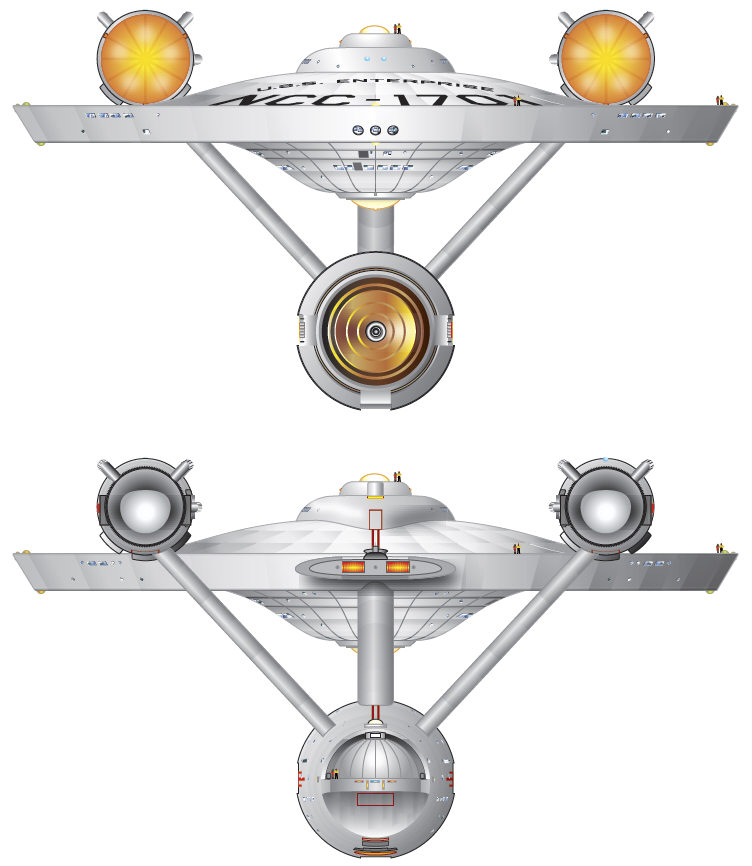
I still prefer the look and feel of the Enterprise from the original series - I like the unstreamlined deep space vessel aesthetic better than the go-faster  flared stylings of the NCC-1701-D and I think the flashy up-to-the-minute blue lights on the newer vessel will date more quickly than the restrained details on the original version (I particularly like the coppery colour of the deflector dish thingy from the old Enterprise). But they really should have got those engines looking right.

Wednesday, 17 February 2010

Anorak heaven

All you ever wanted to know about the bulk carrier vessels of the North American Great Lakes can be found at www.boatnerd.com (via).

Tuesday, 17 November 2009

Change and decay in all around I see

Which mythical hero's conveyance links the Sugarbabes with a river and George Washington's Axe? It sounds like one of those recondite questions from Round Britain Quiz. The correct answer is "The Ship of Theseus", a paradox that raises the question of whether an object which has had all its component parts replaced remains fundamentally the same object.

O, Wikipedia, abide with me!

Wednesday, 10 December 2008

Postcard

Tuning into the news is still a grim experience, but some things can help to put the current state of the world in perspective. I'm just looking at an old postcard featuring a black and white picture of a ship. The message isn't anything special, viz:

Dear Ronnie,

Hope you will soon be well again. Brian send his love and will write to you again.

Love from auntie


It was sent to my dad, then a boy of eleven, some time in 1941 (the exact date on the postmark is obscured). At the time he was in Lincoln County Hospital, recovering from a burst appendix - a serious condition which could have caused potentially fatal peritonitis. Times are hard, but I imagine it was harder in those days - born into a world in the grip of the great depression, topped off by a world war, then ending up in hospital with a life-threatening condition in the days before the National Health Service. Now that is an insecure world. So maybe I should be a bit more upbeat over a few depressing headlines.

My dad survived, (although I think he missed a lot of schooling due to an extended stay in hospital), and I found myself wondering about the fate of the ship on the postcard, the destroyer, HMS Icarus. The name wasn't a good omen, recalling the boy who flew too close to the sun and fell to earth. A quick Internet search revealed that HMS Icarus didn't suffer a similar fate, but survived service off Norway, in the North Atlantic and the Mediterranean to be paid off and broken up for scrap in 1946. During her service career, she served in Atlantic and Russian convoys and the Dunkirk evacuation. She was also responsible for sinking two U-boats and participated in the destruction of two more. So the Icarus story wasn't the tragedy I'd feared, although she was almost on the scene of one of Britain's greatest naval tragedies. In May 1941, the battlecruiser HMS Hood was struck by a shell from the Bismark. One of her magazines exploded and she sank in about three minutes. There were only three survivors from Hood's crew of 1,418 men, picked up by the destroyer HMS Electra. HMS Icarus was on the scene shortly thereafter, but could find no more survivors, just debris.

Sunday, 26 October 2008

How to avoid huge floating things

There seem to have been a lot of big floating things in the news lately. Like the Russian billionaire Oleg Deripaska's mega-yacht for example. As it says here:

Your bog-standard superyacht now costs between £40 and £70 million depending on the interior specification. The running costs tend to be about £5 million a year for the bigger vessels. “It's roughly £1 million a metre,” says Jamie Edmiston, of Edmiston & Co. “For that you get helipads, swimming pools and spas as standard.” The oligarchs want more. “They don't just want a slide for the children, they want a submarine,” says one broker.

Seduced by the jet-set glamour of it all, it looks as if those smart political operatives George Osborne and Peter Mandelson failed to spot the obvious danger signs. As anyone who goes to the cinema could have told them, only Bond villains own that sort of floating lair and people who are unsuspectingly lured on board inevitably find themselves getting hurt. George and Mandy really should have listened to Shirley Bassey.

Such a cold finger
Beckons you
To enter his web of sin
But don't go in!


You said it, girl.

Of course, like most ordinary people, I have nothing to do with big vessels like that. Well, that's not strictly true. Most of the stuff I've ever bought has come here on board something even bigger than an oligarch's yacht. I'm talking about container ships, which have been in the news recently because the shipping lines, like everybody else, are sailing into an economic storm:

Late last year, users of major European container ports kept complaining about one problem. Volumes of containers arriving at ports such as Rotterdam and Antwerp from Asia were rising so rapidly that ports were struggling to cope.

This year, ports can only wish for such problems. Drewry is predicting growth of only 4.1 per cent, and Eivind Kolding, chief executive of Maersk Line, the world's biggest container shipping line and part of Denmark's AP Møller-Maersk, says that volumes are currently shrinking against the same months of last year.

It's strange how invisible these fleets of vast container ships are, especially as the ships are among the biggest vessels on the planet. Consider the Emma Maersk, pride of the Maersk Line and the largest container ship in existence. 397 metres or 1,300 feet long, powered by the world's largest single diesel unit (the ship's engine alone weighs 2,300 tons). Yet I was hardly aware of the ship's existence. She's not to, my eyes, at least, a particularly beautiful ship and the photographs I've seen hardly convey an impressive sense of scale, but how can you not be aware of such a colossus? Especially as it was built in little Denmark, known to the rest of the world for beer, bacon, Sandi Toksvig and open sandwiches (although not necessarily in that order) - you'd think if they'd built the biggest object of its class in the world, they'd be shouting their achievement from the rooftops.

A book called How To Avoid Huge Ships recently came third in The Bookseller magazine's recent competition to find the oddest book title of the last 30 years (first place went to Greek Rural Postmen and Their Cancellation Numbers) and most of us, it seems, avoid them by not giving the subject a moment's thought. Yet the container ships and their sisters, the oil tankers, which can get even bigger, are the largest self-propelled objects ever constructed by the human race and play a vital role in keeping our civilisation going. There's no practical reason for me to know that the tanker Knock Nevis is the biggest ship in the world by length (the Batillus class supertankers, which have now all been scrapped, beat it in terms of tonnage), but I just feel it's the sort of thing anyone who takes an interest in the world around them ought to at least be aware of.

Maybe it's just me - obscure and perhaps irrelevant facts often delight me, especially as distractions from harsh and uncertain times. I did come across details of another class of vessel this week, which has no relevance to anything in the news, but they just looked so weird I felt I had to share the discovery. Re-reading Neal Ascherson's book Black Sea recently I came across a reference to the Russian Tsarist navy's circular ironclads, shallow draft vessels developed to defend coastal waters around the Crimea in the nineteenth century. They sounded rather extraordinary, so I looked up some details on the Internet and they look as every bit as strange as they sound - flat as pancakes, chugging through the shallows like steam-powered lily pads - see for yourself here and here.

Monday, 8 September 2008

Pick and mix

A mixed bag tonight, rather like the old pick and mix counter at Woolies, First off, all of human life (at least the seedier side) can be found down the Old Bailey. If you had hours to spare, you could waste them pondering the follies and wickedness of mankind at the searchable edition of the Proceedings of the Old Bailey 1674-1913. Strangely compelling stuff.

Over at Dark Roasted Blend there's an interesting article on the S S Great Britain's big sister, that wonder of the steam age, the Great Eastern. The Dark Roasted Blend article draws on an another intriguing article by John H Linehard of the University of Houston, comparing and contrasting the Great Eastern and the Titanic:

Isambard Kingdom Brunel, who designed the Great Eastern, was the greatest artist ever to work in iron. He was remarkably thorough, and the Great Eastern reflected that care. It was to be a passenger liner, and no cost was spared in making it safe. It had a double hull. It was honeycombed with bulkheads that created almost fifty water-tight compartments.

The Great Eastern was overdesigned and inefficient, but it still provided transatlantic service for two years. Then, in 1862, an uncharted rock in Long Island Sound tore an 83-foot-long, 9-foot-wide, gash in its outer hull. But the inner hull held. And it steamed safely on into New York Harbor.

The Titanic was another matter. Transatlantic service was now lucrative business. Bit by bit, safety standards yielded to commercial pressures. The Titanic's hull boasted a double bottom, but it had only a single wall on the sides. It had fifteen sections that could be sealed off at the throw of a switch, but the bulkheads between those sections were riddled with access doors to improve luxury service. It didn't have enough lifeboats. Why did everyone think it was so safe? Well, its luxurious beauty was seductive. Historian Walter Lord said of the Titanic, "The appearance of safety was mistaken for safety itself."

When the Titanic grazed a North Atlantic iceberg in 1912, it suffered nothing like the continuous gash in the side of the Great Eastern. Instead, rivets popped and its plates parted from the hull over a 250-foot length. Without a double sidewall, that let in enough water to sink it within a scant two hours and forty minutes.


Fascinating stuff - the whole of Linehard's article is here.

It is better, I mused a post ago, to be able to elect (and eventually kick out) an idiot than to have no say at all in how you're governed. If you're unfortunate enough to live in North Korea, it seems, you get the worst of both worlds - no vote and a tyrant who's also a world-class idiot. Step forward, the Dear Leader, Kim Jong Il, spoiled brat, ludicrous playboy and serial human rights abuser.

Wednesday, 23 July 2008

Steam Leviathans

We're going on holiday to Somerset in September. Here's a visitor attraction I'd love to see, time and toddler permitting - Isambard Kingdom Brunel's pioneering iron-hulled steamship, the SS Great Britain. It's a great pity that his later design, the ill-starred but awesome Great Eastern didn't survive into the 21st (or even 20th) Century - that really would be a sight to behold.