Showing posts with label TRAINS. Show all posts
Showing posts with label TRAINS. Show all posts
Friday, 5 December 2014
All the fun of the fair


Tuesday, 14 September 2010
Some damnable thing

Today we have had a lark of a very high order. Lady Wilton sent over yesterday from Knowsley to say that the Loco Motive machine was to be upon the railway at such a place at 12 o'clock for the Knowsley party to ride in if they liked, and inviting this house to be of the party. So of course we were at our post in three carriages and some horsemen at the Hour appointed.
I had the satisfaction, for I can't call it pleasure, of taking a trip of five miles on it, which we did in just a quarter of an hour - that is twenty miles an hour. As accuracy upon this subject was my great object, I held my watch in hand at starting, and all the time; and as it had a second hand, I knew I could not be deceived; and so it turned out that there was not the difference of a second between the coachee or conductor and myself.
But observe, during those five miles, the machine was occasionally made to put itself out or go it; and then we went at the rate of 23 miles an hour, and just with the same ease as to motion or absence of friction as at the other reduced pace. But the quickest motion is to me frightful: it is really flying, and it is impossible to divest yourself of the notion of instant death to all upon the least accident happening. It gave me a headache which has not left me yet. Sefton is convinced that some damnable thing must come of it.
From the journal of Thomas Creevey, November, 1829
Sunday, 10 January 2010
Balham, Gateway to the South
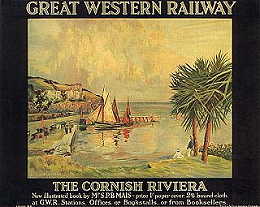
Thanks to Dieselpunk, my mind's currently on the romance of vintage travel - yes, I know that for all the tribulations of modern-day travel, there never was really a golden age, but some of the machines were things of beauty for all that. Some of the advertising slogans from the 'golden age' stretched the truth just a little bit - think of the re-branding of the Cornish coast as the "Cornish Riviera". But for real suspension of disbelief, I've just come across a rather splendid London, Midland & Scottish Railway poster advertising the delights of "Colwyn Bay, The Gateway to the Welsh Rockies"!
Wednesday, 6 January 2010
Snow

Snow's come to Newport Pagnell, as it has to the rest of the UK. Roads impassable, workplaces, schools and nurseries closed. I could complain about how everything in this country grinds to a halt after what Russians, Scandinavians, Canadians and other folk who get serious winter weather would regard as a light dusting of snow. I could, but I won't, as I'm as unprepared as the various authorities responsible for keeping the nation moving.
We have a sloping driveway, so our cars can potentially get stuck in a heavy snowfall and to clear the snow away fast, we clearly need a more effective tool than the little shovel in the garden shed. When I was a lad, my dad had an effective tool for clearing snow off the drive, which he'd made out of a large piece of board on a stick. I've had a year since the last serious snow, have enough basic woodworking skills to make such a thing and know that if enough snow and ice builds up, we can't get our cars off the drive, but I've never got round to making one.
I guess that's what humans tend to do in the face of rare events - we know something can happen, but if it happens infrequently enough, the motivation to do something about it isn't pressing enough to translate into the obvious course of action. If serious amounts of snow happen regularly, every year, individuals and authorities are geared up to do the necessary. If, as in the UK, snowy weather's very infrequent (in the South, we've had a succession of mild winters right up until last year's unexpected week of freezing weather), we just tend to forget that it can and eventually will happen, during the usual fifty-odd weeks of temperate weather. That's why I'm not going to go into an exasperated, eye-rolling rant about how we can't cope with a few inches of snow - at least, not until I get around to attaching a big piece of board to a stick.
Whilst I'm on the subject of dealing badly with rare events, I just came across another sensible suggestion for managing those pesky terrorists.
What if governments and security forces around the world set up a concerted plan not to give Al-Quaeda the oxygen of publicity, unless of course there were damage and casualties to report?
Wouldn't the blackout deal at least a partial blow to the campaign of fear and hatred that the Islamic funda-mentalists have been inflicting upon the world?
Says Claude. It's not rocket science, just the security equivalent of screwing a big piece of board to a stick.
Back to the snow - with a nursery closure day and the roar of the nearby M1 silenced due to traffic chaos, what better way to spend the morning than in the garden with my little boy building a snowman? Well, in my boy's opinion, building a snow Thomas the Tank Engine would be better (see picture above). Fortunately he's still young enough to be impressed by our crude, vaguely train-shaped snow pile.
So long as you don't have a life-or-death journey to make, being snowed in is a wonderful opportunity to stop the daily round and reflect in the eerie silence of a changed world. When you're playing with your little boy, those reflections can be cheerful ones. The reflections at the end of James Joyce's short story The Dead, are of a darker, more melancholy nature, but still remain one of the most atmospheric and lyrical pieces of writing about the thoughts which come when the world stops for snow:
She was fast asleep.
Gabriel, leaning on his elbow, looked for a few moments unresentfully on her tangled hair and half-open mouth, listening to her deep-drawn breath. So she had had that romance in her life: a man had died for her sake. It hardly pained him now to think how poor a part he, her husband, had played in her life. He watched her while she slept as though he and she had never lived together as man and wife. His curious eyes rested long upon her face and on her hair: and, as he thought of what she must have been then, in that time of her first girlish beauty, a strange friendly pity for her entered his soul. He did not like to say even to himself that her face was no longer beautiful but he knew that it was no longer the face for which Michael Furey had braved death.
Perhaps she had not told him all the story. His eyes moved to the chair over which she had thrown some of her clothes. A petticoat string dangled to the floor. One boot stood upright, its limp upper fallen down: the fellow of it lay upon its side. He wondered at his riot of emotions of an hour before. From what had it proceeded? From his aunt's supper, from his own foolish speech, from the wine and dancing, the merry-making when saying good- night in the hall, the pleasure of the walk along the river in the snow. Poor Aunt Julia! She, too, would soon be a shade with the shade of Patrick Morkan and his horse. He had caught that haggard look upon her face for a moment when she was singing Arrayed for the Bridal. Soon, perhaps, he would be sitting in that same drawing-room, dressed in black, his silk hat on his knees. The blinds would be drawn down and Aunt Kate would be sitting beside him, crying and blowing her nose and telling him how Julia had died. He would cast about in his mind for some words that might console her, and would find only lame and useless ones. Yes, yes: that would happen very soon.
The air of the room chilled his shoulders. He stretched himself cautiously along under the sheets and lay down beside his wife. One by one they were all becoming shades. Better pass boldly into that other world, in the full glory of some passion, than fade and wither dismally with age. He thought of how she who lay beside him had locked in her heart for so many years that image of her lover's eyes when he had told her that he did not wish to live.
Generous tears filled Gabriel's eyes. He had never felt like that himself towards any woman but he knew that such a feeling must be love. The tears gathered more thickly in his eyes and in the partial darkness he imagined he saw the form of a young man standing under a dripping tree. Other forms were near. His soul had approached that region where dwell the vast hosts of the dead. He was conscious of, but could not apprehend, their wayward and flickering existence. His own identity was fading out into a grey impalpable world: the solid world itself which these dead had one time reared and lived in was dissolving and dwindling.
A few light taps upon the pane made him turn to the window. It had begun to snow again. He watched sleepily the flakes, silver and dark, falling obliquely against the lamplight. The time had come for him to set out on his journey westward. Yes, the newspapers were right: snow was general all over Ireland. It was falling on every part of the dark central plain, on the treeless hills, falling softly upon the Bog of Allen and, farther westward, softly falling into the dark mutinous Shannon waves. It was falling, too, upon every part of the lonely churchyard on the hill where Michael Furey lay buried. It lay thickly drifted on the crooked crosses and headstones, on the spears of the little gate, on the barren thorns. His soul swooned slowly as he heard the snow falling faintly through the universe and faintly falling, like the descent of their last end, upon all the living and the dead.
Sunday, 9 August 2009
Ghost train
As I've mentioned before I don't like the underlying message of the Thomas The Tank Engine stories. Parental disapproval counts for nothing, though, and my son loves them. His collection of die cast trains from the series has become his favourite thing ever - toy cars are so last month. Anyway, here's a sinister mashup of Thomas The Tank Engine and the late Michael Jackson, posted by some creative genius on YouTube.
Thursday, 30 April 2009
Fear and Loathing on Sodor
Psalm 2:11-12 - Serve the LORD with fear, and rejoice with trembling.
I’ve not been doing a great deal of reading lately, except for bedtime stories. Reading bedtime stories to a child is generally a delight, not a chore (at least up to the moment when you realise that the child’s enthusiasm for one more story has precisely nothing to do with or the merits of the book being waved under your nose, or the skill of your storytelling, but everything to do with postponing bed time). So when junior acquired a book of stories about Thomas the Tank Engine and his friends, I was quite happy.
Thomas the Tank Engine was part of my childhood – as well as some books, I had a couple of records of the train stories (voiced, by Johnny Morris, the man who used to give animals “amusing” voices in Animal Magic, a BBC programme for which I had an inexplicable fondness as a small child). Nostalgic, innocent, wholesome, full of steam trains – what could be more splendid?
Unexpectedly, The Adventures of Thomas has become my least favourite bedtime reading. The main thing I dislike about the current stories is how much the railway network on Sodor resembles a dysfunctional society or workplace. For much of the time, the engines are insecure, anxious, harassed, stressed, thin-skinned, dependent, competitive and jealous. They puff around in mortal fear of being replaced or demoted, desperately trying to please the all-powerful Fat Controller. It’s like watching the baby executives on the The Apprentice jumping through hoops in their pitiful attempts to catch the eye of Alan Sugar, replete from gorging on his power-breakfast. The stories are, I think, intended to be very moral, but the lessons to be drawn from them seem rather limiting – don’t get ideas above your station (that pun was as inevitable as it was terrible), but do respect and fear authority figures.
Children’s stories shouldn’t have a big, clunking, moral, although they can painlessly teach some valuable lessons and ideas about life. These stories have what I see as an anti-moral – a perfect recipe for how not to grow as a human being. Live in fear, respect hierarchies, obey orders without question, don’t have autonomy, don’t question authority, don’t think independently, never be proud of what you’ve achieved, just let your life run on the rails prepared for you by a higher authority.
Years ago, when I read Will Self’s My Idea of Fun, a violent, hallucinatory novel featuring a demented marketing consultant and serial killer whose grotesque mind is moulded by the (imaginary?) influence of a figure called The Fat Controller, I wondered what it was about the Thomas the Tank Engine stories that got Will so worked up. Maybe it was just a piece of calculated gonzo-style outrage from the man famous for doing heroin on John Major’s jet during the 1997 election campaign. But now I’m beginning to see the dark side of Reverend Awdry’s jealous God for myself.
Subscribe to:
Posts (Atom)