Showing posts with label ART. Show all posts

Sunday, 18 April 2021

Paleoart: the next generation

The past is a foreign country; they do things differently there. The deep past is so weird and wonderful it's practically another planet. I've enjoyed the sheer otherness of artists' attempts to recreate scenes from deep time since I was a kid. Here's an illustration of "early forms of life" from the pages of the Odhams Encyclopaedia for Children I was given for my 6th birthday. The artist was one John Rignall:

It's the sort of busy scene, packed with weird and wonderful detail which might appeal to a child, and it did. Looked at from a half century later it shows how far and fast reconstructions of the Mesozoic world have changed. From the kangaroo-posed therapod to the offended-looking tail-dragging sauropod to the absence of feathery dinos that aren't Archaeopteryx, the ancient creatures all have a retro look.

OK, it's an impressionistic overview for kids, including an assemblage of plants and animals most of which lived many millions of years apart from one another. But even the more "realistic" dino books I had as a kid featured reconstructions like this one by Zdenek Burian, of semi-aquatic Brachiosauruses adopting a watery lifestyle to take the enormous weight off their feet:

Some people are, apparently, a bit fed up that the dinosaurs they thought they knew as kids have been superseded by new best guesses at what these creatures looked like in life. Personally, I find a lot of the new paleoart keeps the sense of wonder I had as a child new and fresh.

For a taste of what I mean, I can warmly recommend a visit to Dr Mark Witton's wonderful paleoart-themed blog. It's full to the brim with strange, beautiful and astonishing visions of past life by Mark and many others. From my personal favourite for their sheer weirdness, the giant azhdarchid pterosaurs, to bizarre big-headed predators from the Triassic, or Diplodocus, there are wonders on every page. And also discussions of why (scientists think) these critters look the way they're illustrated. 

 There is, for example, an interesting post on lips versus exposed teeth in illustrations of extinct carnivores. That post seemed, at least to this non-expert, to make a pretty solid case for assuming lips in all but a very few cases. Interestingly, John Rignall's therapod dinosaur from my childhood encyclopaedia, although its teeth are showing slightly, looks as if it has lips. At the very least, Rignall has made it ambiguous and not as boldly and ostentatiously toothy as many lipless carnivorous dinosaur illustrations of the time:

Also interesting that, from all the big, fierce , famous, carnivorous dinosaurs he could have chosen, (T Rex, Allosaurus, Megalodon), Rignall chose the obscure Antrodemus, a contested name for what most paleontologists would call bits of an Allosaurus. Although Rignall might be up there with modern paleoart with what seems to be lips on his Antrodemus/Allosaurus, the kangeroo posture and palms-down hands is definitely retro dino - compare and contrast with this modern reconstruction of the posture of Allosaurus jimmadseni:

Image credit: Scott Hartman (Creative Commons Attribution)

The other great thing about Mark is that, although there's lots of solid science in there, he doesn't take himself too seriously and he's generous with the playful pop culture references; see What Daleks, xenomorphs and slasher movies tell us about palaeoart and here, on his Twitter feed, Mark imagines what a gorilla the size of King Kong might actually look like, (given the biomechanics of very large animals, not much like a gorilla):

"It was skeletal and circulatory weakness killed the beast. We've come up with a patch for these issues with the release of Kong 2.0."

This is fantastic (in both senses of the word), but it's worth remembering that scientist's current understading of the constraints on the size and shape of animals is built on some old and well-established principles. As Stephen Jay Gould once noted:

Galileo first recognized this principle in his "Discorsi" of 1638, the masterpiece he wrote while under house arrest by the Inquisition. He argued that the bone of a large animal must thicken disproportionately to provide the same relative strength as the slender bone of a small creature.
For more speculation on the biology of oversized apes (in this case of the human variety), this video on the biology of giants by YouTuber Trey the Explainer also has some fun with the topic of biological scale:


I'm liking this stuff very much. Almost as much as this awesome poster for the, sadly unmade, Hammer movie Zeppelins v Pterodactyls. Yes, I know I've shared this image before but honestly, just look at this thing. As Dr Johnson almost said, when a man is tired of pterodactyl-on-Zeppelin action, he is tired of life.


Sunday, 28 March 2021

Finding Nemo (again)


From my blog post We all live in a retro submarine from April 2010

I just had a reminder of this photo, which I took in Brighton over a decade ago. A few things have changed since then. My son, who was just about the right size to captain this hobbit-scale sub is now as tall as me (give or take; it's hard to tell when his default posture's the stereotypical teenage slouch). 

But I'm still coming across subs out there which look like takes on Jules Verne's fictional Nautilus. A more or less unrelated search recently came back with this:

Image Credit: H I Sutton's Covert Shores blog

Although it dates from the around  same era when I took my picture, this is no cartoonishly cute sculpture, or theme park attraction, but an attempt at an actual working submarine (well, a semi-submersible, anyway), designed and built with deadly purpose by the Liberation Tigers of Tamil Eelam, better known as the Tamil Tigers, in the closing days of the Sri Lankan Civil War.

Like the sculpture, this is on a far smaller scale than Nemo's Nautilus (it's a midget semi-sub, probably only around a 10th of the length of the fictional 70 metre Nautilus). Interestingly, Hutton also compares it to a Nineteenth Century submersible, but a real one. That's because, like the Confederate Civil War-era sub the Huntley, the Tamil Tigers' vessel looks as if it was designed to attack ships by ramming them with a spar torpedo attached to the pole sticking out of its bow.

This isn't the only interesting oddity to be found in the Covert Shores blog, which features a compelling selection of unusual naval tech, both current & vintage. Highlights include Russia's huge, terrifying nuclear powered/armed torpedo, named "Posiedon" (Посейдон), after citizens were given a vote on the name of Russia's latest weapon of mass destruction (can't help feeling disappointed that they didn't end up with a doomsday weapon called Nukey McNukeface). Then there's quite a bit of stuff on (mainly Latin Ameican) narco subs, the use of marine mammals for naval operations, the mysterious death of Lieutenant-Commander "Buster" Crabb, a prohibition-era moonshine-smuggling sub and the James Bond-ish hardware of Swimmer Delivery Vehicles underwater "chariot" attack craft and various stealthy/low-profile vessels.

Another treat from Covert Shores is Hutton's own interpretatation of Verne's Nautilus, which is closer to a visualisation of what was described in the novel than the Harper Goff's looser, but nonetheless wonderful, visualisation

It wasn't a search for this iconic proto-steampunk design which originally led me to Hutton's blog, though. I was initially looking for information on another a piece of retro futurism from a later era, namely this sleek deco-looking experimental helicopter design from the 1930s:

Like the Tamil Tigers' mini-Nautilus, the  Dorand G20 Gyroplane looks like something that's sprung out of the pages of vintage Science Fiction into real life. In this case, if you ever had a mental picture of the ubiquitous helicopters which flitted around the art deco skyscrapers in Huxley's Brave New World, carrying the Alphas and Betas to and from their places of work, consumption or leisure, it probably looked like something like this.

Like the Tamil mini sub, though, this helicopter was orignally built with more aggressive intentions - there was an idea that the Dorand would replace the spotter plane which was kept on board France's massive inter-war Surcouf cruiser submarine (that's the link which originally brought me to the Covert Shores blog).

The Dorand Gyroplane isn't quite as insanely art deco as the never-flown Bugatti racing plane from the same era, but it comes pretty damn close.

Definitely at the more elegant end of the very wide spectrum of French aircraft designs from the 1930s. As somone once said:

When one looks at French aircraft of the period immediately before and during World War Two, it is evident that there were two schools of thought when it came to aircraft design! One school was to design elegant, graceful and beautiful aircraft. The other was to see just how ugly they could make the airplane and it still fly and perform the duties it was designed for.

Mon Dieu, quel bordel!

 Now there's a design that wouldn't ever make it it into fiction. Oh, hang on...

The Canadian Air Force (according to South Park: Bigger, Longer and Uncut).


Sunday, 29 April 2018

The great leader inspires the youth

20th Century authoritarian kitsch: Roses for Stalin, by Boris Vladimirski
21st Century authoritarian kitsch: Teach a Man to Fish, by Jon McNaughton


For a didactic, ideological painting with a clunkingly obvious propaganda message, Teach a Man to Fish sure poses a lot of questions. I'd add one more question to the list. Who's morally worse, Vladimirski or McNaughton?

You could say Vladimirski was worse, on the grounds that his painting was a fawning celebration of a mass murderer. Say what you like about Trump, but he can't come close to matching Stalin's body count, and probably never will (unless he pokes the nuclear button).

On the other hand, Vladimirski and his fellow socialist realists were churning out obsequious hack work in a society where dissent could be punished by a one-way ticket to the Gulag, or a bullet to the back of the head. McNaughton doesn't have the excuse of acting under duress when he churns out his obsequious hack work.

Tuesday, 29 August 2017

A taxonomy of imaginary elephants

When people who've never seen an elephant try to draw one, the results can be ... interesting.

German artist Uli Westphal has created a family tree of imaginary elephants, based on old accounts and travellers' tales, as drafted by medieval European artists, then elaborated by subsequent copyists.

The resulting bestiary ranges from the conservative (tapier-like creatures, drawn by artists who presumably wanted to keep the reported trunk down to a plausible-looking size), to fanciful beasts sporting fanned-out ears, ribbed like fish fins, or bat wings.

Interestingly, it's some of the most conservative visions, with a modest trunk, or bodily proportions based on a known animal like a horse, that look the least like a real elephant.

The universe, as someone* once mused, is not only odder than we imagine, but probably odder than we can imagine. Although a few of these illustrators got pretty close to out-odding nature with elephants that wouldn't have been out of place in a Hieronymus Bosch painting.

Via

*Someone who could also have explained exactly why an animal the size of an elephant doesn't have the same proportions as a horse.

Monday, 24 April 2017

It's a small world

Welcome to the small, but perfectly formed, Positive Solutions Pavilion (criticism is prohibited).

See the whole tiny exhibition of surrelistic papercraft concept architecture, from the Botanical Sparkly Desert Oasis Pavilion to Templeton Gators Swim Club Pavilion here.

Saturday, 28 January 2017

Deco dragon

We moved house recently and all sorts of forgotten, random objects keep turning up in unexpected places. For example, this 1935 commemorative coin from God knows where, featuring a stylised St George slaying a very streamlined, wingless dragon. You hear a lot about Victorian gothic, but not so much about deco gothic* which, it seems, was also a thing once.


* Not to be confused with express deco gothic.

Monday, 7 November 2016

Sublime, improbable Martian engineering

 *Spoiler alert- if you've not already read H G Wells's The War of the Worlds, do so immediately, or read on at your own peril...*

I've just been re-reading the first alien invasion novel, H G Wells's The War of the Worlds, and I can see again why it created a genre all of its own and why it immediately grabbed me as a child. Mainly because it's such a cracking yarn - the alien visitation starts off as an intriguing curiosity, but escalates to being, ominous, threatening, awe-inspiring and terrifying at an unstoppable pace that mirrors the relentless advance of Well's iconic Martian tripods, seen here in  one of the novel's big reveals:
And this Thing I saw! How can I describe it? A monstrous tripod, higher than many houses, striding over the young pine trees, and smashing them aside in its career; a walking engine of glittering metal, striding now across the heather; articulate ropes of steel dangling from it, and the clattering tumult of its passage mingling with the riot of the thunder. A flash, and it came out vividly, heeling over one way with two feet in the air, to vanish and reappear almost instantly as it seemed, with the next flash, a hundred yards nearer. Can you imagine a milking stool tilted and bowled violently along the ground? That was the impression those instant flashes gave. But instead of a milking stool imagine it a great body of machinery on a tripod stand... Seen nearer, the Thing was incredibly strange, for it was no mere insensate machine driving on its way. Machine it was, with a ringing metallic pace, and long, flexible, glittering tentacles (one of which gripped a young pine tree) swinging and rattling about its strange body. It picked its road as it went striding along, and the brazen hood that surmounted it moved to and fro with the inevitable suggestion of a head looking about.
That's a fantastic piece of writing and there are lots more like it. The book also has its expository digressions, where the action stops and Wells explains things rather than just showing you awesome stuff, but these aren't too long (at least by the standards of the time when Wells was writing) and by this stage he's already created enough momentum to keep you gripped and reading on. Compare and contrast with that other piece of proto-sci-fi, 20,000 Leagues Under the Sea, which also starts with strange, ominous events, building up to an exciting reveal and some great set pieces, but is so weighted down with the ballast of endless pages of over-long explanation that Verne almost sinks the cracking yarn he created.*

If the The War of the Worlds looks forward to every alien invasion yarn that followed, it also looks back to an aesthetic trope that's probably been around for ever, but was largely formalised in the Eighteenth Century and peaked with early Nineteenth Century Romanticism - the sublime. That's the idea that humans don't just appreciate things which are beautiful in an ordered, harmonious way, but also dig stuff that's wild, inhuman in scale and frankly terrifying - as the Tate Britain put it, in the blurb to an exhibition dedicated to "Art and the Sublime":
The best-known theory published in Britain is Edmund Burke’s A Philosophical Enquiry into the Origin of Our Ideas of the Sublime and Beautiful (1757). Burke’s definition of the sublime focuses on such terms as darkness, obscurity, privation, vastness, magnificence, loudness and suddenness, and that our reaction is defined by a kind of pleasurable terror.

During the eighteenth and nineteenth centuries, the sublime was associated in particular with the immensity or turbulence of Nature and human responses to it. Consequently, in Western art, ‘sublime’ landscapes and seascapes, especially those from the Romantic period, often represent towering mountain ranges, deep chasms, violent storms and seas, volcanic eruptions or avalanches which, if actually experienced, would be life threatening.
Compare Wells's description of the towering Martian tripod with William Wordsworth describing his youthful memory of stealing a boat and rowing out onto Ullswater at night, in The Prelude. As young Wordsworth looks back guiltily at a peak overlooking the lake, the huge, shadowy, inhuman form seems, by an unsettling trick of perspective, to be pursuing his boat:
And, as I rose upon the stroke, my boat
Went heaving through the water like a swan;
When, from behind that craggy steep till then
The horizon's bound, a huge peak, black and huge,
As if with voluntary power instinct,
Upreared its head. I struck and struck again,
And growing still in stature the grim shape
Towered up between me and the stars, and still,
For so it seemed, with purpose of its own
And measured motion like a living thing,
Strode after me...
Wordsworth's looming peak only looked threatening, but extreme fans of the sublime had access to far more hardcore material than that. Wells's Martians may have wreaked terrible destruction on the South East of England, but even they would have had a hard time competing with acts of God. The Almighty's awesome destructive capacity was given the sublime treatment by popular Nineteenth Century painter John Martin, in a series of massive, full-frontal disaster porn canvasses like The Great Day of His Wrath:
It's the end of the World as we know it (and I feel fine).
Sublimely terrifying and imaginative though Well's Martian tripods are, it's probably best not to think too hard about how they work. According to Wells's description, the unearthly three-legged machines move like "a milking stool tilted and bowled violently along the ground" and elsewhere he writes of their swiftness and "rolling" motion, which is vivid enough.

But if the whole machine is whirling around to pivot from one leg to the next, surely the Martian pilot within is also being whirled around, unable to stay facing the machine's direction of travel (or any other fixed direction) and getting horribly dizzy, (assuming that the Martian vestibular system can suffer from dizziness).

Maybe the tripod legs whirl around, but the cowl housing the Martian pilot doesn't. But that would imply that controlling part of the machine is mounted on some sort of axle or pivot, which, according to Wells, isn't the way the Martians, with their biomimetic technology, do things:
And of their appliances, perhaps nothing is more wonderful to a man than the curious fact that what is the dominant feature of almost all human devices in mechanism is absent--the wheel is absent; among all the things they brought to earth there is no trace or suggestion of their use of wheels. One would have at least expected it in locomotion...

 ...And not only did the Martians either not know of (which is incredible), or abstain from, the wheel, but in their apparatus singularly little use is made of the fixed pivot or relatively fixed pivot, with circular motions thereabout confined to one plane. Almost all the joints of the machinery present a complicated system of sliding parts moving over small but beautifully curved friction bearings. And while upon this matter of detail, it is remarkable that the long leverages of their machines are in most cases actuated by a sort of sham musculature of the disks in an elastic sheath; these disks become polarised and drawn closely and powerfully together when traversed by a current of electricity. In this way the curious parallelism to animal motions, which was so striking and disturbing to the human beholder, was attained.
Of course, this might just be one of the singularly rare occasions when the Martians did make use of the fixed pivot, but it definitely goes against the Martians' overriding design ethos. Or maybe the cowl isn't on a pivot, just hyper-mobile, like an owl's head:
But this would present difficulties of its own - if the tripod rolled around in only one direction, the head would eventually have to snap back round, even if it could stay pointing in one direction for a while. If the tripod alternated its direction of roll, a hyper-mobile head would work, but the change from whirling in one direction to another would would be inefficient, robbing the machine of momentum, just as it was getting onto a roll.

Movie versions of the novel have struggled (or not tried) to reproduce the motion of the Martian tripods, as described by Wells. In the 1953 film adaptation, the special effects people decided that they just wouldn't be able to create a convincing walking tripod and opted to redesign the Martian fighting machines as floating manta ray-shaped craft, topped with a heat ray on a flexible mounting that looked like a striking cobra. In a nod to the original novel, the film's hero scientist explains that the seemingly unsupported Martian craft are actually held up in mid air and moved by means of three invisible "electromagnetic legs."

With the advent of CGI, a later generation of special effects wizards were finally able to produce a plausible-looking version of the Wellsian tripods for Steven Spielberg's 2005 film adaptation - sort of. In some ways the CGI works well and the tripod machines have some of the Wellsian details right. For example, the limbs are flexible, just as Wells described, looking more like a supple living thing than a stiff, jointed mechanism

.
But the motion is distinctly un-Wellsian - Spielberg's tripods don't whirl forwards with an unstoppable rolling gait, but pick their three-legged way through the ruins like a dog with an injured paw, or a human walking with one good leg, a plaster cast and a crutch. I don't think this really catches the essence of Wells's vision, where the tripods signified two things. First, alienness - no creature on our planet has evolved to walk on three legs. Second, implacable swiftness - it's clear from the original novel that the Martian machines move fast and efficiently on their three legs, bearing down like express trains on the puny humans in their path, pursuing and outflanking them with ease.

To date, nobody (AFAIK) has been able to represent, or reproduce the sort of tripod locomotion Wells described so vividly. Whether this is a failure of imagination, technical skill, or just a reflection of the fact that it's impossible to translate Wells's vision into actual engineering, I don't know (although the fact that terrestrial biology has taken millions of years not to come up with a working three-legged creature might point to three legs just being an inefficient number for a walker).


An impossible form of locomotion, or just one nobody's figured out yet? You decide.


*To be fair, I've only read it in translation and it probably sounds better in French, but the endless pauses in the action when Verne just stops everything to list species of fish, or whatever, must be just as boring in any language.

Wednesday, 28 January 2015

I love the smell of cauliflower in the morning

Oddity of the day: the napalm bursts from Apocalypse Now, recreated with a cauliflower and a light bulb. Why? Apparently Radu Zaciu was first inspired to start photographing illuminated fruit and veg because the German slang term for a light bulb is “glühbirne” (“glow pear").

It's been a good month for this sort of thing, what with Theaster Gates winning the Artes Mundi Prize for his installation, A Complicated Relationship Between Heaven And Earth, or When We Believe, which featured, among other things, a stuffed goat riding a tricycle round a circular track. Why? 'The installation contemplates how objects have been used as signifiers of power - and perhaps re-opens them, to be real instruments of accessing belief.'

No, me neither. At least I understood the light bulb thing.

Mind you, Theaster's probably wise to pitch his tricycling goat as some kind of Profound Artistic Insight Into Serious Stuff. If he didn't, the goats might think that humans were just taking the piss and, as we learnt last year, goats are not to be mocked with impunity.

But, never mind the artybollocks, Theaster does sound like a pretty good bloke who, as well as entertaining the rest of us with his eccentric art, generously chose to share his £40,000 prize money with his fellow nominees, so I'd be genuinely sad to see him set upon by a platoon of enraged goats.

Friday, 10 October 2014

The flying canvases of Paul Klee

I've always liked Paul Klee's semi-abstract geometrical paintings, the ones that you could see as 2D impressions of architectural townscapes or just harmonious arrangements of pleasing blocks of colour. There's a sense of tranquility, rhythm and order that's both satisfying and very easy on the eye.
Red/Green Architecture (yellow/violet gradation), Paul Klee, 1922

I never knew much about Klee's biography, but in this Great War centenary year I've discovered something that suggests he got some of his inspiration from a less-than-tranquil source:
After finishing the military training course, which began on 11 March 1916, he was committed as a soldier behind the front. Klee moved on 20 August to the aircraft maintenance company in Oberschleissheim, executing skilled manual work, such as restoring aircraft camouflage, and accompanying aircraft transports. On 17 January 1917, he was transferred to the Royal Bavarian flying school in Gersthofen ... to work as a clerk for the treasurer till the end of the war. This allowed him to stay in a small room outside of the barrack block and continue painting.
To give you some idea of the connection I'm seeing, take a look at the patterns on the fabric covering this restored World War I German aircraft:


Fokker D VIII, covered in camouflage fabric featuring repeating irregular polygons, 1918.
Quite Klee-esque, don't you think? It's not a complete clincher, as Klee was camouflaging aircraft in 1916 and this sort of pattern above only became widespread in 1917-18, but if we take a nerdy look at the development of aircraft camouflage in the Great War, I think you'll agree that the connection still looks compelling.

In 1914, the air arms of the various belligerents were made up of mainly fabric-covered aircraft. The fabric, along with metal engine covers and visible wooden parts, was left unpainted. The fabric was stiffened with clear dope and the wooden bits were varnished. The first change came when the various other powers started to follow the French practice of applying national markings, in order to discourage friendly fire. Only when their aviators and aircraft were (relatively) safe from being shot by their own side, did  the various authorities turn their attention to using camouflage to protect them from the enemy.

The British took a minimalist, utilitarian approach, leaving the undersurfaces of their aircraft in unpainted fabric and painting the upper surfaces a uniform dull green or brown, which was probably reasonably effective, although the British colours were about as aesthetically appealing as a palette of ruminant dung samples from animals fed on varying amounts of fresh green grass.

The French moved from unpainted fabric, first to silver dope (this wasn't a really bad attempt at camouflage - the silver was there to counteract the degrading effect of the UV in sunlight on the fabric, not as a misguided attempt at concealment), then to various painted wavy, splotchy disruptive lines in the sort of greens and browns that we associate with military camouflage.

The Germans were more inventive and tried a number of paint schemes, from relatively conservative finishes (light greys and patches of greens and browns), to more interesting effects, like a streaky olive green finish over a turquoise base, or this rather pleasing purple and green combo, as seen on the wings of a blazing Albatros, in this painting by Airfix box art legend, Roy Cross:
'Take that, Red Baron!' (from "Biggles is Colour Blind")
Anyway, a lot of these sort of schemes were in use in 1916, when Klee was based in Oberschleissheim. But another, more complex, scheme was being developed, a pointillist-inspired pattern of coloured polygons. It would probably have been in the development stage at the time when Klee was serving as a skilled tradesman-cum-camoufleur, and would have been painstakingly hand-painted, but there is photographic evidence of this being done on an aircraft of the right vintage - an E IV monoplane produced by the Pfalz company, shown here, complete with hand-painted polygons.

As Wikipedia helpfully relates, those time-consuming early experiments with hand-painted  polygons eventually led to some bright spark realising that you could save time and weight by printing the complex pattern onto the fabric beforehand, like wallpaper or curtains, rather than painting it on later (if I'm reading this thread at The Aerodrome right, that bright spark was one 'artist working at Idflieg named Ltn. Reimschneider', although it may be that Reimschneider was just the originator of two particular types of flugzeug tarnstoff, known in English as five colour day and night lozenge patterns, not the concept of printing all such patterns). By 1918, Halberstädter Flugzeug Werke's textile mills were covering most of the Kaiser's military aircraft with pointillism-inspired camouflage fabric, printed with repeating abstract patterns, made up of irregular polygons or regular hexagons.

So I'd say that there's at least as much credibility in the notion that camouflage influenced Klee's art as there is in Picasso's anecdotal declaration that cubists invented camouflage:
I very well remember at the beginning of the war being with Picasso on the boulevard Raspail when the first camouflaged truck passed. It was at night, we had heard of camouflage but we had not seen it and Picasso amazed looked at it and then cried out, yes it is we who made it, that is cubism.
Gertrude Stein, Picasso

While we're (tangentially) on the subject, polygons eventually caught on with the Austro-Hungarians as well, as can be seen on this restored aircraft, formerly the property of the Austro-Hungarian Imperial and Royal Aviation Troops, currently in the Prague Technical Museum:
Knoller C II (photo by Alfvan Beem, Wikimedia Creative Commons)
According to my sources, though, the Austo-Hungarians never got round to producing printed polygons and were hand-painting these complex patterns on their aircraft right up to the bitter end of the war. If so, this is one case where that lazy cliché about German efficiency actually seems to be true. If the reserved occupations were tied up in labour-intensive processes like painting complicated honeycomb patterns onto aircraft and the conscripts were anything like the ones portrayed in The Good Soldier Švejk, it's no wonder the Ausro-Hungarians lost not only the war, but their whole country.
Hi Ho Hi Ho , It's Off To Work We Go!!  (partly-polygon-painted Berg D I fighters in a factory somewhere - photo lifted from a Czech language website)
Mind you, the process may not have been efficient, but the flamboyant end result looked great.
C'est magnifique, mais ce n'est pas la guerre...
But for something even less warlike, get a load of the one aircraft camouflage fabric that I know the Austro-Hungarians did get round to printing. And this time it's not polygons:
Swirly whirlys
And in colour:
Man, that's trippy!
Printed by Johann Backhausen und Söhne, manufacturer of tablecloths, rugs and suchlike, as applied to aircraft like the Austro-Hungarian manufactured version of the Abatros D III, seen here in model form. From the art of war to the soft furnishings of war...


Saturday, 6 September 2014

Thoughtcrime must not go unpunished

Universities and colleges may, equally, encounter high performing employees who, although academically brilliant, have the potential to damage their employer’s brand. This could be through outspoken opinion or general insubordination. Irrespective of how potentially valuable these employees may be to their institutions, the reality is that, in consistently accepting unacceptable behaviour, institutions may be setting dangerous precedents to other employees that such conduct will be accommodated. From a risk perspective, it is also much harder to justify a dismissal, or other sanction, if similar conduct has gone unpunished before.

As much as employers may hope that unacceptable behaviour from key employees will be curbed without sanction, in reality the problems will persist, needing to be addressed further down the line. It remains to be seen whether Suarez is right when he says that he will never bite another player again, but he has made similar statements before. 
David Browne, writing on law firm SGH Martineau's corporate blog, as quoted here.

You heard that right - according to today's managerialist ideology, the 'insubordination' of daring to have independent opinions that that don't fit in with your employers' carefully-curated corporate brand image is a bizarre, pathological aberration, just like footballer Luis Suarez's weird compulsion to keep biting opposing players.

Remember that the employees Browne's talking about here are valued, capable ones in reasonably high-status occupations, working in institutions which ostensibly nurture enquiry, debate and questioning. Imagine what it's like for people who work in the sort of places where 'we don't pay you to think.' Browne just validated Nick Cohen's sobering observation that 'the moment you enter your place of work, you no longer reside within a governed democracy, but instead are enslaved to a systematic dictatorship.'

In a less screwed-up world, David Browne, would be in massive trouble with his bosses for irreparably damaging his firm's brand* in the minds of all reasonable people by blogging this astonishing attack on freedom of speech on the firm's website. After all, a reasonable reader would conclude that any firm which endorsed such views, must have a sinister, authoritarian, bullying ethos and would have no qualms about advising bosses to use legal threats and sackings to punish thoughtcrime.

In the topsy-turvey times we live in, Browne was able to get away with merely 'clarifying' his comments in response to the justified twitterstorm that his horrific blogpost provoked. A key passage of the "clarified" post reads thusly:
This [brand-damaging behaviour] could be through outspoken opinions (where these fall outside the lawful exercise of academic freedom or freedom of speech more widely) or general insubordination, e.g. a failure to comply with the reasonable requests of an employer, or other behaviour such as bullying or harassment of colleagues.
So, there you have it - you can open your mouth, but if you upset your bosses, they and their corporate lawyers might be alert for anything that might be construed to fall 'outside the lawful exercise of academic freedom or freedom of speech more widely' and won't hesitate to use it to get you sacked (see "chilling effect"). Plus you get a lecture on bullying and harassment from more powerful people who think it's fine to push uppity subordinates out of a job for daring to speak out of line.

Thank you for sharing your opinions and clarifications, Mr Browne. They have been duly noted. Now bite me, weasel boy.


*You owe me for one broken irony meter, Browne.

Friday, 2 May 2014

The Dilbert mystery

I worked in a big insurance office when the first collections of Dilbert toons came out, back in the '90s. I became a major fan and introduced the strip to a few of my fellow low-cost, high-density work units,* who also loved it. I still think it's a pretty good description of the absurd reality of corporate life and office politics. I especially like the economy and integrity of the strips, the way the simple, minimalist, consistent line drawings reflect and reinforce the terse, laconic wit of the dialogue. Dilbert, with his blank, deadpan expression is the perfect delivery system for Adams' dry, wry one-liners.

I was also quite a fan of Scott Adams himself, whose career trajectory from downtrodden corporate drone to successful creative artist, living by his wit(s) was an inspiration. I loved the idea of taking all the frustrations and idiocies of working life and turning them, through creative alchemy, into entertainment and a profitable career. It's a perfect escape fantasy; one minute you live the circumscribed life of a lowly team player, faking enthusiasm for (or hiding your resentment at) every dumb idea and bullshit buzzword that oozes down the hierarchy, the next you're a licensed jester, gleefully spearing every new corporate inanity with your pen.

The great thing about being a licensed jester is that you can say what you damn well like and not give a fig for what it will do for your career prospects. It must be great, being able to fearlessly say whatever you damn well like, right?

Wrong, apparently, judging by the title of a recent post on the Dilbert blog, entitled I Miss Having Freedom of Speech. So what's the problem?
Today I wrote two blog posts about events in the news. That writing is some of my best work. You won't see either post. And for that you can thank Jezebel.com, Gawker.com, and Salon.com.

Unfortunately, both of my posts have content that could too easily be taken out of context by the bottom-feeding parts of the media and special interest groups looking to bolster their causes. Even my standard disclaimer wouldn't be enough in these two cases. My opinions in the two posts aren't the least bit offensive, but out of context they would look so. 
What is this potentially explosive content that might be distorted in order to discredit Scott? Too controversial to even hint at - he can't bring himself to mention the thing he was going to write about in his post and when people in the comments plead for a clue, he still ain't sayin' nuthin'. Scott's 'standard disclaimer', by the way, goes like this:
Warning: This blog is written for a rational audience that likes to have fun wrestling with unique or controversial points of view. It is written in a style that can easily be confused as advocacy for one sort of unpleasantness or another. It is not intended to change anyone's beliefs or actions. If you quote from this post or link to it, which you are welcome to do, please take responsibility for whatever happens if you mismatch the audience and the content.
The tone of his recent post and the wording of his disclaimer, imply that he's had at least an e-sack full of hate mail and has quite possibly been subject to physical or litigious threats, on account of controversial subjects he's tackled the past.

Other sources suggest that he's waded into some controversial areas and has simply been forcefully disagreed with by people who thought his comments on specific topics were dumb, ignorant or patronising. The most notorious specific examples are:
I’ve been trying for years to reconcile my usually-excellent bullshit filter with the idea that evolution is considered a scientific fact. Why does a well-established scientific fact set off my usually-excellent bullshit filter like a five-alarm fire? 
and
The reality is that women are treated differently by society for exactly the same reason that children and the mentally handicapped are treated differently. It’s just easier this way for everyone. You don’t argue with a four-year old about why he shouldn’t eat candy for dinner. You don't punch a mentally handicapped guy even if he punches you first. And you don’t argue when a women tells you she’s only making 80 cents to your dollar. It’s the path of least resistance. You save your energy for more important battles.
Taken at face value, these statements seem batshit. Even qualified by his standard disclaimer, they sound pretty bizarre. Maybe he did write these words, but didn't mean them, or was being satirical and meant the opposite of what he wrote, or was deliberately being provocative in order to flush sexist knuckle-draggers and creationist numbskulls into the open, or wanted to "start a conversation" on the issues. But  if you're going to say things like that, you'd better have a very good, specific explanation.

A boilerplate disclaimer that basically says 'I might mean what I'm going to say, or I might not, but I'm not going to tell you which and if you don't like what I say, it's probably your fault for being some kind of literal-minded idiot' triggers my usually-excellent bullshit filter every time. After all, he's an experienced satirical cartoonist who has, so far, been able to negotiate the ambiguity of giving voice to his outrageous or sarcastic characters without having to resort to a 'The views expressed in this cartoon do not necessarily represent the views of Scott Adams' disclaimer after every strip.

Here's a modest proposal. How about deciding whether your basic mode of writing involves saying what you really think, or something else, like being ironic or satirical, then having a more straightforward disclaimer if you feel that you might be misunderstood?

A specific example would be Chris Dillow, who blogs more or less what he thinks. If he's doing something slightly different he adds a 'Note for the hard of thinking' (e.g. 'if you believe in x, then y logically follows - by pointing this out, I don't necessarily mean that I believe in x'). Or there's Tom Pride, whose normal mode is satire. Sometimes he'll post about a real-life story that's so outrageous that it sounds like satire, in which case he'll add, 'not satire.' Simple.

Both blogs are written for a rational audience that likes to have fun wrestling with unique or controversial points of view and both manage perfectly well with simple, comprehensible disclaimers, rather than a catch-all get-out-of-jail-free-card statement. If Scott Adams made his disclaimers a bit simpler, we might finally penetrate the mystery of what he really thinks about things like evolution, gender equality and the thing that must not be named because it's so controversial.


*The phrase "low-cost, high-density work unit" came from a descriptive label I found on the underside of one of the desks we worked at, but it could equally well have described  the Dilbert-esque existence of the millions of human resources who populate the little boxes on corporate org charts.

_____________________

Update - the subsidiary mystery of why Jezebel.com annoys Scott is no mystery (via). If you don't enjoy finding out that your idols have feet of clay (or at least weak ankles), it's been a bad day.

Thursday, 10 April 2014

Mysterious packaging art

There seems to be more surreal symbolism going on here than would be strictly necessary just to sell hand cream:
Why is the woman with the unfeasibly small head planting her tiny plant in that enormous hole? I've been trying to work out what this is supposed to mean for several hours, but I haven't come up with anything plausible yet.

Filed under "I really need to get out more"...

Tuesday, 18 March 2014

The uneven march of progress


Bob Seidensticker is annoyed with theists who give unhelpfully convoluted philosophical answers to empirical questions and concludes that nonscientific philosophy doesn't get anybody very far:
Alvin Plantinga argued that philosophy is relevant at the frontier of science when he said that philosophy is just thinking hard about something. By that definition, Werner Heisenberg (a physicist) was doing philosophy when he came up with his uncertainty principle, Kurt Gödel (a mathematician) was doing philosophy when he discovered his incompleteness theorems, and Alan Turing (a computer scientist) was doing philosophy when he developed the Turing Test. Maybe string theory or ideas on the multiverse are philosophy.

A broad definition of philosophy doesn’t bother me, but note that all these “philosophers” were first scientists or mathematicians. That’s why they were able to make their contributions. While a scientist can put on a philosopher’s hat and do great work, the reverse is not true...

...Lots of sites have Top Ten lists of scientific discoveries for 2013 ... We found new clues that Mars was once habitable, the Voyager 1 spacecraft left the solar system, DNA was sequenced from [a] 700,000 year old animal and 100,000 year old human remains, a meteor exploded over Russia, new gene therapies were found, life was found in a pristine Antarctic lake, and Jupiter’s Ganymede was mapped.

I couldn’t find a list of the Top Ten philosophical breakthroughs for 2013.
Cross Examined

This is a narrow point about scientifically unqualified 'philosophers putting on an imaginary lab coat and playing scientist like a child plays house.' Specifically, he objects to religious apologists muddying scientific enquiries about, say, the origin of the universe, with 'Complicated philosophical arguments' that 'simply try to paper over the glaring fact that evidence for God is negligible and that we have no justification for belief', (he calls these 'caltrop arguments').

But his criticism also opens up a far wider question. Is science the only field in which humans are making anything that we could sensibly call progress? In a very narrow sense, the answer could be 'no' - if you were to define technology as a separate discipline from science, you could also point to clear evidence of technological progress. But if by "science", you mean all the empirical disciplines of science, mathematics and technology, then there seems to be a case to be answered.

The positive side of  Seidensticker's case seems unarguable. Look at two examples of how far science and technology have come in one generation. In 1990, no astronomer in human history had ever observed a planet orbiting another star. In 1992 the first extrasolar planet (orbiting  a pulsar) was discovered. In 1995 the first planet orbiting an ordinary star (other than the sun) was discovered. Today, astronomers know of more than a thousand confirmed exoplanets, with many candidate observations awaiting confirmation and new observations taking place all the time.

Back to early '90s technology on planet earth - 'By Christmas 1990, Berners-Lee had built all the tools necessary for a working Web: the HyperText Transfer Protocol (HTTP) 0.9, the HyperText Markup Language (HTML), the first Web browser (named WorldWideWeb, which was also a Web editor), the first HTTP server software (later known as CERN httpd), the first web server (http://info.cern.ch), and the first Web pages that described the project itself.' It's obvious, even to a total non-expert, that there has been rather a lot of progress on the WWW front since then.

The apparent lack of noticeable progress in fields outside science and technology also seems to support the negative side of Seidensticker's thesis.

Starting with philosophy, never mind 'the the Top Ten philosophical breakthroughs for 2013', how many lay people could name a single philosophical breakthrough that's happened since the creation of the very first Web server, circa 1990? For that matter, how many philosophical breakthroughs of the last century could your averagely well informed non-expert name?

Science and technology can boast many well-known successes: Watson and Crick announcing the structure of DNA, the start of TV broadcasting, the discovery of penicillin and the introduction of antibiotics, the jet engine, insulin, nylon, the discovery of how our universe came into being, the Hubble space telescope, the Large Hadron Collider, the moon landings, the birth of the electronic computer and many more. People understand terms like "splitting the atom" and "rocket science" as metaphors for tasks that require intelligence, hard thinking and expertise. I'm not claiming that acceptance into the general lexicon necessarily validates a breakthrough (we still use 'mesmerise' and a lot of jargon from Freudian analysis in general speech, although Anton Mesmer was more of a charismatic stage magician than a scientist and Freud's theories were unscientific and, generally, plain wrong). But it's still an impressive list.

What have you got, philosophy? Not a lot. Two explanations come to mind:
  1. Philosphers' minds are so highly trained that the average person in the street is too stupid to understand the brain-bogglingly clever breakthroughs they've made.
  2. They just haven't made many/any.
I tend towards explanation 2. on the grounds that the general public are aware of some of the most intellectually difficult problems that the human mind has ever wrestled with. People like David Attenborough and Brian Cox pop up regularly on prime-time telly, explaining really hard stuff like evolution and the origin of the whole damn universe. If philosophy had such an exciting story of discovery to tell, where's the philosophical equivalent of Brian Cox, getting all enthusiastic, awe-struck and wistful about the amazing things philosophers have discovered in the the last few years in that new blockbuster series, Wonders of Philosophy? Alain de Botton, lovely man though he is, doesn't quite cut it in the astonishing discoveries stakes.

And how about progress in the arts? The arts certainly have a higher public profile than philosophy - who hasn't heard of Picasso, Andy Worhol, George Gershwin, Georgia O'Keeffe, The Beatles, Lady Gaga, Orson Welles, J K Rowling, John Steinbeck, Harper Lee or Brian Eno? But how far has art itself "progressed"? Here's the blurb for an exhibition of Ice Age art:
Discover masterpieces from the last Ice Age drawn from across Europe in this groundbreaking show. Created by artists with modern minds like our own, this is a unique opportunity to see the world's oldest known sculptures, drawings and portraits.

These exceptional pieces will be presented alongside modern works by Henry Moore, Mondrian and Matisse, illustrating the fundamental human desire to communicate and make art as a way of understanding ourselves and our place in the world.

Ice Age art was created between 40,000 and 10,000 years ago and many of the pieces are made of mammoth ivory and reindeer antler. They show skilful, practised artists experimenting with perspectives, scale, volumes, light and movement, as well as seeking knowledge through imagination, abstraction and illusion.

One of the most beautiful pieces in the exhibition is a 23,000-year-old sculpture of an abstract figure from Lespugue, France. Picasso was fascinated with this figure and it influenced his 1930s sculptural works.

Although an astonishing amount of time divides us from these Ice Age artists, such evocative pieces show that creativity and expression have remained remarkably similar across thousands of years.
Ice Age art: arrival of the modern mind, The British Museum, 2013.

There are great artists now and there were great artists in prehistory. It's by no means clear that the work of modern visual artists is 'better' in any meaningful way than that of their paleolithic ancestors. You might argue that humans have developed many different techniques and forms of art in the intervening millennia, both in the visual arts and in other domains of artistic expression. But stop to think about what has changed. While 'creativity and expression have remained remarkably similar across thousands of years', science and technology haven't, and advances in these empirical disciplines often seem to have been the drivers of artistic progress. For example:
  • abstract geometrical decoration in Islamic art - although originally inspired by a perceived religious prohibition of idolatry, these new forms were enabled by mathematical knowledge
  • the move towards abstraction and conceptualism in Twentieth Century Western art, driven at least in part by the widespread availability of the camera, which usurped the unique ability of the representative artist to create a convincing facsimile of nature
  • and while we're on the subject of photography, it's an art form that wouldn't exist without the technology coming first
  • ditto cinematography and video games (if you think the latter comes under the ambit of "art" - if not, why not?)
  • humans have had music and musicians since the stone age - what they lacked back then wasn't artistry, but the people who later invented fiddles, guitars, harpsichords, pianos, pipe organs, trombones, sitars, saxophones, synthesisers and musical notation
  • and talking of notation, information technology started with accounting symbols pressed into wet clay, which eventually developed into written language, the medium that transformed the oral storytelling tradition into the various forms of the thing we now call literature
And so on. In short, perhaps the "progress" part of "artistic progress" is down to science and technology, rather than to humans' native artistic drives and talents, which may have existed, virtually unchanged, since the stone age.

So, maybe "science", in its broadest sense is demonstrably progressing, while philosophy and the arts aren't. Is the human race making measurable progress in any field other than the empirical disciplines? I can think of one field where there seems to have been a measurable degree of progress - politics and society:
People sometimes do not realize how total has been the normative triumph of some of the ideas typically associated with democracy, even if one thinks that democracy itself has not succeeded quite as spectacularly. Take, for instance, the norm that rulers of states should be selected through some process that involves voting by all adults in society (I’m being deliberately vague here) rather than, say, inheriting their position by succeeding their fathers. In 1788 there were only a couple of countries in the world that could even claim to publicly recognize something remotely like this norm. Most people could not vote, and voting was not generally recognized as something that needed to happen before rulers could rule; rulers could and did claim to have authority to rule on other grounds. Norms of hereditary selection structured the symbolic universe in which political competition took place, and defined its ultimate boundaries for most people (at least those who lived in state spaces). Yet by 2008 there were only four or five countries in the world that did not publicly acknowledge universal voting rights. 
Even acknowledging the existence of other, less encouraging, developments, that's pretty impressive. We can actually pick out a few identifiable markers of progress (assuming that what "progressives" think of as progress is progress): the ending of apartheid in south Africa and of racial segregation in the southern sates of the USA, the reversal of a lot of anti-gay legal discrimination across most of the developed world a continuation in the general decline in levels of violence identified by Steven Pinker (OK, this one is contested, but as one critic put it, Pinker's vocal critics, like John Gray have provided 'reasons to doubt Pinker’s explanation of the decline of violence is correct, however he has not provided reasons to doubt that violence is declining'),

And this progress seems to have some public recognition - people who couldn't name a contemporary philosopher would recognise the names of Nelson Mandela, Emmeline Pankhurst, Martin Luther King, Rosa Parks, or Peter Tatchell.

Is this another separate domain of human progress, or is it also driven, in a more subtle way, by the relentless march of science and technology?

I'm not sure that there's always a direct link between scientific progress and social progress, but people have proposed all such links. For example, the idea that slave societies don't develop technology because they've already got slaves to do the work. I've heard it argued that the ancient Greeks, who invented the steam engine and astronomical computer could have had their own industrial revolution if only they hadn't been so addicted to enslaving people. A steampunk late classical world would make a good backdrop to an alt-history SF novel (I'm certain it already has, although I've not read one), but this thesis rather glosses over the coercive aspects of the actual Industrial Revolution, (the use of enclosure and eviction to destroy the self-sufficiency of the lower orders to create a class of biddable proletarian wage-slaves, dependent on selling their labour).

You could, more plausibly point to the defeat of the inefficient slave states of the American South by the industrialised North in the Civil War.

But then again, Nazi Germany wasn't known for its tolerance or liberalism, yet it had an atomic weapons programme, pioneered radar, jet engines and rocket propulsion - indeed the man responsible for designing slave-labour-built vengeance weapons for Hitler went on to head the team that put humans on the moon, while his Soviet rival in the space race, Sergei Korolev, was no product of a tolerant, enlightened society, but a former inmate of Stalin's gulags, only reprieved because his talents were needed for the war effort.

There's even the Orson Welles' "cuckoo clock" argument that, far from going hand in hand with technical progress, political progress - peace, justice, equity and so on - actually retards it:
You know what the fellow said – in Italy, for thirty years under the Borgias, they had warfare, terror, murder and bloodshed, but they produced Michelangelo, Leonardo da Vinci and the Renaissance. In Switzerland, they had brotherly love, they had five hundred years of democracy and peace – and what did that produce? The cuckoo clock.
The Third Man

Does social and political progress exist as a thing apart from scientific and technical progress? Ultimately it's hard to measure things like justice and an equitable distribution of power, so I wouldn't say this is a sure thing. But I like to think so.

Wednesday, 29 January 2014

To infinity and beyond, via Milton Keynes


So this guy in Milton Keynes has a project to turn the spaceships from the Sci-Fi paperback covers of my youth into impressively detailed models, an artform guaranteed to bring joy to members of generation Thunderbirds. His first model is based on Colin Hay's artwork for a James Blish novel, Star Dwellers.

Colin Hay's style of illustration irresistibly calls to mind the insanely detailed, brightly-coloured craft created by that giant of Sci-Fi book cover art, Chris Foss, so a lot of us would be delighted to see Foss's designs getting the Grant Louden treatment, too (come to think of it, Chris Foss also did the original illustrations for The Joy of Sex, so ... no, let's not go there).

And apparently, Chris Foss is up for it, although he might have reason be wary about artworks "inspired by Chris Foss", given what happened when one Glenn Brown, A Serious Artist, made a bigger hyper realist reinterpretation copy of a Foss original and declared the copy to be 'serious art', (it must be 'serious art' because it's been made by A Serious Artist, who must be A Serious Artist, because he says he's A Serious Artist...). The hyper realist reinterpretation copy sold for £3.1 million at Christie's.

Grayson Perry said 'In art, seriousness is the most important currency' and, at an exchange rate of £3.1 million for one great big knock-off with added artybollocks, I wouldn't argue. I hope Grant Louden, who seems to have Chris Foss and the other artists who've inspired him fully on board, makes a decent fraction of that sort of money, although I expect he's not quite Serious enough.

Images © Colin Hay and Grant Louden, I guess, (unless you're A Serious Artist).

via

Saturday, 14 December 2013

Thus spake the seraph and forthwith...

... appeared a shining throng
of angels praising God on high
If you've been brought up with the Christian nativity tradition, you've probably got some sort of mental image of the angels referenced, via Luke , in carols like While Shepherds Watched Their Flocks and In The Bleak Midwinter. You've seen them represented enough times, on Christmas cards and other festive merchandise, in school nativity plays and so on:
Angels and archangels
May have gathered there,
Cherubim and seraphim
Throng'd the air
Your typical Christmas card angel is visualised as a beautiful, haloed, androgynous or female winged human in a floaty frock, an image developed by artists from Late Antiquity right through to modern times from the classical pagan prototype of the winged Victory. Alternatively (if the angel in question is a cherub), think Eros as chubby flying baby.

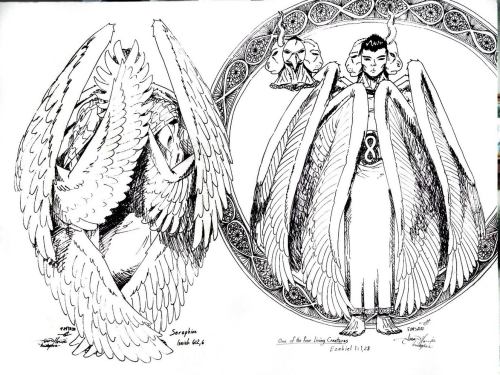
As Daniel Petersen writes in his blog, Ride the Nightmare, the gospel writer probably had far more frightening entities in mind:
It's almost like a well kept secret that angelic beings in the Bible are quite monstrous and terrifying, but in such a way as is meant to convey the holiness of God...
Above him were seraphim, each with six wings: With two wings they covered their faces, with two they covered their feet, and with two they were flying. And they were calling to one another:
“Holy, holy, holy is the Lord Almighty; the whole earth is full of his glory.”
At the sound of their voices the doorposts and thresholds shook and the temple was filled with smoke. (Isaiah 6:2-4)
This is pretty strange and terrifying as it is, but what's not seen in the English translation is that the word 'seraph' in Hebrew connotes something like 'fiery serpents'. So these angels are actually more like flying flaming dragons! (That's why Satan, a fallen angel, is portrayed as the earthbound [de-winged] Dragon in the Book of Revelation.) 
No wonder the shepherds were 'sore afraid.' And as for those Cherubim...
* Each one has four faces (sometimes called a tetramorph),  only one of which is human (the others providing horns, fangs, fur, and beak to the mix)
* Bodies and wings and wheels full of eyes
* Gleaming bronze hooves for feet
* Burning like coals of fire, shooting forth flames
* Flashing about like lightning
Yikes!

Disappointingly enough, Christmas card manufacturers have tended to avoid nativity scenes featuring shepherds cowering in abject, bowel-loosening terror before a grotesque host of six-winged flaming serpents and brazen-hoofed  tetramorphs. Personally, I'd be happy to settle for the freakish monstrosity above as a more exciting alternative to your insipid bog-standard Christmas card angel, if only it wasn't for the ornithological inconsistency of a a bald eagle's head popping up in a Middle Eastern context.

Even when they're not looking as weird as the shape-shifting alien from The Thing caught in mid-transformation, there's something more than a little odd about angels:
Angels as they appear in the Bible are a very curious bunch. Sometimes they look like people, as the ones who visited Lot did, and were presumably extremely good looking considering the entire town wanted to roger them senseless. Sometimes, they look like winged monstrosities that kiss burning coals, like the ones Isaiah saw. Sometimes, they were wheels in the sky, like Ezekiel saw. There was a reason they stated "fear not" upon their arrival.

They also did bizarre things. Some of them merely imparted information, like the heralds of Jesus. Others, however, either killed people (including babies) or else wrestled people to the ground. In one case, an angel wrestled with Moses and was going to kill him, until Moses's wife threw a foreskin at it.

It's also worth noting that they were apparently extremely terrifying to look at; they almost always preface anything they have to say with the remark "Do not fear", owing to the fact that they most often resemble something out of a work by H.P. Lovecraft.
Rational Wiki

The author of Luke's gospel, unlike the Nahum Teate (who wrote While Shepherds Watched Their Flocks) and Christina Rosetti, (who, as any fule kno, did the words for In The Bleak Midwinter), didn't specify which order(s) of angels announced the holy birth but, given the first angel's* stock warning ('And the angel said unto them, Fear not'), we can safely assume that he was one of the scary-looking ones.

And I mean 'he' - even when they're not named (e.g. Gabriel, Michael, Metatron), Biblical angels seem to be male, from the seraph who laid a live coal on Isaiah's mouth to the human-shaped one who wrestled with Jacob. Our modern image of a female or androgynous being is an anachronistic cross-cultural borrowing from the pagan tradition of the Winged Victory (the  halo is probably also a pagan invention, having featured widely in pre-Christian ancient Egyptian, Near Eastern, Greek and Roman religious iconography before making its first appearance in Christian art in 4th century).

To get back to the sort of thing the Bible writers had in mind, we need to lose the image of the modern, beautiful, feminised angel and think back to the muscular, ultra-masculine, hoofed, clawed, or winged hybrid beasts of the ancient Near East:

In their function as guardians of Paradise the cherubim bear an analogy to the winged bulls and lions of Babylonia and Assyria, colossal figures with human faces standing guard at the entrance of temples (and palaces), just as in Egypt the approaches to the sanctuaries are guarded by sphinxes.

Think of Yeats' 'A shape with lion body and the head of a man, A gaze blank and pitiless as the sun' and you get a pretty good idea of the herd of rough beasts that made up the heavenly host.

Daniel Petersen's blog post on fearsomely grotesque angels was originally written for Halloween, which makes me wonder whether we couldn't improve Christmas by grafting some of the dark, irreverent, transgressive fun of Halloween onto a festival currently overstuffed with bland, earnest kitsch. Reclaim the monstrous and terrible and the whole thing gets a lot more interesting. Why not go with the scary angels?

After all, we've already added an almost equally bizarre - if less frightening usually less frightening - flying supernatural being to the festive season. The white-bearded gift-bearer, Saint Nicholas, like some recording angel, has infallible knowledge of who's been naughty or nice and, after being towed through the air by his retinue of stamping, snorting, flying beasts, descends to earth from on high to perform miracles (of a logistical nature). We encourage our children to fervently believe in this synthetic minor deity, cobbled together from bits of paganism, Christianity, folklore and the cult of Mammon, at least until the inevitable disappointment. One day - if the human race is spared from destruction for long enough - people will probably look back and find the concept of Santa almost as weird as the sacred sky-monsters of the ancient Middle East.

The really odd thing about Santa is his ambivalent nature - as if splicing a Christian Saint together with a Norse God  to create the brand ambassador for the year's most lucrative shopping event didn't generate enough cognitive dissonance, we're also encouraged to believe in, and write to, Santa as children, before inevitably discovering that he doesn't really exist. 

I don't know how you'd prove it, but I have this theory that Santa has probably caused more people to lose their faith than Richard Dawkins and all the other New Atheists put together, on the grounds that way more people have gone through the experience of having to question adult authority as a valid basis for belief by finding out about Santa's non-existence than will ever read The God Delusion. Not only that, but while it's easy to mock 'professional God-hatin' Professor Yaffle impersonator Richard Dawkins', only a humourless, sour-faced Puritan killjoy could possibly object to the round, jolly, red-cheeked man who delivers presents to children. 

In Biblical times, people peopled the skies with monstrous and terrifying beings and (as far as I can tell) literally believed in them and in the Good News they proclaimed. Today's adults invent a nonthreatening, genial old man with a sack of prezzies, who descends from the skies to make tots' acquisitive dreams come true, before going on to spread doubt and unbelief in children old enough realise he's just a weird in-joke made up by adults. Appropriately enough for such an apostle of unbelief, Old NickSaint Nick's popular name is an anagram of that other celestial deceiver who fell so spectacularly from grace...

In renouncing terror and the fear of God and His monstrous minions, mainstream religion seems to have lost something. Not just the direct power to coerce, but a sense of awe and gravitas. The Christmas story may be pure bunkum, but in an age of belief, it was also a thing of terrible beauty, painted with a full emotional palette that used dark shadows, strangeness, and horror to complement the the brilliant highlights of  light, transcendence and joy. Christmas, (and mainstream Christian worship) as celebrated today, seems relentlessly upbeat, reassuring, one-dimensional sanitised, bland and infantalised,** when compared with the imaginative world that spawned those frightening weird, elemental, unsettling beings, whose appearance seized the Shepherds' troubled minds with mighty dread.


*The rest of the heavenly host only appear after the first angel's initial announcement.

___________________________
** Update - I wondered whether this was a bit harsh, until this evening, when I was dragged along - against my better judgement - to a "Christingle" service hosted by a disturbingly enthusiastic member of the Happy Clappy brigade, armed with a Powerpoint presentation featuring animated clip art of praying hands and the projected words to "Show me the way to shine for Jesus" (sung to the tune of "Is this the way to Amarillo") for the congregation to sing and clap along to. Words fail me...