Showing posts with label SPORT. Show all posts

Thursday, 21 December 2017

Football League shows Dons how to lecture Wombles

"AFC Wimbledon have been charged by the Football League for failing to use MK Dons’ full name during September’s League One clash between the side[s].

Wimbledon called the visitors Milton Keynes or MK, using the latter on the scoreboard, and did not use the team’s badge in the programme."
James Benge

I'm just waiting for the Association of University Teachers to get in on the act and point out that members of the MK team have no business calling themsleves Dons when not one single member of their squad has ever taught at a higher education institution. Guys, you either need to go back to Wimbledon, or break into academia (and that last point goes for you, too, Hamilton Academical FC).

I, for one, look forward to the day when the Dons will be known, not only for their fancy footwork, but for their esoteric, meticulously-researched lectures on number theory, or tax administration in the late Byzantine Empire.

Tuesday, 9 December 2014

Christ on a bike

The last thing I’ll say for the people that don’t believe in cycling – the cynics and the skeptics. I’m sorry for you. I’m sorry you can’t dream big. And I’m sorry you don’t believe in miracles. But this is one hell of a race. This is a great sporting event, and you should believe
From Lance Armstrong's more-in-sorrow-than-in-anger sermon to those poor benighted haters who disbelieved in the cycling miracles he wrought by faith alone (110% positively, definitely, absolutely without any form of pharmacological assistance whatsoever). Lifted from a great post at Salty Current, which perfectly nails the corrosive effect of militant faitheism on public discourse:
The most aggravating aspect of Armstrong’s project was his promotion of faith in faith and celebration of the faithful identity. He and the cycling big wigs consistently worked to create a community of the faithful that would exclude and shun doubters. He flattered his more credulous fans with the notion that they were better people for promoting Hope and Belief. While the believers were in reality the overwhelming majority, they were sold an image of themselves as members of a small elite whose gift of spirit set them apart from the cynical, faithless masses...
...More generally, skeptics were castigated in the traditional way: contrasted with the virtuous faithful, they were portrayed as mean, callous, lesser people who lacked the life-affirming spark of faith. 
The take-out from Demagoguery for Dummies seems to be that you gotta have faith (or, rather, your followers gotta have it). Get that bit right and dealing with impertinent critics is a breeze - here are some bullet points for aspiring Machiavellians:
  • Make your evidence-lite assertions loudly, confidently and often
  • If anybody questions those assertions or, heaven forbid, tries to engage with the evidence, point out that the critic must be some sort of small-minded, out-of-touch nitpicker. 
  • Always remember to keep on repeating how flawed your faithless critics are, in order to avoid getting bogged down in the (lack of) evidence behind your own assertions (attack is the best form of defence).
Follow these rules and, with any luck, you'll never need to do anything as embarrassing or uncomfortable as having a fact-based discussion.

That's not to say that most people of (usually confused) faith aren't perfectly honest, harmless, guileless and even benign. It's when it gets out into the public sphere and people with power, or people with something to hide, use it to shut down evidence-based argument that faith goes really toxic.

Faith might be the sigh of the oppressed creature, the heart of a heartless world, the soul of soulless conditions and the opium of the people, but it's also the weapon of choice for cheats, con-artists, demagogues and the peddlers of quack remedies. Militant faitheist obfuscation makes the strong stronger and the crooked more comfortable.

Evidence is the democratic weapon you can fight back with, if only you can get your hands on it.

Sunday, 17 March 2013

David Beckham channels Caligula

I'm way behind the curve when it comes to celebrity culture, but I'm filing this factoid under "strange things." Apparently, among the impressive portfolio of body art adorning footballer-turned global brand, David Beckham, there's a tat of a guardian angel above the  phrase 'let them hate as long as they fear. '

As any fule kno, this phrase became notorious as a favourite saying of the insane and famously depraved emperor Caligula, at least according to Suetonius.

I've no idea what - if anything - Becks was thinking when he had this one done, but there's a publishing opportunity going begging there. Just find a snappier title than "The Iconography of Celebrity Tattoos" and whack it out as a coffee-table book in time for Christmas. After all, nobody ever lost money by exhaustively dissecting the lifestyle choices of the rich and famous for the benefit of sleb fans everywhere.

Friday, 14 September 2012

Jesus H. Zeitgeist

With the weight of the new evidence in this report, it is right for me today as Prime Minister to make a proper apology to the families of the 96 for all they have suffered over the past 23 years.
David Cameron's statement about the Hillsborough tragedy, delivered this week

Acknowledging a past wrong 23 years later is all very well, but it's a bit late. How about doing it a century and a half later? This was Tony Blair speaking about the Irish Potato Famine in June 1997:
The famine was a defining event in the history of Ireland and Britain. It has left deep scars. That one million people should have died in what was then part of the richest and most powerful nation in the world is something that still causes pain as we reflect on it today. Those who governed in London at the time failed their people.

Jeremy Paxman was unimpressed:
You should apologise for things that you have done, that you recognise that perhaps you shouldn’t have done or regret. But apologising for things that your great, great, great, great-grandfather or grandmother did, seems to me a complete exercise in moral vacuousness.
Paxman got it right here, but he also got it spectacularly wrong. He was right, I think, to point out that a meaningful apology has to come from the person who did it and nobody else (I'll get to what he got wrong later). Even a Very Important Person can't shoulder the burden of somebody else's sins. The fact that we even entertain this idea is probably due to the reactionary fashion for "respecting" and indulging deeply held beliefs, however bizarre and irrational, with special reference to the odd, but rarely-challenged, notion that a very special individual can atone for the past sins of others:

And he is the propitiation for our sins: and not for ours only, but also for the sins of the whole world. 
1 John 2:2 (KJV)

Or, in the more up-to-the-minute language of the New International Version,  'He is the atoning sacrifice for our sins, and not only for ours but also for the sins of the whole world.' For centuries, clerics have persuaded millions of people to believe in a magic man who was sacrificed to make amends for the sins of millions of other people he'd never even met, including the long dead and the yet unborn.

It's a useful belief system for a hierarchical society built on obedient subjects, as opposed to a free society built on the rights of thinking citizens. People's responsibility to account for their own actions and their right to forgive the actions of others is taken away and judgement is placed into the hands of the mythical chief executive who sits at the apex of a of a pyramidal religious hierarchy. Only the supreme authority figure has the authority to forgive (almost) every sin.* Only the supreme authority figure can dispense ultimate justice (which you may have to hang on until the afterlife to actually experience). Subjects don't even have sufficient agency to make a free choice between sinning and not sinning. Thanks to the doctrine of original sin, the option of avoiding sin is unavailable. You're born naughty and only your loving father in heaven can forgive you.
Behold, I was shapen in iniquity; and in sin did my mother conceive me.

Psalm 51:5 (KJV)

Wow, thanks, mum! And, thanks too, for infant baptism, which means you don't even get to choose whether or not you're in the club. You're initiated as a powerless, unquestioning child with no capacity for reason, then encouraged to carry on accepting that adult authority lies with others for the rest of your life.

As for the sins you can help committing, well the scriptural advice doesn't seem to have been written for grown-ups:

My little children, these things write I unto you, that ye sin not. And if any man sin, we have an advocate with the Father, Jesus Christ the righteous:

1 John 2:1 (KJV)

When I read this passage, the voice I hear in my head sounds like Joyce Grenfell's nursery teacher:**

Children... pay attention, please. Free time is over, so put away your things and we are going to tell our nice story, so come over here and make a circle on the floor all around me, and we'll tell the story together... Hurry up everybody. Don't push - there's lots of room for us all ... Edgar, let go of Timmy's ear and settle down ... George! Don't do that...

Thanks to a few centuries of exceptional people standing up to unreasoning authority, thinking things through for themselves, accepting the evidence of their eyes and ears rather than what authority figures tell them to believe and questioning why things are the way they are, (heroic version), or the sheer weight of  evidence (prosaic version), many people have left this sort of learned infantalisation behind.

I agree with Paxman that it's morally stupid to think you can trade quotas of guilt, so that one person is able to atone for somebody else's actions. If you've done something wrong, nobody else can shoulder your burden of blame (and, conversely, nobody except the victim has the right to forgive a wrong - sorry, Jesus). In the case of Hillsborough, an apology from David Cameron means nothing. However long it is in coming, sincere remorse from Kelvin MacKenzie, or any of the people responsible for making the grounds safe at the time, or for conducting the policing of the match, or for organising the ambulance service response - in short, anybody personally responsible for the negligence and malice that occurred  - would be a start.

I also mentioned that Paxman got something spectacularly wrong about Blair and the Potato Famine. Paxo seems to have been responding to headlines, rather than to the content of Tony Blair's statement. The headlines went something like this; "Blair issues apology for Irish Potato Famine". But, if you read the text of his "apology" it becomes clear that he wasn't actually apologising, just acknowledging that something terrible and indefensible had happened in the past. Given Blair's messianic, holier-than-thou persona, it's understandable that Paxman seems to have looked no further than the headlines and assumed that the Blessed Tony really was morphing into the Lamb of God who taketh away the sins of the world. To Blair's credit, he wasn't doing any such thing (at least in this case).

Normally I'd be uneasy with politicians giving the impression that they're apologising, whilst using carefully-chosen words to avoid actually letting any blame attach to themselves, but in this case, the tone is perfectly right. There was absolutely nothing wrong with acknowledging that the British authorities of the day callously turned a natural disaster into a far worse man-made catastrophe, but Blair was clearly not in a position to accept responsibility for events that happened 150 years before and he, rightly, didn't attempt to shoulder the guilt, or to offer an apology.

In an Irish context, it would have been not only been morally vacuous to offer an apology, but positively dangerous. The idea that Brits alive today carry the guilt for the negligence and malice of British administrations in the past is precisely what made anyone who happened to have been born in Britain a "legitimate target" in the minds of hard-line Irish Republican bomb-makers.

I guess Blair could have complained that the headlines didn't reflect his statement, but failing to correct misleading headlines about an "apology" for events a century and a half in the past is no biggie. Unlike, say, failing to correct misleading headlines suggesting that the country needed to go to war to avoid the imminent danger of attack by a hostile power ("Brits 45 mins from doom","Mad Saddam Ready to Attack: 45 Minutes from a Chemical War", etc). That's something that incontestably happened on Blair's watch, although I'm not expecting the apology that he might legitimately offer for that one any time soon.


*Except for blasphemy (i.e. questioning the authority of the system) which, at least according to Mark, Chapter 3, is the ultimate, unforgivable, sin.

**Normally the voice of the King James Version thunders in my mind with the stark gravitas of a Richard Burton, although the sillier bits are voiced by a tweedy, fussily earnest Alan Bennett-style Anglican clergyman with worn leather elbow patches and bicycle clips, a species sadly now on the endangered list.


Monday, 30 July 2012

War minus the shooting?

I caught that Tim Harford on the radio this morning, making an obvious, but interesting, point about national Olympic medal tallies. In Beijing, China amassed an impressive haul of medals, a lot of them gold. But with a population of 1.3 billion people and enough money in the economy to support large numbers of elite athletes, those numbers shouldn't be that astonishing. Wouldn't a fairer measure of national athletic prowess need to take some account of the size of population it takes to produce a world beater?

To get a feel for this, here are the top ten national gold medal tallies from the 2008 summer games:
Nation Number of gold medals
China 51
USA 36
Russia 23
GB 19
Germany 16
Australia 14
S. Korea 13
Japan 9
Italy 8
France 7
And here are the same nations, with the population size,* divided by the number of gold medals awarded:
Nation Millions of people per gold medal
Australia 1.5
GB 3.3
S. Korea 3.8
Germany 5.1
Russia 6.1
Italy 7.5
USA 8.5
France 9.3
Japan 14.2
China 25.9
This metric supports the Aussies' rep as the world's most sports-mad nation, as well as team GB's pride, whilst making China look not quite that impressive. Include some of the smaller nations that won gold and the list of the world's most efficient gold medal-producing nations looks even more different and knocks China well out of the top ten.

I haven't looked at all the 200-odd competing nations, but a quick glance confirms that Ukraine, with a population of around 45.5 million bagged seven gold medals, or one per 6.5 million people, so did better than Italy. Canada, at one gold per 11.6 million citizens didn't do quite so well, but still out-performed Japan and China. Romania got 4 golds (about one for every 4.8 million people, so better than Russia). When you get down to really tiny populations and one or two gold medals, you could argue that it all gets a bit skewed by random variations in performance (Switzerland's 2 golds would be one per 4 million people, or better than Germany, whilst tiny Estonia's solitary gold went to a nation of just 1.3 million, technically beating Australia.

But most impressive of all, by this measure, is Jamaica, an island of 2.7 million people whose athletes came home with six golds (three courtesy of Usain St. Leo Bolt), or one gold medal per 451,000 people.

I'm not claiming that this is the best or fairest way of looking at things. There are, obviously, lots of other factors in play. 118 countries failed to win a medal of any sort in Beijing, comfortably outnumbering the 86 medal-winning nations. Some of those 118 were tiny, some were big, but just poor. Bangladesh, a country of nearly 150 million people has been competing since 1984, but (at the time of writing) has never won an Olympic medal of any sort. With a per capita GDP of $1,693 there's not much to spare for track and field training and most talented Bangladeshi youths could no more fly to the moon than access expensive kit like  Laser sailing dinghies, carbon fibre bows and arrows or Olympic standard racing bikes.

Then there are things like the detailed demographics and the complex interplay with wealth. All things being equal, a country where the median age is just over 19, like Nigeria has a proportionally bigger pool of potential up-and-coming Olympic talent than the UK (median age about 37). But as we've seen  things aren't equal and the UK has the infrastructure to support more of its elite athletes than Nigeria.

Although fair adjustments are elusive, I would say that unadjusted raw medal tallies don't even come close to giving meaningful international comparisons. I don't think that many people could fail to grasp this point, so I wonder whether the general reluctance to give some context to the figures is a sort of category mistake. Orwell famously said that:
Serious sport has nothing to do with fair play. It is bound up with hatred, jealousy, boastfulness, disregard of all rules and sadistic pleasure in witnessing violence. In other words, it is war minus the shooting.
I'm not so sure. It's only when international sporting events are seen as something akin to war that unadjusted medal tallies make any kind of sense. War is pretty much a zero sum game, with only the most elastic rules.

Imagine that the tiny nation of West Xylophone is invaded, defeated and occupied by its populous and powerful neighbour, Symphonia. The plucky West Xylophonese fight hard and well, holding off the Symphonian hordes with a combination of bravery and ingenuity, causing disproportionate damage to the invaders until they are eventually overcome by vastly superior numbers and firepower. As this is war, not sport, there can be only one winner, Symphonia. The fact that the West Xylophonese performed better in proportion to their numbers is irrelevant. Might makes, if not right, at least the reality on the ground. Symphonia won the war and West Xylophone lost and any observer claiming that West Xylophone "technically" won the war would be talking rubbish.

If the Symphonian Olympic squad comes up against Team West Xylophone, though, the situation is rather different. Sure, people sometimes cheat, or fail to live up to the highest standards of honourable competition, but sport is far more tightly regulated and rule-bound than war. There are rules and norms in war, but a field of activity in which killing people - albeit in approved ways - is seen as inevitable and normal is a hell of a lot more unregulated than one where taking the wrong hay fever meds, or tripping, shoving, or verbally abusing an opponent will incur punishment, whilst detectably breaching the rules of your sport will result in you losing the competition. In contrast, an admired military commander is expected to take unfair advantages, break the rules, deceive the enemy and do anything short of committing atrocities in order to win the battle.

The results of victory and defeat in war and sport are immensely different. Instead of invading and defeating West Xylophone in war, say Symphonia simply bags more Olympic gold in absolute terms, whilst West Xylophone, rather than fighting well but being militarily overwhelmed gains fewer medals in absolute terms, (but more in proportion to the nation's size). In this case you can make a perfectly good case for both nations having done well. The effect of sporting "defeat" (i.e. getting a lower absolute number of medals than a larger competing country) is nothing like the catastrophe of military defeat. Nobody dies, or becomes a refugee, nobody's home gets occupied by a hostile power,** the economy of the nation with the fewest medals isn't trashed. The athletes simply take their five minutes on the podium, then everybody goes home again and starts working towards the next set of quadrennial games, without anybody's homeland having been devastated.

Just because some people treat sport as if it's war minus the shooting doesn't mean that the two activities are really at all similar. Looking at unadjusted national medal totals, with their implied story of absolute victory and defeat, makes these two unrelated things look deceptively alike.

* population figures for the largest nations from here. Others from Wikipedia figures for roughly the right time frame (this is just back of the envelope stuff).

**London's residents and businesses might feel that their city is under occupation, what with the Zil lanes, the rooftop missiles and the Brand Exclusion Zone, but that's not quite the same thing.

_______________________________________

Update

As if to prove my point, four pairs of women's doubles badminton players have been disqualified from the current Olympics for deliberately trying to throw matches in order to secure a more favourable draw in the next round. Orwell might have thought that serious sport was distinguished by a 'disregard of all rules' but, in reality, sport penalises those who get caught flagrantly breaching the rules. In warfare, ruthlessly taking an unfair advantage generally results in victory. When Hannibal surprised the Romans by unexpectedly turning up with more elephants than any defending army could have reasonably expected, there was no umpire around to jump up and revoke his victory at Cannae on the grounds of unsporting behaviour.

Wednesday, 18 July 2012

Nothing to do with the jet stream...

In a groundbreaking relaxation of the Olympic branding rules, the London Organising Committee have finally conceded that God can use the protected terms 'summer' and '2012' in the same sentence, paving the way for Britain to finally have a summer at some point this year.


via

Tuesday, 26 June 2012

Evan Davis does topical standup

It's interesting to hear that the bizarre Olympic brand policing operation now attracts open mockery even from the studiedly impartial BBC Radio 4 newsroom. Commenting on today's newspaper reports about plans to fast track the criminal justice system for Olympics-related crimes, I heard that Evan Davis wondering aloud what would constitute an Olympics-related offence - 'drinking Pepsi or using a MasterCard within five miles of the venue?'

No quite up to the standard of my all-time favourite word bite on the topic ('...the London Olympics brand exclusion zone, perhaps the only advertising project to include its own anti-ballistic missile system'), but not at all bad for a quick aside. Evan just might be able to give up the day job.

Wednesday, 2 March 2011

London 2012 - beauty and the beast

It's crowded, expensive, showing its age and, in places, tatty, but the London Underground has one thing going for it - it's a showcase of good graphic design. From the Underground roundel symbol, to Harry Beck's circuit diagram-inspired map, to the ubiquitous Johnston Sans typeface, the look is crisp, clear and coherent.

In fact, it's everything that the London 2012 Olympics logo isn't. Just look at this:

                                                                                                                                    *

Are your eyes hurting yet? Mine are. What a mess. And it cost £400,000. At its 2007 launch, Lord Coe gushed inexplicably that the image represented 'the vision at the very heart of our brand'. If that's really so, I'd recommend that the 2012 Olympics introduces testing for hallucinogenic, as well as performance-enhancing, drugs.

Given five minutes and an old Bic biro, I could have doodled something better than that, inspired by nothing more than a mild sense of boredom  The Register was suitably underwhelmed:

Olympics minister Tessa Jowell clearly spent too much time in the chill-out room absorbing whalesong from her iPod at the "star-studded" launch of the 2012 Olympics logo in London's Roundhouse earlier today, since she described the rather frightening graphic as both "an invitation and an inspiration" as VIPs battled to verbally out joss-stick each other.

According to the official blurb, the logo is "modern and will be dynamic, evolving in the years between now and 2012" and furthermore "symbolises the Olympic spirit and the ability of the Games to inspire people to take part - not just as spectators, but as volunteers, in the Cultural Olympiad and more"
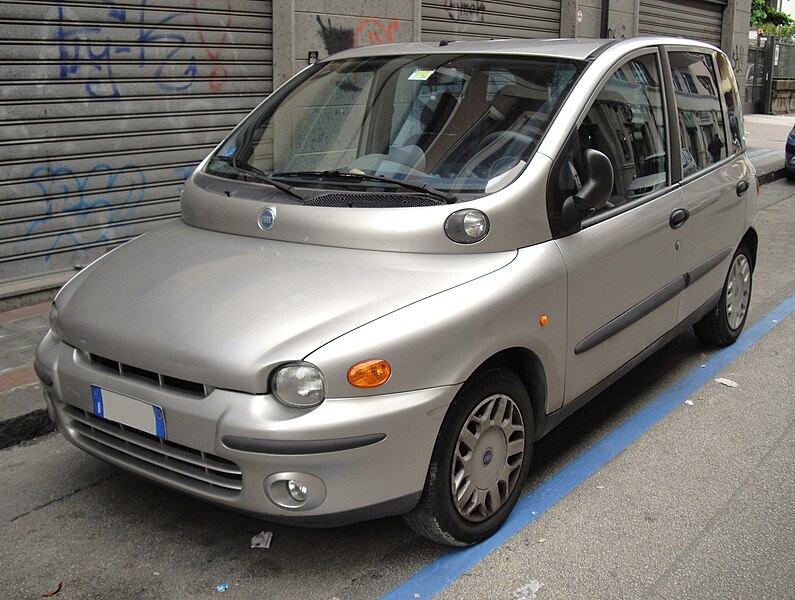
The London 2012 logo deserved to be binned for being as bewilderingly ugly as the pre-facelift Fiat Mutipla without having the excuse of being useful in any way. Unfortunately, it's too late to replace it with something better now and, inexcusably horrible though it looks, I suppose anything that infuriates Ahmadinejad and Iran's Mad Mullahs can't be all bad.


 * London 2012 logo photograph © copyright Nigel Chadwick and licensed for reuse under this Creative Commons Licence.

Rorschach test

If you're familiar with cartoons and have an averagely smutty mind, the logo for the 2012  London Olympic Games looks a bit rude. If you're a propagandist for a demented anti-Semitic, human-rights-abusing theocracy, it looks like a sinister Jewish conspiracy to subliminally flash the word "Zion" across the world's TV screens.

In other news, fashion house Dior has sacked British designer John Galliano for a series of deranged anti-Semitic rants. Presumably he won't be getting a top job in London, Paris, New York or Milan any time soon, but maybe he could consider a new career in Tehran, crafting fashion-forward designer chadors and having his insane outbursts respectfully published by official news agencies, rather than having them dismissed as the embarrassing ravings of a self-obsessed lunatic. He might want to hurry, though - his options will be severely limited if Ahmadinejad ever goes the way of Gaddafi.

Update - I hadn't read this when I titled this post, although it's not surprising that somebody else thought of the ink blot analogy.

Wednesday, 20 October 2010

He shoots - he scores!

It’s weird; we’re having a drip-fed disembowelling of the public sector and above it all looms the gibbous, lowering visage of Wayne Rooney. It’s all round doom here in Aburdistan, like a horror movie where the baboon escapes from confinement when the villagers are distracted by the witch burning. In the end, everything is destroyed.

Some more top quality spending apocalypse porn, this time served up on the Blood and Treasure blog.

‘We are the radicals now’

Today, radical extremists launched an unprecedented series of  unprovoked, devastating, co-ordinated attacks on British jobs and public services. Almost as stunning as the attacks themselves, was the shock realization that the enemy isn’t an overseas power, or foreign terrorist group, but a close-knit cell of homegrown extremists, with strong links to the British establishment.

The attacks have stirred fears that elite British universities have become a breeding ground for extremists who operate through private networks and campus dining societies rather than high-profile university political societies.

Why did the ringleaders, David Cameron, Gideon Osborne and Nick Clegg, three enormously wealthy, college-educated young men with a bright future ahead of them, allow themselves to be lured into such a destructive plot?

The new radical ideology seems to be an elite phenomenon, based on money and contacts made at exclusive schools like Eton, St Pauls and Westminster, rather than a product of the presumed grievances of the downtrodden.

There is evidence to suggest that Cameron and Osborne were radicalized while still students at Oxford and that conditions at Oxford at that time were conducive to such radicalization. Despite persistent rumours that he joined the Cambridge University Conservative Association between 1986 and 1987, the third plotter, Clegg, seems to have been a more naïve individual, only recently drawn into the extremist ideology of waging jihad against public services. But by the spring of 2010, all of them were burning with excitement to strike at the heart of British society.

At University, Cameron and Clegg were both keen tennis players, while the pudgy-faced Osborne struck contemporaries as being entirely unremarkable, if well spoken and affable. Former fellow students have professed astonishment at the three’s involvement in the October 20th incident, although some have seen Cameron and Osborne’s membership of the secretive, restaurant-trashing Bullingdon Club as a chilling warning of their appetite for destruction.

According to our security correspondent, Nick Robinson, Cameron, Osborne and Clegg held meetings with their militant followers this September and October in order to make final preparations for today’s attack.

In their propaganda, the extremists have sought to place the responsibility for waging an ideological jihad against the public sector upon the British public themselves. In a time of austerity, this is seen as more cost-effective than having mujahideen come from other parts of the world to attack the UK.

Over the next decade, the influence that such extremists are able to bear on the rest of society is likely to increase greatly. Without setting off one explosive device or spilling a drop of blood, extremists are able to disrupt the life of a nation and its citizens in ways that few of us can yet imagine.

Friday, 1 October 2010

India's actual shame

Raja Murthy writing in Asia Times Online thinks that the India's real Commonwealth Games shame isn't the less-than-spotless room or unfinished facilities, but in the wasted money in a country where the poor and needy are still very poor and very needy.

Well, anyone worried that the Commonwealth Games is a disastrous waste of money, should try this for size. Yes, India has started building a massive centralized database, holding the details of 1.2 billion people. Biometrics will, apparently, render the massive scheme foolproof. Making this dream / nightmare- a reality will be the responsibility of something called the Unique Identification Authority of India, headed by the founder of India's second-largest outsourcing company.

I haven't checked where the Unique Identification Authority is based but, personally, I think Calcutta would be an appropriate location for UIAI HQ. Wherever it is, the rest of the world will soon be able to watch in horror as billions of rupees are sucked into the new Black Hole of Calcutta (or wherever) until the whole juggernaut collapses under the sheer weight of its own stupidity. If anybody in India ever reads this, please go to the No2ID site to check out why this was a very, very bad idea in the UK and ask yourself why such a scheme would work any better in a vastly more populous country...

Wednesday, 18 August 2010

Golf on trial

People facing serious charges deserve due process, a fair trial and all that stuff. But if - and I repeat if - the president of the Kent County Golf Union was to be tried and convicted of smuggling surface-to-air missiles to Iran, then the evidence supporting Linda Smith's description of golf as an "abomination" would become overwhelming.

The crimes against humanity begin with pringle sweaters and unfortunate golfing slacks. They escalate via a literal belief in the accuracy and wisdom of the sort of Daily Mail editorials that any sane person would immediately recognise as being concocted entirely out spite, ignorance and something unspeakable smelling of mildew. Before you know it you're (allegedly) selling high-tech weaponry to bloodstained God-bothering fanatical maniacs as brutal and unhinged as Torquemada.

Golf. Just say no.

Saturday, 31 July 2010

Golf in unfortunate trousers

For many people the prospect of a comfortable retirement is becoming a mirage, moving further off into the distance as they approach it. At least, as Simon Schama said this week, "It beats death, decay or golf in unfortunate trousers".

Quite right, too - old age and poverty may be frightening, but at least they're not as bad as golf. As Linda Smith once said:

...proper sport being football and cricket and nothing else. Everything else is a game
or a pastime. Except golf. Which is an abomination, encouraging bloated publicans
and estate agents to waddle about a twee and artificial landscape in lurid tight-fitting
pastel jumpers like pregnant Teletubbies.

Monday, 21 June 2010

A word from our sponsor


As you may be aware, Tesco is the official supermarket of the England world cup team, though I bet you’re not aware of it if you happen to live in Scotland, Ireland or Wales. Elsewhere, the stores are festooned with tat and bunting.

Someone working for the Great Beast of retail tells me that the word’s gone out for people who fancy a bit of overtime to come in early Wednesday evening and take all the tat and bunting down: every bit of it, from deely boppers to vuvuzelas, though I suppose all those crappy t-shirts will be marked down for sale as fuel for the bonfires on which effigies of the traitor Rooney will be burned.


Every little helps. As a member of an almost invisible demographic, (heterosexual English male, not particularly interested in football), I don't normally have much to say on the subject, but one thing intrigues me - the inverse relationship between the staggering amounts of money spent by clubs in the English premiership and the performance of the national team. As an outsider, I've always assumed that the paradox was explained by the rich clubs buying in ready-made superstars from abroad, rather than spending the money on seeking out and developing home-grown talent.

The real explanation is probably more nuanced, but the graph in this blog post highlights the contrast between England's lacklustre performance and shedloads of money being spent on English football.

Sunday, 16 May 2010

Pure evil at 200mph

I never really thought that tobacco companies and advertising agencies were run by decent, public-spirited people. But this is so underhand that it almost qualifies as "evil genius".

Respect to Blazecock Pileon at MetaFilter for the heads up.

Thursday, 21 August 2008

In the news

Considering the extravagant displays of poor sportsmanship to be seen in any number of Premiership and international football matches, I'd have thought that Usain "Lightning" Bolt's celebrations after his astonishing and effortless-looking sprint victories might be excused. Jacques Rogge doesn't seem to think so. Then again, there are a few pointed words for M Rogge here - and quite right, too, IMHO.

Elsewhere in the news, the Russian show of force in Georgia continues. The con incidence of the anniversary of the Soviet invasion of Czechoslovakia following the Prague Spring may be just chance, or maybe it's a sign that Czarist, Communist or Capitalist, the huge autocracy at the heart of Eastern Europe has always put its faith in the strong man and feared the "virus of freedom".