Showing posts with label SPACE. Show all posts

Tuesday, 7 August 2018

Brutalism in SPAAACE!

Oh, I do like to be beside the brutalist architecture beside the seaside. The looming concrete bulk of Torquay's Riviera Centre, doing a fair impression of an angular space cruiser in low orbit around a blue planet (possibly Earth).

Wednesday, 7 February 2018

Boudica's chariot in SPAAAACE!

Everybody knows about the Iceni, thanks to Tacitus and his account of the Roman-bashing exploits of that famous freedom fighter/terrorist/rebel alliance leader, Queen Boudica. But that's about all that most people know about the Iceni - a whole society, remembered only through the life story of one elite individual. Which isn't altogether surprising, given the insane amount of resources elites can dedicate to bigging themselves up with ritualised status displays:
The elaborate metalwork found in Snettisham clearly represents an extremely high status, ritual offering that was committed by a group of social elites...

 ...For such a large amount of elaborate metalwork to be taken out of circulation and then deposited, almost certainly points to some form of ritual offering. A similar scenario is seen in the Late Bronze Age where vast amounts of bronze metalwork, particularly weapons, were deposited by competitive warrior elites (Bradley 1982).
From a description of the Snettisham hoard, a stash of Iceni bling which seems to have been buried in order to burnish the owners' bragging rights/rites.

A lot has changed since some Very Important Person sacrificed the Snettisham hoard. But some things aren't all that different, not if you view a Tesla Roadster as an elaborate piece of metalwork, being ritually sacrificed in the most expensively impressive way possible.

I can imagine some space archaeologist of the far future speculating about the status rituals of the 21st Century elite, based on the discovery an ancient high-status ground vehicle, found inexplicably drifting in the asteroid belt. I don't know how our space archaeologist will write up the find, but I kind of hope it's in a paper called Chariots of the Gods, a great title hitherto blighted by association with a very silly book.

Wednesday, 22 November 2017

"To insanity and beyond!"

'I don’t believe in science.' Man who thinks Earth is flat plans to launch self on a rocket

...“I don’t believe in science,” said Hughes, whose main sponsor for the rocket is Research Flat Earth. “I know about aerodynamics and fluid dynamics and how things move through the air, about the certain size of rocket nozzles, and thrust. But that’s not science, that’s just a formula. There’s no difference between science and science fiction.”
USA Today

A proud day for the USA, but a bittersweet one for the UK's own delusional space programme, which was cancelled when interstellar colony ship enthusiast Aidan Powlesland failed to get himself elected as Ukip leader, robbing us of the chance to be the first nation to fire members of its unrealty-based community beyond the reach of Earth's gravity and experts, while probably winning us a bonus Darwin Award, too.

Sunday, 13 August 2017

Ukip still existing for some reason

I think that reason might be comedy. Mainly because the remarkable Aidan Powlesland is among the gaggle of fruitcakes, loonies and closet racists now vying for the Ukip leadership. And in a three-way contest for the most ridiculous figure in British politics, Aidan is definitely the only candidate who could beat Lord Buckethead and Jacob Rees-Mogg:
Aidan Powlesland, who is standing for parliament in the rural seat of South Suffolk, told BuzzFeed News he wants to set aside £100 million for "an interstellar colony ship design" and £30 million for an "interstellar nano-probe fleet design" designed to attract the attention of Russian investor Yuri Milner, and will provide a £1 billion prize to any private company that can mine the asteroid belt by 2026.
Asked whether asteroid mining was a priority for most UKIP voters – compared to issues such as immigration controls – Powlesland replied: "I suppose the absence of the centrality of a proposition within a general dialogue doesn’t necessarily mean that the dialogue is heading in the correct direction."

...Powlesland's election leaflet also includes a pledge to cut the welfare cap from £20,000 per household to £10,500, abolishing all residential planning legislation to encourage housebuilding, repealing employment laws that entrench "political correctness" so companies can "hire and fire at will", and stopping road construction – because we will soon all be travelling by flying cars.

Other flagship policies include buying "ten flying aircraft carriers" for the armed forces – apparently reviving the large-scale zeppelin programmes of the 1930s – and investing in electromagnetic-pulse submarines. He would deploy 15,000 British troops close to the Russia's border, although in a symbolic gesture of friendship he would also make it easier for Russian tourists to travel to the UK.
In an age when entertainment value trumps sane policymaking every time, ladies and gentlemen, I think we have a winner.

Vote Powlesland. You know it makes sense. Especially if they give all the Ukippers a one-way ticket on the interstellar colony ship, Golgafrinchan B Ark-style.

Tuesday, 15 March 2016

In space no one can hear you bark


And while we're in a doggy mood, Belka and Strelka might have been the first space dogs to survive their flight, but it was poor, doomed, Laika whose memory lingered longest. Especially in the hearts of a marching squad of silver-booted, disco-loving Norwegian lesbian space marines, apparently: I'm not entirely sure that I'll be humming that one any time soon, but full marks for turning the weirdness up to eleven, girls. Humanity needs more of this kind of thing, I feel.

via

Tuesday, 2 February 2016

Dogs in spaaaace!

Because our family visit to the National Space Centre coincided with the Centre hosting that Doctor Who convention thingy, the place was stuffed with the obligatory mountain of Doctor Who collectibles (or tat, depending on your point of view). Not that I always mind a bit of memorabilia - I'd have been thrilled if the Space Centre's curators had spent a bit of time on eBay and found stuff like this to put on display:


Your gran's display cabinet goes space-age - rocket-shaped vodka jugs commemorating the space flight of Belka and Strelka, who, in August 1960, became the first creatures to orbit the earth and (unlike Laika) return alive (photo credit El Pantera).

More Belka and Strelka-themed collectible porcelain (photo via ebay).

Thanks to Wikipedia, I now know that it was the Kennedy clan who bagged the ultimate piece of Soviet canine spaceflight memorabilia. After her return to earth, Strelka went on to have a litter of puppies, one of which, Pushinka ("Fluffy"), Khrushchev presented to JFK's daughter Caroline in 1961.

I imagine that daddy accepted the gift with a rather forced smile - the year before, according to Deborah Cadbury's excellent book Space Race, JFK had taken the dogs' flight as an affront to American pride, taking pointed umbrage at the fact that "the first canine passengers in space who safely returned were called Strelka and Belka ... not Rover and Fido." Be that as it may, the Cold War apparently thawed sufficiently for Pushinka to get together with one of the Kennedy dogs and beget a doggy dynasty that exists to this day.

Via here and here.

Wednesday, 12 November 2014

The long drop

...From morn
To noon he fell, from noon to dewy eve,
A summer's day; and with the setting sun
Dropped from the zenith, like a falling star 
Now that's poetry in IMAX. Kind of appropriate for today's long drop:
Rosetta will release Philae at 08:35 GMT/09:35 CET at a distance of 22.5 km from the centre of the comet, landing about seven hours later. The one-way signal travel time between Rosetta and Earth on November is 28 minutes 20 seconds, meaning that confirmation of the landing will arrive at Earth ground stations at around 16:00 GMT/17:00 CET. 
Okay, seven hours doesn't add up to a summer's day and comet 67P/Churyumov–Gerasimenko isn't exactly Lemnos, but a seven hour drop's still an epic plummet by anybody's standards.

Mulciber/Hephaestus/Vulcan survived his fall. Whether Philae makes it is still in the lap of the (other) gods at the time of writing, although, unlike Vulcan, she (he? it?) has the benefit of a live webcast...

Wednesday, 29 January 2014

To infinity and beyond, via Milton Keynes


So this guy in Milton Keynes has a project to turn the spaceships from the Sci-Fi paperback covers of my youth into impressively detailed models, an artform guaranteed to bring joy to members of generation Thunderbirds. His first model is based on Colin Hay's artwork for a James Blish novel, Star Dwellers.

Colin Hay's style of illustration irresistibly calls to mind the insanely detailed, brightly-coloured craft created by that giant of Sci-Fi book cover art, Chris Foss, so a lot of us would be delighted to see Foss's designs getting the Grant Louden treatment, too (come to think of it, Chris Foss also did the original illustrations for The Joy of Sex, so ... no, let's not go there).

And apparently, Chris Foss is up for it, although he might have reason be wary about artworks "inspired by Chris Foss", given what happened when one Glenn Brown, A Serious Artist, made a bigger hyper realist reinterpretation copy of a Foss original and declared the copy to be 'serious art', (it must be 'serious art' because it's been made by A Serious Artist, who must be A Serious Artist, because he says he's A Serious Artist...). The hyper realist reinterpretation copy sold for £3.1 million at Christie's.

Grayson Perry said 'In art, seriousness is the most important currency' and, at an exchange rate of £3.1 million for one great big knock-off with added artybollocks, I wouldn't argue. I hope Grant Louden, who seems to have Chris Foss and the other artists who've inspired him fully on board, makes a decent fraction of that sort of money, although I expect he's not quite Serious enough.

Images © Colin Hay and Grant Louden, I guess, (unless you're A Serious Artist).

via

Thursday, 21 March 2013

Now, Voyager?

There's an interesting article on Bad Astronomy about whether or not the space probe Voyager 1 has left the solar system and become the first human-made artifact to enter interstellar space. As you'll see from the correction to the post, the answer's not entirely clear, mostly due to which definition of "interstellar space" you choose. "Interstellar space" could start:
a) at the point where the solar wind slows to a stop as its constituent particles collide with the particles that exist between the stars 
or
b) at the point where the sun's influence becomes so weak that the prevailing magnetic field changes direction.
Voyager seems to have reached a) but not b). NASA and JPL have apparently chosen reaching b) as their working definition of "leaving the solar system."

Other definitions are available. For example, as of now (ish), Voyager 1 is 123.6 astronomical units (AU) away from the sun (click here for a more precise estimate).

The Oort cloud (the hypothetical spherical cloud of icy bodies surrounding the sun, thought to be the place where long-period comets originate), could be up to 50,000 AU from the sun, or over four hundred times further away from the sun than Voyager 1 is now.

Nobody's ever observed the Oort cloud directly, but assuming that the theories are correct and it does exist, then surely a vast spherical shell of icy material, centred on the sun, is part of the solar system.

Or maybe the boundary lies even further out, at the point where the gravitational influence of the sun is no greater than that of the nearest star.

Nature seems so irreducibly nuanced and subtle that one neat cut-off point may be too much to ask of her. Don't let's ask for the moon. We have the stars (although maybe not just yet).

Thursday, 17 January 2013

Deadly diseases - gotta catch 'em all

Modern parents live in a constant state of asymmetric warfare with the well-resourced, resourceful people who make money from punting tat to kids. We missed the height of the Pokémon ("gotta catch 'em all") craze, but are now fighting a losing battle with Michael Acton Smith, the evil genius who spawned Moshi Monsters.

On line-time spent in the world of Moshi Monsters isn't currently our problem - we've (accidentally, but conveniently) forgotten the password we created when we created The Boy's account in a moment of weakness. It's the real-world incarnation of the characters as collectible/collectable plastic figurines that we're struggling with. According to the definitive publication of record (Moshi Monsters - The Official Collectable Figures Guide, bought with £6.50 worth of Christmas money, but treasured by its owner far above rubies), there are 'over 950 characters!' Nine hundred and bloody fifty.

Having previously experienced the pester power potential unleashed when the owners of the Thomas the Tank Engine franchise decided to multiply the number of branded characters to include a host of additional trains and ancillary vehicles which made only the briefest of appearances in the stories, but immediately became must-have items for every avid junior Thomas fan, we are not amused. That particular fad has long since run its course, but we're still trying to dispose of engine-shedloads of obscure and now unwanted rolling stock on Ebay.

Marketeers, busy moulding the next generation of consumers - don't you just love 'em? Still, at least all Michael Acton Smith has discovered is a way of indirectly parting parents from relatively small increments of disposable income. If he was in the junk food biz, he'd be adding the injuries of premature mortality and avoidable morbidity to the insult of pester power. If ... no, when Moshi Monster-branded fizzy drinks, sugar laden-cereals and salt, saturated fat and poly phosphate-rich mechanically-recovered meat products appear in the supermarkets, I hope Acton Smith loses some sleep over these abominations.

Mind you, if you think any of this is new, or worse than what used to happen, take a look at this collectible item, and think again:
This is what my dad was collecting when he wasn't much older than my son is now. It's Denis Compton from his Player's Cigarettes 1938 collection of trading cards depicting famous cricketers of the day (I still have the complete collection, lovingly stuck into their album - he did catch 'em all). It wasn't just cricketers. Courtesy of Imperial Tobacco (owners of Player's Cigarettes), he also collected and swapped cards depicting 'Hints on Association Football', 'Cycling 1839-1939', speedway riders and railway engines (already popular before the Reverend Awdry unleashed the first of a host of anthropomorphic engines on the world), along with various other themed collections issued by the other big tobacco companies.

Memories of a more innocent, wholesome time when the manufacturers of  'the deadliest artefact in the history of human civilisation' a product that 'killed about 100 million people in the 20th Century' issued trading cards to small children to promote their brands. Hard to believe in an age when cigarette packets are plastered with graphic health warning images and hidden from the impressionable sight of children.

How many people died as an indirect result of learning to "like" cigarette brands as small children? This spring, all being well, I'll be fifty. Dad died of a heart attack before reaching his half century. Whether this was wholly or partly due to growing up in a society where heavily-marketed tobacco products were familiar childhood friends, I'll never know. He was a fairly moderate smoker, fond of a pipe, or occasionally one of those rank little Hamlet cigars (presumably, like Bill Clinton, he didn't inhale - and no bloody wonder, they smelled vile) but he'd more or less given up tobacco in ciggie form before he died, so the jury's out in his case.

By the time I was growing up, I think they must have stopped directly tempting kids with tobacco-related collectibles - at least I don't remember cigarette cards as such. There were still trading cards, of course, but as I recall, they were mostly associated with less questionable products like Brooke Bond or Ty-Phoo tea. Kids hadn't completely kicked the cigarette card habit, though. Although I don't remember actual cigarette cards, I do remember sweet shops still stocking "sweet cigarettes" -sugary white cylinders with a red tip, packaged up like a a pack of real ciggies and generally featuring cigarette card-style trading cards. I also remember coming across chocolate versions, made from the sort of low-grade, tasteless, gritty chocolate generally used for cheap chocolate Christmas novelties.

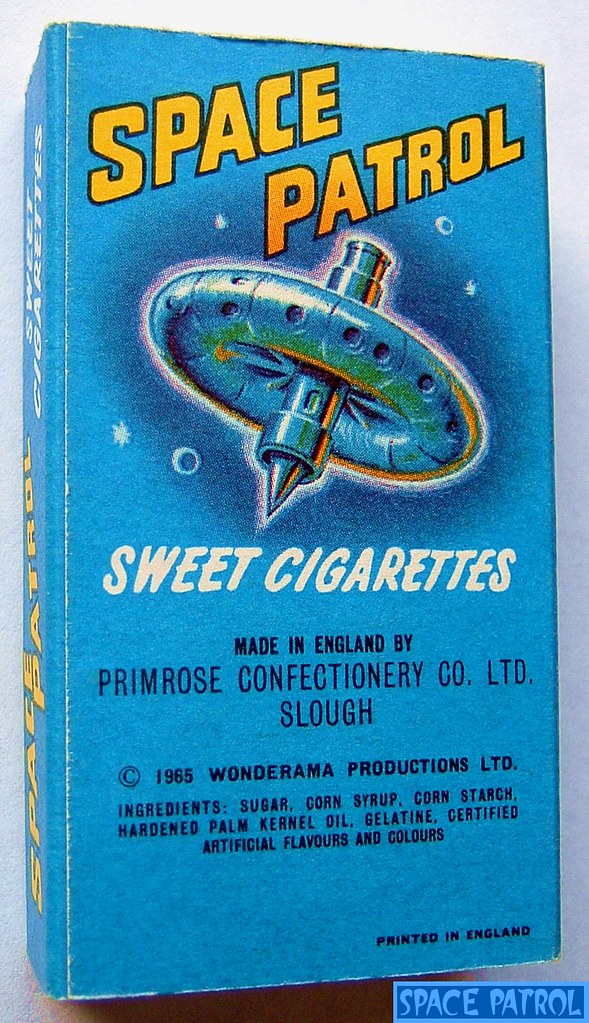
I didn't collect many cards from sweet cigarette packets - the few surviving collections of aeroplane, dinosaur and space travel trading cards I still have, were issued by tea companies. I do remember collecting a few of these bizarre early '70s "Krazy Kreatures From Outer Space" cards, issued by the Primrose Confectionery Company of Slough (I'm pretty sure they were issued with sweet cigarettes, which Primrose did manufacture, although my old memories aren't 100% reliable and there's an outside chance that they actually came with bubble gum packs):
I never caught 'em all, possibly due to what I thought was subtle parental disapproval (of the subject matter rather than the fact that they came with packets of unwholesome things like sweet cigarettes and/or bubblegum). As an aspirational lower-middle class family there always seemed to be an unspoken pressure steering me in the direction of solid, educational Ladybird / Blue Peter / Look and Learn-style material, as opposed to frivolous stuff like The Beano, Dandy and psychedelic pictures of space monsters painted, no doubt, by drug-crazed hippies. As a thoroughly square kid with swotty aspirations, I capitulated to this perceived pressure without resistance, (although not without a guilty yearning for the wackier world(s) of Krazy Kreatures From Outer Space). If you want to indulge this particular guilty pleasure, there are higher-res reproductions of the Krazy Kreatures on the Monster Brains blog (some of them are very strange) and a reproduction of one the "Astronaut's Guides" from the back of the cards on this Gerry Anderson fan site.

I don't know when sweet cigarettes became less common, but judging from the Space 1999-branded packets, they must have been going up to the end of the 1970s, when Dad's heart finally gave out, possibly due to thirty-odd years of ingesting low levels of tobacco products.

According to Mr Wikipedia, sweet cigarettes have been around since the early 1900s. For all I know, they may have had as little to do with the tobacco industry as liquorice bootlaces have to do with the makers of real shoelaces, but given Big Tobacco's relentless pursuit of every marketing opportunity on earth, I suspect some collusion somewhere down the line. Whether or not they were part of Big Tobacco's conspiracy to recruit new smokers, it's highly likely that they were a bad thing. I say 'were' - they apparently still exist, albeit marketed under the disingenuously innocent-sounding name of "candy sticks".

For whatever reason, sweet ciggies weren't my gateway drug to the real thing and their only legacy to date has been rather too many fillings (I didn't even particularly like them, but having bought the damn things for the trading cards, you had to eat them, obviously). Mind you, maybe my fillings have less to do with sweet consumption than the perverse incentives that used to be given to NHS dentists, whose remuneration used to be directly related to the number of treatments they gave. The temptation to do a bit of not-entirely-necessary drilling to top up the holiday fund must have been huge.

There's no big message to take away from all of this except, perhaps, that marketing is powerful stuff and it will beat up public heath and steal its lunch money, given half a chance. You don't have to be a historian familar with the 1860 Food Adulteration Act to see the harm done by laissez-faire - it's there in living memory. Also, any politician who pops up and bleats about the virtues of "self-regulation" for Big Tobacco, or the the processed food and drinks industry is clearly the lobbyists' bitch, rather than the citizens' friend.

And finally, maybe Moshi Monsters aren't that bad, after all (at least until they get drafted to push junk food to kids). Especially this one:
A child's toy in the form of a masonic/Illuminati/dollar bill-style pyramid, complete with all-seeing eye? And it glows in the dark! Never mind The Boy, that's so cool that I want one. If anybody's wondering what to get me for my 50th birthday, I'll happily settle for a Moshi Monsters Series 1 Halloween Glow In The Dark - Cleo Ultra Rare Orange Moshling Figure. A happy birthday and a novus ordo seclorum to me!

Saturday, 19 November 2011

A big hello to all intelligent life forms everywhere...

 ...And to everyone else out there, the secret is to bang the rocks together, guys.

A long while back, I was at a friend's house, listening to records. More specifically, he was playing a few tracks from his collection and inviting those present to 'name that tune'. I was successfully able to name the theme tune to the original radio version of The Hitch Hikers' Guide to the Galaxy - or so I thought. That was when I discovered that it wasn't an original theme tune, but a piece by The Eagles, called Journey of the Sorcerer. Apparently, I'm not the only person to have made this  mistake.

Anyway, shout out to the other seven billion confused B Ark descendants out there on Earth 1.0. Your chill-out tune for today is...


The Eagles - Journey of the Sorcerer

Wednesday, 23 March 2011

There is some corner of another world that is forever mankind.

To: H. R. Haldeman
From: Bill Safire
July 18, 1969.

Fate has ordained that the men who went to the moon to explore in peace will stay on the moon to rest in peace.

These brave men, Neil Armstrong and Edwin Aldrin, know that there is no hope for their recovery. But they also know that there is hope for mankind in their sacrifice.

These two men are laying down their lives in mankind's most noble goal: the search for truth and understanding.

They will be mourned by their families and friends; they will be mourned by the nation; they will be mourned by the people of the world; they will be mourned by a Mother Earth that dared send two of her sons into the unknown.

In their exploration, they stirred the people of the world to feel as one; in their sacrifice, they bind more tightly the brotherhood of man.

In ancient days, men looked at the stars and saw their heroes in the constellations. In modern times, we do much the same, but our heroes are epic men of flesh and blood.

Others will follow, and surely find their way home. Man's search will not be denied. But these men were the first, and they will remain the foremost in our hearts.

For every human being who looks up at the moon in the nights to come will know that there is some corner of another world that is forever mankind.

PRIOR TO THE PRESIDENT'S STATEMENT: The President should telephone each of the widows-to-be.

AFTER THE PRESIDENT'S STATEMENT, AT THE POINT WHEN NASA ENDS COMMUNICATIONS WITH THE MEN: A clergyman should adopt the same procedure as a burial at sea, commending their souls to "the deepest of the deep," concluding with the Lord's Prayer.

On 20th July 1969, the Apollo 11 lunar module touched down safely on the moon - with only about 25 seconds of fuel left in its tanks. The world was half a minute away from hearing these words, with their odd echo of Rupert Brooke, rather than 'one small step for man'.

The dangers of manned spaceflight were all too real; in 1967, astronauts Virgil "Gus" Grissom, Edward White, and Roger Chaffee were killed in a cabin fire that engulfed the Apollo 1 command module during a ground test. In the same year, Soviet cosmonaut Vladimir Komarov died when the parachute on the command module of his Soyuz 1 spaceship failed to open after re-entry, as recalled in these chilling words:

... an NSA analyst, identified in the book as Perry Fellwock, described overhearing Komarov tell ground control officials he knew he was about to die. Fellwock described how Soviet premier Alexei Kosygin called on a video phone to tell him he was a hero. Komarov's wife was also on the call to talk about what to say to their children. Kosygin was crying.

When the capsule began its descent and the parachutes failed to open, the book describes how American intelligence "picked up [Komarov's] cries of rage as he plunged to his death."


NPR

More than forty years later, the Soyuz spacecraft is still in use. When the shuttle is retired, later this year, the only way to get people to the International Space Station will be on board the tried, tested, improved descendant of the Soyuz  spacecraft that killed Komarov (and the crew of  Soyuz 11 in 1971).