Showing posts with label poetry. Show all posts

Tuesday, 8 May 2018

A special nation, just like all the others

"Just after the referendum someone predicted that the brexit negotiations would be a process of 'controlled capitulation'. Which has come to pass. At least our egregious sense of national exceptionalism is being nailed ever deeper into the cross of astounded leaver righteousness."
Perhaps the most egregious thing about the United Kingdom's sense of national exceptionalism is that it's almost exactly like everybody else's sense of national exceptionalism. This, for example, is what "taking back control" looks like in Viktor Orbán's Hungary:
A few weeks ago, in a small town in Hungary, two Catholic nuns were stopped on the street and berated by people yelling, “Migrants! Migrants!” After pushing the old ladies a bit, they called the police, believing they had seen Muslim women in a burqa and hijab. The police saved the nuns from the Christian crowd.
Those eejits might have been wearing the Magyar version of the MAGA hat but, from the UK, this sort of thing  looks depressingly familiar. Remember this story from 2014?
Nigel Farage’s local Ukip branch has rebuked the BBC for its ingrained liberal bias in holding a straw poll on the party leader in front of a London mosque. The mosque in question was Westminster Cathedral...

...This isn’t the first-time a rightwing party has got its buildings confused. The English Defence League mistook Brighton’s Royal Pavilion for a mosque last year.
Different flag, same stupid.

Lose that flag and other people's national exceptionalism starts to look a whole lot like our own:
The Orbán government’s first legislative move is the Stop Soros Act, which will force human rights groups to register as foreign agents and submit to regular police surveillance, fiduciary controls, and punitive taxes. Groups that have absolutely nothing to do with immigration — those looking after Hungarian citizens’ human rights, advocating education and prison reform, representing the homeless and ethnic and religious minorities, etc. — will be persecuted [Brits may not be able to get a decent cup of tea on the Continent, but at they'll at least have enough of a "hostile environment" to make them feel right at home]...

...Orbán’s semi-dictatorship ... unlike its post-Stalinist predecessor, is not statist or centralizing. Its guiding principles are arbitrary, capricious rule and, above all, informality. The real centers of power in Orbán’s Hungary are formally independent institutions (state foundations, semi-private companies, purportedly private firms living on state credit) that are outside the control of normal government administration and of judicial control as well [in the UK, think how policy is shaped by a shady spider's web of obscure, unaccountable interest groups - the Legatum Institute, the European Research Group, the TaxPayers' Alliance, Migration Watch, the Adam Smith Institute...]. Meanwhile, regular administration is being dismantled and well-trained civil servants are being thrown out in droves ["Brexit minister fuels conspiracy about 'rogue' civil servants"] . Drafting of bills happens behind the backs of ostensibly leading politicians and bureaucrats, and rushed through parliament [Henry VIII clauses, anybody?] — usually without discussion.
There's nothing special and unique about people insisting that they're special and unique.

Saturday, 10 March 2018

A compulsory dip in the Sea of Faith

Here's a familiar Victorian lament about the decline of religious faith:
The Sea of Faith
Was once, too, at the full, and round earth’s shore
Lay like the folds of a bright girdle furled.
But now I only hear
Its melancholy, long, withdrawing roar...
Why the decline? As any half-awake student of poetry, or the history of ideas, can tell you, it was Darwin wot done it. "In the third stanza, the sea is turned into the "Sea of Faith", which is a metaphor for a time ... when religion could still be experienced without the doubt that the modern ... age brought about through Darwinism, the Industrial revolution, Imperialism, a crisis in religion, etc."

And I agree with this analysis, as far as it goes. Even many educated people literally believed in the Biblical account of creation before Darwin. After Darwin, there's been such an inexorable decline that non-creationist Christian apologists now routinely claim that most pre-Darwin Christians never believed that the Genesis story was literally true (although contemporary evidence suggests to me that such apologists are just plain wrong).

The Darwin effect was amplified by Nineteenth Century German scholars like David Strauss abandoning the idea of "gospel truth" in favour of an analytical approach which tried to work out which bits of the sacred texts were probably factual history, in the sense we would understand it, and which bits we'd classify as myth, or fiction.

But there's an extra contributing factor which tends to get played down these days. When the Sea of Faith was at the full, you could be fined, or worse, for not going to church:
"Among other complaints made to me by prisoners, J. C. came forward, and stated, that he was placed in the Ecclesiastical Court, 310 and sentenced to pay a fine of 1s., and 14s. costs; that he had been in prison ten weeks, and had no means of paying, and hoped that a representation might be made of his case, or he must remain a prisoner for ever. Upon referring to this man's commitment, I find that he was summarily convicted before two magistrates, that on the of June, being the Lord's-day, called Sunday, in the township of—, did neglect to attend a church, or at some other place of religious worship, on the said day, he not having any reasonable excuse to be absent, and adjudged to forfeit and pay 1s., together with 14s. costs, and, in default, to be kept in prison until the said sums shall he paid. It appeared that the following number of persons had been committed for a similar offence, and been discharged upon payment of the fine and costs:—"
This account comes from evidence presented to the House of Commons in 1842 (a quarter of a century before Arnold's Dover Beach was published), in favour of repealing "certain acts of Elizabeth and James 1st, as inflicted penalties for the non-attendance on divine worship."

A fact worth remembering, whenever anybody makes the standard rhetorical contrast between the warm, simple faith of our forefathers and foremothers and the supposedly cold, calculating rationality of a less religiously-observant age. That simple faith was often encouraged by the simple threat of fines or, if you were too poor to pay a fine, prison.

Tuesday, 18 April 2017

Different bridge

I don't yet have anything instant and/or sensible to say about the snap general election that the PM is trying to call and which I entirely failed to see coming, so here's a nice picture I took a few weeks back:

This was taken on the Millennium, rather than Westminster, Bridge, but I rather like the Wordsworthian vibe of being at the still heart of the city in the early morning, with nobody about, apart from the odd delivery person and early-rising jogger. Some of the ships, towers, domes, theatres and temples have changed since Wordsworth's day (look at the size of the Shard, looming over the tiny silhouettes of Tower Bridge and the Tower of London), but the stillness and clarity of a new morning remain:
Composed upon Westminster Bridge, September 3, 1802

Earth has not anything to show more fair:
Dull would he be of soul who could pass by
A sight so touching in its majesty:
This City now doth, like a garment, wear
The beauty of the morning: silent, bare,
Ships, towers, domes, theatres, and temples lie
Open unto the fields, and to the sky;
All bright and glittering in the smokeless air.
Never did sun more beautifully steep
In his first splendour, valley, rock, or hill;
Ne'er saw I, never felt, a calm so deep!
The river glideth at his own sweet will:
Dear God! the very houses seem asleep;
And all that mighty heart is lying still!

Wednesday, 29 March 2017

Fifty shades of May

Joy unconfined, hip, hip hooray!
It's British independence day!
O, masochistic isles UK,
Unite and through your ball gags say,
"Thank you, thank you, Mistress May!"

We're glad you were so quick and nifty,
Invoking Article number fifty,
Though your reasoning was shifty,
The chancellor has got your drift, he
knows our future's mean and thrifty.

If it hadn't been for you,
We wouldn't have our Empire Two,
To show those foreigners who's who,
Nor ten years more of crisis, too,
You spoil us, Tess, you really do!

Let me peel you a fresh grape!
To thank you for the new red tape,
And saving us from foreign rape,
Not to mention Johnson's jape,
(Bananas of non-bendy shape).

We're glad we won't be free to move,
It will be worth it to reprove,
The migrant hordes we don't approve.
We're so excited now that you've,
Found some rights you can remove.

So just stop thinking and believe,
Those big employers will not leave,
Those Brexiters would not deceive,
More money than you can conceive,
Will save the NHS, don't grieve!

To get a deal is just child's play,
No matter what the experts say,
We'll force them to see things our way,
Or cause a very loud affray,
We are not worthy, Mistress May!


Saturday, 11 February 2017

Make your body great again

"Take back control", they said, and showed me how...
Are you fat and flabby? Or skinny and gawky? Are you short-winded, pepless? Do you hold back and let others walk off with the prettiest girls, best jobs, etc? Then write for my FREE Book about "Dynamic Tension" and learn how I can make you a healthy confident, powerful HE-MAN.
Now, nobody will ever dare to laugh at me again...

More (NSFW) geeky smart-alec mockery below.

Monday, 14 November 2016

About the golden door...


The prospectus sounds great:
Keep, ancient lands, your storied pomp!" cries she
With silent lips. "Give me your tired, your poor,
Your huddled masses yearning to breathe free,
The wretched refuse of your teeming shore.
Send these, the homeless, tempest-tost to me,
I lift my lamp beside the golden door!
But, huddled masses, please note:

  1. That golden door opens onto a crooked billionaire 's penthouse and is strictly off limit to bums like you.
  2. Only kidding about the storied pomp - we're totally cool with that stuff.
  3. Just in case you start getting any ideas, the golden door is guarded by these two characters and they ain't letting nobody in:
Now go back where you came from, losers, we got a wall to build.


Image credit for the image worth crediting.

Monday, 7 November 2016

Sublime, improbable Martian engineering

 *Spoiler alert- if you've not already read H G Wells's The War of the Worlds, do so immediately, or read on at your own peril...*

I've just been re-reading the first alien invasion novel, H G Wells's The War of the Worlds, and I can see again why it created a genre all of its own and why it immediately grabbed me as a child. Mainly because it's such a cracking yarn - the alien visitation starts off as an intriguing curiosity, but escalates to being, ominous, threatening, awe-inspiring and terrifying at an unstoppable pace that mirrors the relentless advance of Well's iconic Martian tripods, seen here in  one of the novel's big reveals:
And this Thing I saw! How can I describe it? A monstrous tripod, higher than many houses, striding over the young pine trees, and smashing them aside in its career; a walking engine of glittering metal, striding now across the heather; articulate ropes of steel dangling from it, and the clattering tumult of its passage mingling with the riot of the thunder. A flash, and it came out vividly, heeling over one way with two feet in the air, to vanish and reappear almost instantly as it seemed, with the next flash, a hundred yards nearer. Can you imagine a milking stool tilted and bowled violently along the ground? That was the impression those instant flashes gave. But instead of a milking stool imagine it a great body of machinery on a tripod stand... Seen nearer, the Thing was incredibly strange, for it was no mere insensate machine driving on its way. Machine it was, with a ringing metallic pace, and long, flexible, glittering tentacles (one of which gripped a young pine tree) swinging and rattling about its strange body. It picked its road as it went striding along, and the brazen hood that surmounted it moved to and fro with the inevitable suggestion of a head looking about.
That's a fantastic piece of writing and there are lots more like it. The book also has its expository digressions, where the action stops and Wells explains things rather than just showing you awesome stuff, but these aren't too long (at least by the standards of the time when Wells was writing) and by this stage he's already created enough momentum to keep you gripped and reading on. Compare and contrast with that other piece of proto-sci-fi, 20,000 Leagues Under the Sea, which also starts with strange, ominous events, building up to an exciting reveal and some great set pieces, but is so weighted down with the ballast of endless pages of over-long explanation that Verne almost sinks the cracking yarn he created.*

If the The War of the Worlds looks forward to every alien invasion yarn that followed, it also looks back to an aesthetic trope that's probably been around for ever, but was largely formalised in the Eighteenth Century and peaked with early Nineteenth Century Romanticism - the sublime. That's the idea that humans don't just appreciate things which are beautiful in an ordered, harmonious way, but also dig stuff that's wild, inhuman in scale and frankly terrifying - as the Tate Britain put it, in the blurb to an exhibition dedicated to "Art and the Sublime":
The best-known theory published in Britain is Edmund Burke’s A Philosophical Enquiry into the Origin of Our Ideas of the Sublime and Beautiful (1757). Burke’s definition of the sublime focuses on such terms as darkness, obscurity, privation, vastness, magnificence, loudness and suddenness, and that our reaction is defined by a kind of pleasurable terror.

During the eighteenth and nineteenth centuries, the sublime was associated in particular with the immensity or turbulence of Nature and human responses to it. Consequently, in Western art, ‘sublime’ landscapes and seascapes, especially those from the Romantic period, often represent towering mountain ranges, deep chasms, violent storms and seas, volcanic eruptions or avalanches which, if actually experienced, would be life threatening.
Compare Wells's description of the towering Martian tripod with William Wordsworth describing his youthful memory of stealing a boat and rowing out onto Ullswater at night, in The Prelude. As young Wordsworth looks back guiltily at a peak overlooking the lake, the huge, shadowy, inhuman form seems, by an unsettling trick of perspective, to be pursuing his boat:
And, as I rose upon the stroke, my boat
Went heaving through the water like a swan;
When, from behind that craggy steep till then
The horizon's bound, a huge peak, black and huge,
As if with voluntary power instinct,
Upreared its head. I struck and struck again,
And growing still in stature the grim shape
Towered up between me and the stars, and still,
For so it seemed, with purpose of its own
And measured motion like a living thing,
Strode after me...
Wordsworth's looming peak only looked threatening, but extreme fans of the sublime had access to far more hardcore material than that. Wells's Martians may have wreaked terrible destruction on the South East of England, but even they would have had a hard time competing with acts of God. The Almighty's awesome destructive capacity was given the sublime treatment by popular Nineteenth Century painter John Martin, in a series of massive, full-frontal disaster porn canvasses like The Great Day of His Wrath:
It's the end of the World as we know it (and I feel fine).
Sublimely terrifying and imaginative though Well's Martian tripods are, it's probably best not to think too hard about how they work. According to Wells's description, the unearthly three-legged machines move like "a milking stool tilted and bowled violently along the ground" and elsewhere he writes of their swiftness and "rolling" motion, which is vivid enough.

But if the whole machine is whirling around to pivot from one leg to the next, surely the Martian pilot within is also being whirled around, unable to stay facing the machine's direction of travel (or any other fixed direction) and getting horribly dizzy, (assuming that the Martian vestibular system can suffer from dizziness).

Maybe the tripod legs whirl around, but the cowl housing the Martian pilot doesn't. But that would imply that controlling part of the machine is mounted on some sort of axle or pivot, which, according to Wells, isn't the way the Martians, with their biomimetic technology, do things:
And of their appliances, perhaps nothing is more wonderful to a man than the curious fact that what is the dominant feature of almost all human devices in mechanism is absent--the wheel is absent; among all the things they brought to earth there is no trace or suggestion of their use of wheels. One would have at least expected it in locomotion...

 ...And not only did the Martians either not know of (which is incredible), or abstain from, the wheel, but in their apparatus singularly little use is made of the fixed pivot or relatively fixed pivot, with circular motions thereabout confined to one plane. Almost all the joints of the machinery present a complicated system of sliding parts moving over small but beautifully curved friction bearings. And while upon this matter of detail, it is remarkable that the long leverages of their machines are in most cases actuated by a sort of sham musculature of the disks in an elastic sheath; these disks become polarised and drawn closely and powerfully together when traversed by a current of electricity. In this way the curious parallelism to animal motions, which was so striking and disturbing to the human beholder, was attained.
Of course, this might just be one of the singularly rare occasions when the Martians did make use of the fixed pivot, but it definitely goes against the Martians' overriding design ethos. Or maybe the cowl isn't on a pivot, just hyper-mobile, like an owl's head:
But this would present difficulties of its own - if the tripod rolled around in only one direction, the head would eventually have to snap back round, even if it could stay pointing in one direction for a while. If the tripod alternated its direction of roll, a hyper-mobile head would work, but the change from whirling in one direction to another would would be inefficient, robbing the machine of momentum, just as it was getting onto a roll.

Movie versions of the novel have struggled (or not tried) to reproduce the motion of the Martian tripods, as described by Wells. In the 1953 film adaptation, the special effects people decided that they just wouldn't be able to create a convincing walking tripod and opted to redesign the Martian fighting machines as floating manta ray-shaped craft, topped with a heat ray on a flexible mounting that looked like a striking cobra. In a nod to the original novel, the film's hero scientist explains that the seemingly unsupported Martian craft are actually held up in mid air and moved by means of three invisible "electromagnetic legs."

With the advent of CGI, a later generation of special effects wizards were finally able to produce a plausible-looking version of the Wellsian tripods for Steven Spielberg's 2005 film adaptation - sort of. In some ways the CGI works well and the tripod machines have some of the Wellsian details right. For example, the limbs are flexible, just as Wells described, looking more like a supple living thing than a stiff, jointed mechanism

.
But the motion is distinctly un-Wellsian - Spielberg's tripods don't whirl forwards with an unstoppable rolling gait, but pick their three-legged way through the ruins like a dog with an injured paw, or a human walking with one good leg, a plaster cast and a crutch. I don't think this really catches the essence of Wells's vision, where the tripods signified two things. First, alienness - no creature on our planet has evolved to walk on three legs. Second, implacable swiftness - it's clear from the original novel that the Martian machines move fast and efficiently on their three legs, bearing down like express trains on the puny humans in their path, pursuing and outflanking them with ease.

To date, nobody (AFAIK) has been able to represent, or reproduce the sort of tripod locomotion Wells described so vividly. Whether this is a failure of imagination, technical skill, or just a reflection of the fact that it's impossible to translate Wells's vision into actual engineering, I don't know (although the fact that terrestrial biology has taken millions of years not to come up with a working three-legged creature might point to three legs just being an inefficient number for a walker).


An impossible form of locomotion, or just one nobody's figured out yet? You decide.


*To be fair, I've only read it in translation and it probably sounds better in French, but the endless pauses in the action when Verne just stops everything to list species of fish, or whatever, must be just as boring in any language.

Sunday, 25 September 2016

"Hopelessly out of date"

"The EU is an institution rooted in the past and is proving incapable of reforming to meet the big technological, demographic and economic challenges of our time. It was developed in the 1950s and 1960s and like other institutions which seemed modern then, from tower blocks to telexes, it is now hopelessly out of date."
Fortunately, there's an alternative, brought to you by people so modern and zeitgeisty that their instinctive frame of reference is the chivalric romances of the High Middle Ages:
"In the past, a knight of the realm who had failed in battle and lost would have quit the field and retired in humility to better understand their own failings.

"How surprising then to find that far from that, Sir Craig Oliver, one of the leading lights of Remain, has decided to instead try to pin the blame for his failure on others, particularly the new prime minister."
Iain Duncan Smith

To be fair, given the imperial nostalgia animating the Brexit project, Iain might be channelling a something a bit more up to date - maybe he's rocking the 19th Century faux Medieval vibe of Pugin, Sir Walter Scott and the Pre-Raphaelites. But, whether it's feudal or Victorian, those Brexiteers really do need to drag a few of their talking heads kicking and screaming into a slightly more recent century (the 20th would do), before they start accusing other people of being out of date.
O what can ail thee, knight-at-arms,
Alone and palely loitering?

La Belle Dame sans Merci

Monday, 8 February 2016

Your Philip Larkin antidote

Sometimes, by Sheenagh Pugh

Sometimes things don't go, after all,
from bad to worse. Some years, muscadel
faces down frost; green thrives; the crops don't fail,
sometimes a man aims high, and all goes well.
A people sometimes will step back from war;
elect an honest man, decide they care
enough, that they can't leave some stranger poor.
Some men become what they were born for.
Sometimes our best efforts do not go
amiss, sometimes we do as we meant to.
The sun will sometimes melt a field of sorrow
that seemed hard frozen: may it happen for you.
And sometimes Sheenagh Pugh sounds exactly like the curmudgeonly cycle-clip-wearing librarian himself, only with a splash of optimism to dilute the brimming cup of futility and despair. Well, I was't expecting life to be a motivational poster, so a splash of optimism will do for me. Cheers!

Hat tip to Radio 4's Poetry Please.

Wednesday, 12 November 2014

The long drop

...From morn
To noon he fell, from noon to dewy eve,
A summer's day; and with the setting sun
Dropped from the zenith, like a falling star 
Now that's poetry in IMAX. Kind of appropriate for today's long drop:
Rosetta will release Philae at 08:35 GMT/09:35 CET at a distance of 22.5 km from the centre of the comet, landing about seven hours later. The one-way signal travel time between Rosetta and Earth on November is 28 minutes 20 seconds, meaning that confirmation of the landing will arrive at Earth ground stations at around 16:00 GMT/17:00 CET. 
Okay, seven hours doesn't add up to a summer's day and comet 67P/Churyumov–Gerasimenko isn't exactly Lemnos, but a seven hour drop's still an epic plummet by anybody's standards.

Mulciber/Hephaestus/Vulcan survived his fall. Whether Philae makes it is still in the lap of the (other) gods at the time of writing, although, unlike Vulcan, she (he? it?) has the benefit of a live webcast...

Tuesday, 10 June 2014

The city and the stars

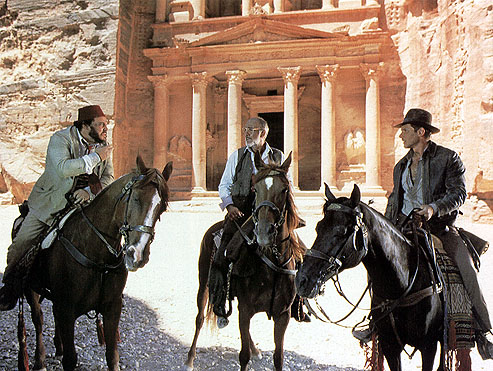
By most people's standards, John William Burgon (1813 –1888) had an interesting and successful professional life. He was an assistant in the antiquities department of the British Museum, then Gresham Professor of Divinity before ending up as dean of Chichester Cathedral. But time, devourer of all things, would already have more or less obliterated his memory if it wasn't for one poem. Or, more precisely, one couplet from his poem, Petra:
match me such marvel save in Eastern clime,
a rose-red city half as old as time.
Lines that it's now almost obligatory to quote in any book or documentary about the remains of the eponymous Nabataean city, famous as a UNESCO World Heritage Site, but probably famouser as a film location in Raiders of the Lost Ark.

There are a couple of interesting things about 'a rose red city half as old as time.' First, Burgon's best phrase, and the one thing for which he's now remembered, seems to be mostly a quotation from another poet, Samuel Rogers, who used the 'half as old as time' trope in his poem A Farewell, when he wrote about 'many a temple half as old as Time.' As a meditation on the transience of things, Rogers' poem anticipates Edward FitzGerald's famous translation of The Rubáiyát of Omar Khayyám, with passages like this:
...Many an eye
Bright as the brightest now, is closed in night,
And many a voice how eloquent, is mute,
although some of Rogers' other lines simply make it clear why we've forgotten him and remembered FitzGerald:
And now a parting word is due from him
Who, in the classic fields of Italy,
(If haply thou hast borne with him so long,)
Through many a grove by many a fount has led thee...
Haply, I can't bear with this sort of stuff for very long.

The other interesting thing is that Burgon probably meant the ringing phrase 'half as old as time', which sounds like poetic license, quite literally. As the literary scholar, Hugh Kenner, pointed out:
Though romantic, Burgon was being workmanlike. To his generation the age of Time was quite definite; for since Adam was created in the year 4004 B.C. on October 23, Time in the year Burgon wrote, 1845, was exactly 5849 years old, going back through half of which we locate the founding of Petra at 1080 B.C.
Even in that generation, geologists were having a tough time trying to reconcile the evidence in the rocks with the Biblical account of the creation, but as a devout believer in Biblical inerrancy, Burgon's faith in his Bible-based chronology was probably immune to such challenges.

Today, people who study these things estimate that our Universe (and, presumably, time itself), came into existence some time between 12 and 14 billion years ago.
The Universe is old. According to the most recent measurements, it is 13.7 billion years old. The rise of mankind, on the other hand, is fairly recent, with Homo Erectus, the first "modern human," appearing around a million years ago and Homo Sapiens, today's humans, arriving only in the past 200,000 years. Imagine compressing the time the Universe has existed into the span of a single day with the Big Bang occurring at the stroke of midnight. Humans crash the party late - at 11:59:56pm, just four seconds before the end of the day.
From a cosmic perspective, Petra has existed for the blink of an eye, rather than being 'half as old as time.' The earth itself, which has been around for an an estimated four and a half billion years, is less than half as old as time. But the recent discovery of something really ancient reminded me of Burgon's conception of a truly epic timescale:
An international team of scientists, led by astronomers at Queen Mary University of London (QMUL), report of two new planets orbiting Kapteyn’s star, one of the oldest stars found near the Sun ...

What makes this discovery different however, is the peculiar story of the star. Kapteyn's star was born in a dwarf galaxy absorbed and disrupted by the early Milky Way. This galactic disruption event put the star in its fast halo orbit. The likely remnant core of the original dwarf galaxy is Omega Centauri, an enigmatic globular cluster 16,000 light-years from Earth that contains hundreds of thousands of similarly old suns. This sets the most likely age of the planets at 11.5 billion years, which is 2.5 times older than Earth and "only" 2 billion years younger than the universe itself (around 13.7 billion years).
Astronomy magazine

To humans, the four and a half billion year age of our own planet is an unimaginable abyss of time, but these exoplanets were already older than that when our world was still nothing but stardust. I know that astronomers have already seen objects even older than the exoplanets orbiting Kapteyn's Star, but there's something about the idea of a planet that ancient, a real place, in our cosmic back yard,* with a surface you could walk on and touch (if only you could figure out how to travel 13 light years) that sends shivers down my spine. I think 'Petra' would be an awesome** name for the planet currently known as Kapetyn b, if only 'more than 80% as old as time' didn't sound paradoxically less impressive than 'half as old as time.'


*i.e. further away than you can possibly imagine, but that's just peanuts compared to space...

**In the 'makes the hairs stand up on the back of your neck' sense of the word, as opposed to the conversational 'if you could just pass me your plate, that would be awesome' usage.

Wednesday, 1 February 2012

The 'F-word'

There are a few words that I'm not comfortable with. The 'N-word' for example. I don't see any reason to tolerate, still less use, racist abuse. I'd find it hard to say, even in the context of reported speech, and I'd draw my own (unflattering) conclusions about anybody using such language (with exceptions for the victims of racial abuse reclaiming such words, or the simple reporting of racist language from the past - you can't learn from history by censoring it).

I don't have such any such principled objections to swearing, but I'm still uncomfortable with it. Just a personal preference and the way I was brought up, I suppose. Obscenities will come out, under extreme provocation but, mostly, I do without. Apart from anything else, endless repetition robs the words of their power and leaves you with nothing in reserve for those, mercifully rare, occasions when a volley of unrestrained swearing really is the only adequate response to some really outrageous situation.

Another of the fringe benefits of of restrained swearing is pain relief. Recent studies suggest that swearing may give relief  from physical pain. But you do have to ration your swearing - the more you swear in everyday life, the less emotionally charged the words become and the less effective swearwords are in reducing pain. I saw somebody demonstrate this effect on telly, in an experiment featuring Brian Blessed and a bucket of iced water, so it must be true.

There's one F-word that I've never, ever been able to force myself to say, though - fiancée. I got engaged a while ago and, all being well, will be married this summer. I'm quite happy with the situation, but the first time I had to refer to my significant other after our engagement, I just couldn't say the F-word and found myself falling back on the tried and tested "partner". I've never yet been able to refer with a straight face - or indeed refer at all - to "my fiancée".

It's not surprising in my case. Self and partner are both well on in our fourth decade, have a school-aged child and have been cohabiting for years, so the term sits a bit oddly, rather like "boyfriend" or "girlfriend" when applied to people beyond a certain age. But even for younger people the word has an odd, archaic ring to it.

First off, it just sounds too la-di-da, like calling a napkin a "serviette". Damn your French fads! At least "partner", sounds practical and down-to-earth. Come to think of it, Peugeot make a van called the Partner, but even the French would have to draw the line at making a commercial vehicle called the Peugeot Fiancée.

Second, The Glums. Post-Second World War Austerity Britain entertained itself by tuning in to Take It From Here, a radio comedy show written by a couple of young iconoclasts called Frank Muir and Denis Norden. The most popular part of Take It From Here was a sketch called The Glums, featuring the misadventures of the desperately perky Eth (June Whitfield) and her gormless fiancé, Ron (Dick Bentley). The Pismotality blog cites David Nathan's book The Laughtermakers: Quest for Comedy to highlight how the show reflected and mocked what was happening to the institution of engagement at the time:

It was about an engaged couple, sending up the relentlessly cheerful families then prevalent on radio, possibly a hangover from the wartime need to maintain morale. The comedy was fairly broad ... but with an undercurrent of reality, reflecting those times when long engagements were a matter of economic necessity.

Sexual intercourse may have begun in 1963, as "Chuckles" Larkin maintained, but accordin' to Norden ... there had already been stirrings in the undergrowth:

 What we ... did … was to send up … family relationships, things that were fairly sacrosanct at the time.

Ron and Eth started from a sketch we did about an engaged couple. We suddenly realised that one of the most hilarious and ludicrous positions to be in was this state of being engaged. It doesn’t apply now. We described it in one of the programmes as driving with one foot on the accelerator and the other on the brake. Nowadays it is driving with both feet on the accelerator.

Strangely, there was something very sexual lurking behind it, though it could never be made explicit in those days. But that was what we were on about, that was what we found funny, that state of having to hold back all the time. Frustration. It was possibly the first glimmer of the permissive society struggling to be born. People sort of recognised that if you were engaged the question was why don’t you go to bed together. But one never dared say it, never mentioned it. It was just simply this blind groping, this aching state, the tension.

Of course we weren’t allowed to indicate any of this for a second, but I think it caught the public at a time when they were becoming aware of sexuality.

Ron’s voice was funny, grotesque, June's voice was absolutely true – we knew who she was founded on. There were a lot of cosy family serials and soap operas on the radio, so it was a slight send-up of them too...

... Eth was the sort of girl for whom women’s papers published photographs of ideal kitchens. .. we used to read them just to get the picture of Eth. .. What was extraordinary though was the number of letters we got from girls asking how we knew that when two people are alone they talk like Ron and Eth ... The obvious answer was that your fiancé is a moron, but they didn’t see it like that. They saw him as the ideal fiancé, completely infatuated and dominated by both parents and girl. That was how a fiancé should be ...

Read the whole thing here If you're not familiar with The Glums, the blog post has a link to a later TV recreation of the characters that captures their uniquely grotesque sound (the original recordings aren't readily available on line due to BBC copyright issues, but they're occasionally rebroadcast on Radio 4 Extra). I doubt whether the word fiancé(e) ever recovered from the association with the simpering Eth and her twit of a boyfriend.

Moving from the 1950s to the '60s, the economic conditions that made long engagements a standing joke, eased, but so did the puritanical attitudes towards sex outside marriage. Look at the figures for marriage in Britain and you'll see marriage rates rising in the 1960s presumably reflecting increased prosperity and a decline in long engagements for couples who couldn't afford to get wed just yet. But after the early 1970s the figures go into an inexorable decline (although remarriage rates go up to a plateau that persists into the early 21st Century).

There are probably other factors at work, but the world that came after the 1960's marriage boom was different from the one that had gone before. In the old world, the institution of marriage and its preamble was Not To Be Trifled With (at least for "Respectable" folk). In the early part of the 21st century, nobody bats an eyelid at people cohabiting, or having a child out of wedlock (things unseen and unspoken of by people like my parents). People in the '50s may have laughed at The Glums, but engagement was still seen as the prologue to Something Very Serious Indeed:


DEARLY beloved, we are gathered together here in the sight of God, and in the face of this congregation, to join together this Man and this Woman in holy Matrimony; which is an honourable estate, instituted of God in the time of man's innocency, signifying unto us the mystical union that is betwixt Christ and his Church; which holy estate Christ adorned and beautified with his presence, and first miracle that he wrought, in Cana of Galilee; and is commended of Saint Paul to be honourable among all men: and therefore is not by any to be enterprised, nor taken in hand, unadvisedly, lightly, or wantonly, to satisfy men's carnal lusts and appetites, like brute beasts that have no understanding; but reverently, discreetly, advisedly, soberly, and in the fear of God; duly considering the causes for which Matrimony was ordained.

First, It was ordained for the procreation of children, to be brought up in the fear and nurture of the Lord, and to the praise of his holy Name.

Secondly, It was ordained for a remedy against sin, and to avoid fornication; that such persons as have not the gift of continency might marry, and keep themselves undefiled members of Christ's body.

Thirdly, It was ordained for the mutual society, help, and comfort, that the one ought to have of the other, both in prosperity and adversity. Into which holy estate these two persons present come now to be joined. Therefore if any man can shew any just cause, why they may not lawfully be joined together, let him now speak, or else hereafter for ever hold his peace. 

That's telling 'em. Compare and contrast those splendidly thunderous words from the Book of Common Prayer with the more inclusive, less scary (and, frankly, rather drippy) form of language in common use in these more permissive times:

In the presence of God, Father, Son and Holy Spirit,
we have come together
to witness the marriage of N and N,
to pray for God's blessing on them,
to share their joy
and to celebrate their love.

Marriage is a gift of God in creation
through which husband and wife may know the grace of God.
It is given
that as man and woman grow together in love and trust,
they shall be united with one another in heart, body and mind,
as Christ is united with his bride, the Church.

The gift of marriage brings husband and wife together
in the delight and tenderness of sexual union
and joyful commitment to the end of their lives.
It is given as the foundation of family life
in which children are [born and] nurtured
and in which each member of the family,in good times and in bad,
may find strength, companionship and comfort,
and grow to maturity in love.

Marriage is a way of life made holy by God,
and blessed by the presence of our Lord Jesus Christ
with those celebrating a wedding at Cana in Galilee.
Marriage is a sign of unity and loyalty
which all should uphold and honour.
It enriches society and strengthens community.
No one should enter into it lightly or selfishly
but reverently and responsibly in the sight of almighty God.

The clergy aren't going to terrify anybody with that. In a world where marriage itself is optional and the language of the marriage ceremony is commonly reduced to a few neutered, inoffensive, feel-good words, stripped of any vestige of awe and majesty, it's no wonder that the word fiancé(e) is being quietly slipped into the drawer where "doily", "antimacassar" and other words too ridiculously quaint to continue existing, are put away to be forgotten.


Monday, 2 January 2012

From the fury of the chicken ships deliver us, O Lord

Watching our hens fussing and bobbing about in the back garden, I've been thinking that they reminded me of something, but I couldn't, for the life of me, think what. It's just come to me, though. They've got the same proportions as old sailing ships. From the generously rounded curves of the lower hull to the upward sweep towards the jutting forecastle and the sprightly, upturned stern, the craft that kicked off the European Age of Exploration looked like nothing so much as giant sea-going chickens.


It would be really neat to say that galleons were the ships most like Gallus gallus domesticus but, sadly for alliteration fans, galleons lacked the high, ungainly forecastle of the earlier carrack, the most hen-like ship of all. Look at the top picture of Portuguese carracks off a rocky coast. Not only do these ships have the bodies of wooden chickens, but the flapping mainsail of the foreground vessel will ring a bell with anyone who's ever seen a running hen steadying itself with an outstretched wing.

Columbus, Magellan, Vasco da Gama, Vespucci and Jacques Cartier all sailed these quaint, gawky-looking carracks to to the blank spaces on the maps to explore strange new worlds, to seek out new life and new civilisations, to boldly go where no European had gone before.

It was an exciting time, but also a brutal one. A time of trade, of discovery and of armed men being disgorged from the wooden bellies of the floating Trojan chickens, bringing conquest, disease, slavery and genocide.

There's something almost deceptive about the unthreatening, domesticated shape of these vessels. So unlike the low, spare, purposeful menace of a raiding viking dragonship: 

Galleys of the Lochlanns ran here to beach, in quest of prey, their bloodbeaked prows riding low on a molten pewter surf. Danevikings, torcs of tomahawks aglitter on their breasts when Malachi wore the collar of gold.

Death's a sly customer, who doesn't always appear in the shape we expect. Death can easily bob into your life in a disguise as absurd as a big, floating chicken. Aeschylus, they say, was unexpectedly killed by a falling tortoise. If the tortoises don't get you, the flying bears might. But whatever form your ship takes, it will come in one day:


Only one ship is seeking us, a black-
Sailed unfamiliar, towing at her back
A huge and birdless silence. In her wake
No waters breed or break. 


He comes, pale vampire, through storm his eyes, his bat sails bloodying the sea, mouth to a mouth's kiss. 

So here's a late New Year's resolution - treasure every finite moment, of life, however confusing, infuriating and absurd it may seem:


Ah, my Beloved, fill the Cup that clears
TO-DAY of past Regrets and future Fears:
To-morrow—Why, To-morrow I may be
Myself with Yesterday’s Sev’n thousand Years.
May your years be long.

Thursday, 15 September 2011

What's wrong with this picture?

Every so often you come across something so elegantly, concisely, perfectly wrong that it's like a tiny acidental poem. Think of this as your fail haiku for today:

My boss was tired of our wire cutters getting stolen. I'm not sure this will solve it.

via

Wednesday, 3 November 2010

'I was somewhat tickled'

I recall that a few years ago I was somewhat tickled by a quote from slovenly artist Tracy Emin, as she unveiled a stick with a sparrow on it in Liverpool (funded by BBC licence payers to the tune of £60,000… ah those carefree New Labour days). She warbled: “I’ve always had the idea that birds are the angels of this earth and that they represent freedom.”

I was tickled because “birds are the angels of this earth”  struck me as just the sort of thing that Madeleine Basset from the Jeeves and Wooster stories might say, in addition to the stars being God’s daisy chain and that every time a fairy sneezes a wee baby is born.

Top blogging from Brit in The Dabbler. Brit goes on to contrast Emin's saccharine little angel on a stick with Ted Hughes' colder description of birds as half machine, half pitiless force of nature in his  poem Thrushes:

Terrifying are the attent sleek thrushes on the lawn,
More coiled steel than living – a poised
Dark deadly eye, those delicate legs
Triggered to stirrings beyond sense – with a start, a bounce, a stab
Overtake the instant and drag out some writhing thing.
No indolent procrastinations and no yawning states,
No sighs or head-scratchings. Nothing but bounce and stab
And a ravening second.

I think Hughes is almost spot on there - almost, because his description always makes me think of starlings rather than thrushes - with their sharp beaks, jerky but strictly controlled movements and metallic, iridescent plumage, there's something automaton-like about starlings. And when thousands of the robotic little blighters flock together, there's no doubting that they're a primal force of nature...

Monday, 11 October 2010

Stacey Island

No man is an island, entire of itself;
every man is a piece of the continent, a part of the main;
if a clod be washed away by the sea,
Europe is the less, as well as if a promontory were,
as well as if a manor of thy friends or of thine own were;
any man's death diminishes me, because I am involved in mankind;
and therefore never send to know for whom the bell tolls;
it tolls for thee.

John Donne, Devotions Upon Emergent Occasions, Meditation XVII

Shorter version:


No man is an island... apart from Barry

Wednesday, 11 August 2010

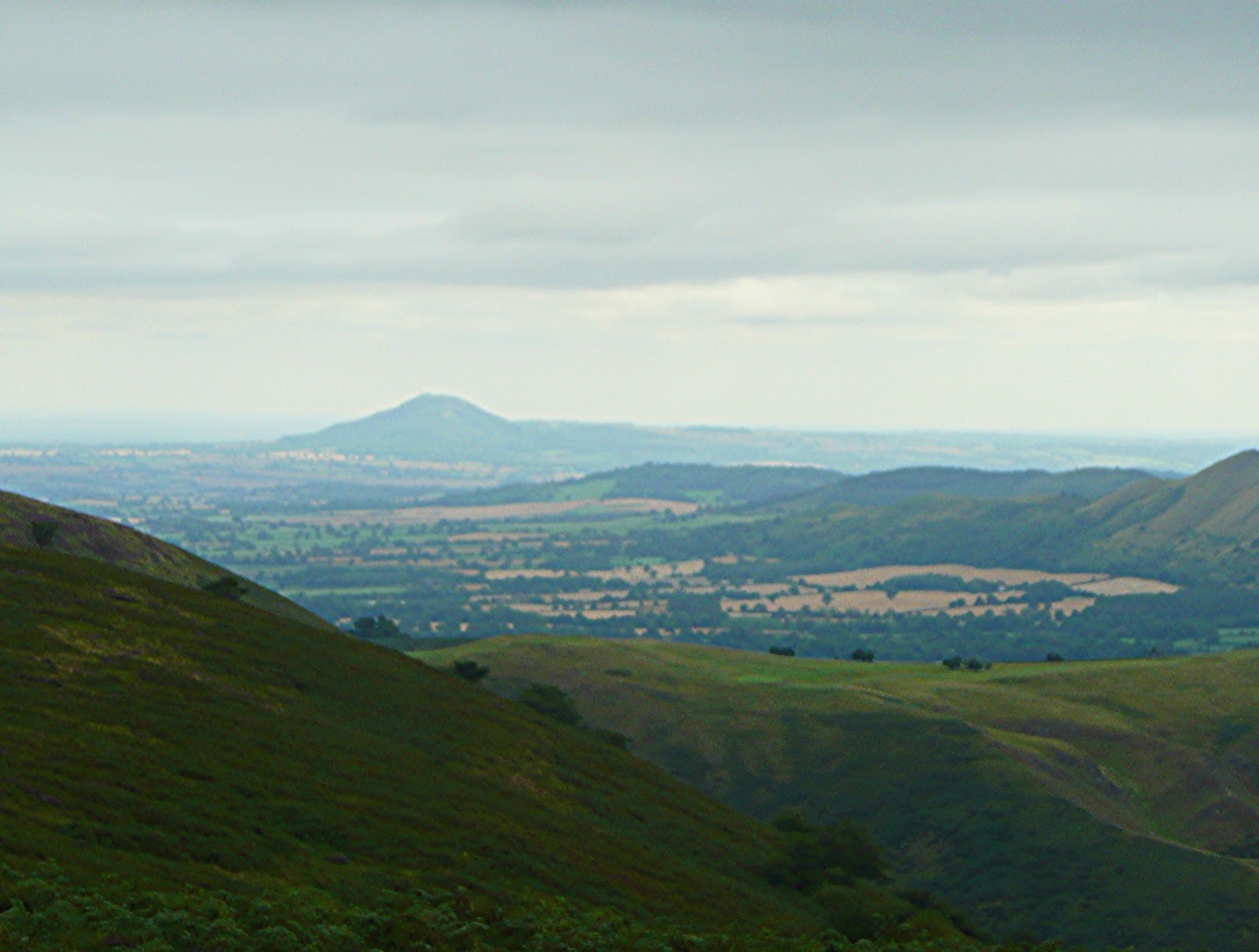
Blue remembered hills


Taken on the Long Mynd, near Church Stretton, Shropshire.

Wednesday, 28 April 2010

Today's featured blog

Constellation
Scrape into the sink
Constellation of black stars
A toast neglected

Angry Toastless Man

Angry toastless man
Malfunctioning appliance
Senseless killing spree


Intensely focused

Intensely focused
I anticipate my toast
Somewhere a dog barks

From Toast Haiku - a blog that does exactly what it says on the tin, except when it's doing something else.

Tuesday, 1 July 2008

An inhuman outrage

Weather forecasters, from Michael Fish, way back to Robert Fitzroy may get a bit of a hard time when they're thought to be getting it wrong, but they get off lightly compared to FitzRoy's uncle, Viscount Castlereagh. If he's remembered at all, it's mainly for the broadsides loosed at him by two of the big guns of Romantic Poetry. Shelley thundered:

I met Murder on the way –
He had a face like Castlereagh –
Very smooth he looked, yet grim;
Seven bloodhounds followed him

All were fat; and well they might
Be in admirable plight,
For one by one, and two by two,
He tossed them human hearts to chew
Which from his wide cloak he drew

On hearing of his death, Byron dismissed his memory with the unflattering lines:

Posterity will ne'er survey
A nobler grave than this:
Here lie the bones of Castlereagh:
Stop, traveller, and piss

Castlereagh attracted such hostility because, as Leader of the House of Commons, he defended the repressive policies of the then Home Secretary, Lord Sidmouth whose tenure saw the ruthless suppression of campaigns for greater democratic representation and smearing of reformers with the accusations of treason and sedition. Sidmouth's repressive measures ultimately included the suspension of habeas corpus and requiring the permission of a magistrate before any public meeting of more than 50 people pertaining to "matters of Church and state" could be held (the Serious Organised Crime and Police Act 2005 isn't as shiny, new and paradigm-shifty as the Home Office apparatchiks would have you think). Although Castlereagh was, by some accounts an accomplished diplomat, his reputation couldn't survive association with such bullies and sleazeballs as Lord Sidmouth's crew.

Little wonder that radicals such as Shelley and Byron despised Castlereagh; it's entertaining to imagine what they might made of the defenders of some more recent Home Secretaries, popping up to defend the indefensible, whether in the guise of extended detention without charge, restrictions on the right to peacefully protest, or ID cards. Mincemeat, hopefully.

Perhaps the most flagrant outrage committed on Sidmouth's watch, certainly the most visible was what later became known as the "Peterloo Massacre". At St Peter's Fields, Manchester, on August 16th, 1819, a crowd of over 60,000 gathered to attend a demonstration for Parliamentary reform, and especially for an end to such corrupt institutions as Rotten Boroughs. The local magistrates, fearing the size of the gathering, panicked and called in the military, in the form of the Manchester Yeomanry, who charged into the crowd, hacking away at peaceful protesters with their sabres. It is thought that eleven people were killed and some four hundred wounded.

A millowner, Thomas Chadwick, who was there, described the massacre as: "An inhuman outrage committed on an unarmed, peaceful assembly."

The deaths were only the beginning - the Government's response to the threat of radical unrest, which is how they saw such lawful demonstrations, was to crack down on the civil liberties of the population with the draconian "Six Acts" which introduced such innovations as "speeding up" the legal process by reducing opportunities for bail, cracked down on free speech, extended powers to search private property for arms.

The Peterloo Massacre has been compared to the 1989 Tiananmen Square Massacre in China. Although the numbers differ - the People's Liberation Army and their tanks may have killed anywhere from from several hundred to seven thousand people, as opposed to the eleven or so fatalities chalked up by the Manchester Yeomanry - there are compelling similarities; two groups of peaceful protesters, demonstrating for democratic reforms, crushed by military force because of the authorities' fear of subversion, followed by an aftermath of suppression and reprisal. History repeating itself? You decide.

Thursday, 12 June 2008

You maniacs! Damn you! Damn you all to hell!

SPOILER WARNING - in the unlikely event that you haven't seen the film of Planet of the Apes (the 1968 original, not Tim Burton's pointless 2001 remake) and don't want to be warned of the plot twist at the end, don't read on. Otherwise, scroll down...


The Government's latest parliamentary victory in pushing through 42 days detention without trial was depressing on many levels. It kept Gordon Brown afloat to fight another day, but remained a reminder of how weak he is and how strong the policy-lite ex-PR weasel David Cameron is - I wouldn't want Gordon to win this one on a matter of principle, but I'm not crazy about a Cameron government coming a step further, either - at best, I think he'll maintain something like the status quo, at worst he'll be New Labour without even the obligatory Labour nods towards social justice (for those of you wondering what any of this has got to do with Planet of the Apes, patience - we'll get there eventually).

As if that's not depressing enough, it shows how wedded Gordon Brown is to authoritarian clunking-fist solutions to problems. The UK authorities can already detain suspects without trial for longer than the authorities in any other country we would regard as remotely democratic or respectful of the rule of law. Even without the extension to 42 days, just look at where we stand. In Canada they can hold somebody for a day before charge or release. In in Russia it's five days, six in France, a week in Ireland, seven and a half days in Turkey.

If the Canadians (who would be indistinguishable to most jihadi nutcases from Americans and whose armed forces are actively involved in fighting the Taliban in Afghanistan) only need a day, why do we have four weeks, holding out for six? Russia - a sort of democracy, but a bit on the authoritarian side, rarely held out as a model of civil liberties and the rule of law - still has to charge suspects after less than a week, or let them go, yet in freedom-loving Britain four weeks is still not long enough for us to hold people without trial "just in case". Turkey; again, it's a democracy, but not exactly a paragon, yet our suspects could be languishing in jail without the authorities having to give any reason for more than 20 days longer than Turkish law permits and we want to add another two weeks, just to be on the safe side. The figures, by the way, come from a Liberty report here.

I've deliberately excluded the USA, where you need to be charged after only two days, because they've got this whole Guantanamo Bay thing happening and are exceptional in using the legal category of "unlawful combatant" to exclude certain classes of prisoner from the legal protections given to criminal suspects or prisoners of war (especially when it comes to detention without trial). But even in the USA this legal jiggery-pokery has been challenged in the Supreme Court. I believe that the range of prisoners who aren't covered by the Geneva Convention has been narrowed down - Al Qaeda suspects are still in legal no-man's land, for example, but Taliban captives are subject to the Geneva Convention, so presumably have the same rights as any other POW.

Perhaps this is just the inevitable result of government action needed to prevent another 9/11. Well, the September 11th attacks were off the scale in terms of deaths in one incident, but:

a) even including 9/11, the chances of dying in a terrorist incident are modest to say the least - read and digest these figures (I can't vouch for the absolute accuracy, but the orders of magnitude are about right). One terrorist death is too many, but they're just not killing that many people, compared with other preventable causes of death.

b) the September 11th plotters were ruthless and effective. But most of the recent crop have been incompetent fantasists. Just look at some of the more recent plots - for example the probably unworkable attempt to bring down airliners with liquid explosives disguised as soft drinks. Official over-reaction has lead to a windfall for soft drink sales at airport shops and shedloads of inconvenience for air passengers, but all in the name of protecting us from a plot too cumbersome to work. Or how about these idiots trying to bring terror to London's West End and Glasgow Airport. Not forgetting Richard Reid, the useless shoe bomber. Maybe we're running out of competent terrorists.

c) as far as I can understand their motives, what terrorists want is to cause as much disruption and terror as possible - which is exactly what governments hyping up the threat level are doing. The also would like to provoke a backlash - for example, I understand that the purpose of most attacks by Islamist radicals in Egypt was to provoke an already authoritarian and oppressive government into becoming even more oppressive, in order to stir up opposition. Well thought out police and anti-terrorism operations and good intelligence work might help a state to deal with terrorism, but sliding into over-reaction and curtailing the civil liberties of the majority is just doing the terrorists' work for them.

The latest attempts to curtail our liberties were what made me think of the final scene of Planet of the Apes. The astronaut, played by Charlton Heston, is exploring the strange planet he's been stranded on, an earth-like world where apes are the dominant species who regard the native humans as animals and treat them as such. At the very end of the film, he comes across the remains of the Statue of Liberty, looming out of the wilderness and finally realises that he's not arrived on some distant planet, but on his own world in the distant future when humans have destroyed their own civilization and the apes have inherited the Earth. His final words are a curse on the stupidity of the human race:

You maniacs! You blew it up! Damn you! Damn you all to hell!

Planet of the Apes is more fantasy than hard Sci-Fi, but that's one hell of a final scene. It's not remotely plausible - even as a child I didn't find it credible that a relatively flimsy copper-sheathed statue hadn't corroded and eroded away centuries ago, over a period when entire cities had apparently crumbled without a trace. But it's such a powerful symbol that most people willingly suspend their disbelief. The image has a monumental, mythic quality, like Shelly's Ozymandias:

I met a traveller from an antique land
Who said: Two vast and trunkless legs of stone
Stand in the desert . . . Near them, on the sand,
Half sunk, a shattered visage lies, whose frown,
And wrinkled lip, and sneer of cold command,
Tell that its sculptor well those passions read
Which yet survive, stamped on these lifeless things,
The hand that mocked them, and the heart that fed:
And on the pedestal these words appear:
"My name is Ozymandias, king of kings:
Look on my works, ye Mighty, and despair!"
Nothing beside remains. Round the decay
Of that colossal wreck, boundless and bare,
The lone and level sands stretch far away.


There's a striking similarity between the two visions of the wrecks of lost civilizations, but there's an important difference, as well. Ozymandias records the wreck of vanity, pomp, vainglory and power. The remains of Lady Liberty are in a way far sadder, for she is a symbol not of long lost crushing autocratic rule, but of hope and freedom. On the pedestal of Ozymandias' statue is carved a vain boast. Compare and contrast with these words from the Statue of Liberty's bronze plaque:

"Keep, ancient lands, your storied pomp!" cries she
With silent lips. "Give me your tired, your poor,
Your huddled masses yearning to breathe free,
The wretched refuse of your teeming shore.
Send these, the homeless, tempest-tossed to me,
I lift my lamp beside the golden door!"


Her decay represents the death of Lincoln's resolve that that "government of the people, by the people, for the people, shall not perish from the earth."

As our elected politicians casually chip away, bit by bit, at the liberties which are among the proudest achievements of our democratic, liberal civilization, I'm haunted by the spectre of the ruined Statue of Liberty. Maybe one day a traveller in our antique land will marvel at the ruined traces of the liberties we once enjoyed and damn us all to hell for the self-destructive maniacs we were.

So even though he's spent most of his life being a Tory, I'll be raising a glass to David Davis tonight. Here's to you, Sir, for making a stand, and here's to Lady Liberty - long may she stand.