|
| "From pollination to the Caucasian wingnut's first released seed you could have taken 28,478,544 steps." Message set into a paving stone outside the Network Rail building, Milton Keynes. |
Showing posts with label photograhs. Show all posts
Showing posts with label photograhs. Show all posts
Monday, 9 April 2018
A spotter's guide to Caucasian wingnuts


Monday, 2 April 2018
Angry waters

Sunday, 1 April 2018
Everything still LÖUDER than everything else
... and they're not skimping on the stage lights, either:

April fool!
That's no rock concert ... It's a combine harvester!
Now try not to think of The Wurzels.

April fool!
That's no rock concert ... It's a combine harvester!
Now try not to think of The Wurzels.
Thursday, 1 February 2018

Sunday, 24 April 2016
Combine harvester of the fields of death
For some reason, my most popular post earlier this year was "Men with silly hats in tiny tanks." Either people really like pictures of tanks, or they really like silly LOLpics. To find out which, I'm going to post a non-silly tank pic and see how many people click. If many, I'll know you're here for the charismatic megafauna of the battlefield (© Charlie Stoss). If few, more LOLs needed.
The M4 Sherman hasn't got a very impressive reputation, but it was produced in impressive numbers (more Shermans rolled off US production lines than the total number of tanks manufactured by the British and Germans combined in the whole of the Second World War). And you have to admit that the mine-clearing variant, implacably beating a path through minefields and barbed wire entanglements with heavy chains on a rotating drum, looked pretty impressive in a strangely medieval way.
 | |
| A Sherman Crab flail tank in front of burning buildings in Arnhem, 14 April 1945. Made by: No 5 Army Film & Photographic Unit. © Imperial War Museum (BU 3515). |
Thursday, 17 March 2016
Horror from the deep
I can't help thinking that the Carmagnolle brothers deserved an Oscar for costume design when they created this nightmarish entity out of a sci-fi horror movie:

But they never got one, because:
Via.

But they never got one, because:
a) they created this in 1878, when moving pictures weren't yet a gleam in the Lumière brothers' eyesand
b) they weren't really trying to design a horrific cybernetic monster with freakish multiple eyes - just a diving suit.But that's still the most frightening thing I've seen in a long time.
Via.
Tuesday, 8 March 2016
Stormy weather

Sunday, 21 February 2016
The off season
Llandudno Pier, February 2016.
 |
| "The very pointlessness of a sea walk is its attractiveness to me." John Cooper Clarke |
 |
| "A seaside resort in the rain is forlorn. Sodden alfresco eateries; puddles on the sun loungers; a great bowl of grey ocean, uninviting." Sara Moss |
 |
| "I went for fish & chips at a faded seaside resort today. There's something rather melancholic about out-of-season resorts which kind of appeals to me. I saw the lonely character in the shelter sharing his fish & chips with the birds and I thought it might make an interesting photograph, despite the gloomy weather. It made me think of a song from my youth, when it was illegal to trade on a Sunday and how boring and tedious Sundays seemed. Well, that's all changed now, but I'm not sure how we are better off." Amro Gebreel |
 | ||||
| "Excuses are monuments of nothingness, They build bridges to nowhere, Those who use these tools of incompetence, seldom become anything but nothing at all." Anon (frequently quoted by motivational speakers and other self-appointed gurus). |
 |
| "The Little Orme (Welsh: Rhiwledyn, also known as Trwyn y Fuwch, Trwyn y Gogarth and Y Gogarth Fach) is 141 metres (463 ft) in height, and is a HuMP. It is one of two headlands situated at either end of Llandudno Bay, in Conwy County Borough, Wales. The other, larger, headland is the Great Orme." Wikipedia |
 |
| "Another good bird quickly followed when we picked up an adult Kittiwake out in the bay between the pier and the Little Orme, not on our predicted list! As we scanned, still trying to find a Razorbill, we saw at least six Kittiwakes, weird." The Biggest Twitch, Alan Davies and Ruth Miller |
Thursday, 22 October 2015
Winter is coming


If these had been taken today, you might either
- envy the amount of cash I've got to splash - according to the London Underground Rent Map, it now costs north of £1,000 per month to rent a one-bedroom pad in that neck of the woods (Highgate is about the closest tube station)
- pity me for having to line the landlord's pocket with nearly three quarters of my hard-earned dosh.
Sunday, 18 October 2015
More seaside Gothic
 |
| The remains of Skegness Pier (a photo I took some time in the late 1980s). |
The 1817 foot pier had cost £20,840 when it opened on 4th June 1881. It included a 700-seat saloon/concert hall at the 'T' shaped head. Steamboat trips began in 1882. The pier-head saloon was extended in 1898, and new refreshment rooms were built at the pier-head...
... On 11th January 1978, a severe storm washed away two large sections of the pier and left the theatre isolated at the seaward end. Plans to link the two sections by monorail, and to build a new 1200 seat theatre and a 250 foot tower all fell through later that year when an application for financial assistance was rejected.
Work began on dismantling the theatre in October 1985 but, while this work was taking place, a fire gutted the building.
Today the pier is only 129 yards (118m) long and no evidence remains of the old pierhead and shelters but what remains of the landward pier deck walkway has since undergone major refurbishment and is now once again a tourist attraction.
Even after refurbishment, what's left of the landward part of the pier looks forlorn. Somebody once defined a pier as a 'disappointed bridge' and that's exactly what it looks like today:

-- Tell me now, Stephen said, poking the boy's shoulder with the book, what is a pier.James Joyce Ulysses
-- A pier, sir, Armstrong said. A thing out in the waves. A kind of bridge. Kingstown pier, sir.
Some laughed again: mirthless but with meaning. Two in the back bench whispered. Yes. They knew: had never learned nor ever been innocent. All. With envy he watched their faces. Edith, Ethel, Gerty, Lily. Their likes: their breaths, too, sweetened with tea and jam, their bracelets tittering in the struggle.
-- Kingstown pier, Stephen said. Yes, a disappointed bridge.
Thursday, 8 October 2015
Swimmers

Just to prove that there's more to the English coast than desolate seaside Gothic, here's another old photo to lift the mood a bit. It was high tide somewhere in Dorset. I forget exactly where, but who cares when it's summer and the water looks this inviting?
Ozymandias-on-Sea
England may not have any abandoned temples in windswept deserts, “vast and trunkless legs of stone” and the misplaced pride of Ozymandias, but it still has its epic follies: places where grand ambition had free rein, at least for a while.From Seaside Gothic by Edmund Richardson.
Visit them today, and you can see the high-water mark, the glorious moment followed by inevitable decline. Weston is one such place: its Grand Pier is awash with wrought-iron latticework, towers, and domes. The wonders of the world were to be gathered here, for Weston to delight in them, and they in Weston. Today, it is almost empty, an abandoned palace floating above the mud.
This reminded me of an photo I took many years ago, not in Weston, but on one of Brighton's piers. Three gulls perch on top of one of the pier's slightly rusty buildings, its windows reflecting the setting sun. I've always thought that the picture captured the faded, melancholy beauty of many an English seaside town and Richardson's article brought the feeling back perfectly.
Anyway, here's the picture in question (so old it was taken on 35mm and scanned):

Sunday, 13 April 2014
Advertising for birdbrains
Here's a guy who's heard that it pays to advertise:

You have to admit it's an impressive display, from that fan of gorgeously patterned feathers, wider than some people are tall, to the extravagant headgear and dandy highwayman coat in shimmering ultramarine.
What's rather less impressive is the degree to which an advertiser with a brain the size of a plump cherry can segment his market and focus on influencing the appropriate target demographic. In short, he's trying to impress the wrong species. Here's another photo with a bit more context:

Although guys showing off to other guys is pretty common, it isn't the small boy in shot he's displaying to - even a peacock isn't dumb enough to waste energy on a mere mammal. The object of his advertising campaign is the poultry cage in the background, where a baffled group of chickens are watching a display that would be fruitless even if the females in question weren't caged and out of reach.
If only all junk mail looked this good.
You have to admit it's an impressive display, from that fan of gorgeously patterned feathers, wider than some people are tall, to the extravagant headgear and dandy highwayman coat in shimmering ultramarine.
What's rather less impressive is the degree to which an advertiser with a brain the size of a plump cherry can segment his market and focus on influencing the appropriate target demographic. In short, he's trying to impress the wrong species. Here's another photo with a bit more context:
Although guys showing off to other guys is pretty common, it isn't the small boy in shot he's displaying to - even a peacock isn't dumb enough to waste energy on a mere mammal. The object of his advertising campaign is the poultry cage in the background, where a baffled group of chickens are watching a display that would be fruitless even if the females in question weren't caged and out of reach.
If only all junk mail looked this good.
Saturday, 17 August 2013
A curious clocke

As when a curious clocke is out of frameThe central conceit and style bring John Donne to mind, although I've no particular reason to think it's by Donne. The other thing it brings to mind is William Paley's watchmaker analogy, living beings understood as as intricate pieces of clockwork that must have been put together by some designer.
A workman takes in peeces small the same
and mendinge what amiss is to be found,
the same rejoynes and makes it trewe and sound
So god this Ladie into two partes tooke
too soone her soule her mortall corse forsooke
But by his might att length her bodie sounde
shall rise rejoynd unto her soule now crownd
Till then they rest in earth and heaven sundred
att which conjoynd all such as knewe them wondred
I knew that Paley didn't get his idea form nowhere - clockwork analogies were used by Descartes and, in a slightly different context, by Newton, with his idea of the divine first cause winding up the celestial clockwork - but it's interesting to see that the metaphor already had enough salience in the wider world to crop up on early Seventeenth Century memorial inscriptions, rather than being confined to the abstruse writings and debates of natural philosophers. Interesting, too, to see how this earlier use of the clockwork analogy incorporates Cartesian dualism, with the 'soule' and 'mortall corse' being the two major elements of the human mechanism.
Given the immaterial nature of the 'soule', it surprises me that modern creationists don't make more use of a more precise update of the two-part clockwork metaphor, with the 'soule' as software, the 'mortall corse' as hardware and the divine techie reassembling and rebooting the whole system at Judgement Day. Or maybe they already do, but I'm just not masochistic enough to have read that much creationist literature.
* 'sow' at the end of line four, is clearly an abbreviated form of 'sound' and I'm assuming that the penultimate word in the poem, 'the', which makes no sense, should read 'them.' I suppose it might also be 'thee', but as the poet doesn't address the deceased directly at any other point in the poem, this seems unlikely.
Thursday, 23 August 2012
The minotaur cyclops...

Sunday, 24 June 2012
Photoshop jihad FAIL

Purely on the basis of the graphic, I'm guessing that these guys aren't drawing on an extensive pool of talent. Most parish newsletters in the UK can muster somebody with better Photoshop skills than this.
I love the way they illustrate 'anti-aircraft guns' with a stock picture of some rockets (what the heck, nobody'll notice) and one downed F4 with an image of two F16s with their landing gear down, amateurishly cut'n pasted onto a background snap of some houses on a hillside (to dramatise the story of a jet shot down over the sea), all slapped together with the finesse you'd expect from a primary school child's first attempt to make a birthday card on the school computer.
Click here to embiggen the original image.
If this illustrates the general level of competence among Hezbollah's followers, it would explain why so many of them see blowing themselves up as a viable career option.
Saturday, 7 April 2012
Rubbernecking fail
As we're visiting North Wales, we decided to take a look at the unlucky cargo ship MV Carrier St John's, blown onto rocks near Colwyn Bay earlier in the week. Although the ship's mast is visible from the A55, the authorities have sadly blocked off any footpaths in the vicinity of the grounded vessel, so I wasn't able to get a decent picture of the ship lying on the rocks (after trudging down some cliffs, I did get to a vantage point where I could make out a portion of wheelhouse in the distance, but that was it).
As we're staying in Llandudno, where nothing ever happens that's louder than a scone being buttered,* it was disappointing not to get a view of the only exciting thing to have happened round these parts in years. I see somebody's managed to get a distant view on Geograph, so that'll have to do as for an illustration of my "I was close-ish to a moderately interesting news story" story.

Photograph © Richard Hoare, published under this Creative Commons Licence.
* Wit © the late Linda Smith (her description of some genteel seaside resort or other; possibly Hove).
As we're staying in Llandudno, where nothing ever happens that's louder than a scone being buttered,* it was disappointing not to get a view of the only exciting thing to have happened round these parts in years. I see somebody's managed to get a distant view on Geograph, so that'll have to do as for an illustration of my "I was close-ish to a moderately interesting news story" story.

Photograph © Richard Hoare, published under this Creative Commons Licence.
* Wit © the late Linda Smith (her description of some genteel seaside resort or other; possibly Hove).
Thursday, 15 December 2011
War (what is it good for?)

Here's a dramatic1940's colour photo of some workers helping to build a Liberator bomber. I love the tight composition and the old-master-style chiaroscuro effect (photo courtesy of The Library of Congress).
It's a small reminder of the vast amount of material and labour diverted from productively satisfying everyday human needs and desires into the destructive business of war. Writing in post-war austerity Britain, George Orwell lamented the waste in his fictionalised account of a nation inured to total war:
The essential act of war is destruction, not necessarily of human lives, but of the products of human labour. War is a way of shattering to pieces, or pouring into the stratosphere, or sinking in the depths of the sea, materials which might otherwise be used to make the masses too comfortable, and hence, in the long run, too intelligent.
1984
There are contrasting views, and they don't come more contrasting than this:
But it was not until government spending soared in preparation for global war that America started to emerge from the Depression. It is important to grasp this simple truth: it was government spending—a Keynesian stimulus, not any correction of monetary policy or any revival of the banking system—that brought about recovery.
I know it's supposed to be a text-book example of Keynsian economics, but still find it quite mind-boggling that such a vast material effort, diverted to ends that weren't just unproductive,* but were actively destructive, could apparently bring about economic recovery. It makes me realise that I need to find a clear economic history of the period that explains what was going on in language accessible to a non-economist.** Such a book ought (assuming Stiglitz and other kindred economic historians are right about cause and effect) to be required reading for policymakers in these post-bust times.
Maybe what the world needs now is war, sweet war (preferably a toned-down version, with none of that unpleasant killing people business).
*I'm talking in purely economic terms here, without any reference to the morality of the conflict.
** Any suggestions gratefully received
Thursday, 17 November 2011
Mock the weak

A lot of people make fun of Milton Keynes, which is fine by me. I think it's a better place to live than most outsiders imagine, although the reality falls short of the Milton Keynes Development Corporation's original vision of a beautifully planned, orderly, harmonious place to live with no building higher than the highest tree. If people want to make fun of concrete cows and the grid roads and all the roundabouts (which really do keep traffic congestion to a minimum), I don't have a problem with that.
In fact, I rather welcome the fact that people treat the place as a bit of a joke, because it means there's less of the thin-skinned, self-important local pride that makes other places look even sillier. I lived in Leighton Buzzard for a short while, at the time when Jeremy Clarkson made a throwaway remark about in a car review about Leighton Buzzard being 'the fifth-best town in Bedfordshire'. The Pages of the Leighton Buzzard Observer carried a furious rebuttal from the affronted council leader (or some such local dignitary), raging and spluttering as if somebody might have actually noticed this remark, or could have cared less.
I'm no Clarkson fan, but this was practically the least offensive thing he's ever said. A comment from Clarkson shouldn't have even been local-newsworthy unless he'd at least called the local council lazy, feckless and flatulent and preferably accused them of murdering prostitutes in between meetings of the planning committee.
What does rile me is comfortably-off people sneering at everybody who lives on the city's poorer estates. Take this nasty little "satirical" e-mail from earlier this year, as reproduced in the Anna Raccoon blog
An Earthquake measuring 5.2 on the Richter scale hit the new city of Milton Keynes on Wednesday morning.
Casualties were seen wandering aimlessly saying “bang out of order”, “mental” and “sorted”. Some are still confused that something interesting actually happened in Newport Pagnell! Some residents of Fishermead were woken before their ‘giros’ arrived and it caused quite a panic!
The earthquake decimated half of the Fullers Slade area causing in excess of £17.55 worth of damage. Several priceless collections of mementos from Ibiza, Corfu, Rhyl and Blackpool were damaged beyond repair including a cute little donkey that ‘broke wind’ when you clapped your hands.
At a time when unemployment is soaring, the numbers of the working poor are at a record high and desperate people are killing themselves after being thrown on the employment scrapheap, isn't it good to know that there are people out there unafraid of mocking the poorest and weakest members of society? I guess, as it becomes less acceptable to taunt people for their race or sexuality, the sort of inadequates who always need somebody to look down have to find a new target to kick, (preferably somebody too weak to kick back). "Chav" is in danger of becoming the new "queer".
What I love is the irony of the thrusting, aspirational suburban golf club set sniggering at the poor for their lack of taste. It's a bit rich, coming from the class that's spent years disfiguring the countryside with a rash of unsightly mock Tudor "executive" homes. These Petit Trianon playhouses for the petit bourgeois are just the architectural equivalent of a flatulent ornamental donkey for people with more money than sense.
The poor, of course, don't get much of a say about what their accommodation looks like. In Milton Keynes this led to some very strange results on the older estates, where 1970's architects were given free rein to design radical, modernist machines for living to house the "overspill" from Greater London. Some of the designs were pretty stark and brutal. The linear, angular, gleaming, metal-clad lines of the '70s buildings in Netherfield, for example, certainly have what Kevin McCloud would call 'integrity', but it's the hard, uncompromising integrity of a housing project designed by daleks.
I hardly need to add that, being low-cost pre-fabricated social housing, they haven't worn tremendously well. The years and individual redecoration can't disguise the uncompromising geometry, but they have destroyed the pristine, chilly unity of the facades, which look patchier and shabbier by the year A lot of MK's original buildings were only supposed to be temporary, built to house the people who came to build the city, then to be torn down to make way for something better. Forty years later, we're still waiting.
I was in Netherfield the other day, when I spotted something rather extraordinary. I'm a bit conflicted about sharing it as, after all I've said about mocking the poor, it might seem like more middle-class piss-taking, but this is such an astonishing collision between the aesthetic of the suburban executive home and the stark functionalism of '70's prefabricated social housing, that you really have to see it to believe it. Sorry about the quality of the following picture, taken with a low-quality mobile phone camera with a scratchy lens - at least it saved me the job of pixellating out the car number plates:

No matter whether the person responsible was rich or poor, (for all I know it might have been the landlord) this is just so wrong it's off the scale. Somebody actually took something from the Decade That Taste Forgot, hybridised it with its opposite and came up with something this unspeakably what-the-hell-were-you thinking?. It's so wrong it's almost right. 'As beautiful as the chance encounter of a sewing machine and an umbrella on a dissecting table' as somebody once remarked. If you want to marvel in higher quality, somebody's posted a far better picture of the building in question here, or you could just put Farthing Grove, Milton Keynes into Google Maps and find it for yourself on Street View.
Milton Keynes - you've just gotta love the weirdness.
Update (Occupy Milton Keynes)
Having posted this, I think I belatedly get it. Seen from the point of view of a resident, maybe this isn't so mental after all. You've got the powers that be pouring people, like so much fungible human overspill, into their anonymous, generic boxes, then one day one of the residents decides to stop being the passive recipient of somebody else's aesthetic and stick two big fingers up at the people who designed these anonymous hutches. What you see before you is an act of defiance and individuality, a sane protest against an absurd world.
It still looks bloody ugly, though.
Update 2 "Civic" amended to "local", as I ended up talking about Leighton Buzzard, which isn't a city by any stretch of the imagination.
Thursday, 10 November 2011
From The Illustrated Uxbridge English Dictionary
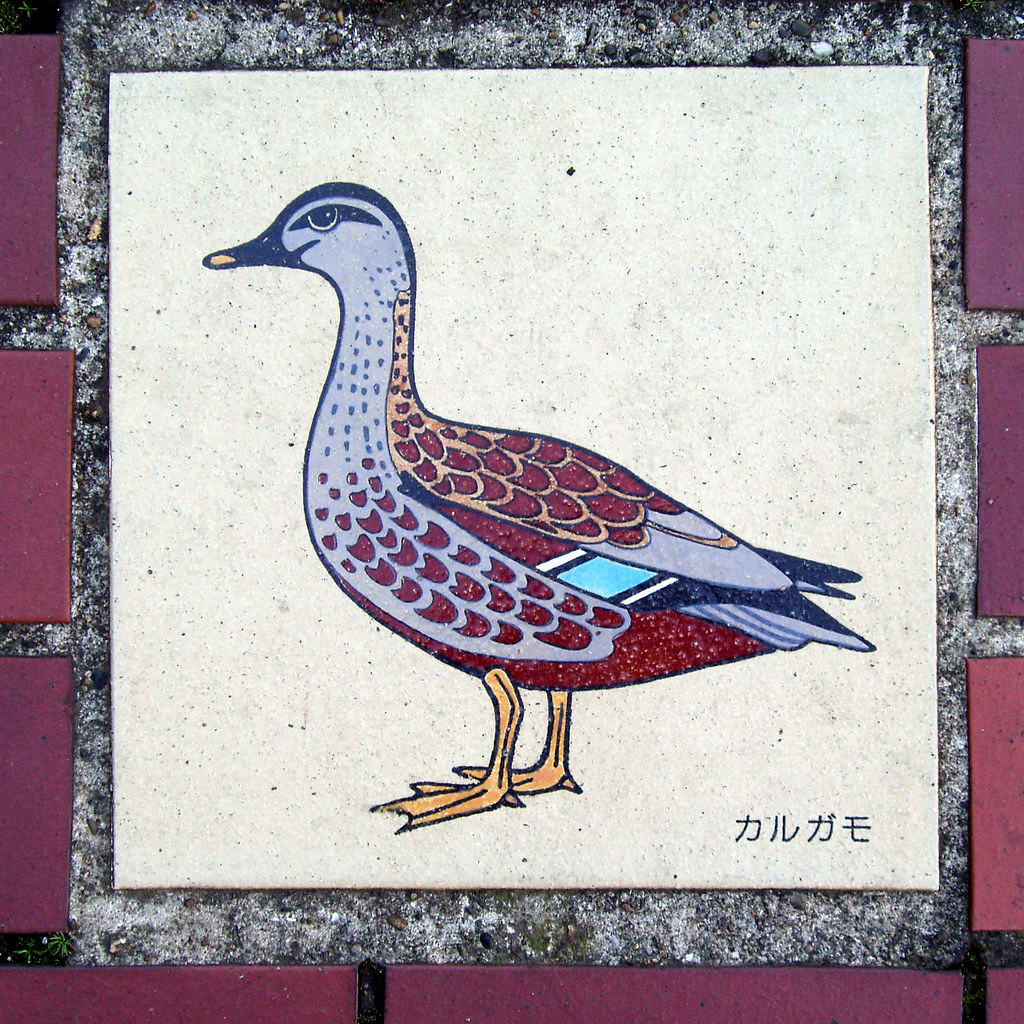
ductile [ˈdʌktaɪl]
Noun: A tile with a duck on it.
Image courtesy of Nemo's great uncle's Flikr stream. Silliness courtesy of The Uxbridge English Dictionary.
Subscribe to:
Posts (Atom)