Showing posts with label ASTRONOMY. Show all posts

Saturday, 24 April 2021

Cleopatra's calendar

Cleopatra VII of Egypt is a historical celebrity for a number of reasons, chiefly her fruitful political and romantic entanglement with Julius Caesar, her doomed political and romantic entaglement with Mark Antony, her subsequent suicide by asp and her status as Egypt's last Pharaoh.*

More recently, she's received more recognition as a wily and ruthless player in the Ptolemys' deadly game of thrones, a political figure in her own right, rather than the caracatured exotic über-seductress of powerful men.

All of this stuff's historically interesting, but I'd say that her most lasting legacy isn't necessarily a dramatic life filled with passion and power politics and its retelling down the ages, but something even more ubiquitous; the calendar which most of the world uses today.

So here's the argument. Most of the world today uses the Gregorian solar calendar. The Gregorian calendar was  introduced in 1582 by Pope Gregory XIII, as a slightly more accurate upgrade to the earlier Julian calendar.

The Julian calendar is, of course, named after Julius Caesar, who introduced it to Rome in 45 BC, replacing the earlier Roman calendar. 

Unlike the transition from Julian to Gregorian, which was a refinement of the same basic calendrical system, the Julian reform was fundamental, substituting a new, solar calendar for the old Roman lunisolar calendar which, by this stage, had some serious issues:

 Around 715BC the twelve month [Roman] calendar was introduced, based on the phases of the Moon. It takes on average 29.5 days between one new moon and the next and so a twelve-month lunar year lasts 354 days but an extra day was added because even numbers were unlucky. The twelve months had between 28 and 31 days in each to make the year last 355 days. February was the shortest month with 28 days and every other year a whole extra month - called Mercedonius which alternated between 22 days and 23 days - was inserted after the 23rd day of February to try to keep the calendar in line with the solar year of approximately 365 days. At the end of Mercedonius the remaining five days of February were taken, so Mercedonius was followed by the 24th of February. But the arithmetic did not quite work - the system gives an average duration for the year of 366.25 days - and the calendar slowly drifted away from the seasons once more. Inserting an extra period to correct the calendar is called an intercalation.

The situation was made worse because the calendar was not a publicly available document. It was guarded by the priests whose job it was to make it work and determine the dates of religious holidays, festivals, and the days when business could and could not be conducted. Through both carelessness and abuse, the intercalations were not made even according to the flawed rules that had been laid down. By the time Gaius Julius Caesar took power in the mid 40s BC the calendar was in a mess and he decided to make a major reform. 

So where does Cleopatra fit in?

Well, back in 48 BC, Caesar, having routed Pompey the Great in battle, had pursued his hard-pressed rival to Egypt. Ptolemy XIII, in a misguided attempt to curry favour with the victorious Caesar, had Pompey assassinated, a gesture which backfired, leading an enraged Caesar to side with Ptolemy's co-ruler and sister, Cleopatra, depose Ptolemy and place his new ally (and lover) on the throne of Egypt.

In 47 BC, Cleopatra bore a son, Caesar probably being the father, while Caesar went off to do more civil war stuff. 

But this wasn't the end of their relationship. In 46 BC, Cleopatra and her little brother (and co-ruler in name only),  Ptolemy XIV, came to Rome and stayed at Caesar's villa. A few things came out of this visit, including Cleopatra entertaining Rome's great and good, Caesar declaring the Egyptian queen a "friend and ally of the Roman people" and a golden statue of Cleopatra being put up in the newly-built Temple of Venus Genetrix.

There was one, more consequential, result of Cleopatra's stay in Rome, according to Pliny the Elder, who identifies the Greco-Egyptian astronomer, Sosigenes of Alexandria, who was presumably part of Cleopatra's retinue, as the guy who actually devised the Julian calendar, proposed by Caesar in 46 BC and introduced in 45 BC. In this context, the radical move from a lunisolar to a solar calendar makes sense, as the Egyptians already used a solar calendar.

So, yeah, you could argue that without Cleopatra, Rome wouldn't have adopted the Julian solar calendar, the direct ancestor of most widely used calendar used in the world today.**

In a world without Cleopatra, the superpower of the ancient world might have refined its calendar along existing lunisolar lines and the modern world's dominant calendar might have had a lot more in common with, for example, the Hebrew calendar.

There are, of course, counter-arguments:

1. We only "know" that Sosigenes devised the calendar from one very short passage (Pliny's Natural History Book 18, 210-212) so it's not certain that Sosigenes really was the calendar guy. Aristarchus of Samos has also been credited as coming up with the Julian calendar, although there's even less direct evidence for this version.

2. If Pliny was right, and it was Sosigenes, then it would be more accurate to call it Sosigenes' calendar, not Cleopatra's, which would give my post title way less name recognition.

3. Name-checking Cleopatra might also make this a version of the questionable "great man" version of history (in this case "great woman", obviously). In a counterfactual world where Cleopatra, or Julius Caesar, or both of them, had never been born, it's likely that Rome would still have dominated Ptolemaic Egypt as a client state before absorbing it completely, so Greco-Egyptian scholarship and the eventual adoption of a calendar based on the Egyptian calendar might have been on the cards anyway.

But it's still at least plausible to think that the world's most widespread calendar might not be preeminent had chance not led to Julius Caesar meeting Cleopatra. And it's about as good an illustration of the Cleopatra's nose theory of history as I can think of.


*Roman pharaohs don't count.

**Not something I'd thought about until I came across a reference to the Egyptian influence on the Julian calendar in this video.

Saturday, 17 November 2018

The shape of evil

My 1931 beginners' guide to astronomy, The Stars In Their Courses by Sir James Jeans, really is the gift that keeps on giving. Currently loving this passage on the Coal Sack Nebula from the very end of the book:
This region contains one of the most brilliant parts of the Milky Way, and also one of its most remarkable features, a pear-shaped black patch on the sky 8° long by 5° wide, which the early navigators and astronomers called the Coal Sack. Early Australian folk-lore interprets this as a yawning pit of darkness and also as the embodiment of evil in the shape of an emu, which lies in wait at the foot of a tree represented by the Stars of the Cross for an opossum driven by its persecutors to take refuge among its branches.
If you grew up watching British TV in the 1970s, the idea of the embodiment of evil in the shape of an emu will ring a few bells...
"Hello, Possums!"

Thursday, 20 September 2018

Close, but no cigar...

The initial mission will therefore last for two years, and cover almost the entire sky, looking at 200,000 stars in total for exoplanets.

Given what we’ve learned about exoplanets from previous searches (like with Kepler), TESS [the Transiting Exoplanet Survey Satellite] is expected to find anywhere from 4,500 to upwards of 20,000 such worlds. Mind you, the first exoplanet was discovered in 1992, and we’ve found roughly 4,000 more in the 26 years since then. TESS will likely double that number in just two years.

It sounds exciting, and it is. The first exoplanet wasn't discovered until 1992. Since then, astronomers have found thousands and it seems from their initial results that planets are incredibly common. This wasn't always what astronomers believed. I've got a very old guide to astronomy, The Stars In Their Courses by Sir James Jeans, first published in 1931.  

As I've blogged before, I like this book, particularly for the way it conveys something of the incomprehensible vastness of our solar system and the distances to the stars using simple language and scale comparisons with everyday objects and distances on earth.

But it is also a book of its time and it includes a number of theories which have now been superseded. Notably, Jeans supposes that the solar system came into being as the result of a close encounter between the sun and another star which passed close by in the distant past. The gravitational pull of the passing star, he thought, ripped a "long filament of hot filmy gas" shaped "rather like a cigar" from the surface of the sun. It was from this cigar of matter that he supposed the planets condensed, with tiny Mercury and Pluto (Pluto was still an official planet back then), forming at the thin ends of the cigar and Jupiter and Saturn condensing in the fat middle where there was more stuff:


If the solar system really had been the result of such a chance encounter, we might expect planets to be rare and for most stars to shine their lonely lights on planetless neighbourhoods. Our world - in fact, our whole solar system - would be a rare aberration.

But now astronomers believe that planets formed from clouds of gas and dust left over from star formation. These protoplanetary discs are thought to be a normal part of star formation, meaning that we should expect most stars to be accompanied by the planets which condense out of these discs.

Less than a century ago, many astronomers thought that most other stars were barren, companionless points of light. Less than three decades ago, they hadn't detected a single planet around another star. Now they've found thousands and expect to find as many more in the next couple of years. And that's just scratching the surface of the billions that are probably out there in our galaxy.

Contemporary readers of James Jeans' book would have been staggered, as I was, by the sheer inhuman immensity of the universe. What they didn't know about was the sheer number of worlds, scattered like dust across that vast emptiness.


Thursday, 21 December 2017

Won't somebody think of the Solstice(s)?

We're so used to people complaining about the commercialisation of Christmas that we're in danger of forgetting the colonisation of this solstice (and the other one) by Mammon. At this special time of year, remember that a solstice is about more than:
"affordable dental and vision plans for individuals and families" (Solstice Benefits Dental Vision and Life Insurance Plan)

"help[ing] Fortune 500 companies seize new opportunities through groundbreaking digital solutions" (Solstice innovation and emerging technology consultants)

"24 HOUR CUSTOMER SERVICE" (shouty Solstice Sunglasses)

"one of our more decorated ships at sea. From world-class staterooms to specialty restaurants" (the cruise ship Celebrity Solstice)

"cannabis growers in Seattle, Washington, for medical marijuana patients and legal recreational marijuana users" (Solstice Medical Marijuana)

"artisan-inspired cuisine in an elegant and relaxed setting" (Solstice Restaurant, Vermont - dress code smart casual, dining style casual elegant, it says here)

"Health Care is Broken - We Have the Solution" (the never knowingly under-hyped Solstice Health Weight-Loss Program)

"a core-based, all levels, family-friendly yoga, barre, and pilates studio with babysitting on-site" (another thing called Solstice)
Let us take a moment to amid all this busyness and commercial hurly-burly to reflect on the true meaning of solstice.

Axial tilt- it really is the reason for the season.

Just thank Jólner that there's no solstital equivalent of the "War on Christmas" - yet. Although in a world where the US Environmental Protection Agency is banned from using phrases like "evidence-based" and the Gove-leaning parts of UK have allegedly "had enough of experts", it might only be a matter of time before we have to give equal time to axial tilt deniers, claiming that the seasonal darkness is God's punishment for humans abandoning family values and no longer being horrible to gays and that the light only returns because people make amends to the deity by sending their kids to crib services.

My solstice wish is that that this new dark age turns out to be as much of an unreal fear as the "War on Christmas" is, so we can all can enjoy a cool Yule this solstice and for many solstices to come.

Sunday, 1 October 2017

The answer is "no" in both cases

Marc Goldberg at Harry's Place has a question:
Will Labour Ban Golf?

It’s both got comedy value and also scares the crap out of me. Just what would a Labour government be capable of doing to Great Britain?
It's this post on a Facebook group that apparently frightens Marc:
Simon Warwick Beresford wrote "Should a Labour Government ban Golf? [his caps] Only rich people can afford to play it. It's boring to watch. It takes up a lot of space that could be used for housing or woodland. And apparently golf course maintenance uses up a lot of fresh water."
Don't get me wrong, there are things that concern me about Labour:
  • Will Labour betray the overwhelming majority its supporters (particularly the younger ones, who have the most to lose) by continuing to back Brexit?
  • Whether or not Labour backs away from Brexit, will the Conservatives manage to pin the blame for their own mess on Labour, just as they succeeded in convincing the country that the last recession was nothing to do with the massive global financial crisis of 2007-08 and everything to do with Labour "maxxing out the national credit card" in some imaginary demented orgy of spending on sure start centres, libraries and disability benefits?
  • Will Labour really crack down on anti-semitism (which is nowhere near as big a problem as it is for the right but still isn't down to an acceptable level - i.e. zero - in an otherwise mostly socially progressive party)?
  • Will Labour be diverted into solving non-problems like peoples' "very real concerns" over immigration, rather than pressing ahead with fundamental reforms that would materially help the less well off, like introducing a Land Value Tax, and effective rent controls?
But am I going to lose a moment's sleep because somebody I've never heard of on a Labour Facebook group is mouthing off about banning golf? If I'm going to worry, I might as well worry about a slightly more plausible scenario, like the mysterious planet Nibiru wiping us all out on its re-scheduled date with destiny, October 15th.

Fortunately, I believe that a tinfoil hat can protect me from the worst effects of a strangely invisible rogue planet hitting the Earth, so I'm off to start making mine right now. In the unlikely event of Nibiru not wiping us all out in a couple of weeks, my shiny hat will also come in handy for shielding my brainwaves from the Corbynite thought police when they come sweeping the area for dissident underground golfers.*


*I've never played golf and have no interest in it, but I do have a couple of unfortunate jumpers that might be mistaken for golf attire by the over-zealous cadres of the Junior Anti-Golf League.

Wednesday, 15 July 2015

Ashes to ashes, stardust to stardust

Yesterday, I pretended, for rhetorical purposes, that the New Horizons probe had a passenger on its voyage to Pluto and beyond. I was making a point about a delusional lack of any sense of proportion or empathy centred around a petty, vindictive power struggle that's causing pointless misery on our planet to no purpose that I can see, other than to save face for people who have the power to change course away from an ever-deepening human-engineered catastrophe, but seemingly lack the will or wit to do so.

Looking up from the gutter and back at the stars, New Horizons really does have a passenger - although he's no longer among the living. The probe carries an aluminium capsule, no longer than a typical USB memory stick, bearing the following inscription:
Interned herein are remains of American Clyde W. Tombaugh, discoverer of Pluto and the solar system’s ‘third zone.’ Adelle and Muron’s boy, Patricia’s husband, Annette and Alden’s father, astronomer, teacher, punster, and friend: Clyde Tombaugh (1906-1997).
Not only ('only??') a fantastic scientific and technical achievement, then, but the most awesome resting place in all of human history. Ever.

Humans have devised some impressive - and sometimes appalling - ways to honour their dead, at least those deemed by their society to merit special recognition. Ancient rulers buried among piles of glittering possessions and the bodies of servants and spouses sacrificed to signal the deceased's power and authority, sky burial on the towers of silence, being set adrift on a burning longboat, the tombs of generals, thronged with winged victories, angels intended to watch over a tomb stolen by a monarch, monuments to tyrants, built by slaves, the inscription on Sir Christopher Wren's tomb, which asks the reader who seeks his memorial to 'look around you' at the awe-inspiring cathedral he designed, the Taj Mahal, the pyramids...

But nobody, until now, could say of a real, once-living human being, 'we placed him among the stars.' Quite literally.

It's what the ancients did with mythic heroes, legendary queens and - bizarrely - with the hair of a real queen. It's only according to an extravagantly poetic legend that the golden locks of Queen Berenice II, (daughter of Magas of Cyrene and Queen Apama II, wife of King Ptolemy III Euergetes, third ruler of the Ptolemaic dynasty of Egypt), were placed among the stars by the goddess Aphrodite. But the remains of Clyde Tombaugh, from Streator, Illinois, are really on their way to the stars, where they'll still be drifting more than five billion or so years hence, when nothing's left of the pyramids but dust, being blown around the charred remains of Earth, if any winds still blow there.

You'd have to be already dead inside for that thought not to send a little shiver down your spine.

We are stardust. Now, for the first time in human history a human is returning , not only to dust, but also to the stars.

Tuesday, 14 July 2015

Athens, the view from Pluto

I'd always assumed that the New Horizons probe, currently whizzing through the outer darkness past the newly embiggened* former ninth planet, was travelling alone. But it's starting to look as if the little probe has picked up a hitchhiker, in the shape of Gideon Rachman, whose bizarre op-ed piece in the FT surely can't have been written by anybody currently living on this planet, or anywhere else within a few billion kilometers of it:
Europe woke up on Monday to a lot of headlines about the humiliation of Greece, the triumph of an all-powerful Germany and the subversion of democracy in Europe.

What nonsense. If anybody has capitulated, it is Germany. The German government has just agreed, in principle, to another multibillion-euro bailout of Greece — the third so far. In return, it has received promises of economic reform from a Greek government that makes it clear that it profoundly disagrees with everything that it has just agreed to. The Syriza government will clearly do all it can to thwart the deal it has just signed. If that is a German victory, I would hate to see a defeat.
From Gideon's unique perspective, which is apparently somewhere in the outer Solar System, it looks as if millions of carefree, happy Greeks are even now caught up in an explosion of dancing in the streets and on the taverna tables, to celebrate cutting a deal which - as far as I can see - gives no hint of relief from, or restructuring of, their crushing, unpayable mountain of debt, promises yet more punitive austerity, with no end in sight, formalises privatisation by the diktat of the occupying powers, along with the indefinite suspension of any hope of fiscal sovereignty, or effective democracy. That, I would suggest, looks considerably more like a defeat, than Rachman's alleged German capitulation.

I'm sure Gideon is right in thinking that The Syriza government will do all it can escape from the deal it signed with a loaded gun pressed to its head. But it was negotiating from a position of weakness from the start and has now been further hog-tied by a bunch of hard-faced control freaks, determined not to give a centimetre and, if possible, to break Syriza in the process, so 'all it can' looks as close to 'nothing' as makes no difference.

For the record, this is what a debtor with real power looks like:
Extension of credit was the most risky activity of all, and in the 1340s the Bardi and other leading banks discovered this to their sorrow. Both firms made the mistake of lending vast sums to King Edward III of England during the 1330s as he prepared for the conflict with France that became the Hundred Years’ War. The bankers soon realized that they had extended too much credit, but since they had already lent so much, they felt compelled to lend more, lest they lose what they had already lent. They also continued lending because they needed royal licenses for the export of medieval England’s great international product, wool, and lending to the king was the price they had to pay for permission to export. By 1343, when it became obvious that Edward was not going to score a speedy victory, the king repudiated his debts to the unpopular foreign bankers.

The amounts lost were enormous: 900,000 gold florins owed to the Bardi and 600,000 to the Peruzzi, none of it ever repaid. Both firms, and also several other Italian banks, were ruined; and since they also held money on deposit from wealthy individuals throughout Italy, their collapse spread financial loss far beyond their membership. The Peruzzi bank went into bankruptcy in 1343; the Bardi struggled on for three more years but were also liquidated.** 
As somebody put it earlier this year, the Syriza leaders are 'not King Edward III of England and cannot refuse to reimburse lenders. Greece cannot bankrupt lenders, imprison or assassinate (blackmail) them' (from an article written long before Varoufakis resigned).


*OK, not by very much, but every little helps, as they say.

**This is history so there is, of course, a more nuanced, revisionist version of the story. But the simple fact remains that Edward clearly won and his creditors lost.

Tuesday, 12 May 2015

An ovation for Nigel

Like Ceres, the general election result had a few small, bright spots, chief among these being Nigel Farage going through with his promise to resign if not elected. So I was disappointed and unimpressed to see him reneging on his promise at the first possible opportunity (resigning on a Friday and coming back the next Monday may technically count as resigning, but only in the idiosyncratic sense that Bill Clinton 'did not have sex with that woman, Monica Lewinski').

This bright spot has shrunk but it hasn't disappeared altogether. When Farage resigned, I was in the Milton Keynes football stadium, helping with the count for the local* elections. At the stadium, they had big screens with the BBC news coverage of the breaking general election results.

Mostly, people got on with what they were doing and kept any thoughts about the results to themselves. But when the news came in that Farage had quit, most people stopped for a moment and spontaneous applause echoed round the huge room. It did my heart good to know that it wasn't just me, my friends,  the 'biased' audience in that TV debate and the other inhabitants of my personal filter bubble who were unimpressed by the Scapegoat-Finder General's 'I'm just a straight-talking bloke, not one of those two-faced politicians' sales pitch.

Now that he's  publicly blown his sales patter by squirming out of his most public promise, I'm hoping that even more people will be clapping the next time he takes a fall.

So what are you going to promise us next, Weasel Boy? Do tell.


*As I'd been poll clerking from 7am to 10pm the previous day, I was up for helping to count the locals for which started at 9.30am on Friday, but not the general election results, which were being totted up from shortly after the close of polling until what-bloody-time-do-you-call-this? in the morning.

Friday, 20 March 2015

As through a glass, darkly

Well, the eclipse has now swept over Europe and there's been nothing on the one o'clock news about massive power outages and general chaos* as the continent's partly-solar-fed power grids fail to cope with this entirely predictable event. Goodness me, I was relieved (not really)!

If there really were people out there who were reduced to a state of panic, I guess the biggest threat to the grid would come shortly after local maximum coverage, when any panicky pants who'd been fearing the coming near-dusk experience all started breathing normally again and switched on their kettles to brew themselves a calming decaffeinated beverage.

Fortunately, it was sunny here at around 9.35 (well, the sun was shining through a very light haze) and I did manage to stop what I was doing for a few minutes and witness the drop in light levels. It wasn't that dramatic, but you could tell that something was subtly different. The sun was high and the visible bit was still too bright to look at, but the light levels felt more like the immediate post-dawn or pre-dusk than half past nine on a bright equinoctial morning.

More than anything else, being outside at the height of the eclipse felt like looking out on a bright spring day from inside a building with tinted glass windows. Plus a slight drop in temperature. Casualties are thought to be light to non-existent, thank Sol Invictus.


*I'll update this post, should news of any actual disruption come in, but don't hold your breath.

Wednesday, 25 February 2015

Afraid of the dark?


A solar eclipse in March could plunge the country into darkness as the sky is covered and energy supplies are put at risk.

The eclipse will block out nearly 90 per cent of the sunlight in parts of Europe – with some of Scotland seeing 94 per cent coverage. And the electricity supplies might not be able to take up the strain, since so much of Europe’s power supply now relies on solar energy.
Screams the Independent. Because Northern Europe has always enjoyed a plentiful supply of reliable, uninterrupted sunshine, so its power networks will obviously collapse on March the 20th due to the unprecedented challenge of a couple of hours of slightly-lower-than-average sunlight and a terrifying two minutes or so of near-twilight (it's not even a total eclipse over most of Europe - you'd have to be in the Faroes or Svalbard to experience a total eclipse, weather permitting).

Spend the time you have left stocking up on candles, canned goods and firearms, or prepare to die.

Amid the general apocalyptic panic and tinfoil hattery, I must admit to being a bit disappointed with the headline contributed by the Daily Mail:
Solar eclipse could see 84% of sunlight blocked out over London. 
Really, people, is that the best you can do? Sunlight, as any fule kno, stimulates the production of vitamin D, which can help protect against cancer, so I was hoping for something more creative, like this:
Solar eclipse could trigger cancer epidemic
as part of the Mail's ongoing project to divide everything in the universe into things that cause cancer and things that prevent it. Have they stopped trying, or what?

______________

Update - since I took that screenshot. I see that those lovely people at the Telegraph have used some of the space saved by not reporting wrongdoing at HSBC to add to the nonsensical scare headlines:
Solar eclipse to disrupt power supplies 
Bless.

Tuesday, 10 June 2014

The city and the stars

By most people's standards, John William Burgon (1813 –1888) had an interesting and successful professional life. He was an assistant in the antiquities department of the British Museum, then Gresham Professor of Divinity before ending up as dean of Chichester Cathedral. But time, devourer of all things, would already have more or less obliterated his memory if it wasn't for one poem. Or, more precisely, one couplet from his poem, Petra:
match me such marvel save in Eastern clime,
a rose-red city half as old as time.
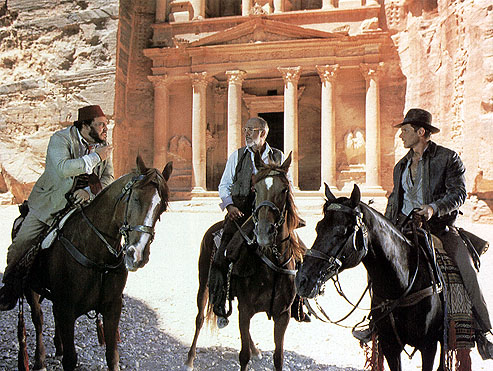
Lines that it's now almost obligatory to quote in any book or documentary about the remains of the eponymous Nabataean city, famous as a UNESCO World Heritage Site, but probably famouser as a film location in Raiders of the Lost Ark.

There are a couple of interesting things about 'a rose red city half as old as time.' First, Burgon's best phrase, and the one thing for which he's now remembered, seems to be mostly a quotation from another poet, Samuel Rogers, who used the 'half as old as time' trope in his poem A Farewell, when he wrote about 'many a temple half as old as Time.' As a meditation on the transience of things, Rogers' poem anticipates Edward FitzGerald's famous translation of The Rubáiyát of Omar Khayyám, with passages like this:
...Many an eye
Bright as the brightest now, is closed in night,
And many a voice how eloquent, is mute,
although some of Rogers' other lines simply make it clear why we've forgotten him and remembered FitzGerald:
And now a parting word is due from him
Who, in the classic fields of Italy,
(If haply thou hast borne with him so long,)
Through many a grove by many a fount has led thee...
Haply, I can't bear with this sort of stuff for very long.

The other interesting thing is that Burgon probably meant the ringing phrase 'half as old as time', which sounds like poetic license, quite literally. As the literary scholar, Hugh Kenner, pointed out:
Though romantic, Burgon was being workmanlike. To his generation the age of Time was quite definite; for since Adam was created in the year 4004 B.C. on October 23, Time in the year Burgon wrote, 1845, was exactly 5849 years old, going back through half of which we locate the founding of Petra at 1080 B.C.
Even in that generation, geologists were having a tough time trying to reconcile the evidence in the rocks with the Biblical account of the creation, but as a devout believer in Biblical inerrancy, Burgon's faith in his Bible-based chronology was probably immune to such challenges.

Today, people who study these things estimate that our Universe (and, presumably, time itself), came into existence some time between 12 and 14 billion years ago.
The Universe is old. According to the most recent measurements, it is 13.7 billion years old. The rise of mankind, on the other hand, is fairly recent, with Homo Erectus, the first "modern human," appearing around a million years ago and Homo Sapiens, today's humans, arriving only in the past 200,000 years. Imagine compressing the time the Universe has existed into the span of a single day with the Big Bang occurring at the stroke of midnight. Humans crash the party late - at 11:59:56pm, just four seconds before the end of the day.
From a cosmic perspective, Petra has existed for the blink of an eye, rather than being 'half as old as time.' The earth itself, which has been around for an an estimated four and a half billion years, is less than half as old as time. But the recent discovery of something really ancient reminded me of Burgon's conception of a truly epic timescale:
An international team of scientists, led by astronomers at Queen Mary University of London (QMUL), report of two new planets orbiting Kapteyn’s star, one of the oldest stars found near the Sun ...

What makes this discovery different however, is the peculiar story of the star. Kapteyn's star was born in a dwarf galaxy absorbed and disrupted by the early Milky Way. This galactic disruption event put the star in its fast halo orbit. The likely remnant core of the original dwarf galaxy is Omega Centauri, an enigmatic globular cluster 16,000 light-years from Earth that contains hundreds of thousands of similarly old suns. This sets the most likely age of the planets at 11.5 billion years, which is 2.5 times older than Earth and "only" 2 billion years younger than the universe itself (around 13.7 billion years).
Astronomy magazine

To humans, the four and a half billion year age of our own planet is an unimaginable abyss of time, but these exoplanets were already older than that when our world was still nothing but stardust. I know that astronomers have already seen objects even older than the exoplanets orbiting Kapteyn's Star, but there's something about the idea of a planet that ancient, a real place, in our cosmic back yard,* with a surface you could walk on and touch (if only you could figure out how to travel 13 light years) that sends shivers down my spine. I think 'Petra' would be an awesome** name for the planet currently known as Kapetyn b, if only 'more than 80% as old as time' didn't sound paradoxically less impressive than 'half as old as time.'


*i.e. further away than you can possibly imagine, but that's just peanuts compared to space...

**In the 'makes the hairs stand up on the back of your neck' sense of the word, as opposed to the conversational 'if you could just pass me your plate, that would be awesome' usage.

Thursday, 27 February 2014

Faculty tour

And, moving down the corridor from the Department of Experimental Theology, we now come to the Department of Experimental Philosophy.
While some of the intrinsic “loopholes” in Bell’s Theorem have been sealed up, one odd suggestion remains on the table: what if a quantum-induced absence of free will (i.e., hidden variables) is conspiring to affect how researchers calibrate their detectors and collect data, somehow steering them toward a conclusion biased against classical physics?

...So in order to clear the air of any possible predestination by entangled interlopers, Kaiser and MIT postdoc Andrew Friedman, along with Jason Gallicchio of the University of Chicago, propose to look into the distant, early Universe for sufficiently unprejudiced parties: ancient quasars that have never, ever been in contact...

...By using the light from objects that came into existence just shortly after the Big Bang to calibrate their detectors, the team hopes to remove any possibility of entanglement… and determine what’s really in charge of the Universe.
Just in case you were wondering, the "Big Bang" they're talking about was the event that supposedly brought our universe into being, not the sound of people's heads exploding as they try to understand what these guys are doing...

Sunday, 14 April 2013

Sun gods of metal

Reading this, it occurs to me that "Coronal Mass Ejection" would be an inspired name for a heavy metal band (maybe it already is,* in which case, apologies for wasting any passing metalheads' time by re-inventing the wheel).

Just an idle thought that wouldn't go anywhere else.

* or at the very least, the thought's probably unoriginal.

Wednesday, 3 April 2013

Starstruck in London

It was a bright cold day in April, and the clocks were striking thirteen we were having a family day out in London. I'd hoped to take my currently space-mad six-year-old to the old planetarium next to Madam Tussauds, but when I googled for details of prices and show times, All in London dot com cheerfully informed me that:
The London Planetarium, once located in Marylebone Street, in the green dome next to Madame Tussauds, has been closed in order to make way for a new celebrity-themed show that opened in July 2006. Although the planetarium used to be one of London’s attractions, there was less demand in recent years. The planetarium was therefore renames [sic] 'the Auditorium' and now hosts a show by Aardman Animations about celebrities.

Now a real* integrated part of the Madame Tussauds experience, the show was designed especially for projection onto the dome shaped ceiling. It takes visitors through a complete 360 degree circuit exploring how our earthly legends such as Marilyn Monroe are viewed by aliens!! 
I resisted the temptation to bang my head repeatedly against the desk (although if I'd done so for long enough I might have become sufficiently brain-damaged to enjoy a "real", integrated, celebrity-themed experience). Knowing that a working planetarium had been gutted in order to make way for this abomination was bad enough, but knowing that the people behind Wallace and Gromit were complicit in the sacrilege was almost too much to bear.

Instead, we took a boat downriver to Greenwich and visited the Royal Observatory, which now houses the Peter Harrison Planetarium, so we got our show with the added bonuses of a river trip in glorious, though chilly, sunshine followed by one of London's best short walks, from the Cutty Sark and Wren's Old Royal Naval College, up through Greenwich Park to the observatory. The Offspring enjoyed the show at the planetarium, which now proudly calls itself 'London's only planetarium.' Because you clearly couldn't find enough geeky kids to support more than one working planetarium in a city that only attracts one and a half million tourists a year and is home to a mere eight million people.

Now that we know that the universe in which we live is billions and billions of times less interesting than whatever Simon Cowell tweeted ten minutes ago, we can safely move on to your breaking sleb news. Our resident paparazzo has a sensational photograph from Greenwich, confirming gossip that celebrity foodstuffs bacon and chocolate have been collaborating on an exciting new project:
Compared to that, the whole of infinity sucks, obviously.


*If you're in the business of promoting waxwork replicas of airbrushed, PR-washed, image-controlled slebs who looked like waxworks to start with, I wouldn't bother with the word "real."

Thursday, 21 March 2013

Now, Voyager?

There's an interesting article on Bad Astronomy about whether or not the space probe Voyager 1 has left the solar system and become the first human-made artifact to enter interstellar space. As you'll see from the correction to the post, the answer's not entirely clear, mostly due to which definition of "interstellar space" you choose. "Interstellar space" could start:
a) at the point where the solar wind slows to a stop as its constituent particles collide with the particles that exist between the stars 
or
b) at the point where the sun's influence becomes so weak that the prevailing magnetic field changes direction.
Voyager seems to have reached a) but not b). NASA and JPL have apparently chosen reaching b) as their working definition of "leaving the solar system."

Other definitions are available. For example, as of now (ish), Voyager 1 is 123.6 astronomical units (AU) away from the sun (click here for a more precise estimate).

The Oort cloud (the hypothetical spherical cloud of icy bodies surrounding the sun, thought to be the place where long-period comets originate), could be up to 50,000 AU from the sun, or over four hundred times further away from the sun than Voyager 1 is now.

Nobody's ever observed the Oort cloud directly, but assuming that the theories are correct and it does exist, then surely a vast spherical shell of icy material, centred on the sun, is part of the solar system.

Or maybe the boundary lies even further out, at the point where the gravitational influence of the sun is no greater than that of the nearest star.

Nature seems so irreducibly nuanced and subtle that one neat cut-off point may be too much to ask of her. Don't let's ask for the moon. We have the stars (although maybe not just yet).

Wednesday, 29 February 2012

Saint Augustine of Hippo - what did he know?


It is only the illiteracy of the current generation of atheists that leads them to think religious practitioners must be stupid or thoughtless. Were Augustine, Maimonides and al-Ghazali - to mention only religious thinkers in monotheist traditions - lacking in intellectual vitality? The question is absurd...

John Gray, reviewing Alain de Botton's book, Religion for Atheists, for the New Statesman

Secularists stand accused of "religious illiteracy". A bit of background here. For me, there are two separate, but linked, reasons for being irreligious.

1. Not believing that the revealed truths set out in sacred texts are, literally, true. Take the creation story in Genesis - it contradicts so much compelling and coherent evidence from the fields of cosmology, planetary science, geology, archaeology, paleontology and ancient history, that it's safe to conclude that it's not a true account of anything that ever happened in the real world. Or take the first miracle that Christ supposedly  wrought, in Cana of Galilee. According to John's Gospel, Jesus turned water into wine. This is one, rather implausible, anecdote in an ancient text. There's not enough evidence to either back up or disprove the assertion, so it seems sensible to apply the sort of rule-of-thumb test we'd apply to the sort of claims people might make today. If somebody's trying to sell you something, and you've not got much information to go on, you might apply the rough and ready rule that 'if it sounds too good to be true, it probably is'. In the absence of any compelling evidence, I'd rate the water-into-wine story as 'too good to be true'. Extraordinary claims require extraordinary evidence.

2. Disquiet over the role of religion in public life. Secularists might find certain religious practises harmful or questionable, or reject religious authority as a legitimate basis for decision-making, or disagree with the divisive effects of teaching children in "faith" schools, or oppose discrimination on the grounds of religion, or disagree with those who say that the views, or interests of religious people or institutions should be privileged above the views or interests of any other members of society. 

There's a strong link between 1. and 2. The authority and privileges enjoyed by religion are based on its claim to access to a set of unique truths and divine authority. Call the truth of scriptures into question and there's no reason to accord the views of a religious leader or committed believer any more - or any less - weight than those of any other citizen. So, I'd have thought it matters rather a lot whether what's written in holy books is, so far as anyone can tell, accurate or otherwise.

This is where the "religious illiteracy" charge comes in. The argument goes thusly:

Unbeliever: I've looked at your scriptures. A lot of the stuff that can be compared with the best available independent evidence seems to be factually wrong, and the supernatural anecdotes aren't credible. Get rid of the stuff that's unreliable and you're left with a bunch of rules and some bits of moral philosophy which we can debate on their own merits, but which are no more sacred or authoritative than anything else written about ethics, by anybody from Socrates to Jacques Derrida.

 
In other words, if I ask myself whether any of the stuff written down in a holy book actually happened, I'm asking the wrong question. It's meant to be understood on a more complex, metaphorical level and it always was. People in the past understood this, but our rationalist, literalist, reductionist modern brains just aren't highly trained enough to get it.

If I was in a cynical mood, I'd immediately dismiss this as a rhetorical trick that conveniently makes every sacred text immune from rational analysis, or sceptical questioning, but there is an interesting assertion that I'd like to follow up. Have some people always believed that certain parts of sacred texts (in this case the Bible) weren't supposed to be taken literally? Not just the parts clearly flagged up as parables or proverbs, which we can all agree were never intended to be taken literally. I'd always thought that the further back you went, and the fewer convincing, alternative sources of knowledge people had, the more likely they were to believe in the literal truth of, say, the creation story in Genesis.

It's not possible for anybody today, except a few wilfully ignorant creationists, to take Genesis literally, but how about people many centuries ago? I don't believe that people back then were all gullible or stupid, but without the benefit of modern knowledge about such things as the cosmological and geological timescale, the heliocentric solar system, evolution and so on, wouldn't this story have been as just as plausible as any other story about how the world came into being? My guess was that quite a few of them did believe Genesis to be literally true.

But, as believers keep on telling us, there is written evidence to the contrary. Saint Augustine of Hippo (354-430AD), for example, had a more subtle, nuanced view. Wikipedia's on hand for a quick citation:

It not infrequently happens that something about the earth, about the sky, about other elements of this world, about the motion and rotation or even the magnitude and distances of the stars, about definite eclipses of the sun and moon, about the passage of years and seasons, about the nature of animals, of fruits, of stones, and of other such things, may be known with the greatest certainty by reasoning or by experience, even by one who is not a Christian. It is too disgraceful and ruinous, though, and greatly to be avoided, that he [the non-Christian] should hear a Christian speaking so idiotically on these matters, and as if in accord with Christian writings, that he might say that he could scarcely keep from laughing when he saw how totally in error they are. In view of this and in keeping it in mind constantly while dealing with the book of Genesis, I have, insofar as I was able, explained in detail and set forth for consideration the meanings of obscure passages, taking care not to affirm rashly some one meaning to the prejudice of another and perhaps better explanation.

De Genesi ad literam

On first reading, it looks as if Augustine didn't believe in the historicity of the Genesis creation story and was worried that literal-minded Christians who did would expose the Church to the mockery of intelligent, educated pagans. Augustine, who didn't benefit from standing on the shoulders of Darwin, Galileo, Hubble, or the rest of The Usual Suspects, had clearly decided that the Genesis account of creation wasn't credible, but, presumably, thought that other parts of scripture were. Quite interesting? Certainly. Score one for the believers? Well let's unpick this one a little bit.

The first thing that strikes me is Augustine's acknowledgement that many things 'may be known with the greatest certainty by reasoning or by experience' (and, by implication, without reference to scriptural authority). We're used to thinking about observation scientific method and reasoning as something uniquely modern. But the ancient Greeks, among others, spent some time observing and thinking about 'the earth, the sky, about other elements of this world, the motion and rotation or even the magnitude and distances of the stars, about eclipses of the sun and moon, the passage of years and seasons, about the nature of animals, of fruits, of stones, and of other such things'. Some of this classical learning may have been superseded by more precise observations and better theories, but educated people in Augustine;s time already knew more than enough to make the Genesis story look crude and unconvincing.

For example, according to Genesis, on day one of Creation God creates light and darkness, day and night. It's not until day four that He gets round to creating the sun and moon. The idea of day and night without any sun must have sounded pretty unlikely to people sophisticated enough to have predicted eclipses and worked out what was causing them. And as if the scientific implausibility wasn't bad enough, textual inconsistencies are already creeping in by Chapter Two. In Chapter One, God creates the fowl of the air on day five of creation, then land animals and humans on day six. In Chapter Two, God forms Adam from the dust, then decides that 'It is not good that the man should be alone', so subsequently makes all the land animals and every fowl of the air specifically to keep him company. Only when it becomes clear that birds and beasts aren't enough to satisfy Adam's desire for companionship does God finally get down to whipping out a spare rib and creating Eve.

No wonder Augustine was worried that non-Christians might laugh. Putting this context round Augustine's interpretation of Genesis as metaphor makes me wonder whether this was really an example of the ancient mind being wiser, more subtle and less literal-minded than we are, or whether his position was just an early example of a tactical retreat from an indefensible position.

As Catholic Answers* helpfully points out, Genesis posed problems for other early writers. Saint Cyprian, writing in the third Century AD, seems to have found it implausible that God created the whole world in the sort of timescale it might take a gang of slaves to put in a new hypocaust, so decided that  'The first seven days in the divine arrangement contain seven thousand years'. This class of explanation comes from what you might call the Humpty Dumpty school of biblical exegesis ('When I use a word,' Humpty Dumpty said, in rather a scornful tone, 'it means just what I choose it to mean — neither more nor less').

Again what springs to mind here isn't ancient subtlety and wisdom, but a politician or bureaucrat using an idiosyncratic definition of words, in order to maintain some wiggle room and defend an exposed position (see 'I did not have sexual relations with that woman, Miss Lewinsky', 'The work experience programme is voluntary', et al.). Augustine himself could give a masterclass in not providing hostages to fortune:

Seven days by our reckoning, after the model of the days of creation, make up a week. By the passage of such weeks time rolls on, and in these weeks one day is constituted by the course of the sun from its rising to its setting; but we must bear in mind that these days indeed recall the days of creation, but without in any way being really similar to them.

 De Genesi ad literam

I think 'we must bear in mind that these days indeed recall the days of creation, but without in any way being really similar to them' is one of the most brilliantly obscure and un-disprovable statements you're ever likely to come across. You'd have to get up very early in the morning to pin down a man who could come out with something like that. 

And, talking of obscurity, does recasting the Genesis creation story as an extended metaphor make us any wiser? Take the specific example of Cyprian's theory that the first week of creation in Genesis was a metaphor for what was really a more reasonable-sounding creation period of seven thousand years. This doesn't actually make sense on either a metaphorical or literal level:

  1. If you think that the whole story is just a metaphor for some profound truth, why change the meaning of the words to make the story more historically plausible? It sounds to me as if Cyprian wasn't claiming that the whole story was just a metaphor for something deeper and more subtle, but rather that he thought that the events related in Genesis actually happened, just over a much longer timescale.
  2. Changing the timescale from a week to seven thousand years might have made the story sound a lot more plausible to Cyprian's contemporaries, who had no way of knowing about deep time and the true age of the earth and universe, but his reinterpretation hasn't stood the test of time. We could always revise his estimates upward and assume that when Genesis talks about a week, that really means 4.6 billion or 14 billion years, but once you've stretched the meaning of language that far, you might as well be re-interpreting absolutely any statement to mean literally anything that takes your fancy (see 'the Humpty Dumpty school of biblical exegesis' above).

Once you lose any sense of clarity over what's a metaphor and what's not, you can make your holy text mean whatever you want it to mean. Take this famous passage from the New Testament:

And again I say unto you, It is easier for a camel to go through the eye of a needle, than for a rich man to enter into the kingdom of God.

Matthew 19:24

Creative Bible commentators have tweaked the meaning of this passage, claiming that The Eye of the Needle was a gate leading into Jerusalem which was notorious for being almost impossible to get a camel through. Therefore, Jesus wasn't saying it was impossible for a rich man to get into heaven, just a bit tricky. Lucky old you, creaming off the rents from your hotel on Mayfair and picking a Get Out of Jail Free Card out of the Community Chest, too! Here's The Straight Dope's Cecil to unpick this one:

Next, the history and archaeology. The notion your Baptist friend has picked up apparently comes from a single ninth-century commentary asserting that in first-century Jerusalem there was a gate called the Needle's Eye which a camel could only get through on its knees. (Sort of like Indiana Jones and the Last Crusade: "only the penitent man will pass …") A cute allegory, but there's no archaeological or historical evidence for the existence of such a gate.

There's a good brief discussion in the article on "kamelos" in Kittel's Theological Dictionary of the New Testament, vol. 3, pp. 592-594 (one of the standard works on New Testament language). TDNT, and other commentators with an interest in history, point out several parallels in later rabbinic language about the impossibility of getting an elephant through the eye of a needle: it's a way of describing something so difficult it's grotesque.

So the "Gate of the Needle's Eye" notion has no firm historical basis. It looks like a way of getting around the plain (but inconvenient) meaning of the text.

Another less-than-glorious example of subtlety and metaphor not actually being any deeper or more profound than the "shallow literalism" of the "religiously illiterate". For people who routinely accuse secular sceptics of being tricky smart alecks who like to think they're being clever, some of these religious thinkers sure like to complicate things. Mind you, it is complication with a purpose. There's a lovely quote from one Dr Kevin Lewis on AskThePriest.org on "The Heresy of Literalism":


And God forbid that the faith leaders should ever be asked to prove, verify or justify their core beliefs, just like any other public figure. Dangerous heresy, indeed.


*  I love Catholic Answers' authoritative quality standard certification. 'I have concluded that the materials presented in this work are free of doctrinal or moral errors. Bernadeane Carr, STL, Censor Librorum, August 10, 2004', sounds so much more impressive than 'certified gluten-free' or 'Complies with BS5852 requirements and regulations. Not suitable for children under 3 years old'.


Wednesday, 27 April 2011

Idiots give Darwin a break

And God made two great lights; the greater light to rule the day, and the lesser light to rule the night: he made the stars also.

Genesis 1:16

Interesting developments in the wacky world of religious fundamentalism. Hardcore Bible-heads in Waco, Texas, have been taking time out from their favourite pastime of furiously denouncing evolutionists as Satan's little helpers, only to take offence at a whole new group of scientists - astronomers and planetary scientists:

Bill Nye, the harmless children's edu-tainer known as "The Science Guy," managed to offend a select group of adults in Waco, Texas at a presentation, when he suggested that the moon does not emit light, but instead reflects the light of the sun....

The lesser light, he pointed out, is not a light at all, but only a reflector.

At this point, several people in the audience stormed out in fury. One woman yelled "We believe in God!" and left with three children, thus ensuring that people across America would read about the incident and conclude that Waco is as nutty as they'd always suspected.

To be fair, this article, which was strangely posted under "latest news" on the Butterflies and Wheels web site yesterday, first appeared on the Think Atheist blog in February 2009, but it's still pretty extraordinary. I wonder what would have happened if the speaker had been Neil Armstrong himself, providing eyewitness testimony?

Crazy Woman (angrily): We believe in God!

Armstrong: Ma'am, I've been there. I've stood on it and I've walked on it and I can assure you that it does not emit light. It's made of rock.
Would Crazy Woman have accepted his word, or would we have witnessed a new alliance between people who are crazy enough to believe in creationism and people who are crazy enough to believe that the moon landings were faked in a in a Hollywood studio?

Whatever. Assuming the Bill Nye incident actually happened and isn't a wind-up (the link to the original article in the Waco Tribune no longer works, but then it is old news), I'm pleased for evolutionary scientists, who can take a temporary break from explaining yet again how inescapably colossal the mountain of evidence supporting the Theory of Evolution really is. On the other hand I'm a bit sorry for astronomers, who already waste enough time debunking fools who keep challenging them to disprove astrology, however many times it's already been debunked...

Friday, 18 February 2011

Definitively inaccurate?

In many of the more relaxed civilizations on the Outer Eastern Rim of the Galaxy, the Hitch-Hiker's Guide has already supplanted the great Encyclopaedia Galactica as the standard repository of all knowledge and wisdom ... though it has many omissions and contains much that is apocryphal, or at least wildly inaccurate...

(from Douglas Adams' foreword to The Hitch-Hiker's Guide to the Galaxy)

It's not a remotely new or original thought, but  Wikipedia really is the Hitch-Hiker's Guide to the Galaxy for our age. For some people it has become the standard repository of all knowledge and wisdom and it certainly has many omissions and contains much that is apocryphal, or at least wildly inaccurate. Where accuracy matters you'd best fact-check the Wikipedia entry.

Where the subject matter is controversial or politically contentious, you'd probably best go elsewhere or at least be aware that the page you are looking at is a battleground littered with biased, sometimes malicious edits and counter-edits from obsessive (mostly male) wonks engaged in a partisan point-scoring contest. I'm not sure that the net result of all these competing axes being ground is any worse than the version of reality served up by the mainstream media, with all those recycled press releases, puffing advertorials, propaganda for the political interests of billionaire media oligarchs and ridiculous salaries paid to pompous, puce-faced, unreliable, reality-challenged columnists with a chronic inability to check their facts or acknowledge any errors caused by their sloppy attitude to the truth.

When it comes to uncontroversial general knowledge and entertainment value, though, I'm way more relaxed about Wikipedia. The Hitch-Hiker's Guide to the Galaxy contains the wonderful disclaimer that the Guide 'cannot hope to be useful or informative on all matters' but 'does make the reassuring claim that where it is inaccurate, it is at least definitively inaccurate.' That's how I feel about the following passage from Wikipedia, recently mined by one of the good folk at Boing Boing. It's from an entry about the larger-than life astronomer Tycho Brahe and it's so entertaining that I almost don't care whether it's true or not. As fiction, it would do credit to one of the more eccentric academics in Terry Pratchett's Unseen University. If fact, it's just splendidly, life-affirmingly bonkers:

Tycho was said to own one percent of the entire wealth of Denmark at one point in the 1580s and he often held large social gatherings in his castle. He kept a dwarf named Jepp (whom Tycho believed to be clairvoyant) as a court jester who sat under the table during dinner. Pierre Gassendi wrote that Tycho also had a tame elk (or moose) and that his mentor, Landgrave Wilhelm of Hesse-Kassel, asked whether there was an animal faster than a deer. Tycho replied, writing that there was none, but he could send his tame elk. When Wilhelm replied he would accept one in exchange for a horse, Tycho replied with the sad news that the elk had just died on a visit to entertain a nobleman at Landskrona. Apparently during dinner the elk had drunk a lot of beer, fallen down the stairs, and died.

Link to Boing Boing here and link to Wikipedia article here. True or false? As Douglas Adams wrote of the Hitch-Hiker's Guide, 'though it cannot hope to be useful or informative on all matters, it does make the reassuring claim that where it is inaccurate, it is at least definitively inaccurate. In cases of major discrepancy it was always reality that's got it wrong.'

Thursday, 16 September 2010

The world's greatest headless dad

Today, Radio 4's excellent "A History of the World in 100 Objects" featured a beautiful jade cup made for the Timurid Emperor Ulugh Beg, grandson of Timur (AKA Tamburlaine The Great). Apparently, Ulugh Beg was a cultured fellow, a lover of mathematics and astronomy, whose patronage got the Observatory of Samarkand built.  A crater on the moon is named after this astronomer-king.

Sadly, although he was a notable intellectual and patron, Ulugh Beg didn't really cut it in the world of power politics.* His rule lasted only two years. The BBC web site notes:

This jade cup from Central Asia would have been valued for its beauty and its protective powers. When this cup was made it was believed that jade would crack if it came into contact with poison...

Ulugh Beg would have owned such a cup to protect himself from assassination by his rivals. However, the cup could not save him from his own son who seized power in 1449 and had Ulugh beheaded.
The clouded jade cup is a rather lovely thing, but this is one of those times when I'd gladly not trade places with the rich and powerful. When my son gets old enough to buy presents, I'd be happy to get a cheap and nasty, mass-produced "World's Greatest Dad" mug and a promise not to decapitate daddy. I'm easily pleased.

*A reputation he shared with the Holy Roman Emperor Rudolph II of Bohemia.

Sunday, 11 July 2010

Eye candy


After a short camping holiday we're back in the garden, checking out the soft fruit harvest. The raspberries are ripening nicely and the dessert gooseberries (variety "Careless") are almost ripe, but the most striking crop must be the redcurrants which have been cropping since before we went away. They may be tiny and a little on the tart side, but they look as fresh and perfect as dew drops, with a deep, translucent ruby glow. It's a joy to see them appearing - they must be one of the most beautiful fruits in creation.

It just goes to show that you don't have to go far to see something extraordinary, although a couple of things from our holiday were just as striking. I've got a picture of one of those things here:


It's the sun, surrounded by a rainbow-tinted halo (the rainbow colours were there, although they don't come out very well in the photo). These are produced by the sun shining through ice crystals in high cirrus clouds. I photographed this one about a week ago, whilst sitting on a Cornish beach.

That same beach was dotted with scores beached jellyfish which would have been an impressive sight, if they had still been floating, rather than laying around as sand-covered blobs. I didn't take any pictures, as they weren't at their most photogenic. If they had still been at sea, they'd have made for some interesting pictures. Most of them were harmless Moon jellyfish (Aurelia aurita), quite transparent apart from four violet crescents. These, I later found out, are the animal's gonads. The remaining jellyfish were also transparent, but thickly streaked with a radial pattern of deep indigo, like dark blue ink. I'm not 100% sure what these were, but they looked like this photograph of a Blue Jellyfish, (Cyanea lamarckii). Whatever they were, that indigo colour was as almost lovely as a redcurrant or a rainbow circle round the sun.