Thursday, 19 July 2012

Shameful, frankly


Ian Tomlinson's final hours on 1 April 2009 were spent in bewilderment. He didn't care about the G20 protests. He just wanted to get to his bed. 

But the 47-year-old never reached it after he collapsed following a strike and push from PC Simon Harwood. Three years on, a jury at Southwark Crown Court has concluded the officer's actions were not criminal and he has been found not guilty of manslaughter.

'I think that is shameful, frankly', said Home Secretary Theresa May. Of course, she wasn't upset about an unprovoked, unpunished assault leading to the death of an innocent bystander. She was just upset that members of her own department might embarrass her by exercising their right to take industrial action after a long-running dispute over job cuts, pay and privatisation.

Because withdrawing your labour and making a fool of your boss is far more evil than snuffing out a an innocent human life.

Wednesday, 18 July 2012

Nothing to do with the jet stream...

In a groundbreaking relaxation of the Olympic branding rules, the London Organising Committee have finally conceded that God can use the protected terms 'summer' and '2012' in the same sentence, paving the way for Britain to finally have a summer at some point this year.


via

Tuesday, 17 July 2012

The Happiest Days of Your Life


Fond memories of school days from MMT in MK:
But in reminiscing fondly about my own experiences growing up going to a school with no uniform, I am suddenly struck by the memory of the only time someone in our class was ‘censored’ for their clothes.
There was a kid who came in one day wearing a Samantha Fox t-shirt – and this was Sam Fox in all her Page 3 glory, fully breastically nuded. Quite rightly, our “Shared Time” teacher ordered him to turn it inside-out for the remainder of the day – I’m not sure how he thought he was ever going to get away with that, even at Stantonbury.
It only strikes me now that this was a t-shirt in a child’s size (he wasn’t the tallest or broadest of 13 year olds), begging the questions a) who would buy / allow their kid to buy t-shirts like that, and b) who made them?  Page Three t-shirts for young ‘uns – for what better example of British life in 1988 could you ask?
 For the benefit of any younger readers, I should point out that "Samantha Fox" was a formerly popular geographical location, akin to Paris, Jordan or Silicone Valley.  For the benefit of older readers, do yourself a favour and get hold of a copy of The Happiest Days of Your Life. It's got Alastair Sim and Margaret Rutherford, not to mention Joyce Grenfell, as the insanely chipper Miss Gossage ('call me sauasage ... good egg, there's our croc!'). Lovely.
_________________

Update: if I'd wanted to be a tedious pedant, I'd have taken issue with the phrase 'begs the question' which doesn't mean what many people seem to think it means, but I liked the rest of this post so much that I'm disinclined to quibble.

Zombie apocalypse at the Telegraph

We've all, from time to time, held or spouted political opinions that owe less to rational analysis of what's going on than they do to prejudice or habit. Some people actually get paid to produce what Chris Dillow calls 'tribal grunts'. We're all, to a greater or lesser extent, guilty of having blind spots and prejudices, but it does gets a bit worrying when the same stimulus continues to provoke the same unvarying stream of Pavlovian drool for thirty-odd years without any sign of nuance, reflection, change, development or learning.

Take the news that the population's gone up, due to a combination of immigration and an uptick in the birth rate. This can only mean one thing - it's time for the Daily Mail headline writers to reach for the blood pressure meds and the caps lock - ('Population of England and Wales soars by nearly FOUR MILLION in just 10 YEARS' - no link provided because there are already more than enough angry people clicking on this). And in the good old Torygraph, Philip Johnston warns:
More public services will need to be privatised, the burdens on taxpayers reduced and people encouraged to look after themselves and make provision for their own future. Yet the reforms needed to bring this about are often resisted by the very people who promoted the population boom that has made them unavoidable. 
Really?  Has it never occurred to Philip, even a millisecond, that it might be more complicated than that. For example, what is the problem that we 'need' to solve through the tax cuts and privatisation? Is it, by any chance, the ageing population, with fewer people of working age supporting more pensioners (AKA the '"demographic time bomb")? The sort of problem that might be mitigated by more people of working age coming into the country, decreasing the average age of the population and increasing the proportion of people paying tax?

But that can't be right, grunts Johnston, because 'While many immigrants, such as those from Eastern Europe, are hard working and skilled, they and their families require housing and health care, and their children need schooling'. Assuming there's a significant uptick in the number of kids, (AKA the people who'll be working and paying taxes when Philip Johnston's in his care home) what does that do to the seriousness of the "demographic time bomb"?

And what's with the 'need' to privatise all these public services? This might have sounded like fresh new thinking in 1980 but it's what they've already been doing for the last 30 years, with mixed results. They've already privatised the low hanging fruit. Sometimes it worked, other times they privatised things like the railways that didn't make much sense in market terms, and didn't clearly make us any better off. Now we're left with the more difficult nitty-gritty services, have we really got good reasons to believe that privatising a service always makes it more efficient, or is this just an ideological reflex? What about the NHS, versus the notoriously inefficient private-sector-led US health care system? Looking at the performance of the fairy jobmothers at A4e, for example, I'd say the case for outsourcing employment services hasn't been proved by a long chalk. And whilst we're on the subject of private contractors with alphabet soup monikers, if 'private=good, public=bad', why's the army stepping in to do G4S's job?

And, as for these tax cuts, well, going easy on tax collection certainly worked out well for the Greeks, didn't it?

I'm sure somebody with a bit more knowledge and analytical skill could produce arguments that I'd find harder to dismiss, but Johnston's not even trying here - he's just shambling on as if the way to win an argument is just to repeat the same message over and over again until your opponent eventually dies or something.

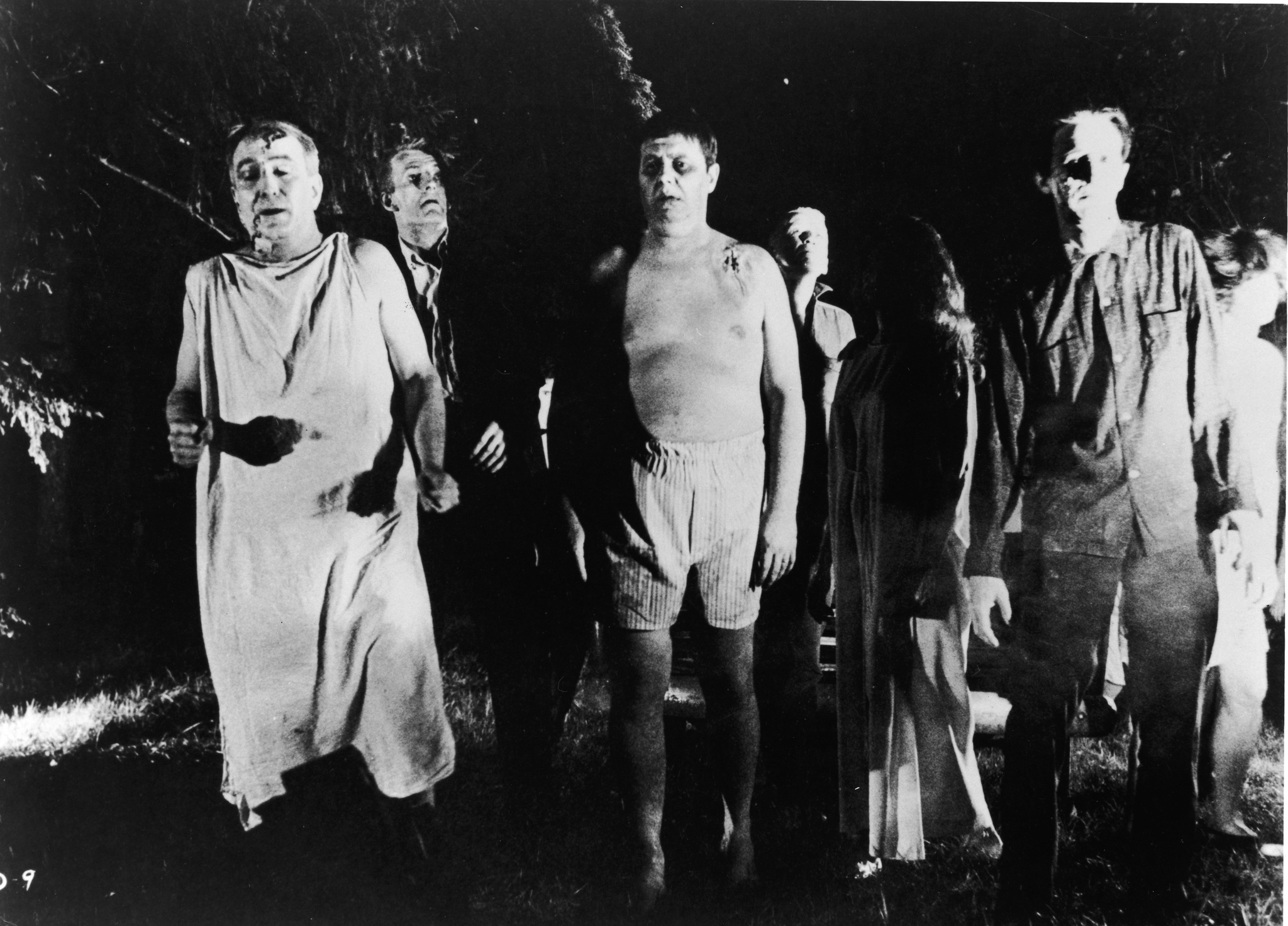
By rights, the dominant rightist ideology of the last generation or so should be dead by now, killed in the great car crash of 2008. Instead, like a zombie in a horror film it lumbers on, undead, urged on by powerful reflexes from deep within its decaying brain stem ... 'must ... stop ... immigrants ... urgh ... must slash taxes  ... must ... privatise ... mmm .... BRAAIINS!!


Friday, 13 July 2012

Parasites and vampire squid ink

When Matt Taibbi called Goldman Sachs 'a great vampire squid wrapped around the face of humanity, relentlessly jamming its blood funnel into anything that smells like money' he was, of course, being grossly unfair to your actual Vampyroteuthis infernalis, which is small, shy, mostly harmless and isn't even a real vampire.The 'vampire squid' line is a great piece of hyperbolic outrage provoked by the hyperbolically outrageous behaviour of the Masters of the Financial Universe, but you wouldn't learn much about zoology from Taibbi's Nature Notes.

If we were looking for a more accurate analogy for the behaviour of ruthlessly manipulative and socially harmful financial institutions, perhaps a parasite like Toxoplasma gondii, which hijacks host organisms and manipulates their behaviour in order to thrive and survive, might be a better candidate. Or the crab parasite Sacculina that injects itself into its host, which it turns from an independent organism into a neutered zombie brood chamber for incubating Sacculina eggs. Or the parasitic ichneumon wasp, jamming its ovipositor into the flesh of its host, all the better to let its maggoty offspring eat the paralysed victim from inside, a process that fuelled Darwin's doubts about the benevolent, merciful entity that was allegedly in charge of things:

I own that I cannot see as plainly as others do, and as I should wish to do, evidence of design and beneficence on all sides of us. There seems to me too much misery in the world. I cannot persuade myself that a beneficent and omnipotent God would have designedly created the Ichneumonidae with the express intention of their feeding within the living bodies of Caterpillars...

Substitute 'the invisible hand' for 'God', 'financial institutions' for 'Ichneumonidae' and 'nations' for 'Caterpillars' and you've got a pretty neat summary of how parasitic financial institutions have been sucking the life blood out of economies. What a book a devil's chaplain might write on the clumsy, wasteful blundering, low and horribly cruel works of Wall Street and the City of London.

So, on the whole, I'd say that Goldman Sachs and all those other delinquent financial institutions are more like manipulative parasites than squids. Where we do see squiddy behaviour, it comes from high profile politicians and thinkers who want to draw attention away from the misdeeds of the rich and powerful with a distracting smokescreen. Here, for example, is post-ideological ideologue and Reith lecturer Niall Ferguson, expending his store of squid ink to shift the blame from the reckless, too-big-to fail, mollycoddled, state-supported financial institutions on to the 'profligate' generation some of whom had the cheek to enjoy a comparatively decent standard of living and have a relatively comfortable retirement to look forward to:


It is perhaps not surprising that a majority of current voters should support policies of intergenerational inequity, especially when older voters are so much more likely to vote than younger voters. But what if the net result of passing the bill for baby-boomers’ profligacy is not just unfair to the young but economically deleterious for everyone?

Don't look at the banks, look at those selfish old hippies, what with their winter fuel allowances and refusal to die in the poorhouse, they're the ones who've been sucking us dry. Play one part of society off against another and watch the real perpetrators slip away in a cloud of ink. Fortunately, you can't fool all of the people all of the time:

The young need a start and wouldn't it be good if they too could look forward to some liberty at the end of their working lives or even that people should continue to work if they want to? If the problem is about how we enable the young to become the contributors they desperately want to be in a contracting economy, then the problem is the contracting economy, not pensioners. One generation doesn't have to be supported at the expense of the other. Of course, eventually they are the same people. The old were once young and the young, if they are lucky, will be old. And, if I remember correctly, there is something else that differentiates people and their life chances at the moment that seems to be a bit more permanent and pertinent. What is it again? Oh yes; class.

If you don't succeed in setting the old against the young, the squiddy apologists for the parasitic overclass have plenty more ink where that came from - set the employed against the unemployed, the able-bodied against the long-term sick, people who were born here against immigrants, private sector employees against public sector employees, home owners against council tenants, grammar-school/faith school /academy-loving middle-class parents against the disruptive kids in 'bog-standard' comprehensives ... The too-big-to-fail, too-convoluted-to-understand corporate leeches and their millionaire symbiotes in the political class disappear behind the inky haze of internecine resentment and live on to parasitise us another day.

The big fish will carry on getting away with it, so long as the little fish carry on fighting each other.


Tuesday, 10 July 2012

Montezuma's breakfast

In our house, when I were a lad, we sometimes used to eat something we called a "Mexican eye" . Take one slice of a sliced loaf, cut a circular hole in the middle, part-fry it, break an egg into the middle, then finish frying, until you end up with a piece of fried bread with a fried egg in the middle. A plate of Mexican eye was traditionally accompanied by my dad cracking some gorily unamusing ocular-themed joke on the lines of 'How do you make a Venetian blind? Poke his eyes out!'

Here's one I made earlier:
It's not an entirely faithful recreation of this cholesterol-laden childhood treat - for the authentic 1960s/1970s vibe, use white bread, rather than the seeded granary thingy we had in the bread bin and fry in something suitably retro like Spry Crisp n' Dry or Trex.

I've tried to get all nostalgic with people over this snack, but nobody I've ever met outside my immediate family has a clue what I'm talking about. When I explain what I mean by "Mexican eye", they tell me it's just a variation on "eggy bread", a dish a lot of other people seem to have grown up with, but which we never cooked in our house.

Mr Google's been no help on my nostalgia quest - when I type in "Mexican eye" I get information about things like Cuete a la Mexicana, a Mexican-style roast made with eye beef, (AKA tenderloin). Alternatively, up pops something extremely NSFW (Urban Dictionary presents some rather eye-opening material if you type in the phrase "Mexican eye" - I won't link directly, but smut buffs now know where to go).

So, it looks as if me and my family are more or less on our own on this one. Is there a special word for unshared nostalgia? There should be.

TV is bad for your health

Since 9/11, a total of 238 American citizens have died from terrorist attacks, or an average of 29 per year. To put that in some perspective, according to the Consumer Product Safety Commission, the average American is as likely to be crushed to death by televisions or furniture as they are to be killed by a terrorist.

Politics, Power, and Preventive Action 

Being alert to the tottering wide-screen telly threat and the IKEA self-assembly wardrobe of death doesn't, of course, mean that we should reduce our heightened state of readiness when it comes to the very real menace of hymenoptera attack.

If you suspenct anything, call the confidential manual handling/pest control hotline right away.

via