Friday, 4 March 2011

Asking nicely

Socialising a four-year-old-child is a marathon, not a sprint. You've just got to keep on endlessly repeating the same message (in different forms) if you want to win the war of etiquette attrition.

Child: I want juice!

Parent [feigns deafness]:    ...

Child: I want juice!

Parent: Did you say something?

Child: I want juice!

Parent: Pardon?

Child: I WANT JUICE!!

Parent: If you want juice, how do you ask for it nicely?

Child [rolls eyes and pulls beseeching face]: I REALLY want some juice.

Parent: If you want somebody to give you something, there's a special word you need to use.

Child: Thank you!

Parent: How about the special word that starts with a "p"?

Child [repeats eye-rolling, gurning performance]: PLEEEESE may I have some juice?

Parent: Of course. Thank you for asking nicely.

Repeat for every new request the child makes over a period of several months. It pays off in the end.

By the time people are grown up, most of them have mastered basic civility. Unless they grow up to be something really important, say the Director-General of the British Retail Consortium. Really important grown ups demand, rather than saying please:

[Stephen] Robertson [director-general of the British Retail Consortium] said: "Against a background of deteriorating sales, the Chancellor needs to support retail in creating new jobs."

The use of "needs" here is a common trope in business lobbying of government. Bosses present themselves not as supplicants ("we ask the government to reconsider") nor as opponents ("fight the cuts") but rather as superior discerners of the future, of what needs to happen. In this way, a sectional interest becomes framed as a claim to necessity.
Notes Chris Dillow.

Wouldn't it be wonderful if we expected our VIPs to attain the same standard of civility as a well-brought up four year old?


Lobbyist: You need to give us more juice!

Minister: When we want something, there's a special word we need to use. Can you remember what it is?

The canary in the coal mine

Spring's definitely in the air. This morning dawned overcast and a bit cold but I was getting up in real daylight, not dragging myself out of bed at that bleary oh-God-it's-still-dark hour and, outside the window, a blackbird was pouring out its burbling brook of song. Then I turned on the radio and discovered that the tired old Lib Dem canary is feeling a considerably less chipper than the full-voiced blackbird:

Labour have won the Barnsley Central by-election, while the Lib Dems slipped to sixth in the South Yorkshire seat.

I think I heard the word 'humiliating' somewhere in the report, too. Isn't it great when something puts a spring in your step and a smile on your lips before you've even had breakfast? I definitely got out of bed on the right side this morning.

Thursday, 3 March 2011

Don't mention the cuts!

Warning: this post may contain traces of sarcasm and a parody of nut-based Daily Mail editorials.

Honestly, you couldn't make it up. Now we read that the BBC is under pressure to censor news broadcasts to avoid upsetting those politically correct killjoys in the government. Apparently, reporters are no longer allowed to use the word 'cuts, in case it offends some humourless government apparatchik. A new politically-correct language guide orders reporters to use the word 'savings' as a 'positive' and less offensive alternative. Talk about political correctness gone barking mad!

Imagine what this policy of censorship would have done to our old and cherished comedies! Basil Fawlty would have had a knock on the door in the middle of the night from the Thought Police of The PC Brigade and been sent away for a spot of political re-eduction for this:

Listen, don't mention the cuts! I mentioned them once, but I think I got away with it all right.

So! It's all forgotten now, and let's hear no more about it. So, that's one diced pork à la Eric Pickles, chopped liver Osborne, some thinly sliced salami, a filleted NHS, and some selected cuts of meat from our carvery.
As Major Tufton Bufton, editor of Jane's World Armies, said, 'We live in politically correct times and what these rulebooks do is keep the politicians happy.'

A conference demountable unit from a management centre

In every large organisation there seems to be a class of people I call jargonauts. They love knowing and using all the latest buzz words and enjoy the totemic power and authority they think comes from moulding language into impressive-sounding jargon, impenetrable to mere outsiders. They hardly seem to notice all those little people outside the loop who just want them to talk comprehensibly. Three cheers, then, for Lady Justice  Hallett, the coroner in charge of the 7/7 bombing inquests, who's had enough of that nonsense:

Lady Justice Hallett let fly at Gary Reason, assistant commissioner of London Fire Brigade.

She spoke out as mention was made of  "a conference demountable unit from a management centre" - which is a portable incident room.

She said: "As far as I can tell, management jargon is taking over organisations and perfectly sensible, straightforward titles are being changed.

"This isn't just somebody being pedantic about the use of English, which it appears to be... when it comes to managing incidents, people don't understand what the other person is."

The coroner said the problem had been an ongoing theme in hearing evidence, adding: "I don't know whether a crew manager is somebody who is responsible for supplies or is used to fighting fires. I have no idea."

She said clarity was key when crews were trying to ensure safety at a disaster scene, saying: "What worries me is all you senior people of these organisations are allowing yourselves to be taken over by management jargon and, as I say, it's not just directed at you... I just think that you people at the top need to say we have to communicate with people in plain English."

UK Press Association

Management bullshit isn't just a pet peeve of irrelevant pedants - at worst, it can cost lives.

The technicals strike back

In the fluid tug-of-war that defines this conflict, military movements have been characterised not by well-planned mass movements of armoured columns supported by air power, but by rapid dashes across the desert by lightly armed men in pick-up trucks and SUVs.

Frank Gardner, BBC March 2, 2011

It’s encouraging to see that the Libyan rebels have successfully seen off Gaddafi’s first attempted counter-attack. I don’t know enough about military matters to know whether or not to be further encouraged by the fact that Gaddafi seems to be relying heavily on a strike force of guys in pick-up trucks.

On the one hand, it seems strange. We know he’s got tanks and other armoured vehicles and he isn’t squeamish about slaughtering his own people when he deems it necessary. He’s operating on the sort of open terrain that lends itself to tank warfare (or at least it did when Rommel’s panzers and the Eighth Army were contesting it). Most of the rebels, (other than ex-soldiers) presumably don’t have tanks, or aren’t trained to operate any captured ones. If Gaddafi can’t, or won’t, use his armour he’s throwing away the sort of massive firepower advantage neatly summed up by Hilaire Belloc in The Modern Traveller:

Whatever happens we have got,
The Maxim gun, and they have not

He could be keeping his tanks in reserve for a last stand in Tripoli, but if the rebels break into the city at any point, he’d risk getting into the sort of street fighting where his tanks would become vulnerable to roadblocks and Molotov cocktails.

If most of the guys in the trucks are mercenaries, perhaps Gaddafi has figured his petro-dollars have bought their undivided loyalty, whereas his army tank commanders might feel a tad conflicted about rolling their tanks over friends, family and neighbours.

Or maybe it was just tactics. Assuming that they didn’t have to go off road all the way, I presume that a bunch of Toyota Hiluxes could have got to Brega a damn sight quicker than a column of tanks. If the pro-Gaddafi forces wanted to launch a surprise attack, maybe speed was of the essence. And let’s not forget that your pick-up trucks with big guns on the back (or “technicals” as they’re known in some parts) are cost-effective force multipliers, as western troops in Afghanistan have found to their cost.

If one of Gaddafi’s primary objectives is raiding and destroying any arms, ammunition and fuel dumps in rebel hands, maybe his fleet of “technicals” is the best force for the job – a modern equivalent of the Long Range Desert Group that cruised around the Libyan deserts giving Rommel a serious headache 70 years ago.

So, in the short term, I don’t know whether or not the lack of tank columns is a good indicator that Gaddafi’s losing his grip (on power – his grip on reality went decades ago) ,or just a matter of tactics. In the longer term, I’ve no idea whether the prognosis is good or bad. Salman Rushdie has just given an optimistic talk about the changes in North Africa and the Middle East, pointing out that Islamist militants don’t yet seem to be filling the vacuum left by toppling tyrants.

I really hope he’s right, but the Iranian Revolution was also started by a mixed popular front composed of liberals, communists, socialists, Islamists and everybody else who just hated a corrupt and brutal regime. It wasn’t long before the Islamist faction, the most ruthless, the most disciplined and the most organised element in the revolution took over and started hauling their fellow revolutionaries off to the Shah’s old prisons and torture chambers. As so often, the prize went to the revolutionaries who risked most, pitied least and had the highest boredom threshold:

To-day the deliberate increase in the chances of death,
The conscious acceptance of guilt in the necessary murder;
To-day the expending of powers
On the flat ephemeral pamphlet and the boring meeting.

Let's hope that the 2011 revolutions will consign 'the adoration of madmen' to history without moving on to 'the necessary murder.'

Wednesday, 2 March 2011

London 2012 - beauty and the beast

It's crowded, expensive, showing its age and, in places, tatty, but the London Underground has one thing going for it - it's a showcase of good graphic design. From the Underground roundel symbol, to Harry Beck's circuit diagram-inspired map, to the ubiquitous Johnston Sans typeface, the look is crisp, clear and coherent.

In fact, it's everything that the London 2012 Olympics logo isn't. Just look at this:

                                                                                                                                    *

Are your eyes hurting yet? Mine are. What a mess. And it cost £400,000. At its 2007 launch, Lord Coe gushed inexplicably that the image represented 'the vision at the very heart of our brand'. If that's really so, I'd recommend that the 2012 Olympics introduces testing for hallucinogenic, as well as performance-enhancing, drugs.

Given five minutes and an old Bic biro, I could have doodled something better than that, inspired by nothing more than a mild sense of boredom  The Register was suitably underwhelmed:

Olympics minister Tessa Jowell clearly spent too much time in the chill-out room absorbing whalesong from her iPod at the "star-studded" launch of the 2012 Olympics logo in London's Roundhouse earlier today, since she described the rather frightening graphic as both "an invitation and an inspiration" as VIPs battled to verbally out joss-stick each other.

According to the official blurb, the logo is "modern and will be dynamic, evolving in the years between now and 2012" and furthermore "symbolises the Olympic spirit and the ability of the Games to inspire people to take part - not just as spectators, but as volunteers, in the Cultural Olympiad and more"
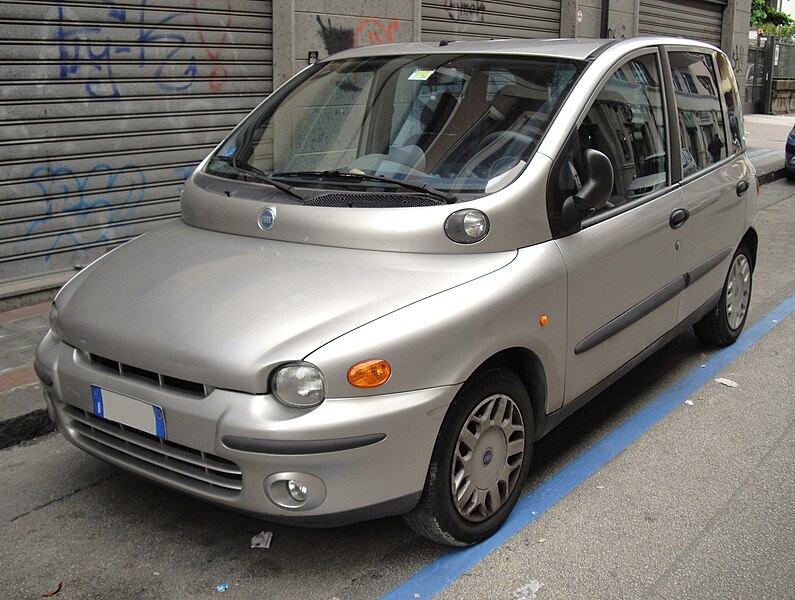
The London 2012 logo deserved to be binned for being as bewilderingly ugly as the pre-facelift Fiat Mutipla without having the excuse of being useful in any way. Unfortunately, it's too late to replace it with something better now and, inexcusably horrible though it looks, I suppose anything that infuriates Ahmadinejad and Iran's Mad Mullahs can't be all bad.


 * London 2012 logo photograph © copyright Nigel Chadwick and licensed for reuse under this Creative Commons Licence.

Rorschach test

If you're familiar with cartoons and have an averagely smutty mind, the logo for the 2012  London Olympic Games looks a bit rude. If you're a propagandist for a demented anti-Semitic, human-rights-abusing theocracy, it looks like a sinister Jewish conspiracy to subliminally flash the word "Zion" across the world's TV screens.

In other news, fashion house Dior has sacked British designer John Galliano for a series of deranged anti-Semitic rants. Presumably he won't be getting a top job in London, Paris, New York or Milan any time soon, but maybe he could consider a new career in Tehran, crafting fashion-forward designer chadors and having his insane outbursts respectfully published by official news agencies, rather than having them dismissed as the embarrassing ravings of a self-obsessed lunatic. He might want to hurry, though - his options will be severely limited if Ahmadinejad ever goes the way of Gaddafi.

Update - I hadn't read this when I titled this post, although it's not surprising that somebody else thought of the ink blot analogy.