Saturday, 29 October 2011

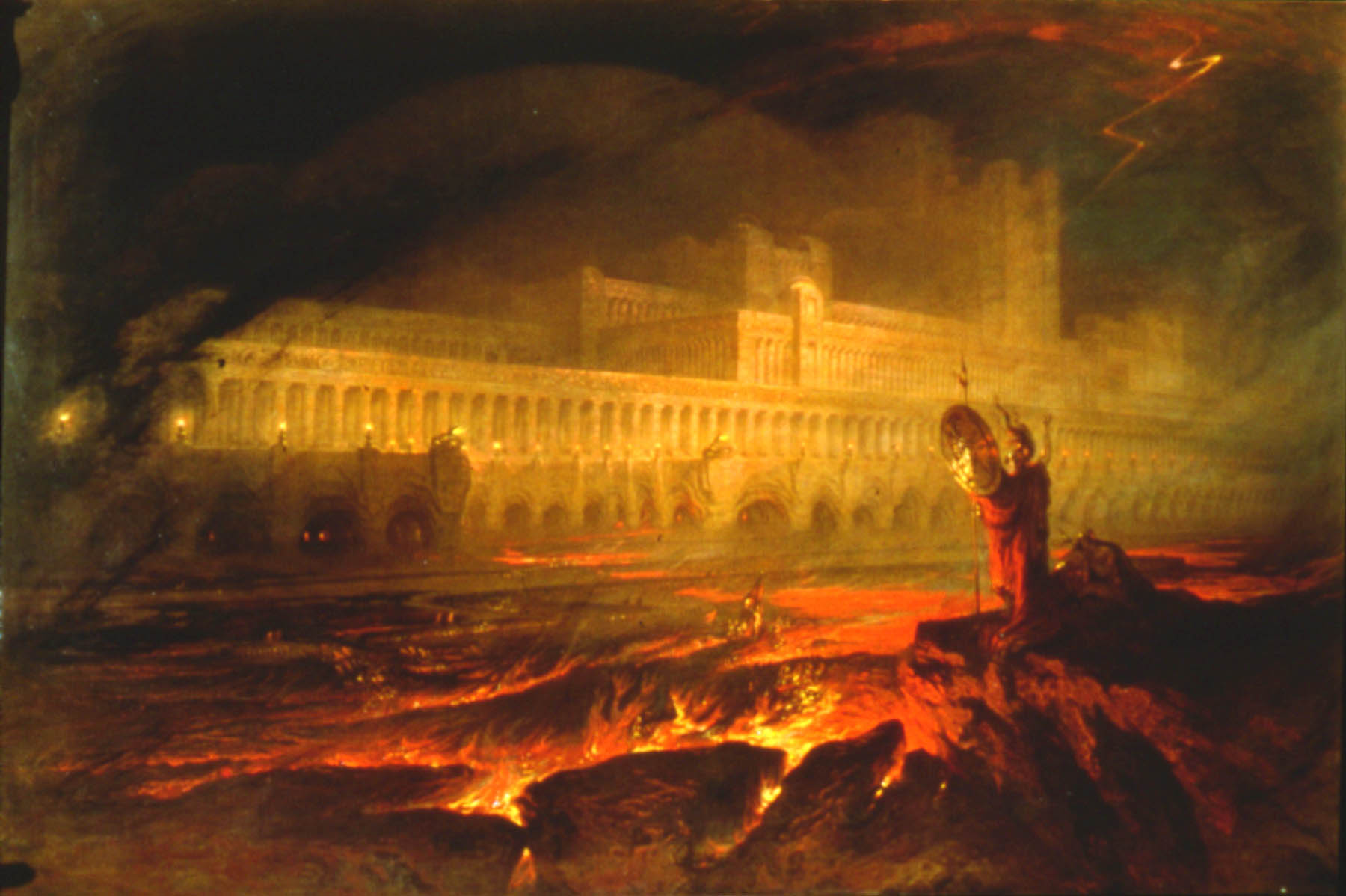
Imperial purple

The imperial stool is capacious enough for a sultan of the most morbid corpulence.

From Millennium by Felipe Fernández-Armesto, which I'm re-reading at the moment.* It's over-written and the clarity of some of the points is drowned in a sea of purple prose but, on the other hand, they don't generally write 'em like that any more and, every now and then, the over-wrought language is a thing of joy in itself. The moody extravagance of the sentence above puts me in mind of Yeats' Byzantium:

Fresh images beget,
That dolphin-torn, that gong-tormented sea. 

*OK, dipping into would be more accurate.

Thursday, 27 October 2011

Apocalypse now?

As the system started to reach inevitable collapse, the state moved in with bank bailouts and quantitative easing, both of which simply moved yet more money from ordinary people to the super-rich. In fact the last three years have seen the biggest transfer of resources from poor to rich in human history.

It cannot last, and whether it is Greece or Italy or Spain which is this week’s fashionable media focus is irrelevant. In making these vast levied and leveraged transfers of resources from poor to rich, states have exhausted the capacity of their people to actually pay them. That is true all over Europe, the UK and US. The currency crises are a tiny symptom of a very large impending crash.

That is why I am not blogging about today’s EU meeting or a specific statement of the US Federal Bank Chairman. They are all pissing into the wind that is shortly to be a tornado. I expect before I die I will see a genuine social revolution. I expect that, as always happens, middle class liberals like me will start by being elated by it, and end up being shot by those who seize on the change, to take their turn to use the power of the state to corner resources for themselves. 

Craig Murray: blog post entitled Capitalism in Crisis.

I don't know whether we're really looking at an apocalyptic future that includes a violent reaction to the class war started by the rich in the Reagan-Thatcher years (which they have been winning ever since), followed by an Animal Farm-style purge by the post-revolutionary elite, or just a few more dreary years of our culture's obsequious Stockholm syndrome-style love-in with the tiny minority who keep slapping the rest of us about (while we channel the resulting anger and frustration into slapping the even more weak and powerless about).

It's starting to feel less like business as usual and more like the prelude to interersting times.


Wednesday, 26 October 2011

I'm sitting on the fence here

Is parliamentary democracy the best available system of government? What about a bit more direct democracy? I must admit that I've never really thought seriously about the alternatives, but a couple of bloggers have just raised the question. The title of Miljenko Williams' post 'Referendums - the coward's way into democracy', leaves little doubt where his sympathies lie; he thinks that referendums don't change fundamental power structures (if parties are able to skillfully manage which questions do and don't get put to a vote), are open to abuse, depending on how you word the question and oversimplify complex issues.

He's not the only one to be suspicious:

I've said it before but it bears repeating: the only time governments and opposition parties call for referendums is when they think they'll yield the result they want. If they don't think this, they avoid them.

Chris Dillow sums up what's perhaps the strongest argument for referendums:

The case for a referendum is simply that, in unbundling options, public preferences can be more clearly expressed.

I like the phrase "unbundling", which sounds quite attractive if you've ever voted for a political party with gritted teeth, because you think they've got the least worst bundle of policies, mixed in with a few horrendous ones. I know I have.

Switzerland, which ranks pretty high on both the Economist Intelligence Unit's Quality of Life Index, 2005 and the Satisfaction with Life Index, 2006, is the most famous example of a country where direct democracy plays a far larger role than it does in the UK. Are the Swiss just happy with a sub-optimal system of democracy, or have they found a way to get round the problem of political parties managing some referendum questions to get the answers they want and ensuring that other questions that don't fit their agenda are never put to a vote? I don't know the answer, but it's a question worth asking.

Monday, 24 October 2011

Like a giant object over troubled water

When you're weary, feeling small
When tears are in your eyes
I will show you a web site dedicated to Large Canadian Roadside Attractions
And you'll probably cheer up a bit

I will ease your mind with Vulcan, Alberta's very own starship Enterprise , the diving moose of Toronto, the drain chicken of Tweed, Ontario, Ernie, the World's Largest Turtle, the giant raspberries of Abbotsford, BC, Altona, Manitoba's giant tricycle (it doesn't actually look that big in the picture, but maybe the house in the background is also hugely embiggened), the Glass Bottle Church of Treherne, Manitoba (churlish of me, I know, but I was vaguely disappointed to find that it was made of bottles, as opposed to being a full-sized church inside a giant glass bottle, which would have been incredibly impressive), Lesia the Ukrainian Girl, a hefty lass from Canora, Saskatchewan, a photograph quizzically entitled Tire People? Daphne, Saskatchewan, (there really should have been a 1950's B movie entitled Attack of the Tire People), another photo with the charmingly undogmatic Canadian claim 'World's Largest Pig (maybe)' and, of course, the World's Largest Beaver, currently residing in Beaverlodge, Alberta.


Sunday, 23 October 2011

I need a hip replacement

I thought that the Internet search term "the cake is a lie" was just amusingly left field and blogged accordingly. It turns out the phrase was a quotation and meme that I just wasn't hip enough to recognise. It's from the computer game Half Life* 'which took the PC gaming world by storm upon its release on November 19, 1998' but is still an unknown quantity around these parts in 2011. I have, by the way, heard of Half Life, even if I'm oblivious to any pop cultural references it has spawned.

It wouldn't be too bad if I was self-consciously trying to emulate Ian Hislop, who was buffing up his carefully-crafted fogey-ish image like a well polished pair of old brogues on Radio 4 the other week (when challenged with buying his first ever pair of jeans for a mildly amusing comedy programme, he quipped that they were surprisingly comfortable and 'I might wear them to evensong'). But I'm not, and I'm left raging against my unwanted decent into old buffer-dom.

Apparently they even know about this in Oklahoma! Where the wind comes sweeping down the plain (note the up-to-the-minute pop cultural reference from 1943).

* Update - no it isn't, it's apparently from Portal, as Meridian has just kindly informed me. D'oh! Less old fogey and more just old and confused.

Friday, 21 October 2011

Tech news

Here's Allison Barrie at Fox News, uncritically regurgitating some press release for an anti-terrorist surveillance system which she breathlessly tells us has attained a genius-level IQ (in other words, more than smart enough to replace Bill O'Reilly).

Before working in defence, Allison worked as a professional ballet dancer performing at the Royal Opera House, London Coliseum, Theatre Royal Drury Lane and the Kennedy Center amongst others. She also acted as a consultant on the dance aspect for some films shooting in the United Kingdom. Allison is qualified in English law and practiced in London as a solicitor.

She is a graduate of Cambridge University and King's College War Studies.

I'm sure we're all going to sleep more soundly from now on.