Monday, 30 December 2013

It is more blessed to give than to receive

Here's a heartwarming seasonal tale for you. A hardened gun-wielding mugger is so overcome by the Spirit of Christmas that he repents and hands his victim back the phone he's just nicked with menaces. Well ... that's more or less the correct sequence of events, but the robber's actual motivation was a tad less uplifting.

Apparently, the gun-toting scoundrel's change of heart had more to do with the outmoded design of the loot he'd just liberated than the with salutary example of the Baby Jesus. Specifically he was unimpressed by his victim's flip phone - “Once he saw my phone, he looked at it like, ‘What the [expletive deleted] is this?’ and gave it back to me” recalled the muggee, Kevin Cook.

Although I don't like to pick quarrels with armed and potentially dangerous criminals, I stand by my stated opinion that the flip phone is actually a damn good piece of design, combining the advantages of folding up small when not in use and, when so folded, being protected against inadvertent keypad presses, or scratches and damage to the display screen, when stuffed into your pocket or handbag along with your keys and loose change. Flippies may be out of fashion now, but I predict they'll be back one day.

But then I've never been an on-trend early adopter - having tried a low-end smartphone for a while, I've decided that I don't need most of its features,* just something that makes calls and has a decent battery life, so I abandoned it in favour of an ancient (non-flippy) Nokia. Which also has the advantage of being too old and primitive to be worth stealing - hell, if they're rejecting three-year old Windows phones, any self-respecting mugger would probably take one look at my lump of prehistoric Finnish plastic and offer me an upgrade.


 *Some features were nice to have but would be easier to use on something tablet-sized - come the day I've got some spare money, I'll see if  I can find a half-decent budget-friendly one.

Saturday, 28 December 2013

Tell it to the Marines

Whilst exquisite technology has been protected...manpower has been seen more as an overhead

Lord Vader, Supreme Commander of the Imperial Forces General Sir Nicholas Houghton, (Officer of the Order of the British Empire, Commander of the Order of the British Empire , Knight Grand Cross of the Order of the Bath, yada, yada) on the state of Britain's armed forces.

You wouldn’t put it past him to use the word “exquisite”...

Terry Pratchett, describing the Patrician of Ankh-Morpork

Two thoughts on the word 'exquisite' in this context:
1. Fire your speechwriter, unless you really want to come across as a camp Hollywood villain (or if you wrote it yourself, I believe the proper form is for a chap to brace himself with stiff G and T before putting his trusty service revolver to his temple and doing the decent thing).

2. Have a think about the end products (eventually) delivered by the mind-bogglingly expensive defence procurement process and ask yourself whether 'exquisite' (in the sense of 'extraordinarily fine or admirable; consummate' or 'of rare excellence of production or execution') is really the best word you could have come up with.
Thought 2. was prompted by the troubled F-35, the aircraft around which Britain's mighty force of two multi-billion pound floating job creation programmes aircraft carriers (or possibly one part-time aircraft carrier, HMS Austerity Queen Elizabeth) has been designed.

David Axe at War is Boring gives a convincing account of how the Royal Navy (and most other Western air arms) ended up in a queue to buy a terrible combat aircraft that 'can't climb, can't turn, can't run'. It's a perfect storm of inter-service rivalry leading to an unworkable specification, aided and abetted by the monopoly power of a defence aerospace industry that's gone through generations of mergers, driven by the spiralling cost of producing new warplanes. Axe traces the whole sorry story back to the Pacific beachheads of World War Two and the US Marines' need for more air cover than the Navy were then providing, getting from then to where we are now via a winding trail of path dependency, littered with unintended consequences.

Looking on the bright side, the F-35 does provide a few decent jobs for people with the right skill set (like my wife's brother-in-law, who really enjoys his current job, working on the F-35's landing gear at the project's Dutch subcontractor Fokker Landing Gear). But, on the whole, I buy Axe's negative assessment and take away two broad conclusions:
  1. There are worrying times ahead for people troubled by the idea of flying killer robots - whether the F-35 programme struggles on to produce many hundreds of inadequate aircraft soon, or is cancelled, leaving any new potential replacement decades of development away in the future, the military are probably going to plug the capability gap with smaller, cheaper drones (perhaps launched by cheaper platforms than aircraft carriers).
  2. We wouldn't see crazy decisions resulting from inter-service turf wars if countries adopted the sensible idea of one unified defence force, rather than bickering rival service fiefdoms.


Big mother watch

... Facebook ... will probably go into unlamented terminal decline as the intrusive, stalker-ish changes required to effectively monitor, control and monetise its users become annoying enough to make many of them abandon Facebook and adopt The Next Big Thing, whatever that turns out to be*

* I may be wrong, but don't start calling me a dimwit until Facebook's clocked up another five years of rude health. 
Me, March 2012

With less than three and a half years to go, Facebook's not in intensive care yet, but it's apparently no longer cool enough for a rising generation of users. What I got wrong was the locus of off-putting privacy concerns - teens aren't that worried about sharing every detail of their their lives with advertisers, potential employers, malicious hackers and various arms of the security state, but the idea of being friended by mum and dad is clearly way too intrusive to tolerate.


Crouching tiger, nodding dog

Banking in China has become like a highway toll system ... Banks charge every time money goes through them.
With this kind of operational model, banks will continue making money even if all the bank presidents go home to sleep and you replaced them by putting a small dog in their seats.
Yao Jingyuan, former chief economist and spokesperson for China’s National Bureau of Statistics

If you think that China's narcoleptic wealth-creators benefit from a cushy operational model, consider what happens in the West, where government bailouts ensure that our Captains of Capital can carry on making money even after they've lost everything in get-rich-quick pyramid schemes and failed mergers and acquisitions.

In other breaking news, the Royal Bank of Scotland has headhunted a new Chief Executive Officer who used to work in the insurance sector...
via

Wednesday, 18 December 2013

Go away, I'm busy

I've just been listening to an interesting talk by Cordelia Fine (YouTube vid below the fold). It's over an hour long, but the takeout is quite straightforward - the evidence base for the whole Men are from Mars, Women are from Venus, Why Men Don't Listen and Women Can't Read Maps gendered brain meme is flimsy to non-existent.

Although I'd always assumed that the Mars/Venus thing was a mountain of ridiculous headline-grabbing pop psychology based on a molehill of hard evidence, personal experience and anecdote did make me think that there really was a kernel of truth under the hype of the gendered brain hypothesis. If, as Fine says, scientists aren't finding convincing evidence to support hypotheses like inherent gender differences in brains being caused by foetal testosterone levels and so on, how come the gendered thinking styles meme seems to match a lot of peoples' experience?

This is where it gets quite interesting. People are suggestible and Fine cites experimental evidence that people are more prone to conform to stereotypical gendered thinking styles in tests when they are prompted or primed to view a particular gendered thinking style as the expected or 'normal' result (see also groupthink, conformity bias, confirmation bias, social desirability bias and the experience of pollsters trying to frame unbiased questions).

If the case for instrinsically gendered brains is weak and the evidence that people routinely conform to social expectations is strong, who benefits from 'gendered brain' meme? Maybe it's all about power.

Take multitasking. The stereotype is that women can multitask, but men concentrate a laser-like focus on a single task. There's some evidence that the cognitive load imposed by multitasking will make anyone - male or female - less efficient and that most of us would benefit from just being allowed to get on with stuff without too many interruptions or distractions. Perhaps the difference between men and women in this respect isn't down to native ability, but status. If you're a high-status individual, your time is seen as important and social convention dictates that you shouldn't be interrupted because whatever you are doing is, by definition, important. If you're a low-status individual, you're assumed to be available to perform tasks assigned by higher-status people and refusing to take on another task on the grounds that you're already too busy is seen as an unacceptable display of insubordination, or proof of idleness.

Given that gender discrimination exists and women often end up in lower-status occupations than their male peers (including unpaid occupations like childcare), the stereotype of the focused, analytical male brain, versus the multitasking female brain may be more sociological effect than inherent cause - high-status males have the power and autonomy to say 'go away, I'm busy' if interrupted, but lower status females are assumed to be doing less important stuff, are assumed to be interruptable and are expected to juggle conflicting requests, rather than having the autonomy to prioritise one thing. We might all be equally bad at multitasking, but women might have to do more of it (and perhaps get better at it) because that's what the social hierarchy demands.

There may also be an emergent element of self-fulfilment coming from the expectation that women are particularly well suited to low-status occupations involving lots of multi-tasking. If the cognitive load caused by multitasking will inevitably impair the performance of anyone (male or female), then you'd expect to see people who are expected to engage in a disproportionate amount of multitasking performing below their full potential. Pile enough conflicting demands on someody and you can use any inefficiencies resulting from lack of autonomy and overload as evidence that they are, regrettably, only suited for a low-status occupations without any autonomy...

 via


Sunday, 15 December 2013

A mothership full of randroids

[Science fiction is] an inherently liberal genre (its many conservative practitioners notwithstanding), in that it sees the status quo as contingent, a historical accident, whereas conservatism holds it to be inevitable, natural, and therefore just. The meta-premise of all science fiction is that nothing can be taken for granted.
I see where Tim Kreider's coming from here, but those 'many conservative practitioners' constitute more than an aberrant outgroup.

Following the same logic, you could argue that the study of history in an inherently liberal discipline, the meta-message of history being that our current, contingent status quo is no more timeless or unimprovable than any of the other social orders which have come and gone through the ages. For what it's worth, that's more or less the broad message I take away myself.  But that would be to ignore those conservative practitioners who take different messages from history, from jingoists who see the subject as a national bragging contest, to reactionaries who conclude that fairness and equality are dangerous delusions that can only ever lead to penury, revolutionary terror and gulags.

Likewise with science fiction, having a galaxy of possible alternate universes to play with doesn't necessarily make you a liberal - think Niven and Pournelle and (up to a point) Neal Stephenson, imagining societies that closely reflect the prejudices of today's elite, where poor people are deservedly poor because they're stupid, violent and generally inferior by nature, so what a good thing there are a few clever, talented rich folk in their high-tech gated enclaves to keep the marching morons in their place before they drag humanity to back to the stone age.

I'm not sure who started this trope, but raising the question opens at least one disturbing possibility. Namely, that we might have to enlarge the list of Sci Fi archetype-creating novels (like Frankenstein, From the Earth to the Moon, The Time Machine, The War of The Worlds and We) to include the appalling Atlas Shrugged as the progenitor of the 'downtrodden elite dystopia' sub-genre.

via

Saturday, 14 December 2013

Thus spake the seraph and forthwith...

... appeared a shining throng
of angels praising God on high
If you've been brought up with the Christian nativity tradition, you've probably got some sort of mental image of the angels referenced, via Luke , in carols like While Shepherds Watched Their Flocks and In The Bleak Midwinter. You've seen them represented enough times, on Christmas cards and other festive merchandise, in school nativity plays and so on:
Angels and archangels
May have gathered there,
Cherubim and seraphim
Throng'd the air
Your typical Christmas card angel is visualised as a beautiful, haloed, androgynous or female winged human in a floaty frock, an image developed by artists from Late Antiquity right through to modern times from the classical pagan prototype of the winged Victory. Alternatively (if the angel in question is a cherub), think Eros as chubby flying baby.

As Daniel Petersen writes in his blog, Ride the Nightmare, the gospel writer probably had far more frightening entities in mind:
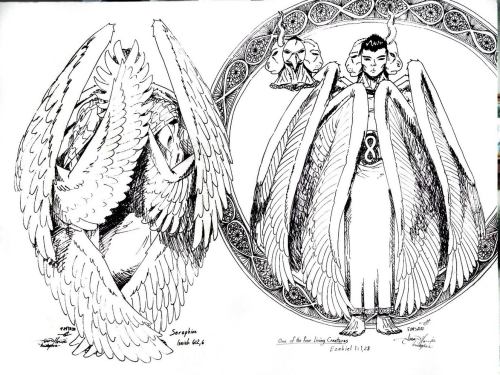
It's almost like a well kept secret that angelic beings in the Bible are quite monstrous and terrifying, but in such a way as is meant to convey the holiness of God...
Above him were seraphim, each with six wings: With two wings they covered their faces, with two they covered their feet, and with two they were flying. And they were calling to one another:
“Holy, holy, holy is the Lord Almighty; the whole earth is full of his glory.”
At the sound of their voices the doorposts and thresholds shook and the temple was filled with smoke. (Isaiah 6:2-4)
This is pretty strange and terrifying as it is, but what's not seen in the English translation is that the word 'seraph' in Hebrew connotes something like 'fiery serpents'. So these angels are actually more like flying flaming dragons! (That's why Satan, a fallen angel, is portrayed as the earthbound [de-winged] Dragon in the Book of Revelation.) 
No wonder the shepherds were 'sore afraid.' And as for those Cherubim...
* Each one has four faces (sometimes called a tetramorph),  only one of which is human (the others providing horns, fangs, fur, and beak to the mix)
* Bodies and wings and wheels full of eyes
* Gleaming bronze hooves for feet
* Burning like coals of fire, shooting forth flames
* Flashing about like lightning
Yikes!

Disappointingly enough, Christmas card manufacturers have tended to avoid nativity scenes featuring shepherds cowering in abject, bowel-loosening terror before a grotesque host of six-winged flaming serpents and brazen-hoofed  tetramorphs. Personally, I'd be happy to settle for the freakish monstrosity above as a more exciting alternative to your insipid bog-standard Christmas card angel, if only it wasn't for the ornithological inconsistency of a a bald eagle's head popping up in a Middle Eastern context.

Even when they're not looking as weird as the shape-shifting alien from The Thing caught in mid-transformation, there's something more than a little odd about angels:
Angels as they appear in the Bible are a very curious bunch. Sometimes they look like people, as the ones who visited Lot did, and were presumably extremely good looking considering the entire town wanted to roger them senseless. Sometimes, they look like winged monstrosities that kiss burning coals, like the ones Isaiah saw. Sometimes, they were wheels in the sky, like Ezekiel saw. There was a reason they stated "fear not" upon their arrival.

They also did bizarre things. Some of them merely imparted information, like the heralds of Jesus. Others, however, either killed people (including babies) or else wrestled people to the ground. In one case, an angel wrestled with Moses and was going to kill him, until Moses's wife threw a foreskin at it.

It's also worth noting that they were apparently extremely terrifying to look at; they almost always preface anything they have to say with the remark "Do not fear", owing to the fact that they most often resemble something out of a work by H.P. Lovecraft.
Rational Wiki

The author of Luke's gospel, unlike the Nahum Teate (who wrote While Shepherds Watched Their Flocks) and Christina Rosetti, (who, as any fule kno, did the words for In The Bleak Midwinter), didn't specify which order(s) of angels announced the holy birth but, given the first angel's* stock warning ('And the angel said unto them, Fear not'), we can safely assume that he was one of the scary-looking ones.

And I mean 'he' - even when they're not named (e.g. Gabriel, Michael, Metatron), Biblical angels seem to be male, from the seraph who laid a live coal on Isaiah's mouth to the human-shaped one who wrestled with Jacob. Our modern image of a female or androgynous being is an anachronistic cross-cultural borrowing from the pagan tradition of the Winged Victory (the  halo is probably also a pagan invention, having featured widely in pre-Christian ancient Egyptian, Near Eastern, Greek and Roman religious iconography before making its first appearance in Christian art in 4th century).

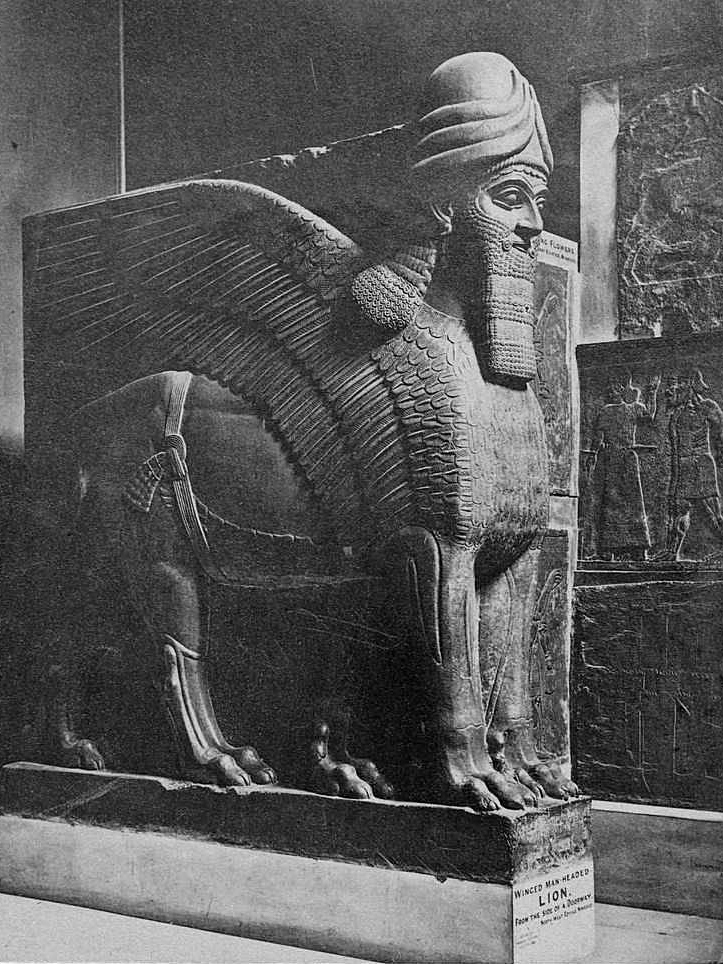
To get back to the sort of thing the Bible writers had in mind, we need to lose the image of the modern, beautiful, feminised angel and think back to the muscular, ultra-masculine, hoofed, clawed, or winged hybrid beasts of the ancient Near East:

In their function as guardians of Paradise the cherubim bear an analogy to the winged bulls and lions of Babylonia and Assyria, colossal figures with human faces standing guard at the entrance of temples (and palaces), just as in Egypt the approaches to the sanctuaries are guarded by sphinxes.

Think of Yeats' 'A shape with lion body and the head of a man, A gaze blank and pitiless as the sun' and you get a pretty good idea of the herd of rough beasts that made up the heavenly host.

Daniel Petersen's blog post on fearsomely grotesque angels was originally written for Halloween, which makes me wonder whether we couldn't improve Christmas by grafting some of the dark, irreverent, transgressive fun of Halloween onto a festival currently overstuffed with bland, earnest kitsch. Reclaim the monstrous and terrible and the whole thing gets a lot more interesting. Why not go with the scary angels?

After all, we've already added an almost equally bizarre - if less frightening usually less frightening - flying supernatural being to the festive season. The white-bearded gift-bearer, Saint Nicholas, like some recording angel, has infallible knowledge of who's been naughty or nice and, after being towed through the air by his retinue of stamping, snorting, flying beasts, descends to earth from on high to perform miracles (of a logistical nature). We encourage our children to fervently believe in this synthetic minor deity, cobbled together from bits of paganism, Christianity, folklore and the cult of Mammon, at least until the inevitable disappointment. One day - if the human race is spared from destruction for long enough - people will probably look back and find the concept of Santa almost as weird as the sacred sky-monsters of the ancient Middle East.

The really odd thing about Santa is his ambivalent nature - as if splicing a Christian Saint together with a Norse God  to create the brand ambassador for the year's most lucrative shopping event didn't generate enough cognitive dissonance, we're also encouraged to believe in, and write to, Santa as children, before inevitably discovering that he doesn't really exist. 

I don't know how you'd prove it, but I have this theory that Santa has probably caused more people to lose their faith than Richard Dawkins and all the other New Atheists put together, on the grounds that way more people have gone through the experience of having to question adult authority as a valid basis for belief by finding out about Santa's non-existence than will ever read The God Delusion. Not only that, but while it's easy to mock 'professional God-hatin' Professor Yaffle impersonator Richard Dawkins', only a humourless, sour-faced Puritan killjoy could possibly object to the round, jolly, red-cheeked man who delivers presents to children. 

In Biblical times, people peopled the skies with monstrous and terrifying beings and (as far as I can tell) literally believed in them and in the Good News they proclaimed. Today's adults invent a nonthreatening, genial old man with a sack of prezzies, who descends from the skies to make tots' acquisitive dreams come true, before going on to spread doubt and unbelief in children old enough realise he's just a weird in-joke made up by adults. Appropriately enough for such an apostle of unbelief, Old NickSaint Nick's popular name is an anagram of that other celestial deceiver who fell so spectacularly from grace...

In renouncing terror and the fear of God and His monstrous minions, mainstream religion seems to have lost something. Not just the direct power to coerce, but a sense of awe and gravitas. The Christmas story may be pure bunkum, but in an age of belief, it was also a thing of terrible beauty, painted with a full emotional palette that used dark shadows, strangeness, and horror to complement the the brilliant highlights of  light, transcendence and joy. Christmas, (and mainstream Christian worship) as celebrated today, seems relentlessly upbeat, reassuring, one-dimensional sanitised, bland and infantalised,** when compared with the imaginative world that spawned those frightening weird, elemental, unsettling beings, whose appearance seized the Shepherds' troubled minds with mighty dread.


*The rest of the heavenly host only appear after the first angel's initial announcement.

___________________________
** Update - I wondered whether this was a bit harsh, until this evening, when I was dragged along - against my better judgement - to a "Christingle" service hosted by a disturbingly enthusiastic member of the Happy Clappy brigade, armed with a Powerpoint presentation featuring animated clip art of praying hands and the projected words to "Show me the way to shine for Jesus" (sung to the tune of "Is this the way to Amarillo") for the congregation to sing and clap along to. Words fail me...