Thursday, 12 December 2013

Seasonal strangeness

Now that the first few chocolates in the Advent calendar have been scoffed, I guess it's time to end my annual grumble about the Christmas marketing offensive being launched some time in September and actually look for something in the season to be jolly to be jolly about. Like this handy seasonal hint for dealing with wild boar attacks:
Legend has it that a scholar was studying a book of Aristotle while walking through the forest on his way to Christmas Mass. Suddenly, he was confronted by an angry wild boar. Having no other weapon, the resourceful Oxonian rammed his metal-bound philosophy book down the throat of the charging animal, whereupon the brute choked to death. That night the boar's head, finely dressed and garnished, was borne in procession to the dining room, accompanied by carolers singing "in honor of the King of bliss."
Television not having been invented yet, nobody was able to turn the incident into a Bear Grylls-style survival documentary, so they turned the story into a carol (allegedly). I've got the Radio 4 series A Cause for Caroling to thank for the folkloric heads up.

Tuesday, 10 December 2013

The Bible as map

A while back, someone wrote this in response to my post Is the Pope a Catholic?
For me at least, Christianity *is* being part of a community attempting to find a form of life that honours the insight of a particular Book. The 'superstructure of interpretation' *is* religion, even if religious people themselves sometimes deny it. A literal approach can't offer access to the 'true' or 'core' religion, since the Bible itself is full of tensions. Everyone has to engage in interpretation; there's no 'clean' reading.

I’m not really sure why this is a ‘problem’ though?
I didn't answer the points raised, because I didn't want to go back down the well-trodden path of explaining why I'm not a believer, which is where my intended reply was heading, and I was happy to carry on simply chilling out for a while, agreeing to differ and leave the analytical questioning of religion to others with far more original and compelling insights. But it sort of bothers me when I can't get my head round things that others find self-evident, or vice versa, so here are a few thoughts on literalism and interpretation that have been rattling around my skull with no place to go.

In terms of what other people might want to believe and take away from the Bible, the non-existence of one 'clean' reading isn't a problem. I'm happy for others to make up their own minds and believe what they want to believe, providing they're not causing harm.

If you want to go further and argue that Christianity, inspired by the insights contained in the Bible, is more than just mostly harmless, but is a coherent, convincing system of belief, the inconsistencies do become a problem.

'The 'superstructure of interpretation' *is* religion ... Everyone has to engage in interpretation; there's no 'clean' reading.'

OK, so let's assume, for the sake of argument, that what we have really is a divinely-inspired text, with humans trying to live in accordance with 'the insight of a particular Book.' We'll also assume that the divine message isn't straightforward, that it comes to us from a wiser being and loses something in the translation when it's dumbed down to a human level of understanding - the message is perhaps distorted by the limiting medium of human language, is told in terms explicable to people living in a particular culture at a particular time, or is sometimes expressed in terms of metaphor and parable in order to be accessible to people.

If all of this is true, then you'd expect to see argument, competing interpretations, no 'clean' reading of the text, right? True, but only up to a point. If this really was an imperfect copy of the Almighty's guide to Life, The Universe and Everything, I'd expect a degree of ambiguity and room for debate around the details, but a reasonably clear central message. I wouldn't expect that guide to be so unclear that people could take away opposite and completely contradictory messages about how to live.

As the Mandela retrospectives have reminded us, in Apartheid South Africa, the Dutch Reformed Church interpreted the Bible as supporting racial segregation and discrimination. At the same time, Martin Luther King Jr. turned to the same book and found a blueprint for racial equality. Priests and chaplains can bless armies, or Bible-inspired conscientious objectors can refuse to participate in war.

If 'the superstructure of religion *is* religion,' then religion seems to be all over the place. Which is why I go back to the Bible, in the hope of having some measure to calibrate people's variant interpretations against. This is hard to do, since 'A literal approach can't offer access to the 'true' or 'core' religion, since the Bible is itself full of tensions.' 'Tensions' is one word you could use. 'Contradictions' is another.

If you want to pick through some of the tensions/contradictions, there's a whole bunch of 'em right here. Some of them are mere nit-picking, but there's plenty of 'tension' around the central tenets of the faith. What's with the New Testament giving us a list of Jesus' male ancestors, when he was supposedly conceived by the union of a virgin and the Holy Spirit? Is God merciful or merciless? Can mortal humans see God or not? Does God ever tempt humans? Is Jesus equal to or lesser than his father? What really happened at the resurrection? Depending on which verse you read, you get very different answers to these questions.

On what basis do you trust one verse as opposed to another that gives a different message, or account of the truth? How do you decide which bits are metaphor and which bits are to be taken literally? OK, scientists know enough about the place of our planet in the Cosmos, deep time and evolution that we know Genesis must be, if anything, a metaphor, but what about Biblical claims where there's no evidence one way or another - on what basis does a believer decide that this thing literally happened, but that thing was just a poetic way to express a deeper truth?

I can accept ambiguity, up to a point. The map, as they say, is not the territory. But a map should at least give you some reliable notion of where you are in the territory. Looking at the Bible-as-map, what I see is a whole bunch of people following the map and wandering off in lots of different directions simultaneously, following a map that's so hard to interpret that two people can set out on two wildly different compass bearings, each convinced that she or he is on the shortest possible route to the same destination as the other.

Real maps haven't always been perfect, but there's a real territory out there and, over the years, as people have explored and surveyed and made mistakes and re-checked and corrected and devised better tools and techniques, they've become more accurate and more useful for telling people where they are. The Bible, in contrast, isn't giving people a set of consistent bearings and landmarks, doesn't readily subject itself to empirical scrutiny, calibration and correction and leaves people wandering round in all directions, their moral compasses aligned with whatever various directions they've decided must be North on a map that's so ambiguous that nobody can agree how it lines up with the cardinal points.

That's why I find the lack of a 'clean' reading to be a problem. Across and within denominations and sects, people have built different superstructures from the same blueprint - see the furious debates over gay marriage and women bishops currently dividing the Church of England, or the divide between liberal forms of Anglicanism in the West and the more fundamentalist version thriving in the developing world. Why is does the superstructure look so wobbly? I'd say it's got a lot to do with unsound foundations built according to a badly-drawn plan:

And the rain descended, and the floods came, and the winds blew, and beat upon that house; and it fell: and great was the fall of it.

Does any of this matter? Up to a point, no. I disagree with religious believers about the nature of things, but, hey, you say tom-ay-to and I say tom-ah-to, let's call the whole thing off. But religious faith is an ideology, as well as a truth-claim. I don't dismiss ideologies, at least as working hypotheses, because nobody is free of bias, or in possession of all the facts and we all have to act in the world on the basis of our educated guesses, without the benefit of perfect knowledge. But I am suspicious of ideologies that close off the possibility of looking up from the map to see if it actually looks anything like the territory, or conclude that, if the map and territory don't seem to match, there must always be some way to prove the map right. 

To borrow a critique of another guide to Life, the Universe and Everything:
The Bible is an indispensable companion to all those who are keen to make sense of life in an infinitely complex and confusing Universe, for though it cannot hope to be useful or informative on all matters, it does at least make the reassuring claim, that where it is inaccurate it is at least definitively inaccurate. In cases of major discrepancy it's always reality that's got it wrong.

Sunday, 8 December 2013

What is wrong with those callous dolts?

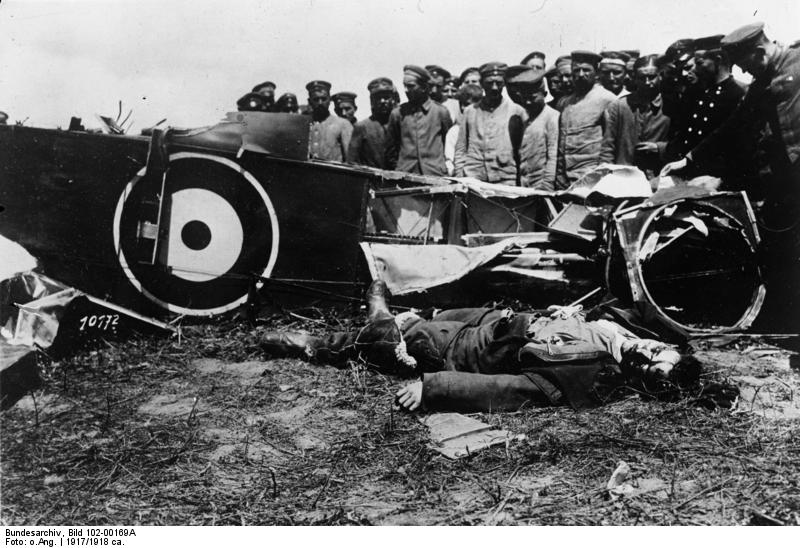
I'm terribly depressed this evening. Ferrie has been killed. He led his patrol out this afternoon, had a scrap, came back leading the others, then as they were flying along quite normally in formation, his right wing suddenly folded back, then the other, and the wreck plunged vertically down. A bullet must have gone through a main spar during the fight.

The other[s] went after him and steered close to him in vertical dives. They could see him, struggling to get clear of his harness, then half standing up. They said it was terrible to watch him trying to decide wether to jump. He didn't, and the machine and he were smashed to nothingness.

I can't believe it. Little Ferrie, with his cheerful grin, one of the finest chaps in the Squadron. God, imagine his last moments, seeing the ground rushing up at him, knowing he was a dead man, unable to move, unable to do anything but wait for it. A parachute could have saved him, there's no doubt about that. What is wrong with those callous dolts at home that they won't give them to us?
Passage from Arthur Gould Lee's book No Parachute quoted on The Aerodrome forum.
It is a fact that during the First World War no British RFC, RAF or RNAS pilot was allowed to use a parachute. Observers in battlefront balloons had them as it was very common for aircraft to attack them, but their parachutes were on a fixed line that opened them up as they jumped...

... German flyers were allowed parachutes during the war and one saved Hermann Goering. The British hierarchy took the view that if pilots were given the means of escape, they would not be as aggressive and would be tempted to leave the machine when it still might be saved.

There was some truth in the statement that available parachutes were too bulky and heavy, and likely to catch on the plane, but it is difficult not to agree that the British approach was uncaring, unfair and unreasonable.
The Morpeth Herald, reporting on a talk by historian Alan Fendley.

By today's standards it's hard to disagree with the 'uncaring, unfair and unreasonable' verdict. But the style of reasoning behind the "no parachutes" rule lives on. After all, the reasoning isn't that different from that informing the ongoing 'welfare reform' project - take away the welfare parachute and people will be incentivised not to crash. A tougher attitude to excuses such as 'my wing fell off' or 'I've been shot down' is bound to encourage people to just try harder to stay airbourne.


Image provided to Wikimedia Commons by the German Federal Archive.

Wednesday, 4 December 2013

Shaggy monster monstered


So, London's answer to Sesame Street's Elmo, Boris the Cornflake Monster™, gets his comeuppance from LBC's Nick Ferrari.  One would have thought that a chap with a first-rate classical education would have known better than to walk into this particular bear trap.

Hubris, meet Nemesis.

Gosh.

Tuesday, 3 December 2013

Capital vices

With all due respect to those two made-up characters Boris™ and Gordon Gekko, it strikes me that greed is getting rather too much attention. After all, if you're going to tell an anecdotal just-so story about how an apparent vice actually leads the best and brightest in our capitalist system to deliver the best of all possible worlds, there are another six, rather less hackneyed, Deadly Sins (AKA Capital Vices) to choose from:

Envy is excellent
BoJo referred to the economically stimulating effect of trying to 'keep up with the Joneses' in his speech, so why not give Envy the proper name-check it deserves, instead of lazily recycling an old '80s movie quote?

Sloth is splendid
Speaking of laziness, proponents of the work ethic might think you can only get out what you put in, but we all know that it's not really hard work that counts, but efficiency. And what is efficiency but using the smallest possible input to create a given amount of output? Working smarter, not harder, is good. The desire to escape from hard work drives innovation, from the washing machine and the vacuum cleaner to the microwave oven and the pre-prepared meal-in-a-minute that it heats up.

Lust is laudable
'There are a number of mechanical devices which increase sexual arousal, particularly in women. Chief among these is the Mercedes-Benz 380SL convertible' (P.J. O'Rourke). Ergo, economic activity is driven forward by our pursuit of wealth, status and excellence, which in turn is clearly driven by our primal urges which must, therefore, be good - see also envy (above), greed conspicuous consumption, advertising, etc, etc.

 Gluttony is Great
British companies are world leaders in both the processed food sector and the diet industry and make innovative use of the synergy between the two to create shareholder value:
There now exist two clear and separate markets. One is the overweight, many of whom go on endless diets, losing and then regaining the weight, and providing a constant revenue stream for the both the food industry and the diet industry throughout their adult lives.
The UK dieting industry contributes around £2bn a year to the British economy, a success story that ought to make everybody very proud (except a few fanatical Marxist weirdos who still apparently think profit is some kind of dirty word).

Pride is patriotic
And while we're on the subject of pride, did not The Blessed Margaret herself (this was, after all, the Third Margaret Thatcher Lecture) remind us that 'tremendous pride in your country' is one of those Victorian Values to which we should all aspire? And she also told us that we should be really proud of ourselves when we do the right thing, (like, say, breaking a strike):
Yet we can remember that on Monday, nearly a quarter of the members of NUR turned up for work.

Today, we appeal to every train driver to put his family, his comrades, and his country first, by continuing to work tomorrow. That is the true solidarity which can save jobs and which stands in the proud tradition of British railwaymen.*

Wrath is wonderful
And what else do we remember about the Blessed Margaret? Mostly that she was very cross for rather a lot of the time; full of righteous anger with those she held responsible for Britain's national decline, handbag-swingingly irate with Europe, hopping mad with tax-and-spend socialists, exasperated with wets and bleeding-heart liberals who 'just drool and drivel they care.' And she used that anger to change the country, smiting the miners with her wrath, preparing the way for a home-owning, share-owning, free-booting, deregulated enterprise society 'tapestry of men and women and people' [sic] and , by her own estimation, leaving 'the United Kingdom in a very, very much better state than when we came here eleven and a half years ago.' Getting mad clearly drove her to get things done, which has to be A Good Thing, right?

Expect the competing demands of mayoral speech writing to lead to light blogging round these parts in the near future...

____________________________________

*Update - this doesn't actully explain how Pride makes us all rich, but I'm guessing that, if you're a smart cornflake, you've already worked out that Pride was a Victorian Value and Victorian Values make a nation rich, as we all know from the fact that when we were all Victorians, Britain was the Top Nation.

Monday, 2 December 2013

The long and the short of Christmas

I was going to ignore the upcoming Yuletide Juggernaut for a little longer but now the radio has shoved the concept of  "Cyber Monday" into my ears, I might as well share a couple of observations people have made on the contemporary Christmas. Basically, the rubbish bits lasts far too long and its Unique Selling Point is far too short.

As Mary Elizabeth Williams wrote a while back, Christmas has won the phoney "war against Christmas" and launched a massive counter-attack which has reduced Autumn, formerly a perfectly good season in its own right, to a second-rate warm-up act, the tinsel-draped "run-up to Christmas."

Peter* looks at the central message of Christmas, the one hiding behind the all kitsch and consumerism, like a chocolate behind the door of an Advent calendar, and can't find anything at all to disagree with - except for one, rather fundamental, flaw:
Finally on this point, the central message of Christmas is "peace and goodwill to all mankind". It kinda strikes me that everyone should be doing that every day anyway: we don't need some day especially set aside to be nice, and then behave like little shits every other day of the year. 
I couldn't have put it better myself (which is why I'm quoting somebody else). If we're only aspiring to peace and goodwill for Christmas, what the hell do we think we're doing with the rest of the year?


*Who has decided not to "do" Christmas this year - a brave decision, because, however clearly he lets everybody know that he's not opposed to other people having fun and celebrating however they damn well like, there's you just know there's going to be some hard-of-thinking, ultra-conformist fun-Fascist out there who's going to take umbrage at anyone who dares to be different and declare people like Peter to be killjoys for not celebrating in the conventionally approved format.

Sunday, 1 December 2013

The extraordinary married life of a domestic goddess

No, not that one. I'm thinking of the marital career of the altogether more frightening household deity who presided over the TV kitchens of my childhood, the formidable Fanny Cradock. Widowed and pregnant at the age of 17, Fanny (who started life as Phyllis Nan Sortain Pechey), chalked up four marriages, two of them bigamous. On the occasion of her final marriage, to her monocled TV sidekick, Johnny, the marriage certificate apparently recorded her age as '55' in glorious disregard of the fact that her eldest son was, by then, a few months short of his fiftieth birthday.

Nigella's marriage to Charles Saatchi may have been odd, but if you want full-on surreal bonkers, it's Fanny and Johnny you need, at least according to Luke Honey in The Dabbler:
I turned to Time to Remember, a year in the life of- a monthly account of their Continental excursions. There’s a bizarre moment when Johnnie, at the wheel of “the Duchess” (their Bentley Flying Spur) is attacked by a huge flock of enraged owls. 
Did you just say 'attacked by a huge flock of enraged owls' Luke? I just need a copy of that book right now (preferably from Fantastic Fiction dot co dot uk).